
There’s no single national checklist for developer requirements for road network upgrades. The obligations depend on the road authority and the proposed works. In Western Downs, an application to extend or upgrade the Council road network must be submitted in writing and include the applicant’s contact details, reasons for the works, site and location plans, and the required road standard.
That’s why establishing who controls the road is an essential early step. For example, external works on Victoria’s arterial road network must meet Department of Transport and Planning requirements, and the department reviews the design and construction. The developer or external party is responsible for the associated work, design, construction, repair and restitution.
This article explains what developers may need to provide or meet, from application information and design review to construction standards, testing, handover and defect obligations. It also outlines how requirements differ across Australian jurisdictions, helping you identify the relevant approval pathway and plan traffic and access assessments for a development proposal.
Key Takeaways
- Establish whether the proposed works concern a local council road, an arterial road or a new subdivision road, as this affects the approval and delivery process.
- Prepare a clear application package, including the reasons for the works, location plans and the road standard being proposed.
- Allow for different council contribution policies; eligibility and the applicant’s share can depend on the type and purpose of the works.
- Plan for construction standards, inspections, handover documents and responsibility for defects when a new road or upgraded asset is transferred.
- Use traffic assessments to identify how a development may affect surrounding roads, intersections, vehicle access and parking demand.
Developer requirements for road network upgrades
Requirements depend on the road owner, the type of work and the development approval pathway. A subdivision road, a council road extension and works on an arterial road can involve different design, funding and handover obligations. Start by identifying the road authority and whether the proposal concerns a public road, a new road reserve or private access. This distinction helps establish which application process and technical standards apply.
Applications and contributions in Western Downs
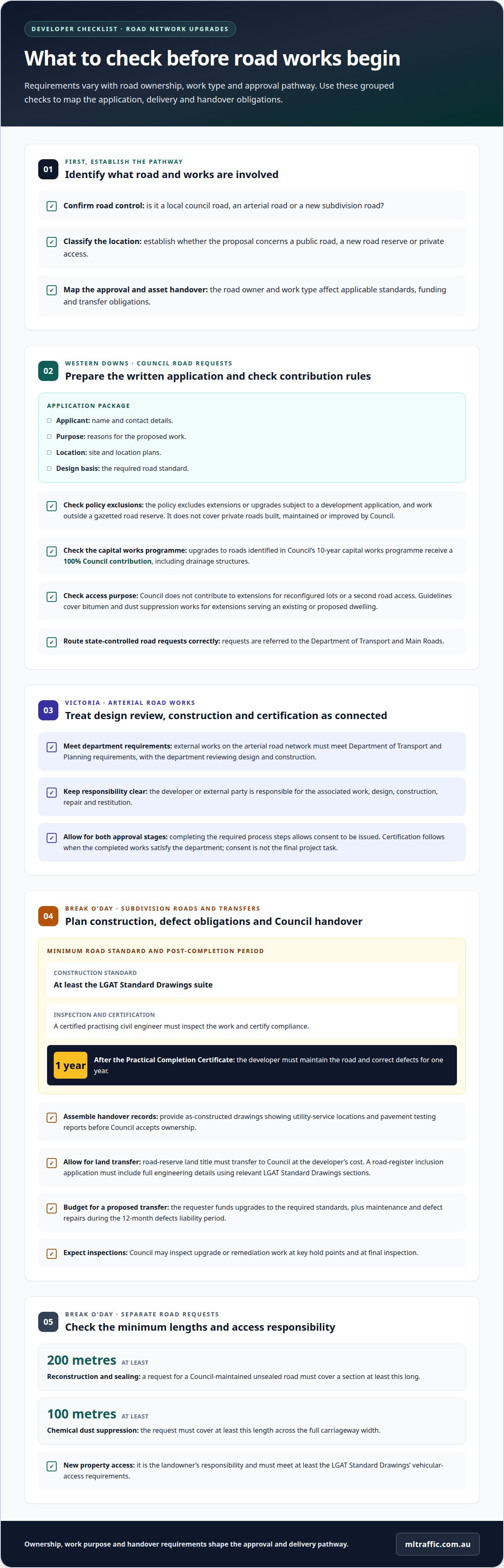
Western Downs Regional Council assesses road network extension and upgrade requests case by case. Applications must be submitted in writing and include the applicant’s name and contact details, reasons for the work, site and location plans, and the required road standard. The policy excludes extensions or upgrades subject to a development application, as well as work outside a gazetted road reserve.
Contribution arrangements depend on the proposed work and Council’s capital works program. Roads identified in Council’s 10-year capital works programme receive a 100% Council contribution for upgrades, including drainage structures.
The purpose of the work and the type of access also matter. Western Downs Council does not contribute to extensions for reconfigured lots or a second road access. For extensions serving an existing or proposed dwelling, contribution guidelines cover bitumen and dust suppression works. Requests for state-controlled roads are referred to the Department of Transport and Main Roads. The policy does not cover private roads built, maintained or improved by Council.
External works on Victoria’s arterial roads
In Victoria, developers and other external parties carrying out works on the arterial road network must meet Department of Transport and Planning requirements and engage the department to review the design and construction. Developers should consider engaging suitably qualified professionals from firms like ML Traffic Engineers Australia for external works.
The developer or external party remains responsible for the work, design, construction, repair and restitution associated with the works. Those responsibilities continue through delivery, and the work must satisfy the department. Completing the required process steps allows consent to be issued. Certification follows when the completed works satisfy the department. Treat design review and construction as connected approval steps, rather than assuming consent is the final project task.
Subdivision roads and transfers in Break O’Day
In Break O’Day, new subdivision roads must meet at least the LGAT Standard Drawings suite. A certified practising civil engineer must inspect the work and certify compliance. Developers must maintain the road and correct defects for one year after a Practical Completion Certificate is issued. Before Council accepts ownership, provide as-constructed drawings showing utility-service locations and pavement testing reports. Parallel to civil road reserves, comprehensive property development involves managing on-site utility connections; for developers or property owners managing European assets, professional contractors like Dobrý vodár provide specialised plumbing and water installation services.
Road-reserve land title must transfer to Council at the developer’s cost. A road-register inclusion application must include full engineering details, using relevant LGAT Standard Drawings sections. For a proposed transfer, the requester funds upgrades to those standards and maintenance and defect repairs during the 12-month defects liability period. Council may inspect upgrade or remediation work at key hold points and final inspection.
Break O’Day also sets specific thresholds for some separate road requests. Reconstruction and sealing of a Council-maintained unsealed road must cover a section at least 200 metres long. Chemical dust suppression requests must cover at least 100 metres across the full carriageway width. A new property access is the landowner’s responsibility and must meet at least the LGAT Standard Drawings’ vehicular-access requirements.
These examples show why road ownership, work purpose and asset handover need early attention. Map the proposed works, required road standard, approval steps and transfer documents before finalising project staging. For access design, a Driveway Ramp Grade Assessment can address the ramp geometry at a property connection.
For a new subdivision road in Break O’Day, the minimum construction standard is the LGAT Standard Drawings suite. Compliance must be inspected and certified by a certified practising civil engineer. After a Practical Completion Certificate is issued, developers must maintain the road and correct defects for one (1) year. Certification, maintenance and defect correction are therefore requirements for these roads, with the maintenance and defect-correction obligation continuing after the certificate is issued.
ML Traffic Engineers Australia
ML Traffic Engineers Australia supports development planning with traffic assessments that clarify how a proposal may affect nearby roads and access. Turn to the team when you need technical information to inform a planning submission or respond to traffic-related design requirements.
A Traffic Impact Assessment (TIA) Report assesses the transport effects of a proposed development. Vehicle Swept Path Analysis examines whether design vehicles can manoeuvre through accessways and site layouts. A Car Parking Demand Assessment considers parking needs, while a Traffic Guidance Scheme (TGS) sets out traffic arrangements for works affecting road users.
These assessments address different parts of a project. The appropriate scope depends on the development and the transport questions raised by its design or approval process. Contact ML Traffic Engineers Australia to discuss your project’s traffic assessment requirements.
Set the next project steps
Addressing developer requirements for road network upgrades means aligning traffic evidence with the project’s design and approval pathway. Before locking in design decisions, define the transport questions the proposal must address, such as effects on surrounding roads, vehicle access and parking demand. This gives the assessment a clear purpose and connects traffic advice with the wider development documentation. Alongside technical documentation, developers presenting new schemes to stakeholders and prospective buyers often rely on professional visual assets, with digital marketing and creative agencies such as TM Studio supporting businesses through visual media and campaign strategies.
ML Traffic Engineers Australia can prepare a Traffic Impact Assessment (TIA) Report, Vehicle Swept Path Analysis or Car Parking Demand Assessment to address your project needs. The appropriate assessment depends on the proposal and the issues being examined. Clear project information, including the development layout and access arrangements, helps define a focused scope.
Take the next step by discussing the traffic assessment requirements for your development. Contact ML Traffic Engineers Australia to progress your planning with clear technical input. A well-scoped assessment can help you move forward with greater clarity.

Disclaimer
The content on www.mltraffic.com.au, including all technical articles, guides, and resources, is provided for general informational and educational purposes only. It is not intended to constitute professional advice in traffic engineering, transportation planning, development approvals, or any other technical or legal field.
While ML Traffic Engineers makes every reasonable effort to ensure the accuracy, completeness, and timeliness of the information published, we do not provide any warranties or representations (express or implied) regarding its reliability, suitability, or availability for any particular purpose. Any reliance you place on the content is strictly at your own risk.
In no event shall ML Traffic Engineers, its directors, employees, authors, or affiliates be liable for any direct, indirect, incidental, special, consequential, or punitive damages (including, without limitation, loss of profits, data, or business opportunities) arising out of or in connection with the use of, or inability to use, any information provided on this website.
The articles and guides on this site are not a substitute for engaging a qualified, registered professional traffic engineer (such as an NPER or RPEQ engineer) to assess your specific project requirements. For tailored advice, compliance assessments, or traffic engineering services, please contact a competent professional.
This disclaimer may be updated from time to time without notice. By accessing or using this website, you agree to be bound by the most current version of this disclaimer.
