
What if adding parking spaces or installing new technology makes a car park harder to use? Developing a car park management strategy should start with evidence about demand and site constraints, not assumptions about the solution. If turnover is unclear, congestion is building or unauthorised vehicles are taking up spaces, it’s understandable to consider stricter controls or digital tools first. But without understanding the cause, those measures may not solve the problem.
A practical strategy measures how the car park performs and identifies who uses it, when demand peaks and where delays or access issues occur. You can then set clear objectives and compare operational controls, layout changes and technology against those needs. This helps you choose measures that support users and site performance without committing to changes the evidence doesn’t justify.
This guide explains how to assess parking demand, review site layout and vehicle access, and select suitable management measures. It also covers how traffic engineering input, including parking demand assessment and car park design, can help investigate design or access constraints, and why strategies should be reviewed as site needs change.
Key Takeaways
- Define the site problem and the strategy’s scope before selecting controls, equipment or design changes.
- Use demand, turnover, parking duration and user requirements to identify performance gaps.
- Compare operational measures, layout changes, communication and technology by their prerequisites, disruption and success measures.
- Make developing a car park management strategy actionable with an action register that assigns owners, dependencies and decision points.
- Consider specialist traffic engineering input when evidence points to parking demand, layout, access or vehicle movement constraints.
Developing a car park management strategy starts with the site problem
A car park management strategy is a documented plan that connects a site’s objectives and user needs with decisions about parking demand, access, operations and measurable performance. Start by identifying what isn’t working, rather than assuming new equipment or tighter controls will fix it.
Common triggers include congestion at entry or exit points, low turnover, unauthorised parking, safety concerns and changes in demand. Clarify where and when the issue occurs, who is affected and what a successful outcome would look like. This Parking management reference provides a broad overview of parking’s economic, geographical and urban-planning dimensions.
For a visual example of a sustainability-focused car park product, watch this walkthrough:
What is a car park management strategy designed to achieve?
Set outcomes you can check, such as reliable access, more efficient use of spaces or a clearer experience for drivers, pedestrians and other site users. Separate immediate operational problems, such as vehicles occupying reserved spaces, from longer-term design constraints, such as a layout that restricts circulation. Objectives should reflect the site’s users, purpose and operating conditions.
What evidence should you collect before making changes?
Build a baseline before choosing a response. Observe representative days and record occupancy, turnover, duration of stay and peak periods. Compare demand with the spaces available, then map user groups, access points, pedestrian routes, loading needs and observed conflicts.
Useful evidence may include:
- When and where queues, conflicts or unauthorised parking occur.
- Which spaces are used, by whom and for how long.
- How vehicle movements interact with pedestrian routes and loading activity.
Record how and when observations were collected. A single quiet day or unusually busy period may not represent typical conditions, so note limitations before drawing conclusions. If the evidence points to a layout, parking demand or vehicle access constraint, specialist assessment can help clarify the issue before you consider design changes.
Assess demand, access and layout before choosing car park measures
A reliable strategy depends on understanding how the car park performs, not just how many marked spaces it has. Compare observed demand with available spaces, then assess how access, circulation and site constraints affect users. This helps distinguish a genuine shortage from poor turnover, inefficient allocation or a layout that limits usable capacity.
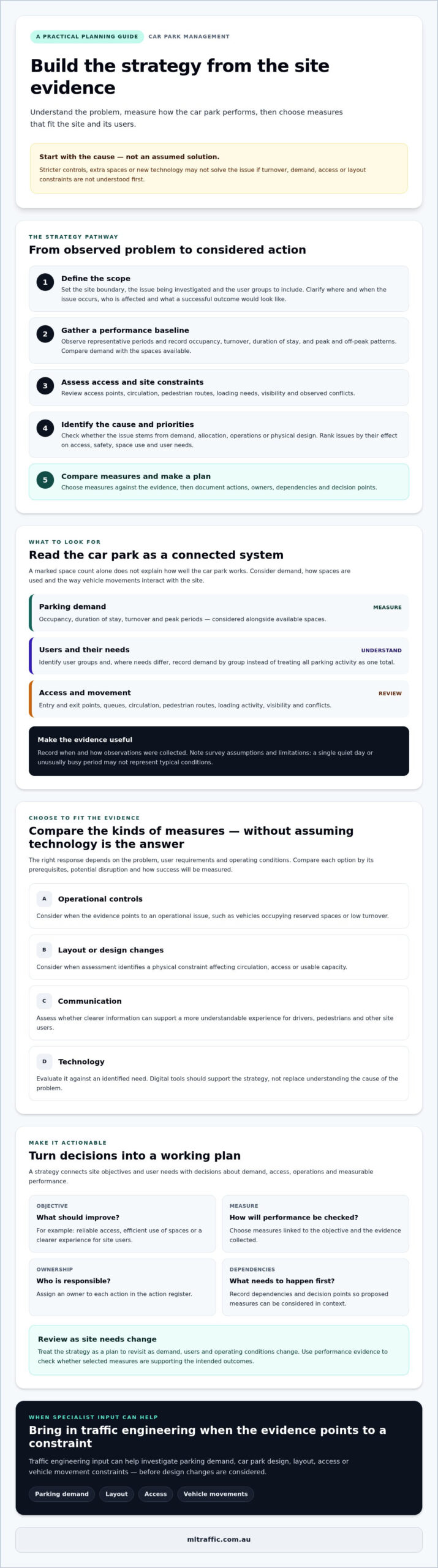
Use a repeatable sequence before selecting measures:
- 1. Define the scope. Set the site boundary, the issue being investigated and the user groups to include.
- 2. Gather data. Record occupancy, turnover, duration of stay, and peak and off-peak patterns.
- 3. Assess constraints. Review access points, circulation, pedestrian routes, loading and visibility.
- 4. Identify causes. Check whether the problem stems from demand, allocation, operations or physical design.
- 5. Set priorities. Rank issues by their effect on access, safety, space use and user needs.
How do you measure parking demand and utilisation?
Use occupancy surveys and duration observations at relevant peak and off-peak times. Compare occupied spaces with those available, and note how long vehicles stay and how often spaces turn over. If staff, visitors or permit holders have different requirements, record demand by user group instead of treating all parking activity as one total.
Document the survey dates, observation periods and assumptions. A short survey may miss shift changes, appointments or other recurring peaks, so explain its limitations before using the results to justify changes. The International Parking & Mobility Institute is another source of industry information, but local site evidence should guide decisions.
How do layout and access affect management options?
Inspect vehicle entry and exit, queues, aisle function, turning movements, pedestrian routes, loading areas and sight lines. A control intended to reduce congestion may not help if entry geometry is causing delays. Likewise, a marked space may be difficult to use if vehicles can’t manoeuvre safely within the layout.
Consider the vehicles that use the site and whether they can enter, circulate, park and leave as intended. Where movements are constrained, a Vehicle Swept Path Analysis may help test access and manoeuvring. For further design context, see the AS 2890.1 car park design guide.
Check applicable parking design standards and planning controls with the relevant authority for the project jurisdiction. Confirm the current edition and applicability of AS 2890.1 and AS 2890.2 before relying on their requirements. If evidence points to a demand or layout constraint, explore car parking demand assessment and design services as a next step.
Compare car park management options without assuming technology is the answer
A useful strategy may prioritise process changes before new technology. If visitors are using staff spaces because permit rules are unclear, a clearer allocation process may address the cause more directly than number plate recognition. Compare each option against the problem it is meant to solve, what must be in place, the disruption involved and how you’ll measure its effectiveness.
| Option | Problem addressed | Prerequisites and likely disruption | Measure of success |
|---|---|---|---|
| Operational controls | Unclear allocation, unauthorised use or poor turnover | Agreed rules, assigned enforcement responsibilities and consistent communication. Usually limited physical disruption. | Fewer unauthorised vehicles or improved turnover. |
| Layout changes | Confusing circulation, constrained access or inefficient space configuration | Design review and, where needed, assessment of vehicle movements. Works may disrupt access or temporarily reduce available spaces. | Improved circulation, access or usable space. |
| User communication | Drivers unaware of parking rules, space allocation or available alternatives | Accurate, consistent information across relevant channels. Requires ongoing updates when arrangements change. | Fewer rule-related queries or improved compliance. |
| Parking technology | A specific access, payment, occupancy or monitoring requirement | Defined operational need, system compatibility, support arrangements and consideration of privacy obligations. Installation and changeover may disrupt operations. | Reliable system performance and improvement in the target measure. |
When are operational controls or user policies appropriate?
Consider permits, allocation rules, time limits or visitor procedures when governance is unclear or spaces aren’t being used as intended. Confirm who is responsible for applying the rules and how users will be informed. Check the site’s accessibility needs, existing policies and applicable requirements before introducing restrictions. A rule that can’t be explained or applied consistently is unlikely to resolve the underlying issue.
When should design changes or parking technology be considered?
Consider design changes when evidence points to circulation, access or space configuration as the cause. Number plate recognition, access control and payment systems are options only when they address a defined site requirement. Before selecting a system, check compatibility with existing systems, ongoing support needs and relevant privacy obligations. For more context on matching management choices to user needs, review these campus parking best practices.
Developing a car park management strategy means selecting a proportionate response, not adopting every available measure. If the evidence indicates a layout or access constraint, car park design and assessment services may help inform the technical next step.
Turn the car park strategy into actions, measures and regular reviews
A strategy becomes useful when each priority has an owner, a next step and a way to check the result. Convert agreed actions into a register, separating low-disruption operational changes from design work that may need technical assessment or approval. This makes dependencies visible and helps decision-makers avoid committing to a layout or system change while key assumptions remain unresolved.
How should you prioritise and implement strategy actions?
Rank proposed actions by the problem they address, their feasibility, dependencies and expected operational effect. Assign responsibility for policy updates, user communications, follow-up surveys and technical investigations. Record what is known, what is assumed and what still needs confirmation before approving a physical change.
An action register can use a consistent format:
- Action and objective: State the issue being addressed and the intended outcome.
- Owner and dependencies: Name the responsible role and any decisions, assessments or approvals needed first.
- Timeframe and decision point: Set a review date and specify what evidence will inform the next step.
- Measure: Identify the indicator that will show whether the action is working.
For example, you could implement and monitor a clarified policy before considering a physical layout change. If the issue persists, the decision point can prompt further investigation rather than an automatic commitment to more disruptive work.
Which performance measures should you review over time?
Choose indicators that relate directly to site objectives. Depending on the problem, these may include occupancy, turnover, access delays, complaints or unauthorised parking. Pair operational data with user feedback. Occupancy alone may show whether spaces are full, but not whether queues, unclear rules or access changes are affecting the experience.
Repeat surveys using consistent methods and representative operating periods so results can be compared. Record any changes in survey conditions or site operations that could affect interpretation. Review measures against the original baseline and note intended results as well as unintended impacts.
Review frequency should reflect measured performance and how quickly site use, development plans and operating conditions change. Revisit the action register when evidence shifts, an action misses its objective or a proposed development changes demand or access. Developing a car park management strategy is an ongoing process: retain what works, revise what doesn’t and reassess unresolved constraints as conditions change.
If a review identifies a design or parking demand question that needs technical input, explore car park design and assessment services.
When a traffic engineer can strengthen a car park management strategy
Traffic engineering input is useful when site evidence points to a demand, layout or vehicle access constraint that operational rules alone may not resolve. A car park demand assessment can examine parking needs in relation to a proposed development and its site conditions. Car park design can address layout concerns, while access assessments or vehicle swept path analysis can help investigate whether vehicles can enter, circulate and manoeuvre as intended.
Consider specialist assessment when a development proposal may change parking demand, when observed congestion appears linked to site geometry, or when an approval process requires project-specific traffic information. The appropriate scope depends on the issue and the requirements of the responsible authority. Check applicable standards and approval requirements for the project jurisdiction.
What can traffic engineering input assess?
A traffic engineer can consider demand, site layout and vehicle access together to help clarify the cause of a performance issue. For example, if larger service vehicles struggle to turn within an existing layout, this vehicle swept path analysis guide explains how vehicle movements are assessed. If the concern is whether parking supply aligns with a proposed use, a demand assessment may provide relevant evidence for planning and design decisions.
This work is distinct from day-to-day parking operations. Engineering consultancy can assess demand, access and design constraints, but it doesn’t provide routine parking management, enforcement or parking equipment. Those responsibilities need to be addressed separately by the site owner or relevant operator.
How can a site owner take the next step?
Prepare information that will help define the problem and scope the investigation:
- Available site or layout plans, including access points and circulation routes.
- Parking observations or records, with survey dates and limitations.
- Current operating rules, user groups and known access or manoeuvring issues.
- A concise description of the problem and any proposed development or approval requirements.
Ask prospective advisers to clarify the assessment scope, required inputs, deliverables and any relevant authority approvals. This helps ensure the work addresses the question at hand instead of commissioning a broader investigation without a defined need. Developing a car park management strategy is most effective when specialist advice is sought for a specific, evidence-based constraint, while operational decisions remain with those responsible for running the site.
If your findings point to a demand, layout or access issue, discuss your traffic engineering requirements with ML Traffic Engineers Australia.
Put your car park strategy into action
A practical strategy starts with a clear understanding of the site problem, supported by demand and access evidence. Choose proportionate measures, assign responsibility and review performance as site needs change.
Developing a car park management strategy is an ongoing process. Where evidence points to a parking demand, layout or vehicle access constraint, traffic engineering input can help assess the issue and inform the next step.
ML Traffic Engineers provides car park design, parking demand assessment and vehicle swept path analysis, backed by more than 15 years of traffic engineering and transport planning experience. The consultancy serves clients nationally across Australia.
Have a specific site issue to assess? Discuss your car park assessment requirements with the team. A well-defined next step can help turn site evidence into a strategy that works for your users and operations.
Frequently Asked Questions
What should a car park management strategy include?
A car park management strategy should set out what the site needs to achieve and how parking arrangements will support those objectives. Include the users and operating conditions considered, the evidence informing decisions, agreed actions, responsible roles and performance indicators. Record dependencies, assumptions and items requiring confirmation, such as project-specific approval requirements. This gives site decision-makers a clear basis for implementation and makes it easier to explain why measures were selected.
How do you assess car park demand and utilisation?
Assess demand by observing parking use across operating periods relevant to the site. Record occupancy, how long vehicles stay and how often spaces become available. Separate staff, visitor or other user groups where their needs differ, and note any unusual conditions during observations. State the survey dates, methods and assumptions. This context helps decision-makers interpret the findings and avoid treating limited observations as a complete picture of typical demand.
When should a business introduce parking technology?
Consider parking technology after identifying a specific requirement that existing processes can’t meet effectively. A site may need to manage entry permissions, payments or information about space use, but the right system depends on its operating model. Before proceeding, confirm the intended function, compatibility with existing systems, support arrangements and relevant privacy considerations. If the underlying issue is unclear allocation or communication, a policy or process change may be a more suitable first step.
Can a car park management strategy improve access without adding spaces?
Yes. Access may improve through clearer allocation, better visitor instructions or adjustments to vehicle and pedestrian movements, depending on the cause of the problem. First distinguish a shortage of spaces from delays caused by queues, confusing circulation or spaces being used by the wrong groups. Then assess a targeted change using relevant indicators, such as access delays and user feedback. Adding spaces isn’t the only possible response to poor performance.
How often should a car park management strategy be reviewed?
Set review points to suit the site’s rate of change and the measures being monitored. Reassess sooner if a development proposal, change in site use or altered operating conditions could affect parking demand or access. Compare repeat observations collected on a consistent basis, and consider user feedback alongside operational data. A review should identify whether actions met their objectives, created unintended effects or need adjustment, rather than simply confirm that the plan remains on file.
When should I engage a traffic engineer for car park planning?
Engage a traffic engineer when a planning or site question needs technical assessment of parking demand, car park layout, vehicle access or manoeuvring. This may be relevant to a development proposal or where vehicle movements appear constrained. ML Traffic Engineers provides car park design, parking demand assessment and vehicle swept path analysis, with more than 15 years of traffic engineering and transport planning experience and national service coverage across Australia.
What is the difference between car park management and car park design?
Car park management sets out how parking is allocated, communicated and monitored, including how performance is reviewed. Car park design concerns the physical arrangement of spaces, circulation and vehicle access. They inform each other but are distinct activities: an operational issue may reveal a layout constraint, while a suitable design still needs clear operating arrangements. Site operators handle day-to-day management; specialist design input can assess physical layout or access questions.

Disclaimer
The content on www.mltraffic.com.au, including all technical articles, guides, and resources, is provided for general informational and educational purposes only. It is not intended to constitute professional advice in traffic engineering, transportation planning, development approvals, or any other technical or legal field.
While ML Traffic Engineers makes every reasonable effort to ensure the accuracy, completeness, and timeliness of the information published, we do not provide any warranties or representations (express or implied) regarding its reliability, suitability, or availability for any particular purpose. Any reliance you place on the content is strictly at your own risk.
In no event shall ML Traffic Engineers, its directors, employees, authors, or affiliates be liable for any direct, indirect, incidental, special, consequential, or punitive damages (including, without limitation, loss of profits, data, or business opportunities) arising out of or in connection with the use of, or inability to use, any information provided on this website.
The articles and guides on this site are not a substitute for engaging a qualified, registered professional traffic engineer (such as an NPER or RPEQ engineer) to assess your specific project requirements. For tailored advice, compliance assessments, or traffic engineering services, please contact a competent professional.
This disclaimer may be updated from time to time without notice. By accessing or using this website, you agree to be bound by the most current version of this disclaimer.
