

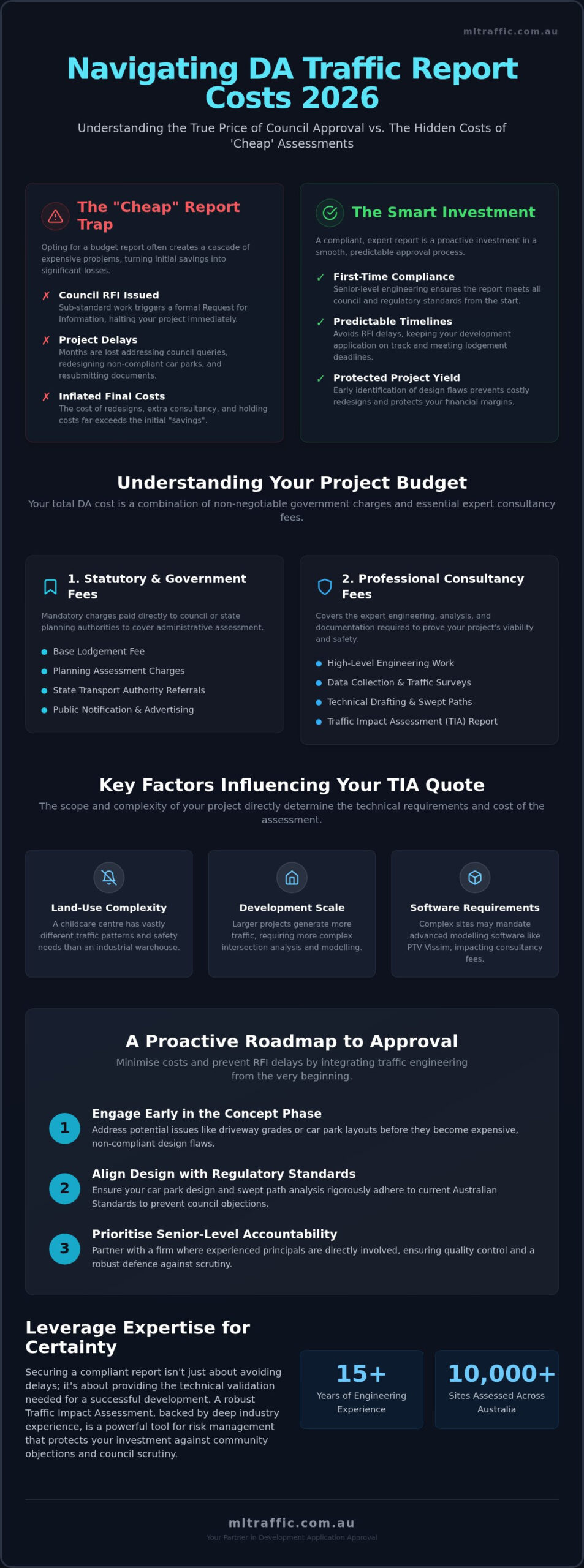
A “cheap” traffic assessment often becomes the most expensive line item in your project budget once the council issues a formal Request for Information (RFI) or rejects your car park design. While every developer wants to minimise overheads, understanding the development application traffic report cost 2026 requires looking beyond the initial quote to the long-term price of compliance and approval. Cutting corners on technical assessments doesn’t just risk your lodgement deadline; it invites the kind of scrutiny that can stall a multi-million dollar development for months.
We understand that managing the planning process feels like a moving target, especially when unexpected delays eat into your margins. This guide provides the clarity you need to secure a compliant, cost-effective assessment that satisfies council requirements from the first submission. We’ll examine the variables that drive consultancy fees, the impact of software requirements like PTV Vissim 2026, and how to identify a fixed-fee partner who prioritises senior-level accountability. By understanding these drivers, you can avoid hidden costs and ensure your project moves from lodgement to approval without traffic-related objections.
Key Takeaways
- Distinguish between statutory council fees and professional consultancy expenses to create a transparent and accurate project budget.
- Identify how land-use complexity and development scale directly influence the technical requirements and scope of your Traffic Impact Assessment.
- Discover how early engagement during the concept phase helps manage the development application traffic report cost 2026 by preventing non-compliant designs.
- Minimise the risk of expensive council Requests for Information (RFIs) by ensuring your car park design and swept path analysis align with current regulatory standards.
- Leverage over 15 years of engineering expertise and direct principal involvement to secure a compliant report that meets strict lodgement deadlines.
Understanding the Investment: Why DAs Require a Traffic Report
Australian councils require a formal Impact Assessment whenever a proposed development significantly alters the existing land use. This requirement stems from the need to protect the integrity of the local road network and ensure public safety. Whether you’re developing a childcare centre, an industrial warehouse, or a residential dual occupancy, the development application traffic report cost 2026 reflects the technical rigour required to prove your project won’t cause gridlock or safety hazards. A Traffic Impact Assessment (TIA) is a technical document that predicts and manages transport outcomes.
For smaller projects with minimal impact, a council might only request a brief Traffic Impact Statement. However, larger developments generally trigger a full Assessment, involving complex intersection analysis and car parking demand assessments. The following video provides context on how traffic engineering procedures are implemented to manage vehicle movement:
The Purpose of Traffic Engineering in Planning
The primary objective of traffic engineering within the planning system is to validate that the existing road network capacity can handle the projected trip generation of a new site. Engineers use industry-standard software and methodologies to model how vehicles enter and exit your property without compromising the flow of traffic on adjacent streets. Safety remains the highest priority. Every report must demonstrate adherence to national standards for sight distances and pedestrian safety. This technical validation ensures that motorists and pedestrians can navigate the area safely once the project is operational.
Risk Management for Developers
Engaging a traffic engineer early in the process is a strategic move to protect your site yield. We often identify car park design flaws or driveway ramp grade issues that would otherwise lead to a council refusal or an expensive Request for Information (RFI). By integrating traffic advice into your Statement of Environmental Effects, you provide a robust defence against community objections and council scrutiny. This proactive approach minimises the “hidden cost” of redesigns and project delays. Our team at ML Traffic Engineers leverages over 15 years of experience across 10,000 sites to ensure your development application remains on track for approval.
Statutory Fees vs. Professional Consultancy Costs
Budgeting for a new project requires a clear distinction between the two primary cost layers involved in the planning process. Many developers mistakenly conflate council lodgement fees with the professional fees charged by technical experts. In reality, these are separate financial obligations. Your total development application traffic report cost 2026 is comprised of non-negotiable government charges and the consultancy fees required to produce a compliant Traffic Impact Assessment (TIA).
Statutory fees are paid directly to the local council or state planning authority. These funds cover the administrative burden of assessing your application and managing the public notification process. Professional consultancy fees, however, cover the high-level engineering work, data collection, and technical drafting necessary to prove your site is viable. Relying on a “budget” report often results in significant financial losses later, as sub-standard work frequently triggers complex council Requests for Information (RFIs) that stall your progress.
Government and Referral Agency Fees
Councils across Australia maintain specific fee schedules for development applications, often indexed annually. These charges typically include a base lodgement fee and additional costs for planning assessments. If your project is located on a state-controlled road, you may also encounter referral fees for state transport authorities. These agencies provide a secondary layer of scrutiny to ensure regional traffic flow remains unaffected. Significant developments also incur advertising and public notification costs, which are mandatory to satisfy community consultation requirements. These fees are statutory and cannot be discounted or waived by your engineering partner.
Professional Engineering Service Costs
The consultancy portion of your budget covers the technical expertise required to navigate the Guide to Traffic Impact Assessment and other regulatory frameworks. This involves detailed site inspections and the collection of accurate traffic data, such as peak-hour turning counts. Engineers must also perform technical drafting to ensure every element of your car park design complies with AS 2890 standards. This technical rigour is essential for securing approval without traffic-related objections.
Securing senior principal involvement during the analysis phase adds immense value, particularly when negotiating with council engineers over complex site constraints. At ML Traffic Engineers, we ensure that the expert who starts your project is the one who completes the technical work, providing continuity and accountability that larger firms often lack. If you need a transparent breakdown of the requirements for your specific site, you can request a fixed-fee quote to ensure your project remains on budget.
Key Factors Influencing Your Traffic Impact Assessment Quote
Every development project presents unique variables that determine the scope of engineering work required. The development application traffic report cost 2026 varies significantly based on whether you’re proposing a residential dual occupancy or a large-scale commercial hub. Large hubs require extensive trip generation modelling and impact analysis on the surrounding network; whereas smaller residential projects focus on site-specific access and parking. Our team leverages experience across 10,000 sites to determine exactly which technical assessments are necessary for your specific project scale.
Land use complexity is a major driver of consultancy fees. Childcare centres and medical clinics have high peak-hour trip rates and strict drop-off requirements. Industrial warehouses, by contrast, focus on heavy vehicle movements and loading dock efficiency. We assess these needs against the Austroads national guidelines to ensure your report meets the technical expectations of council planning officers. This adherence to national standards is the best way to secure a compliant, cost-effective assessment.
Site Complexity and Access Requirements
Physical constraints often increase the depth of assessment needed. Challenging driveway ramp grades or obstructed road frontages require detailed design work to prove safety for motorists and pedestrians. If your site involves delivery vehicles or waste collection, a Vehicle Swept Path Assessment is essential. This technical drafting demonstrates that trucks can enter and exit the site in a forward direction without striking kerbs or structures. These detailed design requirements are critical factors in your final quote.
The Role of Specialised Software in 2026
Modern traffic engineering relies on high-fidelity software to provide certainty and satisfy council scrutiny. We use AutoTURN for precise vehicle manoeuvring diagrams and SIDRA for intersection operations assessment on high-traffic sites. The requirement for sophisticated traffic modelling software like PTV Vissim 2026 directly impacts the development application traffic report cost 2026 for more complex sites. Ensuring total compliance with the latest versions of AS 2890.1 and AS 2890.2 is the only way to avoid the hidden costs of design rework.
Parking demand assessments play a critical role in the final quote. If your project has a parking shortfall, our team provides technical justifications or identifies parking credits. This frequently involves empirical data collection to prove that the proposed supply meets the actual demand of the specific land use. Accurate parking analysis prevents the delays caused by non-compliant car park designs and ensures your project moves toward approval.
How to Minimise Costs and Avoid Council RFI Delays
Strategic planning is the most effective way to control the development application traffic report cost 2026. Many developers wait until the final stages of design to engage a traffic consultant. This delay often results in architectural plans that fail to meet Australian Standards, necessitating expensive redesigns. By integrating traffic engineering advice into the initial concept phase, you ensure that access points and internal circulations are compliant from the outset. This proactive approach eliminates the cycle of rework that inflates consultancy fees and project timelines.
Providing high-quality, scaled architectural plans is equally vital. Vague or incomplete drawings force engineers to make assumptions, which council officers will likely challenge with a Request for Information (RFI). Clear documentation allows for a precise assessment, reducing the hours required for technical analysis. Adopting “deemed-to-satisfy” designs also lowers complexity. When a project aligns strictly with the acceptable outcomes of a planning scheme, the need for lengthy merit-based justifications is significantly reduced.
Early Intervention Strategies
Resolving car park layout issues before the architect finalises the DA set prevents site yield losses. We identify potential “deal breakers” in driveway access or vehicle manoeuvring early in the process. This allows for adjustments when the design is still fluid. For comprehensive guidance on meeting these requirements, refer to our detailed Car Parking Demand Assessment guide. Correcting a ramp grade or aisle width at the concept stage is far more cost-effective than attempting to justify a non-compliant design to a sceptical council engineer.
Effective Communication with Council
A robust technical report pre-empts common council objections by addressing potential concerns before they are raised. The value of having a registered professional, such as an NPER or RPEQ engineer, sign off on your report cannot be overstated. This certification provides councils with the assurance that the work meets national standards. Preparing for pre-lodgement meetings with accurate technical data further streamlines the process. It allows you to address specific council requirements early, ensuring a smoother path through the assessment phase. To secure a compliant report for your next project, contact our senior principals today for a fixed-fee proposal.
Expert Traffic Engineering Solutions for DA Approval
Achieving council approval requires more than just a technical document; it demands a strategic partner who understands the bureaucratic nuances of the planning system. With over 15 years of experience, we’ve refined our processes to ensure the development application traffic report cost 2026 remains transparent and predictable. Our firm is built on the principle of senior leadership involvement. Unlike larger, impersonal consultancies where technical work is often delegated to junior staff, our senior principals perform the analysis and drafting themselves. This direct involvement ensures every assessment is compliant with national regulatory standards and council-specific requirements from the outset.
We provide a reliable, no-nonsense approach to traffic engineering that prioritises results over unnecessary bureaucracy. By maintaining a staccato and information-dense communication style, we deliver the technical data councils require without the fluff that causes delays. Our registered NPER and RPEQ engineers understand that your project timeline is critical. We focus on providing the technical certainty needed to move your development from the concept phase to a successful lodgement.
Proven Track Record Across Australia
Since 2005, we have completed over 10,000 sites across Australia, covering a vast range of practical project environments. Our expertise spans diverse land-use categories, including residential subdivisions, dual occupancies, childcare centres, medical clinics, service stations, and large-scale industrial warehouses. We also specialise in complex assessments for shopping centres, gymnasiums, schools, and place of public worship developments. This exhaustive experience allows us to anticipate council objections before they occur. We provide a specific promise of personnel continuity; the expert who initiates your project remains your technical lead through to approval. To understand the broader impact of our work, you can read about The Role of a Traffic Engineer in Developments.
Get Started with Your Traffic Report
Securing a fixed-fee quote for your 2026 development project is a straightforward process. To provide an accurate assessment of the development application traffic report cost 2026, we require your current architectural plans and a clear description of the proposed land use. Once we’ve reviewed your project details, we provide a transparent proposal that covers all necessary technical assessments, such as vehicle swept path analysis or car parking demand assessments. Our typical timeline for report preparation is designed to meet strict lodgement deadlines, ensuring your project remains on schedule. You have direct access to our senior principals, Michael Lee and Benny Chen, for immediate technical advice. This approach ensures accountability and professional reliability at every stage of the DA process.
Secure Your Planning Approval for 2026
Navigating the planning system requires a clear understanding of both statutory fees and professional consultancy requirements. By distinguishing between these costs and engaging technical experts during the concept phase, you protect your site yield and project timeline. Implementing “deemed-to-satisfy” designs and ensuring strict adherence to Australian Standards prevents the expensive cycle of council RFIs and redesigns.
Managing the development application traffic report cost 2026 effectively means choosing a partner with a proven track record of success. We have completed over 10,000 projects since 2005, providing developers with direct access to registered NPER and RPEQ engineers for every assessment. Our senior principals lead the technical work on every project, ensuring accountability and personnel continuity from the initial quote through to council approval. Contact our senior principals for a fixed-fee traffic report quote to ensure your development moves forward with technical certainty and confidence.
Frequently Asked Questions
How long does it take to prepare a traffic report for a DA?
Preparation timelines typically range from 5 to 10 business days following the receipt of all necessary architectural plans. This duration allows for detailed site analysis, trip generation modelling, and the drafting of technical findings. If your project requires external traffic counts or complex intersection modelling using SIDRA, the timeline may extend to accommodate data collection. We prioritise meeting lodgement deadlines to ensure your development application remains on schedule.
Will I need a swept path analysis for a small residential development?
Australian councils frequently mandate a Vehicle Swept Path Analysis for small residential projects, including dual occupancies and townhouses. This technical diagram proves that standard vehicles can enter and exit the site in a forward direction while navigating driveway gradients and narrow access ways. We use AutoTURN software to validate these movements against AS 2890.1 standards. Confirming these manoeuvres early prevents expensive council requests for redesigned access points during the assessment phase.
What is the difference between a Traffic Management Plan and a TIA?
A Traffic Impact Assessment (TIA) focuses on the permanent operational effects of a new development on the road network. In contrast, a Traffic Management Plan or Traffic Guidance Scheme (TGS) manages temporary vehicle and pedestrian movements during the construction phase. While the TIA supports the initial development application traffic report cost 2026, the TGS is typically a post-approval requirement necessary to secure a construction certificate or satisfy specific council permit conditions.
Does my traffic report need to be signed by a registered professional engineer?
Most Australian councils require technical reports to be certified by a registered professional engineer, such as an NPER or RPEQ holder. This certification provides a guarantee that the assessment meets national engineering standards and regulatory frameworks. Our senior principals are fully registered and provide direct oversight on every project. This professional sign-off is essential for minimising the risk of council objections and ensuring your report carries the necessary technical authority.
Can a traffic engineer help if council has already issued an RFI?
We frequently assist developers who have received a Request for Information (RFI) from council regarding traffic or parking concerns. Our team reviews the specific objections and provides the technical data or design modifications required to satisfy the assessing officer. Whether the issue involves car park design non-compliance or inadequate trip generation data, we leverage our experience across 10,000 sites to provide a robust response that keeps your project moving forward.
What information do I need to provide to get a fixed-fee quote?
To provide an accurate fixed-fee quote, we require a set of current architectural plans, including site layouts and floor plans. You should also specify the proposed land use, such as the number of residential units, childcare places, or the gross floor area for commercial sites. Clear documentation allows us to determine the exact technical scope, such as the need for swept path analysis or car parking demand assessments, ensuring no hidden costs arise later.
Are traffic report requirements the same in every Australian state?
While the foundational principles of traffic engineering are consistent, specific reporting thresholds and assessment methodologies vary between Australian states and local government areas. Each council maintains its own planning scheme and car parking rates, which we must reconcile with national guidelines like those from Austroads. Our national coverage ensures we tailor every report to meet the specific technical expectations of the local authority, regardless of where your development project is located.
How often do Australian Standards for parking (AS 2890) change?
Australian Standards for parking and access do not change annually but undergo periodic revisions to reflect modern vehicle dimensions and safety requirements. It’s critical that your traffic engineer uses the most current versions, such as AS 2890.1 for off-street parking and AS 2890.2 for commercial vehicles. Using outdated standards is a common cause for council RFIs and can significantly impact the development application traffic report cost 2026 due to technical rework.

Disclaimer
The content on www.mltraffic.com.au, including all technical articles, guides, and resources, is provided for general informational and educational purposes only. It is not intended to constitute professional advice in traffic engineering, transportation planning, development approvals, or any other technical or legal field.
While ML Traffic Engineers makes every reasonable effort to ensure the accuracy, completeness, and timeliness of the information published, we do not provide any warranties or representations (express or implied) regarding its reliability, suitability, or availability for any particular purpose. Any reliance you place on the content is strictly at your own risk.
In no event shall ML Traffic Engineers, its directors, employees, authors, or affiliates be liable for any direct, indirect, incidental, special, consequential, or punitive damages (including, without limitation, loss of profits, data, or business opportunities) arising out of or in connection with the use of, or inability to use, any information provided on this website.
The articles and guides on this site are not a substitute for engaging a qualified, registered professional traffic engineer (such as an NPER or RPEQ engineer) to assess your specific project requirements. For tailored advice, compliance assessments, or traffic engineering services, please contact a competent professional.
This disclaimer may be updated from time to time without notice. By accessing or using this website, you agree to be bound by the most current version of this disclaimer.
