

If your drive-through coffee site layout relies on internal reservoir capacity guesswork, your planning application will likely face significant hurdles before it reaches approval. Securing a professional fast food drive-thru traffic impact assessment is now a critical technical requirement for developers across Australia, rather than a mere planning formality. With evolving road management regulations and guidelines now in full effect, planning authorities nationwide have intensified their scrutiny of vehicle spillover and its impact on public road safety. ML Traffic Engineers Australia specialises in these assessments, ensuring your project meets all national standards.
You likely recognise that the risk of a Development Application (DA) rejection or the high cost of redesigning a site layout late in the process can jeopardise your entire project timeline. It is a common frustration to face confusion over queuing length requirements when every square metre of your site is valuable. This guide ensures you master the specific technical standards and planning authority expectations required for a smooth approval. We will break down the AS/NZS 2890.1:2021 compliance factors, relevant planning levy considerations for 2026, and the precise queuing metrics that lead to a compliant, risk-free development.
Key Takeaways
- Identify the high-intensity morning peak patterns that councils scrutinise to ensure your site layout manages pedestrian safety and traffic flow effectively.
- Master the essential technical components of a fast food drive-thru traffic impact assessment melbourne to provide the data required for intersection performance analysis.
- Optimise internal reservoir capacity and vehicle swept paths to eliminate the risk of traffic queuing onto public roads and avoid late-stage redesign costs.
- Engage in pre-lodgement meetings with local council engineers to identify potential traffic conflicts early and fast-track your formal planning approval.
- Leverage direct access to senior traffic engineering principals to ensure your technical assessments meet the latest 2026 regulatory standards and Victorian infrastructure requirements.
Why Drive-through Coffee Developments Face Intense Traffic Scrutiny
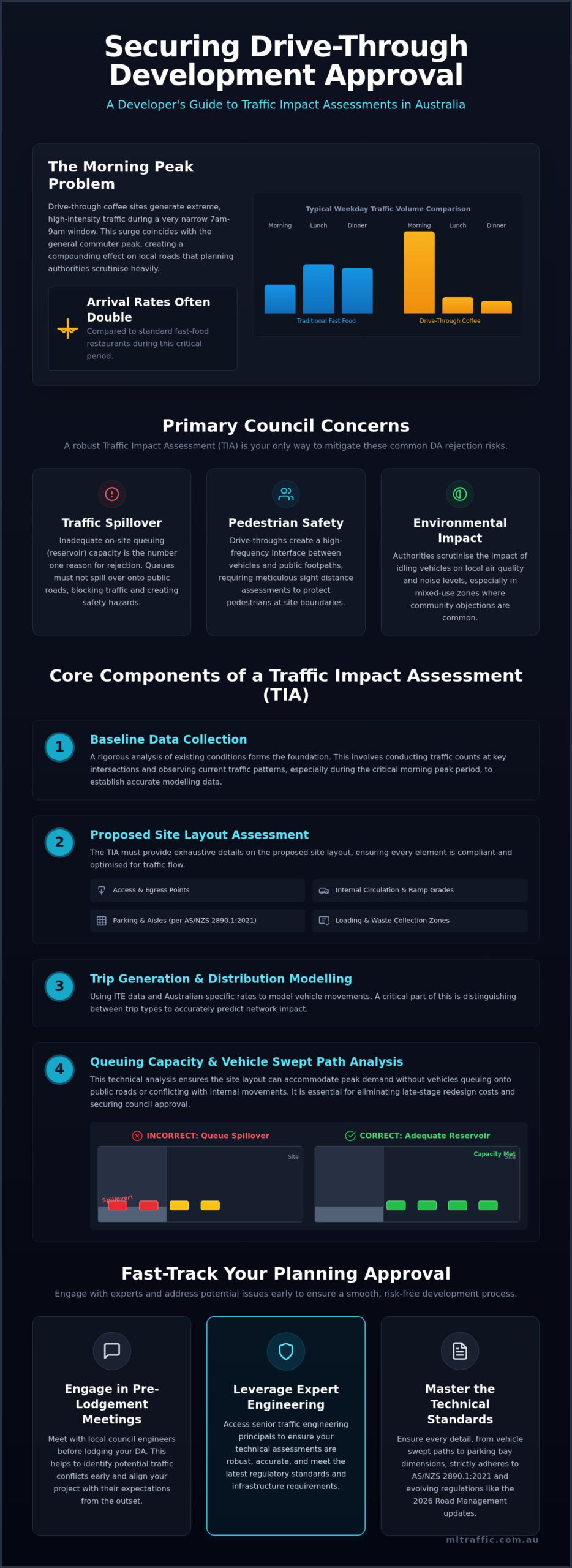
Melbourne councils have significantly increased their oversight of drive-through coffee developments. Unlike traditional fast-food outlets that see balanced peaks across lunch and dinner, coffee shops generate extreme, high-intensity traffic volumes within a very narrow morning window. This surge often coincides with the general commuter peak, creating a compounding effect on the local road network that planners must address. It’s a technical challenge that requires precise data to overcome.
A primary concern in any fast food drive-thru traffic impact assessment melbourne is the reservoir capacity. This is the number of vehicles that can queue on-site before obstructing the public road. If the queue spills over, it blocks through-traffic and creates safety hazards. Planning authorities often apply Induced Demand Theory when reviewing these applications. They understand that providing more efficient drive-through access can actually attract additional vehicle trips that might otherwise have been avoided or delayed.
To better understand the operational challenges and site impacts of these developments, watch this analysis:
Understanding the Morning Peak Demand
Arrival rates for coffee-specific sites are often double those of standard fast-food restaurants during the 7:00 am to 9:00 am period. While many of these are pass-by trips involving drivers already on the road, their sudden deceleration and turn-in movements can disrupt established traffic flow. Mobile ordering has further complicated these patterns. While it reduces transaction time at the window, it often increases the arrival rate during peak minutes. This puts immense pressure on the internal site layout. We’ve seen that sites without adequate queuing often face immediate rejection under the Road Management (Works and Infrastructure) Regulations 2026.
Council Concerns and Planning Objectives
Councils prioritise the safety of pedestrians at site boundaries. A drive-through creates a high-frequency interface between vehicles and public footpaths, requiring meticulous sight distance assessments. Environmental factors also play a role. Authorities now scrutinise the impact of idling vehicles on local air quality and noise levels, particularly in mixed-use zones. Community objections frequently focus on these congestion points. Providing a robust fast food drive-thru traffic impact assessment melbourne is the only way to mitigate these risks and secure approval. Developers should seek expert traffic engineering services to manage these technical requirements and ensure the site remains commercially viable.
Core Components of a Traffic Impact Assessment (TIA) Report
A TIA is a mandatory technical study that evaluates how a proposed development influences the existing road network. For a fast food drive-thru traffic impact assessment melbourne, the report must quantify the additional load on local infrastructure. It begins with a rigorous analysis of existing conditions. Our team conducts traffic counts at key intersections and observes current traffic patterns during the critical morning peak period. This baseline data is essential for accurate modelling.
The assessment provides exhaustive details on the proposed site layout, including:
- Access and egress point locations and widths.
- Internal circulation roadways and driveway ramp grades.
- Parking bay dimensions and aisle widths per AS/NZS 2890.1:2021.
- Dedicated loading and waste collection zones.
Trip Generation and Distribution Modelling
We utilise the ITE Trip Generation Manual alongside specific Australian data to model vehicle movements. It is essential to distinguish between trip types. New trips are entirely new to the network. Pass-by trips are already on the adjacent road and simply turn into the site. Diverted trips involve a change in route to visit the development. For drive-through coffee sites, pass-by trips often comprise a high percentage of morning volume. This distinction prevents the overestimation of the development’s impact on the broader road network. Accurate modelling ensures you don’t pay for infrastructure upgrades that your project doesn’t actually necessitate.
Intersection and Network Performance
Engineers analyse the Level of Service (LoS) for nearby signalised and unsignalised intersections. This industry-standard metric grades traffic delay from A to F. We identify the specific tipping point where development traffic triggers the need for mitigation. This might include lane widening or intersection signalisation. Understanding these triggers early allows you to optimise your site design for maximum compliance. For a comprehensive overview of these technical requirements, read our Traffic Impact Assessment: The Definitive Guide for Australian Developers. Our senior principals ensure every report meets the strict criteria of the Department of Transport and Planning (DTP) to secure your planning approval.
Analysing Queuing Capacity and Vehicle Swept Paths
A successful fast food drive-thru traffic impact assessment melbourne must prove that the site can contain its own demand. The internal reservoir is the designated queuing area between the property boundary and the first point of service. If this capacity is insufficient, vehicles will inevitably obstruct public footpaths or local traffic lanes. We calculate the required queue length by assessing peak arrival rates against service time assumptions. This includes the duration from the initial order point to the final collection window.
Service times vary based on menu complexity and payment efficiency. For coffee-focused developments, these intervals are typically shorter than full-service restaurants, yet the arrival frequency is higher. Engineers must account for these variables to ensure the site layout remains compliant with AS 2890.1:2021 standards. Our assessments provide the technical certainty that your internal circulation handles these loads without impacting the external road network.
The Science of Queue Length Assessment
We determine the 95th percentile queue length to ensure that the queue only exceeds the site’s capacity 5% of the time. This is the standard benchmark required by most Victorian councils. Implementing dual-lane drive-throughs or tandem order points can significantly increase this internal capacity without expanding the site footprint. However, these configurations require precise design to manage the merge point efficiently. For a deeper technical breakdown, see our article on AS 2890.1 Explained: The Ultimate Guide to Compliant Car Park Design.
Swept Path Analysis and Site Access
Vehicle Swept Path Analysis is the second pillar of site compliance. We utilise AutoTURN software to simulate the exact movements of Small Rigid Vehicles (SRVs) and Medium Rigid Vehicles (MRVs) throughout the site. It is critical that delivery trucks and waste collection vehicles can navigate the car park without blocking the drive-through lane or requiring dangerous multi-point turns. Councils often request specific proof that waste management can occur during off-peak hours without impacting site safety. You can master these requirements by reviewing our Swept Path Analysis: A Complete Guide for Australian Developments. Our senior engineers perform these simulations personally to ensure your site layout is both functional and compliant before you lodge your application.
Navigating the Planning Approval Process with Local Councils
Planning approval for drive-through developments in Victoria involves a rigorous technical review. A professionally prepared fast food drive-thru traffic impact assessment melbourne serves as the primary evidence for your proposal. However, the application process requires active coordination between developers, architects, and council engineers. We recommend initiating pre-lodgement meetings to identify specific council concerns regarding site access and queuing before formal submission. This proactive approach identifies potential conflicts early, reducing the likelihood of costly redesigns after the metropolitan planning levy has been paid.
When a development has access to a declared road, the Department of Transport and Planning (DTP) acts as a referral authority. Their requirements often exceed local council standards, particularly regarding intersection performance and sight distances. If council issues a Request for Further Information (RFI), your response must be technical and substantiated by data. Our senior principals handle these inquiries directly. This ensures that technical justifications align with the Road Management (Works and Infrastructure) Regulations 2026. It’s this direct involvement that prevents projects from stalling in the referral phase.
Preparing a Robust Development Application
Consistency across your application documents is essential. Traffic findings must be integrated into the Statement of Environmental Effects to ensure a unified planning argument. Architectural plans must mirror the dimensions and grades specified in the traffic report exactly. We provide clear, colour-coded swept path diagrams that allow council officers to verify compliance with AS 2890.1 at a glance. Discrepancies between the traffic report and the site plan are a leading cause of avoidable project delays.
Addressing Community and Stakeholder Feedback
Community objections often focus on fears of local gridlock and noise. We use empirical trip generation data to debunk these myths and provide a realistic outlook on traffic flow. In cases where objections persist, we can propose a Construction Traffic Management Plan (TMP) to mitigate short-term impacts. If a project proceeds to a VCAT hearing, our senior engineers provide expert testimony to defend the technical merits of the design. You can contact our senior principals to discuss the specific planning requirements for your Melbourne site. Negotiating permit conditions effectively requires an engineer who understands both the technical standards and the bureaucratic process.
Expert Traffic Engineering for Your Drive-through Project
A drive-through development is a high-risk investment that requires more than a standard traffic report. Generic consultancy firms often overlook the specific complexities of high-frequency arrival patterns and the resulting pressure on internal site boundaries. Engaging a specialist for your fast food drive-thru traffic impact assessment melbourne ensures that your technical data stands up to the scrutiny of both local councils and the Department of Transport and Planning. Professional modelling identifies potential congestion points before they become permanent design flaws.
ML Traffic Engineers Australia provides a distinct advantage through direct access to senior leadership. We operate with a no-gatekeepers policy. You speak directly to the senior principals who perform the technical work. This level of accountability is rare in larger firms where projects are often handed down to junior staff. Our 15 years of industry experience allows us to apply national expertise to the specific challenges of Victorian planning regulations. We ensure every assessment is compliant with AS 2890.1 and AS 2890.2 standards.
Our Hands-On Approach to Traffic Engineering
We guarantee personnel continuity throughout the duration of your project. The engineer who initiates the client relationship is the same expert performing the Vehicle Swept Path Analysis and intersection modelling. This approach is vital for complex, constrained urban sites where every centimetre of queuing space matters. We develop customised solutions that balance commercial requirements with strict regulatory compliance. Understanding the role of a traffic engineer in developments is the first step toward securing a compliant site layout. Our meticulous attention to detail ensures that your project avoids the high costs of late-stage redesigns.
Get Started with Your Traffic Assessment
Successful developments begin with early feasibility reviews. We identify red flags in your initial site layout, such as inadequate driveway widths or insufficient reservoir capacity, before you lodge your application. This early intervention reduces the risk of community objection and council rejection. We provide comprehensive TIA reports tailored to the specific requirements of your local government area. Our reports are data-driven, results-oriented, and designed for fast-tracked planning approval. You can contact ML Traffic Engineers Australia for a project-specific quote. We ensure your fast food drive-thru traffic impact assessment melbourne meets the latest 2026 technical standards and secures your site’s future.
Secure Your Drive-through Planning Approval
Navigating the technical complexities of a drive-through development requires more than a standard site plan. Success in 2026 depends on proving internal reservoir capacity and precise vehicle swept paths to meet Victorian regulatory standards. A compliant site layout prevents queue spillover and satisfies council safety requirements, ensuring your project remains commercially viable. Securing a professional fast food drive-thru traffic impact assessment melbourne is the definitive step to mitigate planning risks and avoid late-stage redesign costs.
ML Traffic Engineers Australia offers over 15 years of specialised traffic engineering experience. We provide direct access to senior principals for every project, ensuring technical accountability from inception to approval. Our proven track record with complex drive-through developments allows us to manage bureaucratic hurdles and referral authority requirements efficiently. We apply rigorous data modelling to defend your site design at every stage of the planning process.
Contact ML Traffic Engineers Australia for a Professional Traffic Impact Assessment and ensure your development meets all technical and council expectations. We look forward to helping you deliver a high-performing, compliant project.
Frequently Asked Questions
What is a Traffic Impact Assessment (TIA) for a drive-through?
A Traffic Impact Assessment (TIA) is a technical report that evaluates how a proposed development influences the surrounding road network. For a fast food drive-thru traffic impact assessment melbourne, the study quantifies peak hour trip generation and assesses intersection performance. It provides councils with data-driven evidence that the site handles its own traffic load without degrading local road safety or efficiency. This document is a core requirement for a successful development application.
How many queuing spaces does a drive-through coffee shop need?
The required number of queuing spaces depends on the 95th percentile queue length calculation. This metric ensures that the internal reservoir is sufficient to contain vehicles 95% of the time during peak demand. Coffee shops typically require higher capacity due to intense morning peaks. We calculate this by comparing arrival rates against service time assumptions from the order point to the collection window. This prevents external road obstructions and satisfies council safety requirements.
Why does the council require a Swept Path Analysis for my site?
Councils require a Vehicle Swept Path Analysis to verify that service vehicles can navigate the site safely. Using specialised software like AutoTURN, we simulate the movements of Small Rigid Vehicles (SRVs) and Medium Rigid Vehicles (MRVs). This analysis proves that delivery trucks and waste collection vehicles can access loading zones and exit the property without requiring dangerous multi-point turns. It ensures that service operations do not block active drive-through lanes or pedestrian walkways.
What is the difference between a TIA and a Traffic Management Plan?
A Traffic Impact Assessment (TIA) is a strategic study used to secure planning approval by evaluating long-term network effects. In contrast, a Traffic Management Plan (TMP) or Traffic Guidance Scheme (TGS) focuses on the operational management of vehicles and pedestrians. TMPs are typically required for the construction phase to ensure short-term safety through physical controls and signage. While a TIA assesses capacity, a TMP dictates how traffic is physically directed on-site.
How long does it take to prepare a traffic report for a DA?
Preparation times for a comprehensive traffic report generally range from two to four weeks. This timeline accounts for site inspections, manual traffic counts, and the technical modelling required for intersection analysis. Complex sites involving referral authorities like the Department of Transport and Planning may require additional time for coordination. Early engagement with a traffic engineer is essential to ensure the report is ready for your formal DA submission and avoids unnecessary project delays.
What happens if my drive-through queue spills onto the main road?
Queue spillover creates significant safety hazards for through-traffic and pedestrians. If a fast food drive-thru traffic impact assessment melbourne indicates a high risk of spillover, the council will likely reject the application or issue a Request for Further Information. Persistent spillover in operational sites can lead to compliance audits, enforcement notices, or the imposition of restrictive permit conditions. These measures can severely limit your commercial throughput and damage your project’s long-term viability.
Do I need a traffic engineer if my site is small?
Small sites often require more rigorous traffic engineering because they are space-constrained. Every metre of internal reservoir capacity is critical on a compact lot. A traffic engineer ensures that parking bay dimensions and queuing lanes comply with AS 2890.1 within these tight boundaries. Professional oversight reduces the risk of expensive redesigns late in the process. It helps secure approval for sites that might otherwise be deemed unfeasible by council officers due to congestion fears.
What Australian Standards apply to drive-through coffee shop design?
The primary standards governing drive-through design are AS/NZS 2890.1:2021 for off-street car parking and AS 2890.2 for commercial vehicle facilities. These standards dictate specific requirements for parking bay widths, ramp grades, and circulation roadways. Compliance with these national regulations is mandatory for planning approval in Victoria. Our engineers ensure every site layout meets these benchmarks to provide a safe and functional environment for customers, delivery drivers, and waste collection staff.

Disclaimer
The content on www.mltraffic.com.au, including all technical articles, guides, and resources, is provided for general informational and educational purposes only. It is not intended to constitute professional advice in traffic engineering, transportation planning, development approvals, or any other technical or legal field.
While ML Traffic Engineers makes every reasonable effort to ensure the accuracy, completeness, and timeliness of the information published, we do not provide any warranties or representations (express or implied) regarding its reliability, suitability, or availability for any particular purpose. Any reliance you place on the content is strictly at your own risk.
In no event shall ML Traffic Engineers, its directors, employees, authors, or affiliates be liable for any direct, indirect, incidental, special, consequential, or punitive damages (including, without limitation, loss of profits, data, or business opportunities) arising out of or in connection with the use of, or inability to use, any information provided on this website.
The articles and guides on this site are not a substitute for engaging a qualified, registered professional traffic engineer (such as an NPER or RPEQ engineer) to assess your specific project requirements. For tailored advice, compliance assessments, or traffic engineering services, please contact a competent professional.
This disclaimer may be updated from time to time without notice. By accessing or using this website, you agree to be bound by the most current version of this disclaimer.
