

A single millimetre of deviation in your ramp design is often the difference between a Council-approved development and a costly, forced redesign. Designing driveway and ramp gradients for low clearance vehicles requires more than just meeting a maximum slope; it demands precise geometric transitions to prevent underbody scraping and avoid future litigation. You likely recognise that even a minor oversight in vertical alignment can lead to significant liability issues once a building is occupied and residents begin reporting vehicle damage.
This guide provides the technical clarity required to master AS 2890.1 compliance, ensuring your project secures DA approval without the need for expensive post-submission corrections. We will examine the specific requirements for 2-metre transition lengths, maximum gradients for residential and commercial developments, and the critical crest and sag geometry needed to protect the modern Australian vehicle fleet. While AS 2890.1:2004 remains the primary reference for many authorities, we also address the necessity of accounting for more recent regulatory shifts to ensure your designs remain robust and compliant in a changing planning environment.
Key Takeaways
- Understand the core AS 2890.1 requirements, including the 2-metre transition rule and maximum gradient limits for residential and commercial developments.
- Learn how to correctly apply driveway and ramp gradients for low clearance vehicles to ensure smooth transitions at crests and sags, preventing underbody damage.
- Discover how professional Vehicle Swept Path Analysis using AutoTURN software can simulate vertical clearance and identify scraping risks before construction.
- Master the documentation required for a successful DA submission, including the specific sections and compliance statements needed for a certified Driveway Ramp Grade Assessment.
- Recognise why meeting minimum Australian Standards may not be enough for modified vehicles and how to design beyond the baseline to mitigate future liability.
The Mechanics of Vehicle Scraping: Crests, Sags, and Ground Clearance
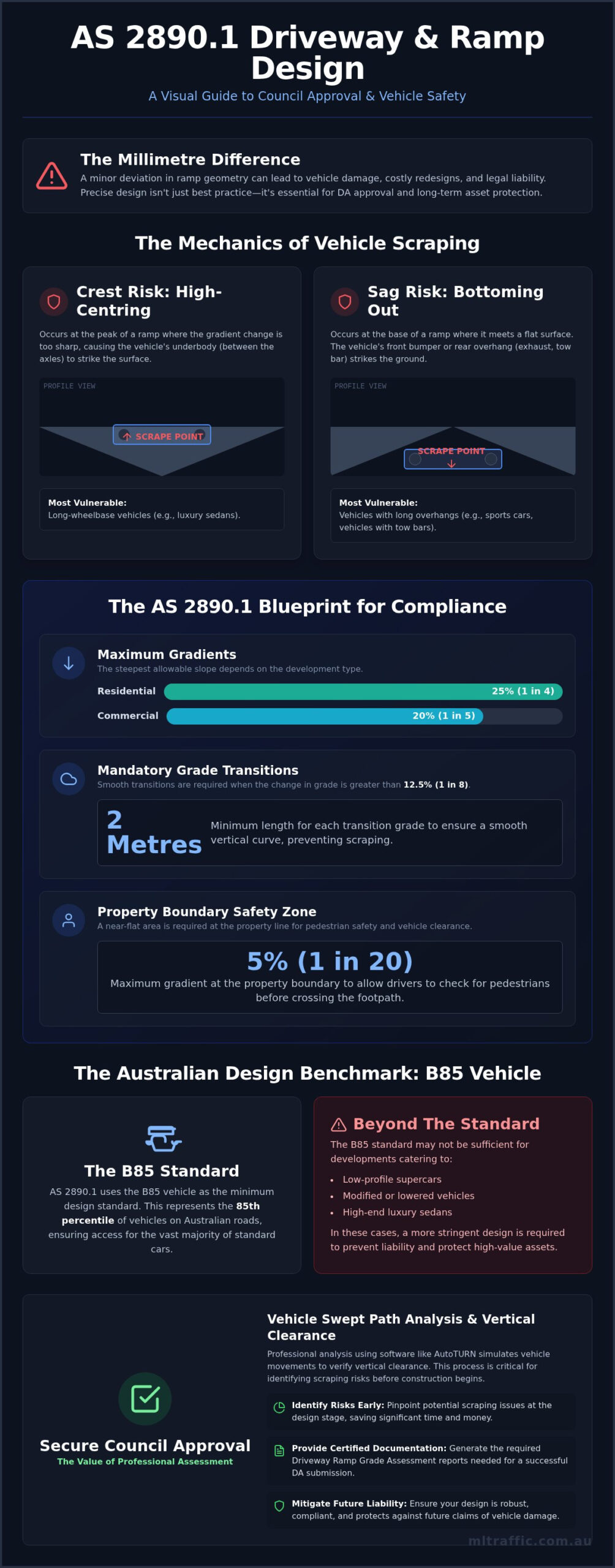
Scraping is a direct result of a geometric conflict between the vehicle’s chassis and the driveway surface. This phenomenon occurs at transition points where the gradient changes abruptly. When designing driveway and ramp gradients for low clearance vehicles, engineers must focus on two critical areas: the crest and the sag. A crest is the peak where a ramp meets a level surface or a different grade. If this transition is too sharp, the vehicle’s underbody between the front and rear wheels will strike the pavement, a situation often called high-centring.
The sag occurs at the bottom of the ramp. Here, the risk shifts from the underbody to the vehicle’s overhangs. As the car levels out, the front bumper or the rear exhaust and tow bar can strike the ground. The length of the vehicle’s wheelbase plays a decisive role here. Longer vehicles are significantly more vulnerable at crests because the distance between the axles allows the centre of the chassis to hang lower relative to the peak of the grade. Small, low-slung sports cars and long-wheelbase luxury sedans represent the highest risk categories for these design failures.
When repeated scraping leads to irreparable damage, owners may need to consider disposal options; for those in the Melbourne region, Melbourne Car Removal provides professional vehicle removal and competitive valuations for all car types.
To better understand this concept, watch this helpful video:
Understanding the Breakover Angle
The breakover angle is the maximum supplementary angle a vehicle can drive over without the apex of the angle touching any part of the vehicle’s underbody. Low ground clearance directly reduces this allowable angle. For developers, this means that steep ramp designs without adequate transitions will inevitably lead to property damage. Sports cars with long wheelbases are the worst-case scenario; they require much shallower gradients and longer transition zones to clear the same crest that an SUV would navigate easily.
The B85 Vehicle Standard: The Australian Benchmark
Australian Standards, specifically AS 2890.1, utilise the B85 vehicle as the design benchmark. This model represents the 85th percentile of vehicles on Australian roads, ensuring that the majority of standard cars can safely access a site. While designing for the B85 vehicle is the minimum requirement for Council compliance, it has limitations. In high-end residential or luxury developments, the B85 standard may not protect low-profile supercars or performance vehicles enhanced by specialists like Oztrack Performance Tuning & Engines. In these specialised cases, driveway and ramp gradients for low clearance vehicles must be designed to a more stringent internal standard to prevent future litigation from residents or tenants.
AS 2890.1 Standards: Maximum Gradients and Transition Requirements
The AS 2890.1 standard dictates the legal framework for vehicle access across Australia. Compliance requires strict adherence to gradient limits that vary based on the intended land use. For domestic driveways, the maximum allowable gradient is 1 in 4 (25%). Commercial developments are restricted further, typically to 1 in 5 (20%), to accommodate a broader range of vehicle types and higher traffic volumes. These limits are not suggestions; they are safety thresholds designed to prevent vehicles from losing traction or sustaining damage.
A critical requirement is the 1 in 20 (5%) rule at the property boundary. This shallow grade must be maintained for the first section of the driveway. It ensures that drivers have a level platform to stop and check for pedestrians before crossing the footpath. It also prevents the vehicle from bottoming out as it transitions from the public road to the private ramp. Failing to implement this flat section is a primary cause for Council DA rejections. Relying on Geometric Design Strategies that incorporate these transitions is essential for any project involving driveway and ramp gradients for low clearance vehicles.
Transition grades are mandatory whenever the change in slope exceeds 12.5% (1 in 8). These transitions act as a buffer, preventing the abrupt changes in pitch that lead to underbody scraping. Without these intermediate slopes, even a vehicle with standard ground clearance may strike the pavement at the crest or sag of a ramp.
The 2.0 Metre Transition Rule
The 2-metre transition zone is a non-negotiable safety feature for steep ramps. When a driveway moves from a 1 in 20 boundary grade to a 1 in 4 main ramp, an intermediate section is required. This section must be at least 2 metres long. The gradient for this transition is calculated as the average of the two connecting slopes. For instance, transitioning from 5% to 25% requires a 2-metre segment at 15%. This softens the crest and provides the necessary clearance for the vehicle’s chassis to pass without contact.
Gradient Limits by Development Type
Residential standards allow for steeper grades due to the predictable nature of the vehicles using them. However, public access ramps and commercial loading docks require more conservative slopes to ensure heavy vehicle clearance and safety for diverse users. For a deeper look at broader compliance, see our guide on AS 2890.1 Explained: The Ultimate Guide to Compliant Car Park Design. A professional Driveway Ramp Grade Assessment provides the certified documentation needed to prove these calculations meet the 85th percentile vehicle requirements.
Designing for Low Clearance: Beyond the Minimum Compliance
A driveway that meets the bare minimum of AS 2890.1 does not guarantee safe passage for every vehicle. While the B85 design vehicle covers the vast majority of standard commuters, it often fails to account for the specific geometry of performance cars or modified commuters. Designing driveway and ramp gradients for low clearance vehicles requires a shift from compliance-only thinking to risk-based engineering. In multi-level car parks, “hot spots” frequently emerge at the junction of a helical ramp and a flat parking deck. These areas combine vertical changes with horizontal curves, creating complex compound angles that can trap unsuspecting drivers.
Cross-fall gradients, or the side-to-side slope of a driveway, are often overlooked in basic assessments. These lateral slopes are necessary for drainage but can compromise vehicle stability on steep inclines. If a ramp has a significant cross-fall, one side of the vehicle sits lower than the other. This effectively reduces the ground clearance on the downhill side, increasing the risk of the chassis striking the pavement even if the longitudinal gradient is technically compliant. Precision is paramount. As highlighted by Site Wiz Surveys, accurate construction layout is essential to avoid rework on complex civil projects. A case study from a recent Sydney residential project showed that a mere 1% construction error in the ramp’s final pour resulted in 100% non-compliance. The resulting underbody damage to residents’ vehicles led to a complete and expensive reconstruction of the entry ramp.
Lowered Vehicles and Aftermarket Modifications
Modern automotive design prioritises aerodynamics, leading to lower factory clearances than the models available when the original B85 standards were drafted. Aftermarket suspension modifications further invalidate these standard assumptions. For high-end residential developments where sports cars are common, we recommend designing for a B99 vehicle profile. This larger, lower design template ensures that even the most demanding vehicle geometry can navigate the site without incident. It is a proactive strategy to prevent future litigation and maintain the asset’s value.
Maintaining the mechanical health of these specialised vehicles is just as important as the driveway design itself. For owners and fleet managers, velocetuning.com.au offers expert log book servicing to ensure that low-clearance and performance cars remain in peak condition despite the challenges of urban access.
The Impact of Speed and Dynamic Clearance
Static clearance is only part of the equation. As a vehicle moves down a ramp, the suspension compresses under braking or when hitting a sag gradient. This dynamic clearance loss means a car that clears a ramp at a crawl might scrape if driven at a standard speed. Entry speed directly influences how much a vehicle’s nose dives at the bottom of a slope. Using textured surfaces for better grip is important, but if the texture is too aggressive, it can further reduce the margin of error for low-slung front splitters. Our Driveway Ramp Grade Assessment services account for these dynamic factors to ensure a truly safe design.
Mitigating Risk: Swept Path Analysis and Geometric Design Strategies
Verification is the final pillar of a compliant design. While manual calculations provide a baseline, advanced driveway and ramp gradients for low clearance vehicles are best validated through digital simulation. We utilise AutoTURN software to model the interaction between the vehicle chassis and the proposed pavement surface. This process moves beyond static numbers; it allows us to visualise how a vehicle navigates the entire length of a ramp. By generating detailed longitudinal sections, we can map the clearance at every centimetre of the journey, identifying potential failure points long before any concrete is poured.
Geometric strategies offer creative solutions when site constraints make standard gradients difficult to achieve. For example, curving a ramp can effectively increase the travel distance between two vertical points. This reduces the effective gradient and allows for longer, more gradual transition zones. It is a sophisticated method of “stretching” the geometry to accommodate vehicles that would otherwise scrape on a straight, steep ascent. These strategies must be meticulously documented in a professional Driveway Ramp Grade Assessment to satisfy Council requirements.
Vertical Swept Path Analysis
Most developers are familiar with horizontal swept paths to check turning circles, but vertical analysis is equally critical for site access. This specialised assessment simulates the vertical movement of the B85 vehicle, or a custom low-clearance profile, over the ramp’s crests and sags. 3D modelling identifies specific underbody clash points where the exhaust, bumpers, or chassis might hit the ground. For a broader understanding of how these simulations work, see our Swept Path Analysis: A Complete Guide for Australian Developments. This level of detail is often the deciding factor in securing DA approval for challenging sites.
Remedial Strategies for Existing Steep Driveways
When an existing driveway is found to be non-compliant, several remedial options are available. Re-profiling a crest involves grinding down the concrete to soften the angle, though this is limited by the thickness of the slab and the presence of reinforcement. In some instances, adding a modular ramp extension or a specialised “wedge” at the sag can improve the approach angle. However, these modifications must be carefully engineered. Any remedial work requires a new round of professional certification to ensure the revised geometry meets AS 2890.1 standards and does not create new hazards for pedestrians or other vehicles.
If you are facing a Council rejection or need to verify a complex ramp design, contact our senior principals today for a certified Driveway Ramp Grade Assessment.
Securing Council Approval: The Value of a Professional Assessment
Council approval for any medium to high-density development hinges on technical proof of access. A set of architectural drawings is rarely sufficient on its own. Local authorities require a certified Driveway Ramp Grade Assessment to ensure that the proposed driveway and ramp gradients for low clearance vehicles are not only theoretically possible but practically safe. This certification shifts the liability from the Council to the qualified engineer. It provides a layer of assurance that the built environment won’t result in damaged property or blocked access once the project is finalised.
A professional report is a comprehensive technical document. It includes detailed longitudinal sections that map the vehicle’s path from the road crown to the parking bay. These reports contain several essential components:
- Detailed gradient calculations for every segment of the ramp and transition.
- Scaled sections demonstrating chassis clearance at critical crest and sag points.
- Specific compliance statements referencing the relevant clauses of AS 2890.1.
- Vertical swept path diagrams that simulate the movement of the B85 design vehicle.
Engaging a specialist traffic engineer prevents the common pitfall of Request for Further Information (RFI) delays. When a Council planner identifies a potential scraping risk, they’ll halt the DA process until an expert assessment is provided. By submitting a certified report at the initial lodgement, you bypass these bureaucratic hurdles. You keep your project timeline on track and avoid the frustration of back-and-forth correspondence with planning departments.
The Assessment Process: From Plan to Certification
The assessment begins with a rigorous review of your architectural site plans and existing ground levels. We verify every slope against the benchmarks set in AS 2890.1:2004, while also accounting for more recent regulatory updates and local Council variations relevant in 2026. This verification ensures that your design accommodates the B85 vehicle as the minimum baseline. Once the geometry is confirmed as compliant, we issue a formal Traffic Engineering certificate. This document acts as the definitive proof of access safety for your submission.
Engaging an Expert Traffic Consultant
Engagement with an expert consultant should occur during the schematic design phase. Early involvement allows for minor adjustments to floor-to-floor heights or ramp lengths before the building’s structural footprint is locked in. This proactive approach saves thousands of dollars in potential construction costs or redesign fees. Our principal-led approach ensures that a senior expert with over 15 years of experience oversees your assessment, providing direct accountability and meticulous attention to detail. Contact the team at ML Traffic Engineers Australia for a project-specific assessment and secure your DA approval with confidence.
Ensure DA Success Through Geometric Precision
Designing compliant access requires a meticulous approach to vertical alignment. Meeting the baseline percentages of AS 2890.1 is only the starting point. Protecting the modern vehicle fleet demands specific attention to transition lengths and breakover angles. You’ve seen how even a minor 1% deviation in a final pour can lead to significant underbody damage and legal liability. By prioritising precise driveway and ramp gradients for low clearance vehicles during the design phase, you eliminate the risk of Council RFIs and expensive post-construction remediation.
ML Traffic Engineers brings over 15 years of experience in Australian traffic engineering to your project. We are specialists in AS 2890.1 and swept path compliance, ensuring every report is technically robust and ready for immediate submission. Every DA report benefits from direct Senior Principal involvement, providing the authoritative oversight needed for complex residential and commercial sites. This hands-on approach ensures your project meets regulatory benchmarks while maintaining practical vehicle safety.
Request a Professional Driveway Ramp Grade Assessment today to secure your development’s access. We look forward to helping you achieve a seamless, compliant design that protects your assets and your residents.
Frequently Asked Questions
What is the maximum driveway gradient allowed in Australia?
The maximum gradient for a residential driveway is typically 1 in 4 (25%), while commercial or industrial ramps are restricted to 1 in 5 (20%). However, these limits are subject to specific Council requirements and the 1 in 20 (5%) boundary rule. This shallower grade at the property line ensures safe pedestrian crossing and prevents initial underbody contact as the vehicle transitions from the public road.
How do I stop my car from scraping on my driveway?
Stopping a car from scraping requires softening the abrupt change in slope at the top and bottom of a ramp. Implementing transition zones that are half the gradient of the main ramp provides the necessary clearance for the vehicle’s chassis. For existing issues, re-profiling the concrete or using modular ramp inserts can sometimes improve approach angles, though these must be carefully engineered to maintain compliance.
What are the transition requirements for a steep ramp under AS 2890.1?
AS 2890.1 requires transition segments whenever a change in grade exceeds 12.5% (1 in 8). These segments must be at least 2 metres long and have a gradient that is the average of the two slopes it connects. Correct application of these transitions is the primary method for managing driveway and ramp gradients for low clearance vehicles to avoid chassis damage and high-centring.
Does my driveway need to comply with AS 2890.1 for a private house?
Yes, private residential driveways must comply with AS 2890.1 to secure Development Application (DA) approval. While some homeowners overlook this during renovations, Councils strictly enforce these standards to ensure safe vehicle access and to prevent future liability. A non-compliant driveway can lead to property damage or significant difficulties during the eventual sale of the home if the access is deemed unsafe.
Can a Traffic Engineer certify a driveway that is already built?
A Traffic Engineer can perform an as-built assessment to certify an existing driveway. This involves measuring the actual gradients and transition lengths on-site to verify they meet Australian Standards. If the driveway is found to be non-compliant, the engineer can provide a remedial design plan to rectify the gradients and achieve the necessary certification for Council or insurance purposes.
What happens if my driveway grade is rejected by the local Council?
If a Council rejects your driveway grade, you will likely receive a Request for Further Information (RFI) or a forced redesign. You must then provide a certified Driveway Ramp Grade Assessment that proves the geometry is safe for the B85 design vehicle. Professional intervention at this stage is critical to avoid further delays and ensure the revised plans meet all regulatory benchmarks for approval.
How long should a transition zone be on a 1 in 4 ramp?
A transition zone on a 1 in 4 (25%) ramp must be at least 2 metres long according to AS 2890.1. This 2-metre segment should sit at a gradient of 1 in 8 (12.5%) if it is connecting the steep ramp to a level surface. This specific length is the minimum required to protect the wheelbase of a standard passenger vehicle from striking the pavement at the crest.
Is a 25% gradient too steep for a sports car?
A 25% gradient is often too steep for sports cars with low ground clearance and long wheelbases. While this grade is the maximum allowed for residential use, it is designed for the B85 vehicle standard. Owners of performance vehicles should consider designing driveway and ramp gradients for low clearance vehicles using a more conservative B99 profile to ensure the chassis clears the crest without contact.

Disclaimer
The content on www.mltraffic.com.au, including all technical articles, guides, and resources, is provided for general informational and educational purposes only. It is not intended to constitute professional advice in traffic engineering, transportation planning, development approvals, or any other technical or legal field.
While ML Traffic Engineers makes every reasonable effort to ensure the accuracy, completeness, and timeliness of the information published, we do not provide any warranties or representations (express or implied) regarding its reliability, suitability, or availability for any particular purpose. Any reliance you place on the content is strictly at your own risk.
In no event shall ML Traffic Engineers, its directors, employees, authors, or affiliates be liable for any direct, indirect, incidental, special, consequential, or punitive damages (including, without limitation, loss of profits, data, or business opportunities) arising out of or in connection with the use of, or inability to use, any information provided on this website.
The articles and guides on this site are not a substitute for engaging a qualified, registered professional traffic engineer (such as an NPER or RPEQ engineer) to assess your specific project requirements. For tailored advice, compliance assessments, or traffic engineering services, please contact a competent professional.
This disclaimer may be updated from time to time without notice. By accessing or using this website, you agree to be bound by the most current version of this disclaimer.
