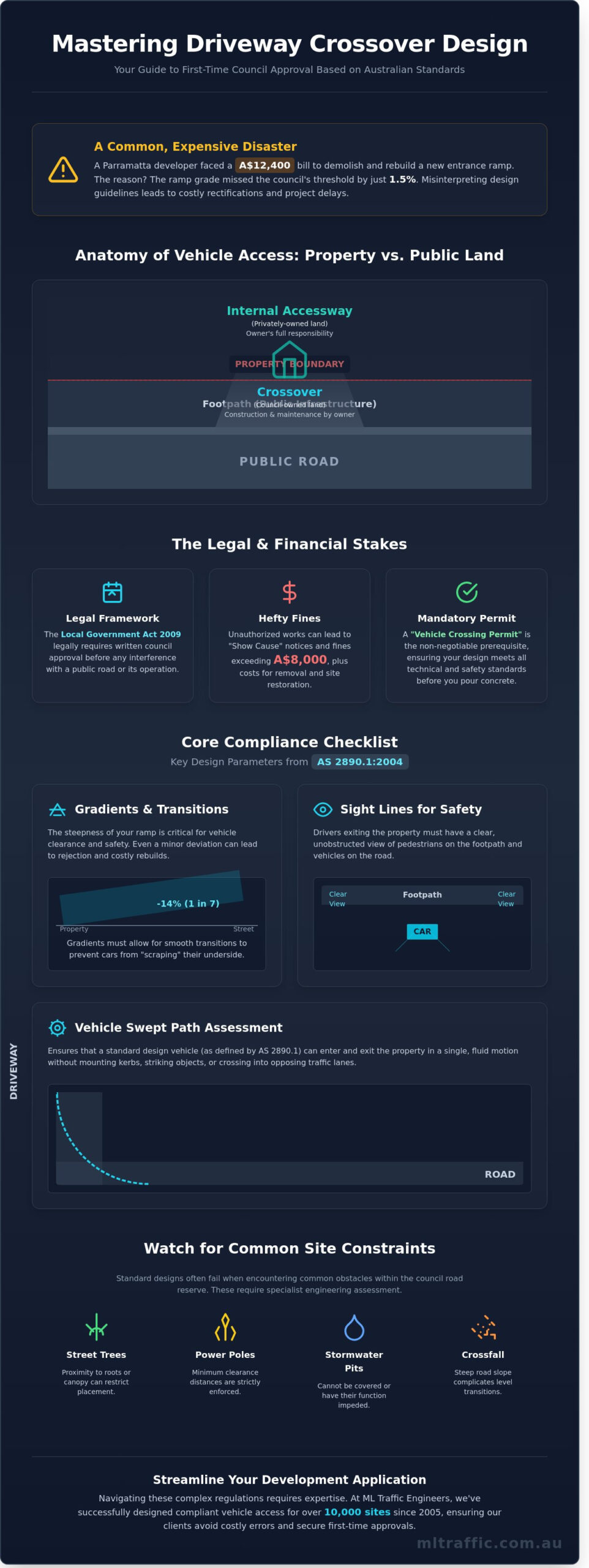
Last Tuesday, a developer in Parramatta faced a A$12,400 bill to demolish and rebuild a brand new entrance because the ramp grade missed the council’s threshold by just 1.5%. It’s a common, expensive disaster that happens when designers misinterpret the driveway crossover design guidelines. You’ve likely felt the headache of trying to reconcile the broad requirements of AS 2890.1 with the hyper-specific, often contradictory demands of your local council. It’s exhausting to risk your project’s timeline on technicalities that seem to change depending on who reviews your application.
I’ll show you how to master the technical requirements and Australian Standards needed to design a compliant driveway crossover that secures council approval the first time. At ML Traffic Engineers, we’ve navigated these regulations for over 10,000 sites since 2005, and we know exactly where the pitfalls lie. This article previews the specific gradients, vehicle swept path assessments, and sight-line requirements you must get right to avoid rejection and ensure safe, functional vehicle access for your property.
Key Takeaways
-
Understand the critical legal distinction between your private driveway and the council-owned crossover to ensure your project remains compliant with public road regulations.
-
Master the technical driveway crossover design guidelines and AS 2890.1:2004 standards required to secure a "first-time" approval from the council traffic department.
-
Identify common site constraints, such as street trees and power poles, that frequently cause standard designs to fail during the rigorous engineering review process.
-
Learn why obtaining your formal construction permit before pouring concrete is the only way to avoid expensive rectifications and potential legal complications with local authorities.
-
Discover how direct access to senior traffic engineers can streamline your development application by providing expert oversight from the initial quote to final approval.
Table of Contents
-
Understanding Driveway Crossovers: The Bridge Between Private Land and Public Roads
-
Key Australian Standards and Design Parameters for Crossover Compliance
-
Why "Standard" Designs Often Fail: Dealing with Engineering Complexities
-
The DA Approval Process: From Design Concept to Construction Permit
Understanding Driveway Crossovers: The Bridge Between Private Land and Public Roads
A driveway crossover isn’t just an extension of your garage floor; it’s the specific portion of your vehicle entry located within the public road reserve. While your driveway sits on your private title, the crossover occupies land owned by the local government. This distinction is critical for any property owner in Brisbane or the Gold Coast. For a foundational Understanding Driveway Crossovers, you must recognize that this infrastructure facilitates the transition from a high-speed public environment to a low-speed private one. It acts as a structural bridge that must support the weight of heavy vehicles while protecting underground utilities.
Councils maintain strict control over this piece of infrastructure because it’s technically public property. They don’t want haphazard construction compromising the integrity of the road edge or the safety of pedestrians. When you follow established driveway crossover design guidelines, you’re ensuring that the transition doesn’t damage the kerb, gutter, or the road surface itself. Poorly designed crossovers can lead to significant liability issues. If a crossover is too steep or lacks proper grip, it becomes a hazard during Queensland’s frequent heavy rain events. We’ve seen cases where improper levels caused local street flooding because the crossover acted as a dam rather than a conduit for stormwater.
Crossover vs. Accessway: Knowing the Difference
The accessway is the internal path on your property used to approach the road. It’s your private responsibility. The crossover starts exactly at your property boundary and extends to the kerb or road edge. It’s easy to confuse the two, but the legal obligations differ significantly. Here’s a brief breakdown of the infrastructure ownership:
-
Internal Accessway: Owned and maintained by the property owner.
-
Crossover: Located on Council land; however, the property owner is responsible for the cost of construction and ongoing maintenance.
-
Kerb and Channel: Council infrastructure that must be professionally modified to accommodate the crossover.
-
Footpath: Public infrastructure that the crossover must safely intersect without creating trip hazards.
In Brisbane and the Gold Coast, the property boundary is the legal line in the sand. Once you cross that line toward the street, you’re on Council turf. This means your driveway crossover design guidelines must prioritize the public’s right of way over your personal aesthetic preferences.
Why Council Approval is Non-Negotiable
Section 75 of the Local Government Act 2009 provides the legal framework for road management in Queensland. It explicitly states that a person must not interfere with a road or its operation without written approval. If you perform unauthorized works, you’re breaking the law. Councils like Brisbane City Council (BCC) or City of Gold Coast (GCCC) can issue "Show Cause" notices. These notices often lead to hefty fines, which can exceed A$8,000 for a single violation in 2024. Beyond the fine, Council can force you to remove the unapproved concrete and restore the site to its original condition at your expense.
A "Vehicle Crossing Permit" is the mandatory prerequisite for any construction. This permit ensures your project meets Australian Standards (AS 2890.1) and local planning codes. It covers technical aspects like sightlines, gradients, and material thickness. Don’t risk the structural integrity of your property or your bank account by skipping this step. Getting it right the first time is the only way to ensure your property remains compliant and accessible for the long term.
Key Australian Standards and Design Parameters for Crossover Compliance
The foundation of all driveway crossover design guidelines in Australia is AS 2890.1:2004. This standard governs off-street car parking and access, providing the technical framework that Brisbane City Council and City of Gold Coast engineers use to evaluate applications. Compliance isn’t optional. It ensures that your property access doesn’t damage public assets or create hazards for road users. At ML Traffic Engineers, we’ve applied these standards to over 10,000 sites across Australia since 2005, ensuring every design meets rigorous safety benchmarks.
Standard width requirements vary significantly based on land use. For a standard residential lot, the crossover width typically ranges between 3.0 and 5.0 metres. Commercial crossovers are much wider, often reaching 6.0 to 9.0 metres to accommodate heavy rigid vehicles (HRVs) or articulated vehicles. You must also include a "splay" or "flaring" at the kerb line. This triangular expansion, usually 1.0 to 1.5 metres wide, accounts for a vehicle’s turning circle. Without a proper splay, tyres will frequently strike and degrade the kerb, leading to costly council rectification orders.
Material specifications are equally strict. Residential crossovers require a minimum of 100mm thick N25 grade concrete reinforced with SL72 mesh. For industrial applications or sites expecting heavy delivery vehicles, 150mm to 200mm of N32 concrete is the standard. Some developers opt for heavy-duty asphalt, though this requires a compacted 150mm fine crushed rock (FCR) base to prevent subsidence under load. Getting these specs wrong leads to structural failure within the first 24 months of use.
Sight Lines and Pedestrian Safety Zone
Safety is the primary driver of crossover regulation. Drivers exiting a property must have a clear view of the footpath and oncoming traffic. We define this using sight triangles, typically measuring 2.0 metres by 2.5 metres. Within these zones, obstructions are prohibited. Fences must be lower than 0.9 metres, and vegetation must be kept clear. According to Texas A&M driveway design research, optimizing these geometric sight lines can reduce driveway-related pedestrian accidents by as much as 30%. Letterboxes and signage are common culprits for non-compliance that we identify during our initial site audits.
Ramp Grades and Transition Zones
Steep sites present the greatest engineering challenge in South East Queensland. To prevent vehicles from "bottoming out" or scraping their undercarriage, we adhere to strict gradient limits. The maximum allowable grade for a private driveway is generally 1 in 4 (25%), but the crossover on public land must be much flatter, often 1 in 20 (5%). We use transition sections, such as a 1 in 8 or 1 in 10 slope for at least 2.0 metres, to smooth the change in angle. If your site is particularly challenging, we provide specialized driveway ramp grade assessments to ensure your design is functional. It’s often better to consult an expert early to avoid expensive redesigns during the construction phase. Our senior engineers, Michael Lee and Benny Chen, personally review these assessments to guarantee accuracy and compliance with AS 2890.1.
Why "Standard" Designs Often Fail: Dealing with Engineering Complexities
Most property owners assume that following a Council standard drawing ensures an automatic approval. It doesn’t. Standard templates assume a flat, clear, and perfectly straight road frontage. Real Brisbane and Gold Coast streets are rarely that simple. When you apply for a permit, you aren’t just building a slab of concrete; you’re modifying public infrastructure. This is why driveway crossover design guidelines focus heavily on what exists outside your property boundary.
You’ll often find a mature street tree or a power pole exactly where you want your entry. Brisbane City Council prioritizes tree canopy retention above almost all other minor works. Removing a healthy street tree can cost you thousands in "amenity value" offsets and replacement fees. Similarly, Energex and Ergon require specific clearances from power poles, usually between 1.0 and 1.5 meters, to ensure maintenance crews can access the equipment safely. If your design encroaches on these zones, your application will be rejected immediately.
On-street parking is another major hurdle. Every new crossover removes a portion of the kerbside where the public can park. In high-density suburbs like West End or Southport, Council is reluctant to trade public parking for private access. If your proposed crossover is wider than the standard 3.6 meters or if you’re requesting a second entry point, you must prove that the loss of a 6-meter parking space won’t negatively impact the neighborhood. We’ve seen many "standard" designs fail because the designer didn’t account for the local parking demand or the specific road hierarchy.
Safety at intersections is non-negotiable. If your property is on a corner, your driveway crossover design guidelines must strictly adhere to sight distance requirements. Generally, crossovers shouldn’t be located within 6 to 10 meters of an intersection tangent point. This ensures that drivers exiting your property have a clear view of oncoming traffic and that turning vehicles don’t collide with cars entering your driveway. Non-linear road frontages, such as those on sharp curves or cul-de-sacs, require custom engineering to ensure the driveway is perpendicular to the kerb tangent, preventing vehicles from "bottoming out" as they transition from the road.
The Role of Swept Path Analysis
We use AutoTURN software to run digital simulations of vehicle movements for every complex site. This isn’t just for your family car. If you’re developing a multi-unit site or a commercial property, Council requires proof that an 8.8-meter medium rigid vehicle or a waste truck can enter and exit in a forward gear. A professional Vehicle Swept Path Assessment ensures your layout works before you pour concrete, preventing costly post-construction modifications.
Managing Drainage and Utility Services
Infrastructure hidden underground often dictates your crossover location. We always start with a Dial Before You Dig (DBYD) search to identify Telstra, Optus, or Unitywater assets. Relocating a single telecommunications pit can cost between A$3,000 and A$15,000 depending on the complexity of the wiring. If your street uses open swale drains instead of traditional kerb and channel, you’ll need a reinforced concrete culvert pipe. This pipe must be sized by an engineer to handle specific 1-in-10-year storm events without flooding the road or your neighbor’s property.
The DA Approval Process: From Design Concept to Construction Permit
You must obtain formal council approval before a single cubic metre of concrete is poured. Commencing works without a Permit to Work in the Road Reserve is a significant legal risk. In Brisbane and the Gold Coast, unauthorized crossovers can result in fines exceeding A$2,500 and mandatory demolition orders at the owner’s expense. The approval process is technical. It requires a clear understanding of how local government traffic departments evaluate safety and infrastructure longevity.
The typical timeline for a council traffic department referral ranges from 10 to 20 business days. This duration depends on the complexity of the application and the current backlog of the Assessing Officer. For larger developments, such as multi-unit dwellings or commercial hubs, a standard application isn’t enough. You will likely need a Traffic Impact Statement (TIS). This document justifies the access point location based on traffic volume, speed limits, and intersection proximity. Selecting a contractor who can interpret RPEQ-certified technical drawings is vital. If the builder ignores the specified levels, the final crossover won’t pass the mandatory council inspection.
Step 1: The Pre-Design Site Assessment
Success begins with an accurate survey of the road reserve. You must identify all existing kerb conditions and public infrastructure before drafting. Look for Telstra pits, water meters, sewer manholes, and street trees. These assets often have a 1.0 to 1.5-metre clearance requirement. You should also consult the Council Local Planning Scheme (LPS). The LPS sets hard limits on crossover widths. For example, many residential zones limit driveway widths to 3.5 metres at the property boundary to preserve on-street parking and verge landscaping.
Step 2: Engineering Drawings and Documentation
Council engineers require detailed longitudinal sections. These drawings show the driveway profile from the garage floor down to the road centerline. They ensure the design follows driveway crossover design guidelines regarding maximum gradients and transitions. Your documentation must include exact dimensions, RL (Reduced Level) data, and material specifications. For commercial sites or properties with steep terrain, we include a Swept Path diagram. This simulation uses software to prove that a B85 or B99 vehicle can enter and exit the site without scraping the chassis or encroaching on the opposite lane.
Step 3: Council Referral and RFI Management
The assessment process often involves a "Request for Further Information" (RFI). This occurs when the council identifies a potential conflict with driveway crossover design guidelines or safety standards. An RFI stops the statutory clock on your application. Having a qualified traffic engineer respond to these technical queries is the fastest way to resolve disputes. We provide direct evidence and engineering justifications to satisfy council requirements. You can visit our about page to see our 15+ years of experience in managing these specific council negotiations. We ensure the consultant who quotes your job is the one who does the work.
Don’t risk costly delays or reconstruction orders by submitting incomplete designs. Our team ensures your access points meet all regulatory standards for a smooth approval process.
Contact ML Traffic Engineers for expert DA approval support.
Streamlining Your Development with ML Traffic Engineers
Navigating council requirements shouldn’t feel like a gamble. At ML Traffic Engineers, we’ve refined a process that prioritizes direct communication and technical precision. Since 2005, our firm has assisted private developers in securing approvals by ensuring every plan adheres strictly to the driveway crossover design guidelines. You won’t find a revolving door of junior staff here. The traffic consultant who provides your initial quote is the same professional who performs the technical assessment and signs off on the final report. This hands-on approach eliminates the communication gaps that often lead to costly delays in the development application process.
Our senior engineers, Michael Lee and Benny Chen, personally handle every project that comes through our doors. With between 30 and 40 years of experience each, they bring a level of expertise that junior-heavy firms simply cannot match. We focus our energy on private clients and their specific development applications, whether you’re building a multi-unit residential complex or a commercial warehouse. If you want to explore the technical depth of our previous work or understand the evolution of traffic standards, we invite you to view our older articles for a more comprehensive look at our engineering history.
We’ve successfully completed assessments for over 10,000 sites across Australia. This massive data set allows us to anticipate council objections before they happen. We understand the nuances of how different local governments interpret the driveway crossover design guidelines, which allows us to tailor our reports to meet specific local expectations. We don’t just provide drawings; we provide a clear path to approval based on decades of practical application and thousands of successful outcomes.
Professional Certification and Peace of Mind
Securing an RPEQ (Registered Professional Engineer of Queensland) certification for your DA report is a non-negotiable step for most developments. Our registered engineers ensure that every design is compliant with AS 2890.1 and specific local council requirements. This professional oversight reduces the risk of long-term maintenance issues, such as scraping or poor drainage, which often result from substandard designs. By getting the geometry right the first time, you avoid the A$5,000 to A$15,000 costs associated with retrofitting or rebuilding non-compliant crossovers after construction has already begun.
Contact Us for a Project Quote
Every site presents unique challenges, from steep gradients to restricted sight lines. We encourage you to reach out for a direct consultation to discuss the specifics of your property. Our team provides clear, fixed-fee quotes so you can budget your development with confidence. With a track record of over 10,000 sites, we have likely solved a problem similar to yours already. Visit our contact page today to submit your site details and speak directly with Michael or Benny about your project requirements.
Secure Your Council Approval with Compliant Engineering
Navigating the path to DA approval requires more than just following a basic template. Successful projects depend on strict adherence to AS 2890.1 and a deep understanding of how local council requirements intersect with site specific constraints. We’ve seen how "standard" designs often fail when they don’t account for complex gradients or sight-line requirements. At ML Traffic Engineers, we bring 15 years of specialized experience to your project. We’ve successfully assessed over 10,000 sites across Australia, ensuring every design meets the necessary driveway crossover design guidelines for a smooth approval process.
You shouldn’t have to deal with mid-level gatekeepers or junior staff who don’t understand the nuances of your development. Our firm operates on a simple principle: the traffic consultant who provides your quote is the one who does the work. You’ll have direct access to our senior traffic engineering principals throughout the entire process. This accountability ensures your project stays on track and meets every technical benchmark required by authorities. It’s time to move your development from the drawing board to the construction phase with confidence.
Get a Professional Traffic Engineering Quote for Your Crossover Design
We’re ready to help you clear the final hurdle in your application process.
Frequently Asked Questions
Can I build a second driveway crossover for my property?
You’re generally limited to one crossover per property for standard residential lots with less than 20 metres of frontage. Brisbane and Gold Coast councils prioritize street parking and pedestrian safety, so they rarely approve a second access point. If your lot is a corner site or has a frontage exceeding 20 metres, we can help you apply for a second crossing by providing a Traffic Impact Statement to justify the necessity.
How wide can a residential driveway crossover be in Australia?
Standard residential crossovers typically range from 3.0 metres to 5.0 metres wide at the property boundary. These dimensions ensure compliance with driveway crossover design guidelines and accommodate a B85 vehicle swept path. While 5.4 metres is often the maximum allowable width for a double garage, any design exceeding these limits requires a specific RPEQ certified assessment to prove it won’t compromise street drainage or safety.
Who is responsible for the cost of constructing a crossover?
The property owner is responsible for 100% of the costs associated with the design, construction, and ongoing maintenance of the crossover. You’ll need to budget for council application fees, which typically range from A$400 to A$750 in South East Queensland. If the construction requires relocating a telecommunications pit or a water meter, these utility costs are also your responsibility and can add A$2,000 or more to your total budget.
What happens if my driveway crossover doesn’t meet AS 2890.1 standards?
Council will refuse your operational works permit or demand a complete rebuild if your crossing fails to meet AS 2890.1 standards. Non-compliance often involves incorrect driveway ramp grades that cause vehicles to scrape or bottom out. We’ve seen homeowners forced to pay upwards of A$5,000 to demolish and replace non-compliant concrete because they didn’t follow the driveway crossover design guidelines during the initial pour.
Do I need a traffic management plan for crossover construction?
You must have a Traffic Guidance Scheme (TGS) if your construction work encroaches on the road or a public footpath. This is a mandatory safety requirement under the Queensland Guide to Temporary Traffic Management. Failing to have a certified plan on-site can result in immediate work stoppages and fines starting at A$1,500 from local council inspectors or Workplace Health and Safety officers.
How far should a crossover be from a street tree or power pole?
You’re required to maintain a minimum clearance of 1.0 metre from power poles and 2.0 metres from existing street trees. If the tree is a significant species or has a trunk diameter exceeding 150mm, the Gold Coast City Council often mandates a 3.0-metre offset to protect the root system. If you can’t meet these clearances, you’ll likely need an arborist report or written permission from the utility provider before approval.
Can I use gravel or pavers for my crossover instead of concrete?
Councils in Brisbane and the Gold Coast generally prohibit gravel crossovers because loose stones wash into the 100-year-old stormwater infrastructure. You’re usually required to use reinforced concrete or asphalt. If you prefer pavers, they must be laid on a reinforced concrete base to ensure the structure can support a 3.0-tonne axle load. Using unbonded pavers will lead to shifting and surface failure under the weight of standard SUVs.
How long does it take to get council approval for a new vehicle crossing?
A standard self-assessable application usually takes between 10 and 15 business days for approval. If your property has steep terrain or requires a "Referral Agency Assessment," the process can extend to 35 days or longer. We recommend submitting a professional site plan on day one to avoid the back-and-forth requests for information that often delay projects by several weeks.
Which areas do you cover?
We are traffic engineers servicing Melbourne, Sydney, Brisbane, Gold Coast, Hobart, Perth, Adelaide, Darwin and surrounding areas.
