
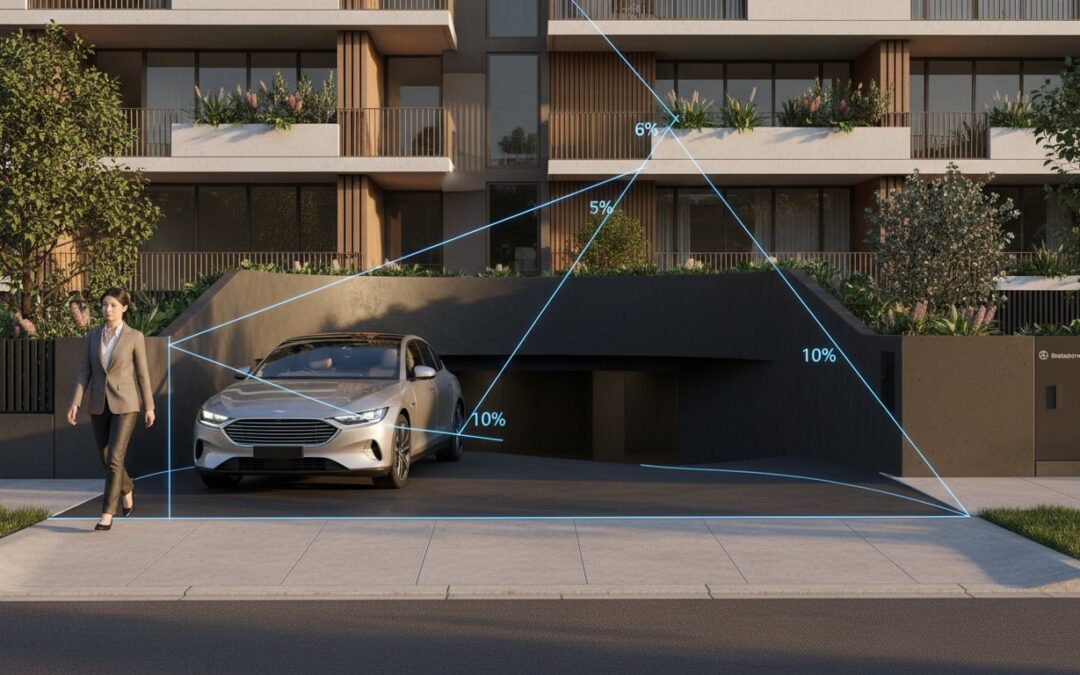
Imagine receiving a Council Request for Further Information (RFI) that halts your development for six weeks just because a driveway ramp grade is 1% too steep. It is a common setback that costs Australian developers thousands in holding costs and unnecessary redesign fees. You likely already know that a driveway is more than just a path for cars; it is a complex piece of engineering that must satisfy strict Australian Standards. We have seen these issues across more than 10,000 sites since 2005, and the solution always starts with technical precision rather than guesswork.
This guide will help you master the specific requirements for design for curves and straights, transitions, pedestrian visibility at the property boundary to secure your DA approval without the typical back and forth. You will learn how to prevent vehicles from scraping on steep transitions and how to meet the exact sightline requirements of AS 2890.1. We are going to break down the geometric transitions and visibility assessments you need to ensure your project moves straight from the drawing board to construction.
Key Takeaways
- Understand why council planners treat driveway geometry as a non-negotiable safety element in any successful Traffic Impact Assessment.
- Learn how to manage maximum driveway slopes and calculate effective grades to meet strict Australian standards for domestic and commercial access.
- Prevent costly vehicle damage by implementing precise summit and sag curve transitions that eliminate scraping risks at grade changes.
- Secure your development’s compliance by mastering the technical nuances of design for curves and straights, transitions, pedestrian visibility at the property boundary as required by AS 2890.1.
- Discover how expert traffic engineering input bridges the gap between complex geometric design and council’s safety expectations to streamline your DA approval.
Why Driveway Geometry and Property Boundary Design Determine DA Success
The point where your private property meets the public road network isn’t just a patch of concrete; it’s a critical safety zone. A driveway serves as the primary interface for vehicle movement, and council planners treat this area with extreme scrutiny. They view driveway safety as a non-negotiable component of a Traffic Impact Assessment. If your plans don’t align with the primary governing standard, AS 2890.1, you risk the heavy financial burden of a rejected Development Application (DA).
To better understand how these design elements impact safety, watch this helpful video:
Ignoring geometric standards leads to costly redesigns and construction delays that can blow out a project’s budget by thousands of dollars. Proper design for curves and straights, transitions, pedestrian visibility at the property boundary ensures that vehicles can enter and exit without endangering the public. At ML Traffic Engineers Pty Ltd, we’ve seen how a single oversight in ramp grades can halt a multi-million dollar development. Compliance isn’t just a suggestion; it’s the difference between a project that moves forward and one that gets stuck in bureaucracy.
The Role of the Traffic Engineer in Design
Standard architectural plans often focus on aesthetics and internal floor space, frequently failing technical traffic scrutiny. Professional traffic engineering identifies these friction points before they reach the council desk. At ML Traffic Engineers Pty Ltd, the consultant who provides your quote is the one who does the work. This hands-on approach ensures that technical details aren’t lost in translation. Early-stage intervention allows us to adjust levels and site access points, saving you from the headache of a “Request for Further Information” (RFI). We’ve seen projects delayed by 6 months because a driveway was just 2% too steep.
Common Council Objections to Site Access
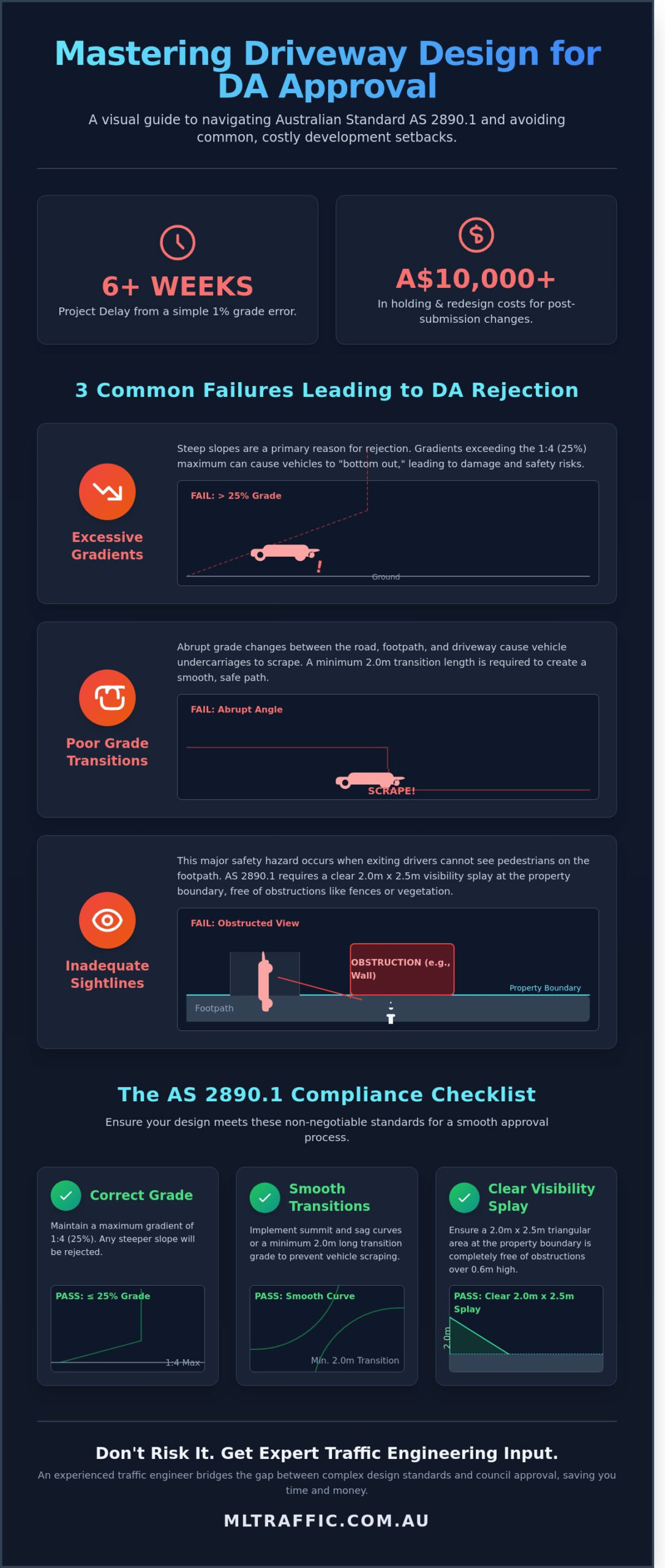
Most objections stem from three primary failures that lead to safety hazards or structural damage. When your design for curves and straights, transitions, pedestrian visibility at the property boundary is flawed, the council will likely issue an objection based on the following:
- Inadequate sight distance: This is a major safety concern where drivers exiting the property can’t see pedestrians or oncoming traffic within the required 2.0m by 2.5m clear visibility splay.
- Excessive gradients: Steep slopes exceeding the 1:4 (25%) maximum limit often lead to vehicles bottoming out, especially for low-clearance cars.
- Poorly planned transitions: Abrupt changes between the road and the driveway disrupt vehicle flow. Without a 2.0m long transition grade, vehicles will likely scrape their undercarriage on the pavement.
By addressing these geometric requirements during the design phase, you protect your investment and ensure a smoother path to council approval. It’s about getting the technicalities right the first time to avoid A$10,000+ costs associated with post-submission redesigns.
Designing for Curves and Straights: Navigating Gradient Standards
Getting your driveway gradient right isn’t just about ease of access; it’s a matter of strict compliance with Australian Standard AS 2890.1. If your design fails these metrics, you risk expensive reconstruction or a rejected Development Application (DA). The standard differentiates between domestic and commercial facilities because the vehicle types and traffic volumes vary significantly. For residential sites, the absolute maximum gradient is 1:4 (25%), but you can’t maintain this steepness across the whole length. You must account for the geometry of the land and how it interacts with the vehicle’s underside.
When we look at the geometry of curves, the “effective grade” becomes a critical factor. On a curved path, the inner edge is always steeper than the outer edge. If you don’t calculate this correctly, a vehicle might meet the 1:4 limit on the centerline but exceed it on the inside radius, leading to loss of traction or scraping. We’ve seen projects where a lack of precision in the design for curves and straights, transitions, pedestrian visibility at the property boundary resulted in vehicles being unable to exit safely in wet weather.
Maximum Driveway Slope Australia: The Numbers You Need
The first 6 metres of your driveway inside the property boundary are the most regulated. AS 2890.1 requires a maximum gradient of 1:20 (5%) for this initial section. This “landing” area ensures cars aren’t entering the public road at an extreme angle, which protects the gutter and improves safety. Beyond this 6-metre mark, you can increase the slope to the 1:4 (25%) absolute maximum for steep residential blocks. However, for commercial or “other” parking facilities, the standard maximum is typically 1:5 (20%) to accommodate a wider variety of vehicle wheelbases. Using a 1:5 ratio for residential builds is often a safer bet if the site allows, as it reduces the risk of low-clearance vehicles bottoming out.
Geometric Alignment: Curves vs. Straights
Curved driveways require a minimum inside radius of 4.0 metres to ensure standard passenger vehicles can navigate the turn without hitting curbs or garden beds. Straights are simpler but require careful placement to provide a flat transition before the vehicle crosses the property line. This is where swept path analysis becomes an essential tool. It maps the exact path a car takes, ensuring the wheels stay on the pavement and the body doesn’t overhang into obstacles. Proper design for curves and straights, transitions, pedestrian visibility at the property boundary prevents blind spots where a driver might not see a person on the footpath until it’s too late. If you’re unsure about your site’s compliance, our traffic engineering services can help verify your plans against council requirements.
The Art of the Transition: Managing Grades to Prevent Vehicle Damage
Abrupt changes in grade are the primary cause of vehicle scraping and undercarriage damage. When a car moves from a steep ramp to a flat garage floor or a level street without a buffer, the chassis or bumpers often strike the pavement. This isn’t just a nuisance; it’s a design failure that can lead to costly repairs and non-compliance with Australian Standards. To prevent this, engineers use “summit” curves for convex peaks and “sag” curves for concave dips.
The mechanics are simple. Transition zones act as a middle step to soften the change. Under AS 2890.1, if a grade change exceeds 12.5% for domestic driveways or 15% for other uses, a transition is mandatory. These zones are typically 2 metres long. The math is straightforward: the transition gradient should be roughly half the change in grade. If you’re moving from a 5% level area to a 25% steep ramp, a 2-metre transition at 15% provides the necessary clearance to keep the vehicle’s body off the ground.
Preventing Scrape and Bottoming Out
Designing a safe driveway requires calculating the break-over angle for specific vehicle classes. We look at B85 vehicles, which represent 85% of cars on Australian roads, and B99 vehicles, which cover large SUVs and vans. A 2-metre transition at the top and bottom of steep slopes ensures these vehicles don’t “high-center” on summits or scrape their front spoilers in sag curves. It’s much cheaper to run driveway ramp grade assessments during the planning phase than to jackhammer concrete later. Meticulous planning ensures that even low-clearance vehicles can navigate the slope without incident.
Transition Zones and Property Boundaries
The property boundary is often the most difficult area to manage. You must balance the private ramp’s steepness with the public footpath’s existing levels. It’s a common mistake to assume you can alter the “cross-fall” of the council footpath to suit your driveway. You can’t. The driveway must adapt to the public infrastructure. Technical requirements usually mandate a “flat” section, often with a 1:20 (5%) grade, at the property line. This specific design for curves and straights, transitions, pedestrian visibility at the property boundary ensures drivers have a clear line of sight to people walking on the path before the vehicle nose emerges. Proper transitions at this junction prevent the car from entering the street at an awkward or dangerous angle.
- Summit curves prevent the vehicle’s floor from scraping the peak.
- Sag curves prevent the front and rear bumpers from hitting the ground.
- 2-metre transitions are the industry standard for most residential and commercial applications.
- Council footpaths must remain at their original cross-fall for pedestrian safety.
Pedestrian Visibility at the Property Boundary: Meeting AS 2890.1 Requirements
Failing to account for pedestrian safety at the property line is a primary reason councils refuse driveway applications. Australian Standard AS 2890.1 is explicit about how a vehicle must interact with the footpath. When you plan the design for curves and straights, transitions, pedestrian visibility at the property boundary, the safety of people walking past your site takes precedence over aesthetic landscaping. A “blind” exit isn’t just a safety hazard; it’s a significant legal liability for the property owner.
Decoding the Sight Triangle
AS 2890.1 Figure 3.3 specifies a mandatory sight triangle at the exit point of every driveway. This zone requires a clear view measuring 2.0 metres along the property boundary and 2.5 metres back into the site, measured from the edge of the driveway. Within this “X” and “Y” area, no obstructions are permitted above a height of 900mm. This includes letterboxes, masonry pillars, dense hedges, or high fences. If your driveway geometry includes sharp curves near the exit, the vehicle might be positioned at an angle that reduces this visibility. We ensure your architectural plans integrate these clear zones early to avoid expensive modifications during the construction phase.
Solving Visibility Issues in Tight Spaces
Limited frontage often makes compliance difficult. In these scenarios, we recommend using splayed fences or replacing solid sections with transparent materials like vertical slats or glass. These allow for the necessary visibility without sacrificing security. While some developers suggest convex mirrors to fix sight line gaps, most Australian councils reject them as a primary solution. Mirrors distort distance and can fail due to weather or vandalism. For a technical breakdown of how to manage these constraints, refer to our Sight Line Assessment guide. We use specific data from over 10,000 successful site assessments to find a compliant path forward.
The design for curves and straights, transitions, pedestrian visibility at the property boundary must be handled with precision. If a driver cannot see a child on a scooter or a person in a wheelchair until the bonnet is already on the footpath, the design is flawed. We provide the technical expertise to ensure your driveway meets AS 2890.1 standards while maintaining the functional needs of your development. Don’t risk a council rejection or a post-construction order to tear down a brand new fence.
Ensure your project meets all Australian visibility standards by booking a professional traffic engineering assessment today.
Securing Approval: How Traffic Engineering Resolves Complex Access Issues
Achieving council approval for a new driveway is rarely a matter of luck. It’s the result of precise geometric alignment and a deep understanding of AS 2890.1. When you submit a Development Application (DA), the council’s traffic department looks for a cohesive design for curves and straights, transitions, pedestrian visibility at the property boundary. If these technical elements aren’t correctly calculated, you risk costly redesigns or outright rejection. ML Traffic Engineers bridges the gap between architectural vision and regulatory compliance by providing data-backed assessments that satisfy even the most stringent council requirements.
We’ve been trading since 2005, giving us a historical perspective on how Australian access standards have evolved. Our approach is simple: the traffic consultant who provides your quote is the one who does the work. This direct accountability ensures that the technical nuances of your Car Park Design are handled by an expert, not a junior staff member. With over 10,000 sites assessed across Australia, we know exactly what local authorities expect in a Traffic Impact Statement.
The ML Traffic Advantage
Working with our team means you get direct access to senior engineers, including Michael Lee and Benny Chen. We bring over 15 years of experience to every project, focusing on practical outcomes that save you money. We don’t just identify problems; we solve them. Whether it’s a tight inner-city lot or a sprawling industrial warehouse, we ensure your design for curves and straights, transitions, pedestrian visibility at the property boundary meets safety benchmarks while maximizing your site’s potential.
- Direct Accountability: You speak directly to the principals, Michael Lee and Benny Chen. No gatekeepers or junior intermediaries.
- Proven Volume: Over 10,000 sites assessed since 2005 across every land-use type imaginable.
- Technical Precision: Full adherence to AS 2890.1 standards to ensure your driveway ramp grades and sight-lines are compliant from day one.
Next Steps for Your Project
Before you submit your DA, run through this final checklist to avoid delays. Ensure you have a Vehicle Swept Path Assessment for your largest expected vehicle. Check that your driveway ramp grades don’t exceed the 1:4 maximum for domestic use or the specific gradients required for commercial access. If you’re unsure about your site’s compliance, reach out for a confidential discussion about your requirements.
To request a fee proposal, we typically need your preliminary site plan and a description of the proposed land use. We provide clear, fixed-price quotes so you can manage your project budget with certainty. Don’t let a driveway slope error stall your development. Contact our team today to secure your traffic engineering certification and move your project forward.
Streamline Your Development with Expert Access Design
Getting your driveway geometry right isn’t just about aesthetics; it’s the critical factor between a seamless DA approval and a costly redesign. Every millimetre matters when you’re managing complex gradients and ensuring vehicle clearance. You’ve seen how a meticulous design for curves and straights, transitions, pedestrian visibility at the property boundary is essential to meet AS 2890.1 requirements and keep your project moving forward. Neglecting these technical details often leads to rejected applications or expensive onsite rectifications later.
At ML Traffic Engineers, we’ve spent decades refining this process. Our team has successfully assessed over 10,000 sites across Australia, providing developers with the technical certainty they need to satisfy council. When you work with us, you don’t deal with junior staff. You get direct access to our principal engineers who are specialists in AS 2890.1 compliance. We focus on practical solutions that balance site constraints with strict regulatory standards. Let’s make sure your next project is safe, functional, and approved without delay.
Get a Professional Traffic Assessment for Your Project
We look forward to helping you navigate your access challenges and securing a successful outcome for your development.
Frequently Asked Questions
What is the maximum driveway slope allowed in Australia for residential properties?
The maximum driveway slope for residential properties is 1 in 4 (25%) as per AS 2890.1. However, most Australian councils strictly enforce a 1 in 5 (20%) limit for the majority of the ramp. If your land is particularly steep, you’ll need a qualified traffic engineer to design a custom solution that prevents vehicle bottoming out while still meeting local planning codes.
Do I need a transition zone for a driveway that is only slightly steep?
You must include a transition zone if the change in grade between two sections of your driveway exceeds 12.5% or 1 in 8. These transitions prevent the front or rear of your car from scraping the concrete. We typically design these as 2.0 metre segments with a gradient that sits exactly halfway between the two connecting slopes to ensure a smooth, safe passage.
What are the AS 2890.1 requirements for pedestrian visibility at a driveway?
AS 2890.1 mandates a clear sight triangle of 2.0 metres by 2.5 metres to maintain pedestrian visibility at the property boundary. This specific area must remain free of any growth or structures higher than 900mm. Failing to provide this visibility is a major safety risk and is one of the most common reasons councils reject driveway applications during the final inspection phase.
Can I build a fence right up to the property boundary next to my driveway?
You can’t install a standard 1.8m fence right to the boundary if it sits within the pedestrian sight zones. Any fencing within the 2.0m by 2.5m triangle must be kept below 0.9m in height or be at least 50% transparent. This ensures drivers exiting the property can see children or cyclists on the footpath. We recommend checking your specific council’s DCP for any stricter local variations.
How long should the flat section of a driveway be before it hits the street?
A level section of at least 2.0 metres is generally required at the property line before the driveway hits the street. This flat landing ensures the vehicle is horizontal when the driver is checking for pedestrian visibility at the property boundary. Without this flat area, your car’s headlights might point too high or low, and your field of vision will be severely compromised when entering traffic.
What happens if my driveway design doesn’t meet Australian Standards?
If your driveway fails to meet Australian Standards, you risk council orders to demolish and rebuild the entire structure. This can cost anywhere from A$10,000 to over A$40,000 depending on the site complexity. Beyond the financial loss, a non-compliant driveway can void your insurance if an accident occurs. It’s always more cost effective to get the design right before the concrete is poured.
Is a swept path analysis required for a standard residential driveway?
Councils often require a swept path analysis to confirm your design for curves and straights accommodates a standard B85 vehicle. This simulation proves the car can enter and exit in a single continuous movement without mounting curbs or hitting walls. It’s a critical requirement for narrow lots or basement garages where space is tight and the margin for error is less than 300mm.
How do I calculate the gradient of my existing driveway?
Calculate your gradient by dividing the vertical rise by the horizontal run and multiplying by 100 to get a percentage. For example, a 2.0 metre rise over a 10.0 metre distance equals a 20% grade. While you can do this with a tape measure, we use high precision survey equipment to ensure your plans meet the 1% tolerance levels often required for council approval.
Disclaimer
The content on www.mltraffic.com.au, including all technical articles, guides, and resources, is provided for general informational and educational purposes only. It is not intended to constitute professional advice in traffic engineering, transportation planning, development approvals, or any other technical or legal field.
While ML Traffic Engineers makes every reasonable effort to ensure the accuracy, completeness, and timeliness of the information published, we do not provide any warranties or representations (express or implied) regarding its reliability, suitability, or availability for any particular purpose. Any reliance you place on the content is strictly at your own risk.
In no event shall ML Traffic Engineers, its directors, employees, authors, or affiliates be liable for any direct, indirect, incidental, special, consequential, or punitive damages (including, without limitation, loss of profits, data, or business opportunities) arising out of or in connection with the use of, or inability to use, any information provided on this website.
The articles and guides on this site are not a substitute for engaging a qualified, registered professional traffic engineer (such as an NPER or RPEQ engineer) to assess your specific project requirements. For tailored advice, compliance assessments, or traffic engineering services, please contact a competent professional.
This disclaimer may be updated from time to time without notice. By accessing or using this website, you agree to be bound by the most current version of this disclaimer.
