
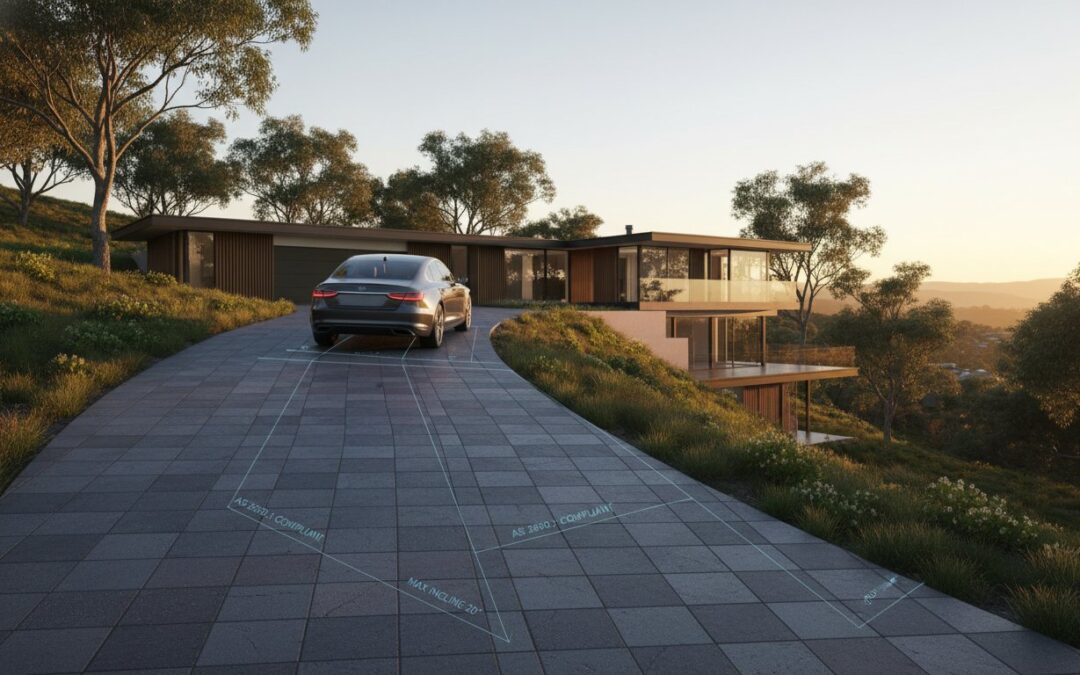
A non-compliant driveway is more than a design flaw; it’s a $20,000 liability that can lead to the immediate rejection of your Development Application. When managing driveway design for steep slopes, the margin for error is non-existent. You likely already know the frustration of a vehicle’s underside scraping on a transition or the anxiety of a car losing traction in wet weather. These aren’t just inconveniences. They’re signs of a design that fails to meet the rigorous engineering requirements of AS/NZS 2890.1:2004.
You want a driveway that passes council inspection the first time and provides safe access for all vehicle types without damage. This article provides the technical clarity you need. We’ll examine the essential engineering principles and Australian Standards required to design a safe, compliant, and scrape-free driveway on steep terrain. You’ll learn about the critical 1 in 4 maximum gradients, the 1 in 20 limit at property lines, and why professional ramp grade assessments are now a non-negotiable requirement for modern property development.
Key Takeaways
- Master the technical requirements of AS/NZS 2890.1:2004 to ensure your project complies with mandatory gradient and sight line standards.
- Determine how to calculate and implement transition zones to eliminate vehicle underside scraping on sharp grade changes.
- Explore advanced engineering solutions for driveway design for steep slopes, including switchback configurations and high-grip surface material selection.
- Understand the critical role of a certified Driveway Ramp Grade Assessment in navigating the Council approval process for complex sites.
- Gain insight into how direct access to senior traffic engineers streamlines your development application and reduces long-term liability risks.
Table of Contents
-
Fundamentals of Driveway Design for Steep Slopes & AS 2890.1 Compliance
-
Managing Gradient Transitions: Preventing Vehicle Underside Scraping
-
Engineering Solutions for Extreme Inclines: Switchbacks and Surfaces
-
The Council Approval Process: Why You Need a Driveway Ramp Grade Assessment
-
Expert Driveway Design and Traffic Engineering with ML Traffic Engineers Australia
Fundamentals of Driveway Design for Steep Slopes & AS 2890.1 Compliance
Engineering driveway design for steep slopes is a precise calculation of vertical rise over horizontal distance. It is not a matter of landscaping or aesthetics. The primary regulatory framework in Australia is AS/NZS 2890.1:2004, including Amendment 1. This standard dictates how gradients must be managed to ensure vehicle safety and accessibility. Understanding the Fundamentals of Driveway Design is the first step in avoiding the $20,000 rectification costs associated with non-compliant construction.
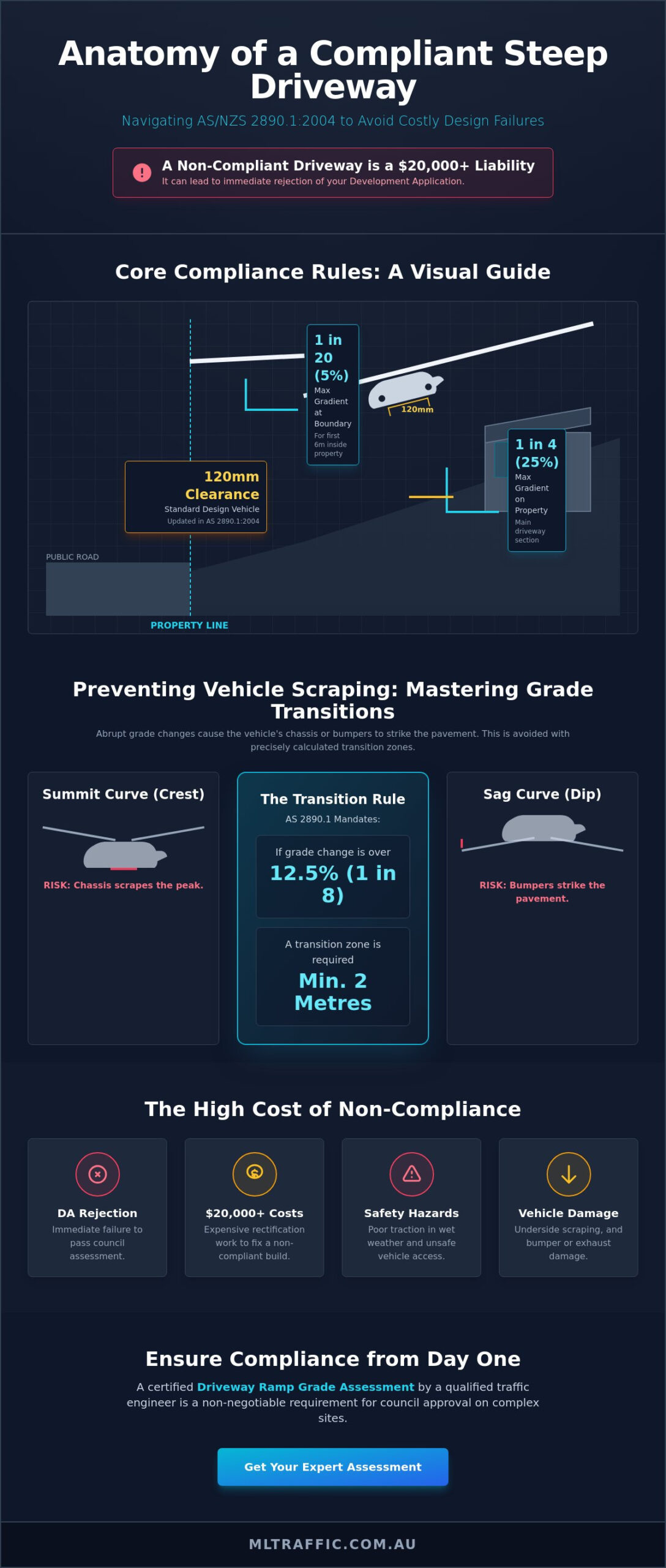
The standard sets a maximum allowable gradient of 1 in 4 (25%) within private property boundaries. This limit is not a blanket rule for the entire length of the driveway. At the property line or where the driveway crosses a footpath, the grade cannot exceed 1 in 20 (5%). This flatter section must extend for the first 6 meters within the property boundary to ensure drivers have clear sight lines. Failure to adhere to these thresholds leads to vehicles bottoming out or losing traction during wet weather. To better understand this concept, watch this helpful video:
Key Terminology in Steep Driveway Engineering
Engineers use specific terms to describe vertical alignment. A ‘Summit’ curve occurs at the top of a hill, while a ‘Sag’ curve happens at the base. Both require transition zones if the change in grade exceeds 1 in 8 (12.5%). AS 2890.1 mandates these transitions be at least 2 meters long. This prevents the vehicle’s chassis from scraping. Ramp grade refers to the ratio of rise to run. Percentage slope is that same value expressed as a percentage. For example, a 1 in 4 grade is a 25% slope. Precise calculations are required to ensure the vehicle swept path remains clear of the road surface.
National Requirements for Residential Access
Local councils use AS 2890.1 to assess Development Applications (DAs). They frequently demand a certified Driveway Ramp Grade Assessment for any site with complex topography. These standards also consider emergency vehicle access. Fire trucks require specific clearance and turning circles that residential cars don’t. Engineers use standard design vehicles with a 120mm ground clearance to test these designs. This 120mm standard was updated from 100mm in the 2004 revision to reflect modern vehicle dimensions. Ensuring your design accommodates this clearance is critical for project approval. Most councils won’t accept a design that hasn’t been verified by a qualified traffic engineer.
Managing Gradient Transitions: Preventing Vehicle Underside Scraping
Vehicle underside scraping is the primary indicator of flawed engineering in driveway design for steep slopes. This issue, often called the ‘break-over’ problem, occurs when the change in gradient is too abrupt for a vehicle’s wheelbase or overhangs. At a summit, the chassis hits the peak. At a sag, the front or rear bumpers strike the pavement. Avoiding this requires precise mathematical modelling of vertical transitions rather than relying on visual estimates.
Implementing transition zones involves using intermediate gradients to soften the entry and exit points of a steep ramp. For example, a direct jump from a 5% road cross-fall to a 25% driveway ramp will cause immediate damage. The Engineering Solutions for Extreme Inclines provided by international transport authorities emphasize that these transitions must be calculated based on the longest wheelbase likely to use the property. If you’re unsure about your site’s vertical alignment, a professional driveway ramp grade assessment can identify these conflicts before construction begins.
Designing Compliant Transition Grades
The 2-metre transition rule is the standard method for softening grade changes. AS 2890.1 mandates that if the change in grade exceeds 1 in 8 (12.5%), a transition section of at least 2 metres must be inserted. This section uses a gradient that is approximately half the difference between the two main grades. For a summit, this prevents the vehicle from ‘high-centering.’ For a sag, it ensures the approach angle doesn’t exceed the vehicle’s clearance. Maintaining AS 2890.1 compliance is impossible without these calculated vertical curves.
Validation through Swept Path and Clearance Analysis
A 2D drawing is insufficient for steep slope approval. It cannot account for the dynamic movement of a vehicle or the exact clearance at every point of the wheelbase. Engineers use specialised software to simulate the ‘B85’ design vehicle, which represents the 85th percentile of the Australian vehicle fleet. This simulation proves that the 120mm ground clearance standard is maintained throughout the entire movement. Most local councils now require these swept path assessments as part of the DA process for any driveway exceeding a 15% grade. It’s the only way to guarantee the design works for all standard vehicle types without risk of liability or property damage.
Engineering Solutions for Extreme Inclines: Switchbacks and Surfaces
Designing a functional driveway design for steep slopes requires more than just following gradient limits. When the natural topography exceeds the 1 in 4 threshold, linear paths become impractical. Engineers implement horizontal curves, or switchbacks, to increase the total travel distance. This extension effectively lowers the vertical percentage grade, making the incline manageable for standard vehicles. These curved layouts introduce new complexities regarding vehicle clearance and turning radii that must be resolved during the design phase.
Material selection is critical for both safety and longevity. In Australia, the cost of a plain concrete driveway on a sloping surface is approximately $75 per square meter as of early 2026. While asphalt is a more affordable alternative at $30 to $60 per square meter, it often lacks the structural rigidity required for high torque loads on extreme inclines. Some competitors suggest gravel for its drainage properties, but gravel fails on steep slopes during heavy braking. The stones displace easily, leading to a loss of traction and surface rutting. A solid, textured surface is the only reliable engineering choice for gradients exceeding 15%.
Selecting the right material is only half the battle; finding a builder who can execute the design is equally important. TradieLink helps Australian homeowners find qualified tradespeople who specialize in the construction of complex, high-gradient driveways.
Layout Strategies for Steep Terrain
A straight path is simpler to construct but often results in gradients that trigger council rejection. A curved approach allows for a more gradual ascent. You must provide flat landing zones, with a grade no steeper than 1 in 20 (5%), at both the top and bottom of the ramp. These areas allow vehicles to pause safely before entering traffic. Incorporating Swept Path Analysis is essential for these curved designs. It ensures that longer vehicles don’t clip the inner curb or cross into opposing lanes during the turn.
Surface Grip and Traction Maintenance
Surface texture directly impacts wet-weather safety. Exposed aggregate finishes, which range from $100 to $150 per square meter, provide the necessary friction for tyres to maintain grip. Drainage must be integrated to prevent the driveway from acting as a stormwater channel. This involves a minimum 1 in 40 cross-fall to direct water toward recessed drainage grates. On long runs, a crushed rock base ($1,500 to $1,800 for 50 square meters) or a poured concrete base ($2,300 to $2,800) is required to prevent subsidence. These technical details ensure the driveway remains safe and compliant throughout its service life.
The Council Approval Process: Why You Need a Driveway Ramp Grade Assessment
Local councils across Australia have significantly tightened their scrutiny of development applications involving difficult terrain. Any driveway design for steep slopes that exceeds a 15% gradient typically triggers an automatic referral to council engineering departments. This scrutiny is intended to prevent long-term liability and safety issues. Without a formal Driveway Ramp Grade Assessment, your application is likely to be met with a Request for Information (RFI). These requests can delay project timelines by 30 to 60 days.
A Driveway Ramp Grade Assessment is a technical report that provides empirical proof that your proposed design complies with AS 2890.1. It bridges the gap between a conceptual architectural drawing and a functional engineering solution. In many cases, this report is integrated into a broader Traffic Impact Assessment, especially for multi-residential or commercial developments. Providing a pre-certified design at the initial submission stage demonstrates professional due diligence and streamlines the approval process.
Documentation Required for Development Applications
Council assessors require specific technical drawings to verify compliance. You must provide longitudinal sections that illustrate the relationship between existing ground levels and the proposed finished surface. Detailed cross-sections at critical transition points, such as the property boundary and the garage entry, are also mandatory. These drawings must clearly demonstrate how the standard ground clearance is maintained across every transition. Certification from a qualified traffic engineer is the final requirement that validates these calculations for the council.
Site-Specific Challenges and Council Variances
Some sites are so constrained that adhering strictly to the ‘Deemed-to-Satisfy’ provisions of AS 2890.1 is impossible. In these instances, councils may allow ‘Performance Solutions.’ These require a more intensive level of Traffic Engineering to prove that the alternative design still provides safe and functional access. A major focus of these assessments is sight distance. On a steep exit, the driver’s eye height must be positioned to see pedestrians on the footpath before the vehicle’s nose emerges. Failure to address these site-specific challenges often leads to permanent access restrictions. If you require a compliant report for your development application, contact ML Traffic Engineers Australia to arrange a certified assessment.
Expert Driveway Design and Traffic Engineering with ML Traffic Engineers Australia
ML Traffic Engineers Australia has been trading since 2005. We focus on private clients who require technical assistance with development applications for complex sites. Our team provides the authoritative expertise required to resolve driveway design for steep slopes across all Australian jurisdictions. We’ve completed assessments for over 10,000 sites, including residential apartments, commercial warehouses, and community facilities. This extensive project history ensures that no access challenge is beyond our professional capability.
Our firm operates on a principle of direct accountability. The traffic consultant who provides your quote is the same senior engineer who performs the technical work. This approach eliminates the bureaucracy found in larger firms and ensures your project benefits from senior-level involvement at every stage. Principals Michael Lee and Benny Chen bring between 30 and 40 years of individual experience to every assessment. We use specialised software, such as AutoTURN, to conduct 3D modelling and clearance verification. This precision ensures your driveway design for steep slopes meets AS 2890.1 requirements and eliminates the risk of vehicle damage.
Our Technical Capabilities
We deliver a comprehensive suite of traffic engineering services designed to secure council approval on the first submission. Our Driveway Ramp Grade Assessments provide the formal certification mandated for steep terrain. We perform Vehicle Swept Path Analysis to verify that B85 vehicles can navigate tight residential and commercial layouts without conflict. Our team also provides full Car Park Design services that are strictly compliant with AS 2890. We understand the specific requirements for various land-use types, from childcare centres and medical clinics to retail developments and places of worship.
Start Your Compliant Design Today
Securing a compliant driveway design begins with a rigorous technical review of your site plans. We provide national service coverage, assisting developers and architects across Australia with their most challenging topography. To receive a rapid quote, provide your existing and proposed ground levels for our initial review. You’ll have direct access to our principals throughout the project lifecycle. Contact our senior engineers today to discuss your steep site requirements. We provide the professional assurance and meticulous documentation needed to move your development application forward without unnecessary RFI delays.
Secure Your Project Approval with Certified Engineering
Achieving a functional driveway design for steep slopes depends on rigorous adherence to AS 2890.1. As established, managing gradient transitions and surface traction isn’t just a safety requirement; it’s a legal one. Non-compliant designs frequently lead to project delays and rectification costs that exceed $20,000. These risks are entirely avoidable with professional oversight. Professional engineering ensures your property remains accessible for all standard vehicle types without the risk of damage or scraping.
ML Traffic Engineers Australia offers the technical precision needed for complex terrains. By leveraging our experience on over 10,000 sites and providing direct access to principals with 30 years of expertise, we ensure your development application is robust and compliant. Don’t leave your property’s accessibility to chance. Get a Compliant Driveway Design Quote from Our Senior Engineers to finalize your design with confidence. Your path to a safe, scrape-free driveway starts with expert engineering.
Frequently Asked Questions
What is the maximum allowable gradient for a residential driveway in Australia?
The maximum allowable gradient for a private driveway within a property boundary is 1 in 4 (25%) according to AS 2890.1. However, this limit does not apply to the entire length. Where the driveway crosses a property line or footpath, the grade must not exceed 1 in 20 (5%) for the first 6 metres. This ensures safe sight lines and prevents vehicles from entering the roadway at a dangerous angle.
How do I stop my car from scraping at the bottom of a steep driveway?
You stop vehicle scraping by implementing a sag transition grade that softens the change between the steep ramp and the flat road. AS 2890.1 requires these transitions to be at least 2 metres long when the change in grade exceeds 12.5%. These sections effectively halve the percentage change at the base, providing the necessary clearance for front and rear bumpers to clear the pavement.
Does AS 2890.1 apply to private residential driveways?
AS 2890.1 is the legally enforceable Australian Standard for all off-street car parking, including private residential driveways. Local councils use this standard as the primary benchmark when assessing Development Applications. Failure to comply with these engineering requirements often leads to the immediate rejection of your application or costly legal liability if a vehicle is damaged on your property.
What is a transition grade and why is it necessary for steep slopes?
A transition grade is an intermediate slope used to link a flat surface to a steep incline. It is a critical component of driveway design for steep slopes because it prevents the vehicle’s chassis or bumpers from striking the ground. Without these 2-metre segments, the abrupt change in angle would cause most modern vehicles with a 120mm ground clearance to ‘bottom out’ at the summit or sag points.
Can I use gravel on a steep driveway, or is concrete required?
Concrete or asphalt is the required standard for steep slopes because gravel lacks the necessary stability under braking and acceleration. On gradients exceeding 15%, loose gravel displaces easily, leading to deep ruts and a total loss of traction during wet weather. A solid surface allows for textured aggregate or broomed finishes that ensure tyres maintain grip on extreme inclines.
What happens if my driveway design doesn’t meet council standards?
If your design fails to meet standards, the council will issue a Request for Information (RFI) or reject your Development Application entirely. This causes significant project delays. If a non-compliant driveway is actually constructed, the property owner faces rectification costs that often exceed $20,000. Professional certification from a traffic engineer is the only way to avoid these financial risks during the planning phase.
How much does a professional driveway ramp grade assessment cost?
The cost of a professional assessment depends on the complexity of the site and the number of transition points required. While fees are project-specific, obtaining a certified report is a minor investment compared to the $20,000 cost of removing and replacing a non-compliant concrete driveway. Most councils now mandate this technical report as a standard requirement for any site with significant elevation changes.
Do I need a traffic engineer for a single residential dwelling on a slope?
You need a traffic engineer for a single dwelling if the site topography is steep enough to require complex vertical curves. Councils frequently demand a certified driveway design for steep slopes to prove that a B85 design vehicle can access the garage without scraping. A traffic engineer provides the mathematical validation and swept path analysis necessary to secure DA approval for difficult residential blocks.
Which areas do you cover?
We are traffic engineers servicing Melbourne, Sydney, Brisbane, Gold Coast, Hobart, Perth, Adelaide, Darwin, Canberra and surrounding areas.

Disclaimer
The content on www.mltraffic.com.au, including all technical articles, guides, and resources, is provided for general informational and educational purposes only. It is not intended to constitute professional advice in traffic engineering, transportation planning, development approvals, or any other technical or legal field.
While ML Traffic Engineers makes every reasonable effort to ensure the accuracy, completeness, and timeliness of the information published, we do not provide any warranties or representations (express or implied) regarding its reliability, suitability, or availability for any particular purpose. Any reliance you place on the content is strictly at your own risk.
In no event shall ML Traffic Engineers, its directors, employees, authors, or affiliates be liable for any direct, indirect, incidental, special, consequential, or punitive damages (including, without limitation, loss of profits, data, or business opportunities) arising out of or in connection with the use of, or inability to use, any information provided on this website.
The articles and guides on this site are not a substitute for engaging a qualified, registered professional traffic engineer (such as an NPER or RPEQ engineer) to assess your specific project requirements. For tailored advice, compliance assessments, or traffic engineering services, please contact a competent professional.
This disclaimer may be updated from time to time without notice. By accessing or using this website, you agree to be bound by the most current version of this disclaimer.
