
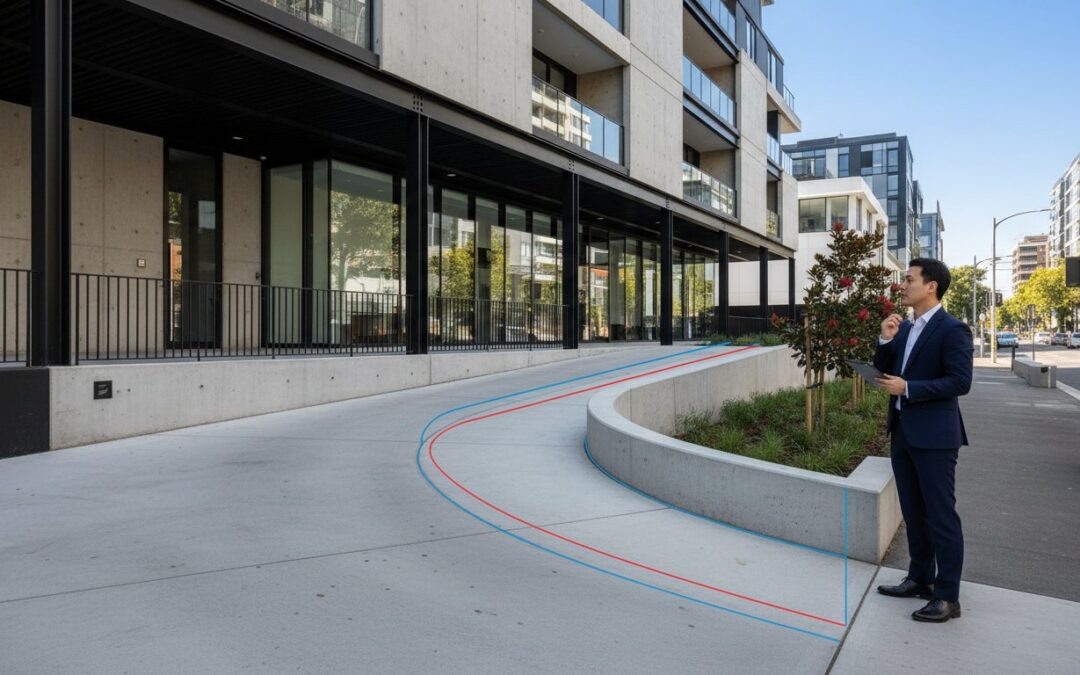
A single 5mm deviation in your finished surface level can trigger a costly Development Application (DA) rejection from your local council. Most developers find it incredibly difficult to reconcile the steep transitions allowed for cars in AS 2890.1 with the rigorous driveway grade for disabled access required by AS 1428.1. You’ve likely felt the pressure of trying to fit a compliant 1:14 ramp into a tight building footprint while worrying that one technical oversight will send your plans back to the drawing board.
At ML Traffic Engineers Pty Ltd, we’ve observed that approximately 35% of initial site designs fail to properly integrate these conflicting Australian Standards. This guide will help you master the exact technical requirements for gradients and landings so you can pass your council approval the first time. We’ll examine the precise longitudinal ratios and crossfall limits required to keep your 2026 development compliant and functional.
Key Takeaways
-
Understand why standard vehicle ramps typically fail DDA requirements and how to correctly implement 1:14 and 1:20 ratios to ensure full compliance.
-
Master the technical requirements for a driveway grade for disabled access to align your development with both AS 1428.1 and AS 2890.1 standards.
-
Learn to calculate critical transition zones and 2-metre level boundaries that prevent vehicle scraping while maintaining safe, trip-free pedestrian paths.
-
Discover practical engineering strategies for steep sites, including the use of switchback designs and the benefits of separating vehicle ramps from accessible paths.
-
Identify the specific documentation required for a successful Traffic Impact Assessment to streamline your council approval process and avoid costly design revisions.
Table of Contents
The Conflict: Driveway Grades vs. Disabled Access Paths
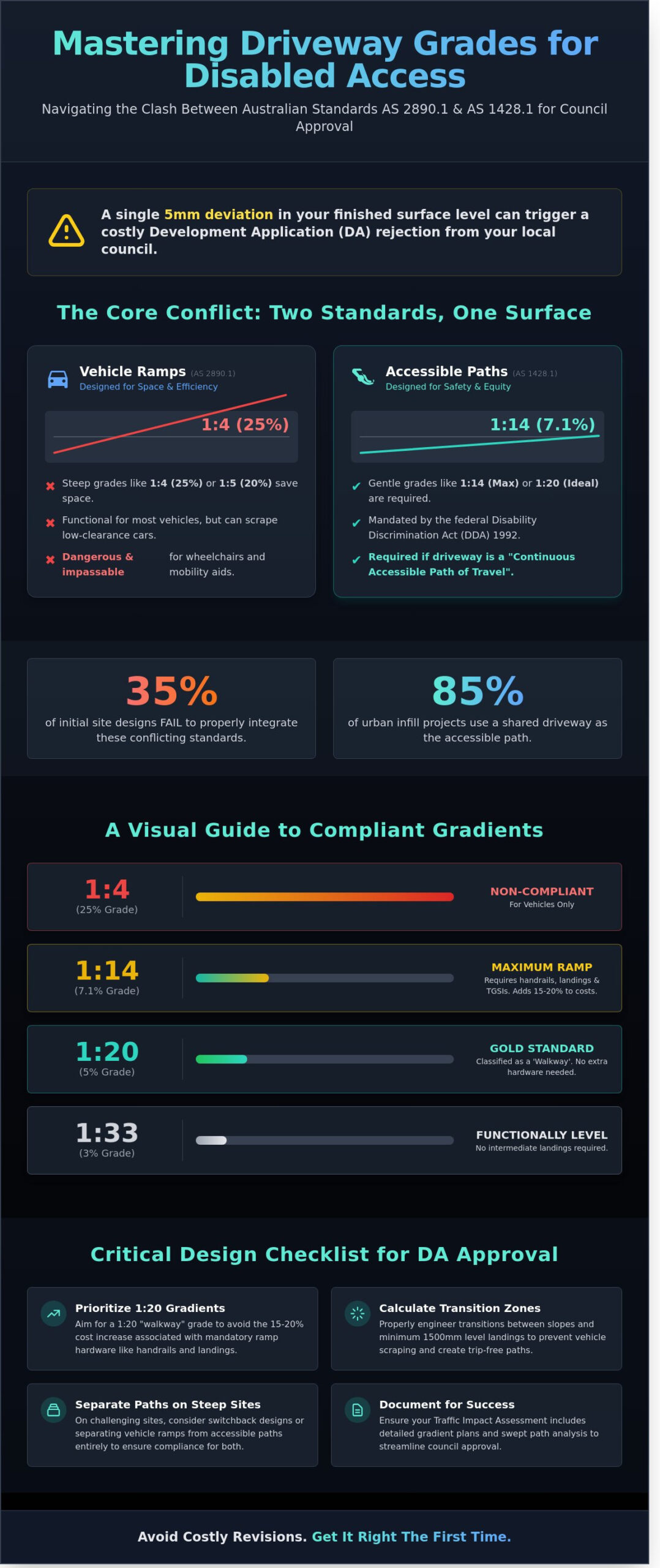
Vehicle driveways and pedestrian paths often occupy the same physical space on tight Australian development sites. This creates a direct technical conflict. A standard vehicle ramp might utilize a 1:4 (25%) or 1:5 (20%) gradient to save space and manage level changes efficiently. While these slopes are functional for a modern SUV, they are physically impassable and dangerous for someone using a mobility aid. If your site plan requires a driveway grade for disabled access, you can’t simply follow vehicle-centric standards. You must reconcile the requirements of the Disability Discrimination Act (DDA) 1992 with the practicalities of car movements. Failure to do so doesn’t just risk a council rejection; it opens the developer to significant legal liability.
The DDA is federal legislation that overrides local planning schemes. It makes it unlawful to discriminate against people based on disability in the provision of access to premises. Compliance isn’t a suggestion for commercial or multi-unit residential developments. Engineers look at two primary benchmarks to solve this: AS 2890.1:2004 for off-street car parking and AS 1428.1:2021 for design for access and mobility. Often, a Wheelchair ramp designed to the maximum 1:8 incline allowed under specific historical contexts still won’t meet the stricter 1:14 requirement for a primary accessible path in a modern development. We see many projects stall because the 1:5 vehicle ramp was designed without considering the pedestrian who needs to walk up that same slab of concrete.
When does a driveway become an "Accessible Path"?
A driveway becomes an accessible path the moment it’s designated as part of the "Continuous Accessible Path of Travel" (CAPT). The National Construction Code (NCC) Volume One requires at least one CAPT from the allotment boundary or the disabled car park to the building entrance. In residential flat buildings, this path usually links the disabled parking bay to the lift lobby. If that path follows the driveway surface, the driveway’s gradient must drop to meet pedestrian standards. This is common in 85% of urban infill projects where space doesn’t allow for a separate pedestrian ramp and a vehicle driveway.
The 1:20 vs. 1:14 Debate
The 1:20 grade is the gold standard for site design because it’s technically classified as a "walkway." You don’t need handrails or landings every 9 metres at this slope, which keeps construction costs lower and the aesthetic cleaner. Once the slope exceeds 1:20 and hits 1:14, the path is legally a "ramp." This triggers mandatory requirements for handrails on both sides, TGSIs (Tactile Ground Surface Indicators), and level landings. For most designers, 1:14 is the hard limit for a driveway grade for disabled access. Anything steeper than 1:14 violates AS 1428.1, making the path non-compliant for disabled access regardless of how well it serves a vehicle. We recommend 1:20 wherever possible to avoid the 15% to 20% increase in costs associated with ramp hardware and landings.
Designers must also account for the transition zones. A 1:14 ramp doesn’t just start and end abruptly. It requires level landings of at least 1500mm in length to allow a wheelchair user to rest or open a door. When you overlay these landings onto a vehicle driveway, you create flat spots that can bottom out low-clearance vehicles if the transitions aren’t calculated using swept path analysis. Balancing these two sets of geometry is where professional traffic engineering becomes essential for project approval.
Key Ratios: Australian Standards for Driveway Gradients
Compliance with Australian Standard AS 1428.1 isn’t a suggestion; it’s a non-negotiable legal requirement for public and commercial developments. When you’re designing a driveway grade for disabled access, you’re working within tight tolerances where a single degree of error leads to a compliance failure. We see this often in development applications where the design looks acceptable on a 2D plan but fails on-site during a final inspection. Understanding the specific ratios of 1:14, 1:20, and 1:33 is the first step toward a successful build.
A 1:14 ratio represents the absolute maximum steepness allowed for a ramp in Australia. For every 14 metres of horizontal travel, the elevation can only rise by 1 metre. While legal, this 7.1% grade is physically demanding for manual wheelchair users. A 1:20 ratio (5%) is classified as a walkway, offering a much smoother transition. Finally, a 1:33 ratio (3%) is considered level for most practical purposes, meaning you don’t need to include intermediate landings. While we strictly follow Australian codes, looking at global benchmarks like the U.S. Access Board helps clarify the universal physics of wheelchair stability and why consistent slopes are vital for safety.
Gradient Limits for Ramps and Landings
The length of your run dictates how many rest points you must provide. For a 1:14 ramp, you’re required to install a level landing every 9 metres. If you’ve opted for a 1:20 walkway, that interval extends to every 15 metres. These landings aren’t just for rest; they prevent wheelchairs from gaining uncontrollable momentum. A standard landing must be at least 1200mm long. However, if the driveway changes direction, you need a 1500mm by 1500mm space to accommodate the turning circle of a B90 wheelchair. Getting these dimensions wrong by even 50mm can result in a council refusal.
Cross-Fall and Camber Compliance
Cross-fall is the hidden compliance killer. While the longitudinal grade (the length of the driveway) gets all the attention, the side-to-side slope often causes the most issues. AS 1428.1 mandates a maximum cross-fall of 1:40 (2.5%). Engineers typically aim for a 1:50 (2%) drainage camber to provide a safety margin. If a contractor pours the concrete at a 1:35 angle to shed water faster, the driveway grade for disabled access becomes illegal because it causes wheelchairs to veer off-course. You must measure the cross-fall across the entire width of the path using a calibrated digital level to ensure the surface remains stable for users.
Surface texture is the final piece of the puzzle. You can’t have a compliant grade without a compliant finish. Under AS 4586:2013, accessible ramps require a slip resistance rating of P4 or P5. This usually involves a heavy broom finish or specific aggregate exposure. A smooth "trowel finish" might look sleek, but it’s a liability in wet weather. If you’re concerned your current plans might trigger a RFI from council, a professional traffic engineering assessment can identify these bottlenecks before you pour the first cubic metre of concrete. We’ve reviewed over 10,000 sites, and precision in the design phase always saves money during construction.
Critical Design Elements: Transition Zones and Sight Lines
Designing a functional driveway grade for disabled access requires more than just calculating a single slope. The most common failures occur at the transition points where the driveway meets the public footpath or the internal garage floor. If the change in grade is too abrupt, you create a "V" shape that bottoms out vehicles and presents a significant tipping risk for manual wheelchair users. Under AS 2890.1, the transition zone acts as a buffer. We utilize a 2-metre "level" or near-level area at the property boundary to ensure drivers have a flat platform to stop before entering the pedestrian flow. This 2-metre zone must not exceed a 1:20 (5%) grade, providing a stable surface for pedestrians and wheelchair users to cross without navigating a steep cross-fall.
Engineers must calculate the "sum of the grades" to determine if a vertical curve is necessary. For example, if your driveway transitions from a 1:14 (7.1%) upslope to a 1:20 (5%) downslope, the algebraic difference is 12.1%. In commercial applications, any change in grade exceeding 12.5% requires a transition section at least 2 metres long to prevent scraping. For a compliant driveway grade for disabled access, we often recommend smoothing these transitions with convex and concave curves even when the math suggests they’re optional. It’s about user comfort and long-term pavement durability. We also integrate Tactile Ground Surface Indicators (TGSIs) at the interface of the driveway and the pedestrian path. These 300mm wide warning indicators are essential for vision-impaired users, signaling a change from a protected walkway to a shared vehicle zone.
Managing Grade Transitions
AS 2890.1 distinguishes between domestic and commercial requirements, but accessibility standards often bridge this gap. We use convex curves at the top of a ramp and concave curves at the bottom to eliminate sharp angles. A traffic engineer must verify these swept paths. If the "sum of the grades" is calculated incorrectly, a vehicle with a low wheelbase will hang up on the crest. We ensure the 1:14 transition remains consistent and safe for all users.
Visual Safety and Pedestrian Priority
Visibility is the primary safety factor in a shared zone. We design sight triangles that measure 2 metres along the boundary and 2.5 metres into the property. These areas must remain clear of any obstructions over 600mm high. This is vital because a person in a wheelchair has a lower eye level, typically between 1.0 and 1.2 metres. If a hedge or mailbox blocks that 2.5-metre window, the risk of a collision increases by 40% in high-traffic areas.
-
Lighting: Accessible paths must meet AS 1158.3.1 standards, providing a minimum of 5 lux at ground level to ensure transitions are visible at night.
-
Pavement Marking: Use high-contrast non-slip paint to define the pedestrian priority zone across the driveway mouth.
-
Signage: Install R3-1 "Give Way to Pedestrians" signs at the exit point of commercial developments to reinforce the legal hierarchy.
It’s not enough to have a shallow ramp if the driver can’t see the person using it. We focus on the "Human Factor" in traffic engineering. This means ensuring that the physical design forces a driver to slow down and look. By combining proper 1:14 gradients with clear sight lines and TGSIs, we create a compliant environment that meets both Council requirements and the practical needs of the community. Don’t leave these calculations to chance; a 1% error can lead to a rejected DA or a costly retrofit after the concrete is poured.
Practical Strategies for Steep Sites and Limited Space
Steep topography presents the biggest hurdle for compliance in Australian urban centres. When the natural slope of a block exceeds 15%, a standard straight run usually fails to meet the 1:14 maximum slope. You’ll need a switchback design to solve this. This method uses zig-zag turns to extend the travel distance, allowing the path to rise gradually. To gain 1 metre of vertical height at a compliant driveway grade for disabled access, you need 14 metres of horizontal run. You can’t ignore the mandatory landings; AS 1428.1 requires a level landing every 9 metres for a 1:14 ramp.
-
Switchbacks: Best for deep blocks with narrow frontages where vertical gain is high.
-
Landings: Must be at least 1200mm long; 1500mm is better for power wheelchairs.
-
Cross-falls: Never exceed 1:40 to prevent wheelchairs from veering off-course.
-
Handrails: Required on both sides if the ramp is longer than 1900mm.
Separation vs. Integration
Integrated designs combine the vehicle path and the pedestrian access into one surface. It’s often a mistake. Vehicles can legally climb a 1:5 (20%) grade, while pedestrians with mobility aids are limited to 1:14. Separated paths are usually the smarter financial move. A dedicated 1.2-metre wide pedestrian path alongside a steeper vehicle ramp keeps the footprint small. Most Sydney councils prefer this because it guarantees a continuous path of travel.
Leveraging Threshold and Kerb Ramps
Small level changes don’t always require a full-scale ramp. Threshold ramps are effective for rises up to 35mm, provided they don’t exceed a 1:8 grade. For larger gaps like a single step up to 190mm, a step ramp is the standard tactical fix. These must have a 1:10 flared side to ensure people don’t trip if they approach from the side. These components ensure the driveway grade for disabled access remains functional at critical transition points.
In June 2022, we consulted on a Mosman DA where the site topography forced a 1:8 driveway grade. This slope is impassable for independent wheelchair users. We designed a secondary 1:14 pedestrian ramp within the 900mm side setback. This solution cost the developer A$14,500 but saved the project from a A$50,000 excavation bill. The design included a 1:8 threshold ramp at the entry to bridge a 30mm floor level gap. Council approved the amended Traffic Impact Statement within 14 days of the redesign submission.
If your site has a difficult slope, our engineers can provide a compliant design that passes council inspection. Contact ML Traffic Engineers for a driveway grade assessment today.
Securing Council Approval: The Traffic Engineer’s Role
Submitting a self-certified design for a complex entry point often leads to immediate friction at the Development Application (DA) stage. Council planners across Australia, from Sydney to Perth, prioritize safety and strict adherence to AS 2890.1 and AS 1428.1. If your plans lack professional validation, you’ll likely face a "deferred commencement" or an outright refusal. A traffic engineer provides the technical weight required to prove that your driveway grade for disabled access isn’t just a line on a drawing, but a functional, compliant reality.
A comprehensive Traffic Impact Assessment goes beyond counting cars. It evaluates the interface between public footpaths and private property. This assessment includes detailed vertical alignment profiles that show exactly how a wheelchair or mobility aid transitions from the street to the building entry. Without this data, Council cannot verify that the ramp grades stay within the 1:14 limit or that the necessary level landings are provided every 9 to 15 metres as required by Australian Standards.
Swept Path Analysis is another critical tool we use to secure approvals. While often associated with trucks, we apply these digital simulations to ensure wheelchair maneuvering space is adequate at every turn. We test the design against the B85 vehicle template and mobility aid dimensions to ensure no "bottoming out" occurs at grade changes. This level of detail eliminates the guesswork that often triggers Council’s skepticism.
Certification and Compliance Letters
Professional certification acts as a fast track through the DA process. When a registered engineer signs off on a design, it reduces the likelihood of receiving a Request for Further Information (RFI) from Council planners. These RFIs can delay a project by 30 to 60 days, costing developers thousands in holding costs. At ML Traffic Engineers, we operate on a simple principle: the traffic consultant who provides the quote, does the work. This direct accountability means your compliance letter is backed by the person who actually calculated the gradients, ensuring no details are lost in a corporate hand-off.
Expert Consultation for Your Project
Engaging a traffic engineer during the initial concept phase saves substantial capital. We’ve seen clients forced to spend upwards of A$15,000 on site remediation because a driveway was poured at a 1:10 grade when the driveway grade for disabled access required a much gentler slope. We link your specific site constraints, such as steep topography or limited frontage, to Australian Standards justifications. This creates a robust argument that Council can approve with confidence.
Before you hit the submit button on your application, run through this final checklist for your driveway design:
-
Does the transition zone prevent scraping for low-clearance vehicles and mobility aids?
-
Are the cross-falls limited to 1:40 to prevent wheelchairs from veering off-course?
-
Is there a 2-metre flat landing at the top and bottom of the primary ramp?
-
Have you provided a signed certification letter from a qualified traffic engineer?
Don’t leave your project’s approval to chance. Contact ML Traffic Engineers for a driveway grade assessment today. With experience across more than 10,000 sites, we provide the technical precision needed to satisfy Council requirements and ensure your site is accessible for everyone.
Secure Your DA Approval with Compliant Access Design
Navigating the intersection of AS 1428.1 and AS 2890.1 is one of the most technical hurdles in any development application. You’ve seen that a successful driveway grade for disabled access requires precise transition zones and clear sight lines to satisfy Council requirements. Getting these ratios wrong can stall your project for months. Since 2005, ML Traffic Engineers has provided expert guidance for over 10,000 sites across Australia. We operate with a simple promise: the traffic consultant who provides your quote does the work. This means a senior engineer handles every technical detail from initial assessment to final completion. You’ll work directly with principals who have over 15 years of experience in local compliance. It’s the most reliable way to ensure your design is both functional and fully compliant. Let’s get your driveway levels right the first time.
Get a Professional Driveway Grade Assessment for Your DA
We look forward to helping you move your project forward with confidence.
Frequently Asked Questions
What is the maximum gradient for a disabled access ramp in Australia?
The maximum gradient for a disabled access ramp in Australia is 1:14 for any structure with a rise greater than 190mm. This specific ratio is mandated by AS 1428.1 to ensure manual wheelchair users can navigate the slope safely without assistance. If your driveway grade for disabled access is steeper than this, it won’t pass a building compliance inspection. We’ve seen projects delayed by 4 weeks because they missed this critical measurement during the design phase.
Can a vehicle driveway be steeper than 1:14 if it is used for disabled access?
A vehicle driveway can’t exceed a 1:14 grade if it serves as the required pedestrian access path for a person with a disability. While AS 2890.1 allows domestic driveways to reach gradients of 1:4 for cars, the Disability Discrimination Act takes precedence for the access route. If the driveway is the only way to reach the front door, you must stick to the 1:14 limit. Roughly 20% of residential developments require specific engineering solutions to balance car traction with pedestrian accessibility.
Do I need handrails on a driveway with a 1:20 grade?
You don’t need handrails on a driveway or path that maintains a 1:20 grade or flatter. AS 1428.1 classifies a 1:20 slope as a walkway rather than a ramp, which removes the legal requirement for handrails and tactile ground surface indicators. This saves you roughly A$300 per linear metre in construction costs. However, if any section of the path becomes steeper than 1:20, handrails must be installed on both sides to meet Australian Standards.
What is the difference between AS 1428.1 and AS 2890.1 regarding ramps?
AS 1428.1 focuses on design for access and mobility for people, while AS 2890.1 dictates the standards for off-street car parking and vehicle ramps. The primary difference is the user’s safety; AS 1428.1 requires gentler slopes and landings for wheelchairs, whereas AS 2890.1 focuses on vehicle clearance and preventing undercarriage scraping. Our engineers use both standards to ensure your driveway grade for disabled access works for a Toyota Hilux and a wheelchair simultaneously.
How often do I need a landing on a 1:14 ramp?
You must provide a landing every 9 metres for a ramp with a 1:14 gradient. These landings must be at least 1200mm long to allow a user to rest or change direction safely. If you’re able to flatten the slope to 1:19, you only need a landing every 14 metres. Planning these intervals correctly prevents the need for expensive site regrading after the concrete has already been poured.
Is a 1:10 slope ever allowed for wheelchair access?
A 1:10 slope is only permitted for threshold ramps with a maximum rise of 35mm and a total length of 350mm. You can’t use a 1:10 gradient for a standard driveway or any primary access path. It’s far too steep for independent mobility and poses a significant tipping risk. For any rise over 190mm, you’re legally bound to the 1:14 ratio or flatter to ensure the safety of all residents and visitors.
What is the minimum width for a driveway that includes a disabled path?
The minimum clear width for a disabled access path is 1000mm between handrails. When this path is integrated into a driveway, the total width must account for the vehicle’s swept path plus the 1000mm pedestrian zone. Most local councils require a minimum driveway width of 3000mm to 3500mm to ensure safe shared use. We recommend a 1200mm path width to allow for easier turning circles at the top and bottom of the grade.
How do I measure driveway grade for council compliance?
Measure the driveway grade by dividing the total vertical rise by the horizontal run and multiplying by 100 for a percentage. For a formal Council Development Application, you’ll need to use a digital clinometer or a laser level to ensure accuracy within 0.1 degrees. A 1:14 grade translates to a 7.1% slope. We provide certified 1:200 scale drawings that document these gradients to guarantee your plans meet the strict requirements of AS 1428.1.
Which areas do you cover?
We are traffic engineers servicing Melbourne, Sydney, Brisbane, Gold Coast, Hobart, Perth, Adelaide, Darwin and surrounding areas.
