

A single degree of error in your driveway gradient calculation for council can be the difference between a successful Development Application and a costly, months-long redesign. You already know that steep or complex sites present significant engineering hurdles that require precise technical solutions. It’s frustrating when technical terms like 1:4 ratios, 25% grades, and 15-degree slopes are used interchangeably, especially when a calculation mistake means vehicles will bottom out on the kerb or scrape their undercarriage. At ML Traffic Engineers, we’ve seen how these avoidable errors stall projects for months.
This 2026 compliance guide provides the exact technical framework required to master AS 2890.1 standards and ensure your driveway design meets every local government requirement. We’ll show you how to calculate compliant slopes that facilitate safe vehicle passage. You’ll learn the specific transition zone requirements for change of grade, the mathematical formulas for converting ratios to percentages, and the professional strategies used by our senior consultants to secure rapid council approval for even the most challenging Australian terrains.
Key Takeaways
- Understand the mandatory requirements of AS 2890.1 to ensure your driveway geometry meets the latest Australian Standards for residential and commercial developments.
- Learn the precise step-by-step methodology for a driveway gradient calculation for council, including how to accurately convert rise and run into compliant ratios or percentages.
- Identify why a compliant slope may still fail without a detailed swept path analysis and ground clearance assessment to prevent vehicle scraping.
- Discover the technical differences between maximum allowable grades for various land-use types to avoid costly design errors during the planning phase.
- Recognise when a certified traffic engineering report is required to secure DA approval for steep sites or complex property access points.
Why Councils Mandate Strict Driveway Gradient Calculations
A driveway gradient represents the rate of change in elevation over a specific horizontal distance. For a successful driveway gradient calculation for council, you must adhere to precise mathematical principles that govern vehicle clearance. Understanding how gradients are calculated allows developers to predict how a vehicle’s wheelbase will interact with the pavement surface. Councils mandate these calculations to ensure safe vehicle ingress and egress, preventing property damage and maintaining public infrastructure integrity.
In 2026, Australian local government authorities have tightened compliance standards due to increased urban density and the rising weight of modern electric vehicles. A gradient that is too steep or lacks proper transitions creates immediate safety risks. It can lead to loss of traction in wet conditions or restricted sightlines for exiting drivers. Proper calculations also address the relationship between the driveway surface and the pedestrian footpath, ensuring a level cross-fall that prevents tripping hazards.
To better understand this concept, watch this helpful video:
The 2026 Development Application (DA) process requires high-accuracy longitudinal sections. If your driveway gradient calculation for council fails to meet the specific requirements of the local Development Control Plan (DCP), your application will likely face significant delays. Accuracy at the design stage is the only way to avoid costly rework during the construction phase.
The Consequences of Incorrect Gradient Calculations
- Vehicle Scraping: Poorly designed transitions cause vehicles to bottom out. This creates significant liability for developers if the design doesn’t meet AS 2890.1 standards.
- Council Refusal: Inaccurate plans trigger a Request for Further Information (RFI). This often stalls projects for 4 to 8 weeks while new levels are surveyed and drafted.
- Drainage Failure: Incorrect slopes lead to water pooling or uncontrolled runoff. This causes long-term erosion and can damage the structural foundations of the dwelling.
Regulatory Baseline: The Role of Local Planning Schemes
Local councils adopt national standards like AS 2890.1 but often modify them to suit local topography. You must reference specific “Standard Drawings” provided by your council in your DA submission. However, a “Standard” drawing is a generic template; it doesn’t guarantee compliance for complex or steep sites. Expert traffic engineering services are often required to provide custom swept path assessments and longitudinal sections that prove a design works on a specific allotment. At ML Traffic Engineers, we ensure that the traffic consultant who provides the quote is the one who does the work, ensuring accountability for every percentage of grade calculated.
Understanding AS 2890.1: The National Standard for Driveway Geometry
AS 2890.1:2004 is the primary Australian Standard governing off-street car parking and access. It provides the technical framework for all vehicle ramps and driveways. Local councils use this standard as the benchmark for safety and functionality. An accurate driveway gradient calculation for council depends on a strict adherence to these geometric requirements. Failure to comply usually results in a rejected Development Application or costly rectification works after construction.
The standard sets specific limits to ensure vehicles don’t scrape their undercarriages or lose traction. While the 20% (1 in 5) rule is a common reference point, it isn’t an absolute ceiling for every scenario. Developers can exceed this limit with specific council permission, provided they submit a report from a qualified traffic engineer. This report must prove the design remains safe for the intended vehicle types. Our team at ML Traffic Engineers specializes in these assessments; the traffic consultant who provides your quote is the expert who does the work.
- Standard Maximum: 20% (1 in 5) is the general limit for most residential ramps.
- Absolute Maximum: 25% (1 in 4) is only permitted for domestic driveways under strict conditions.
- Commercial Limit: 10% (1 in 10) is the preferred maximum for high-volume or heavy-vehicle access.
Maximum Gradients for Different Land Uses
Domestic driveways allow for steeper grades due to lower traffic volumes and predictable vehicle types. The 1:4 (25%) absolute limit is the maximum allowable slope, but it’s rarely recommended for the entire length of a driveway. Commercial and industrial sites have different requirements. A 1:10 (10%) gradient is often the preferred maximum for commercial access to accommodate delivery vans and ensure pedestrian safety. Driveway length also impacts allowable steepness. A short, steep ramp might be acceptable, whereas a long ramp at the same grade can cause engine strain or safety risks during wet weather.
Critical Geometric Components of AS 2890.1
Geometry involves more than just the slope of the main ramp. Crest transitions are vital for preventing “high-centering” as a vehicle moves over a peak. Without a proper crest, the middle of the car can scrape the pavement. Sag transitions are equally important at the bottom of a slope to prevent front or rear bumper scraping. A transition grade is a required buffer between two different slopes. If your project involves complex terrain, our traffic engineering services provide the technical assessment needed for compliance.
Ignoring these transitions leads to significant legal implications of non-compliance. In the 2019 VCAT case 1418, a developer was forced to address driveway defects that failed to meet AS 2890.1 standards, highlighting the financial risks of poor planning. Performing a driveway gradient calculation for council that respects both the main grade and these transitions is the only way to ensure a successful, compliant build.
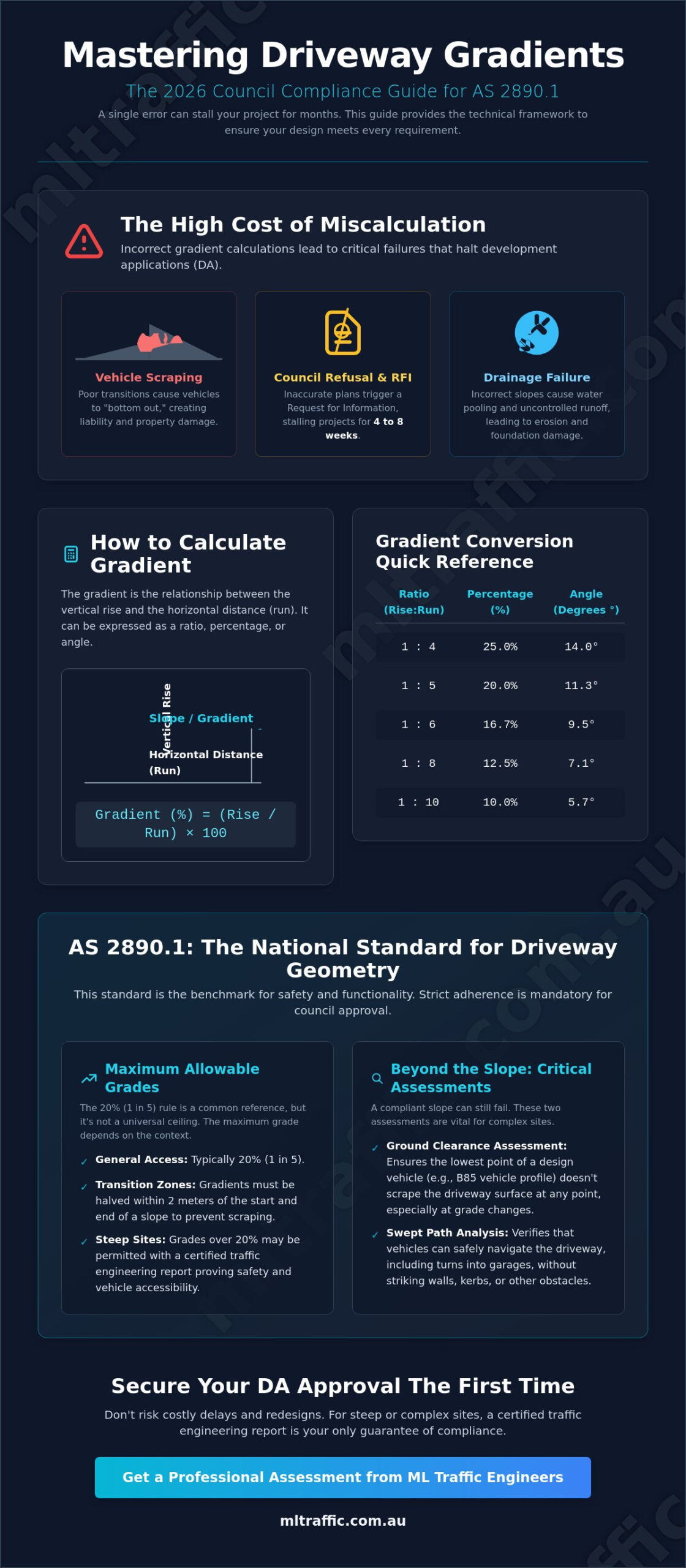
How to Calculate Driveway Gradients for Council Submission
Calculating the correct driveway gradient is a technical requirement for every Development Application (DA) in Australia. Councils demand precise data to ensure vehicle safety and prevent structural damage to the road reserve. Follow these five steps to complete a professional driveway gradient calculation for council submission.
- Step 1: Determine Rise and Run. Measure the total vertical height change (rise) from the property boundary to the garage floor. Measure the horizontal distance (run) across which this height change occurs.
- Step 2: Convert to Ratios or Percentages. Divide the run by the rise to get a ratio; for example, a 10-metre run with a 2-metre rise equals 1 in 5. Multiply the rise by 100 and divide by the run to get a percentage, which is 20% in this case.
- Step 3: Identify Grade Changes. Locate every point where the slope changes. Any change greater than 12.5% (1 in 8) usually requires a transition zone to prevent the vehicle undercarriage from bottoming out.
- Step 4: Verify Ground Clearance. Apply standard vehicle templates. The B85 template represents the 85th percentile car. The B99 template covers larger 4WD vehicles and is often required for residential flat buildings.
- Step 5: Document Results. Compile these figures into a formal Driveway Ramp Grade Assessment. This document serves as technical proof of compliance for council traffic engineers.
The Math: Ratios vs. Percentages vs. Degrees
Traffic engineers in Australia prefer ratios like 1:4 or 1:20. Builders often discuss gradients in percentages. A 25% grade is the same as a 1 in 4 ratio. Avoid using degrees in engineering drawings for council. Degrees are often misinterpreted by contractors on-site; a 15-degree slope is significantly steeper than a 15% slope. If you don’t stick to ratios or percentages, your driveway gradient calculation for council may be rejected for lack of clarity. AS 2890.1 standards rely on these specific units to ensure consistency across all states.
Calculating Transition Zones
The Australian Standard AS 2890.1 specifies that a transition zone is mandatory when the change in grade exceeds 12.5% for summit grade changes or 15% for sag grade changes. These zones must be at least 2 metres long. For example, if moving from a 5% property boundary to a 25% main ramp, a 2-metre section at 15% must sit between them. This prevents the vehicle’s “break-over” point from hitting the pavement. Our team at ML Traffic Engineers uses specialised swept path software to model these transitions and guarantee zero ground contact for B85 vehicles. Meticulous calculation at this stage prevents expensive rectification costs after the concrete is poured.
Beyond the Slope: Ground Clearance and Swept Path Analysis
A compliant driveway gradient calculation for council doesn’t always guarantee a functional design. A ramp can strictly follow the percentage limits defined in AS 2890.1 but still cause a vehicle to scrape its undercarriage or fail to complete a turn. This occurs when the design fails to account for the physical interaction between vertical transitions and horizontal curvature. If a vehicle is turning while ascending a steep grade, the effective ground clearance changes, often leading to “bottoming out” at the crest or sag of the ramp.
Integrating swept path analysis with your gradient assessment is the only way to prove a design works in three dimensions. Councils increasingly demand these simulations to prevent future property damage and traffic flow issues. We use specialized software to model how specific vehicle profiles move through the proposed space, ensuring that the body of the car stays within the designated path while the wheels maintain constant contact with the pavement.
The “B85” Design Vehicle Test
The B85 vehicle is the standard benchmark for Australian driveway design. It represents the 85th percentile of cars on our roads. To pass council scrutiny, engineers must plot the B85 undercarriage profile against the proposed driveway section. This test identifies if the vehicle’s wheelbase or overhangs will strike the ground. If your driveway gradient calculation for council reveals a risk of scraping, we design transition “blunt” grades to smooth out the change in angle. For commercial or high-density residential sites, we may also test against the B99 vehicle to accommodate 99% of passenger cars.
Intersection of Gradient and Sight Distance
Steep driveways significantly impact a driver’s ability to see pedestrians on the footpath. When a vehicle is positioned at a steep upward angle near the property boundary, the car’s hood can obstruct the driver’s view of the public domain. We calculate a “sight triangle” at the boundary to ensure clear visibility. If the gradient is too steep at the point of exit, it creates a safety hazard that councils won’t approve. Our Traffic Engineering services include detailed sight-line assessments to ensure your project meets safety requirements and Australian Standards.
Securing DA Approval: Why Professional Assessment is Essential
Australian councils have tightened their Development Application (DA) requirements significantly. A simple hand-drawn sketch or a basic architectural line won’t suffice for sites with complex topography. Local government authorities now demand a certified Traffic Engineering report for any project where the terrain poses a risk to vehicle clearance. Amateur attempts at a driveway gradient calculation for council often overlook the critical transition zones between the property line and the road carriage. This oversight leads to vehicles scraping their undercarriages or becoming high-centered, which creates long-term liability issues for the property owner.
A professional assessment mitigates risk for developers and builders by providing a technical guarantee of accessibility. If a driveway is constructed based on an uncertified DIY plan and fails to accommodate a standard B85 vehicle, the rectification costs can exceed A$20,000 in demolition and regrading fees. Engaging an expert early in the design phase prevents these financial setbacks and ensures the project aligns with the geometric requirements of the specific local council area.
What to Expect in a Professional Driveway Report
A comprehensive report provides the technical evidence required to move a project from the planning stage to construction. You’ll receive more than just a single percentage figure. The documentation includes:
- Detailed longitudinal sections that map every grade change from the garage floor to the street gutter.
- Compliance certification against AS 2890.1, ensuring the design meets national standards for off-street car parking.
- Expert recommendations for design modifications, such as adjusting floor levels or lengthening ramp transitions, to achieve a compliant driveway gradient calculation for council.
- Clear site plans that demonstrate vehicle swept path clearance for the most demanding maneuvers.
The ML Traffic Advantage for Australian Developers
ML Traffic Engineers operates with a direct, no-nonsense philosophy. We don’t use junior staff or account managers as gatekeepers. The traffic consultant who provides your quote is the same senior engineer who performs the technical work. This accountability ensures that the specific nuances of your site are understood and addressed correctly the first time. Our team brings over 15 years of experience to every assessment, providing a level of reliability that larger, more bureaucratic firms cannot match.
Since 2005, we have completed over 10,000 successful site assessments across Australia. This track record gives us a deep understanding of the specific bureaucratic requirements of various local councils. We provide the technical certainty needed to avoid costly Requests for Information (RFIs) and project delays. For a professional driveway ramp grade assessment that meets all regulatory standards, contact our senior engineering team today.
Secure Your DA Approval with Compliant Driveway Design
Navigating the technicalities of AS 2890.1 and AS 2890.2 requires absolute precision to avoid costly redesigns or DA refusals. A precise driveway gradient calculation for council submission isn’t just a recommendation; it’s a mandatory requirement for 2026 compliance across all Australian jurisdictions. You’ve seen how ground clearance and swept path analysis dictate the functional success of your site access. Relying on guesswork often leads to vehicle scraping and non-compliance issues that halt construction progress.
ML Traffic Engineers brings decades of specialized experience to your development project. We’ve assessed over 10,000 sites across Australia, ensuring every ramp and parking layout meets strict national standards. When you work with us, the traffic consultant who provides your quote is the one doing the work. You’ll have direct access to our principal engineers, Michael Lee and Benny Chen, throughout the entire assessment process. This hands-on approach eliminates unnecessary bureaucracy and delivers technical reports that councils trust for immediate approval. Get a professional Driveway Ramp Grade Assessment for your project today to ensure your site is fully compliant and ready for construction. We look forward to helping you move your project forward with confidence.
Frequently Asked Questions
What is the maximum driveway gradient allowed by council?
The maximum driveway gradient allowed for private residential access under Australian Standard AS 2890.1 is 1 in 4 (25%). For the first 6 metres inside the property boundary, the grade shouldn’t exceed 1 in 20 (5%) to maintain safe sight lines and pedestrian safety. Local councils often enforce these specific ratios through their Development Control Plans (DCP), so you must verify local variations before starting construction.
How do I calculate a 1 in 4 driveway slope?
To calculate a 1 in 4 driveway slope, divide the total vertical rise by the horizontal length of the ramp. A 1 in 4 ratio means that for every 4 metres of horizontal distance, the driveway rises or falls by 1 metre. This equates to a 25% grade or an angle of 14.04 degrees. Accurate driveway gradient calculation for council submissions requires precise measurements from the property boundary to the garage floor using a laser level.
What is a transition grade and when is it required?
A transition grade is a shorter, intermediate slope segment that sits between a steep ramp and a flat surface to prevent vehicle scraping. AS 2890.1 requires these 2 metre long transitions when the change in grade exceeds 1 in 8 (12.5%). For a 1 in 4 ramp, you’ll need a 1 in 8 transition at both the top and bottom to provide enough clearance for the B85 design vehicle.
Can I build a driveway steeper than 25% if I have a small lot?
You cannot exceed the 25% maximum gradient specified in AS 2890.1, even on constrained or small lots. Councils prioritize vehicle safety and accessibility, and exceeding this limit often leads to vehicle “hang up” where the chassis hits the pavement. If your site topography is extreme, you’ll need a professional driveway gradient calculation for council that includes a performance solution from a qualified traffic engineer to prove the design works.
What happens if my driveway does not comply with AS 2890.1?
Non-compliance with AS 2890.1 usually results in the council refusing your Occupation Certificate (OC) or rejecting your Development Application (DA). Rectifying a non-compliant driveway after the concrete is poured is expensive, with costs often ranging from A$5,000 to A$20,000 for demolition and reconstruction. It also creates significant legal liability issues for the property owner if a vehicle is damaged or an accident occurs on the non-compliant surface.
Do I need a traffic engineer for a residential driveway?
You’ll need a traffic engineer if your driveway exceeds a 1 in 5 (20%) grade or if the council requests a Vehicle Swept Path Assessment. Engineers use specialized software to ensure your car won’t scrape on the crest or sag of the ramp. At ML Traffic Engineers, the consultant who provides your quote performs the actual technical work, ensuring your residential application meets all RPEQ and Australian Standard requirements without bureaucratic delays.
How long does a driveway gradient assessment take?
A standard driveway gradient assessment takes 3 to 5 business days once you provide the site levels and architectural plans. This timeframe includes the detailed calculation of all ramp segments, transition zones, and the production of a formal compliance report for your council submission. More complex sites that require swept path analysis for multiple vehicle types might take up to 7 business days to ensure every technical detail is addressed.
What is the difference between a crest and a sag in driveway design?
A crest is the high point or “hump” where two slopes meet, while a sag is the low point or “valley” of the driveway. Both require careful design because a sharp crest can cause a vehicle to bottom out, and a deep sag can damage front or rear bumpers. AS 2890.1 provides specific formulas for both scenarios to ensure that the vehicle’s chassis maintains adequate ground clearance throughout the entire length of the driveway.

Disclaimer
The content on www.mltraffic.com.au, including all technical articles, guides, and resources, is provided for general informational and educational purposes only. It is not intended to constitute professional advice in traffic engineering, transportation planning, development approvals, or any other technical or legal field.
While ML Traffic Engineers makes every reasonable effort to ensure the accuracy, completeness, and timeliness of the information published, we do not provide any warranties or representations (express or implied) regarding its reliability, suitability, or availability for any particular purpose. Any reliance you place on the content is strictly at your own risk.
In no event shall ML Traffic Engineers, its directors, employees, authors, or affiliates be liable for any direct, indirect, incidental, special, consequential, or punitive damages (including, without limitation, loss of profits, data, or business opportunities) arising out of or in connection with the use of, or inability to use, any information provided on this website.
The articles and guides on this site are not a substitute for engaging a qualified, registered professional traffic engineer (such as an NPER or RPEQ engineer) to assess your specific project requirements. For tailored advice, compliance assessments, or traffic engineering services, please contact a competent professional.
This disclaimer may be updated from time to time without notice. By accessing or using this website, you agree to be bound by the most current version of this disclaimer.
