

A single non-compliant gradient on a 1:20 transition can stall a A$1.5 million development application for months. We’ve seen projects delayed because a driveway profile drawing for council lacked the specific vertical clearances mandated by Australian Standards. You’re likely tired of deciphering technical jargon in Council RFIs or worrying that a steep site will lead to vehicle scraping issues once the concrete is poured. It’s a valid concern that often leads to costly redesigns and construction setbacks. Our team has assessed over 10,000 sites since 2005, and we know that precision in the longitudinal section is the difference between an immediate approval and a six month delay.
We’ll show you exactly what’s required in a driveway longitudinal section to ensure your design meets AS 2890.1 compliance from the first submission. This guide provides a technical checklist for property access and a clear breakdown of the engineering requirements needed for successful Council approval. You’ll learn how to interpret longitudinal sections, calculate ramp grades, and avoid the common errors that trigger mandatory rejections. We’re moving past the fluff to give you the exact technical requirements your project needs to stay on schedule.
Key Takeaways
- Understand the mandatory gradients and ramp design requirements under AS 2890.1:2004 to ensure your longitudinal sections meet strict Australian Standards.
- Learn the technical components required for a professional driveway profile drawing for council, including essential connections to the existing road crown and kerb levels.
- Avoid costly project delays and RFIs by identifying the common technical errors and omissions that lead to Council rejections during the development application process.
- Determine the specific roles of surveyors and Traffic Engineers in capturing accurate site levels and providing the professional certification required for complex developments.
Table of Contents
- Understanding Driveway Profile Drawings for Council Approval
- Key Technical Requirements and AS 2890.1 Compliance
- Why Council Rejects Driveway Profiles (and How to Avoid It)
- The Step-by-Step Process of Creating a Compliant Profile
- Professional Engineering Certification for Your Development
Understanding Driveway Profile Drawings for Council Approval
A driveway profile drawing for council is a longitudinal section that maps the vertical elevation of a vehicle’s path. In Australian civil engineering, this drawing provides a side-on view of the driveway from the road centerline, through the kerb and gutter, across the property boundary, and into the final parking area. It’s a mandatory requirement for most Development Applications (DA) because a standard 2D site plan cannot demonstrate vertical clearance or slope compliance. While a site plan shows where the driveway goes, the profile drawing shows how it gets there without damaging vehicles.
These drawings are essential for managing the interface between private property and the public road reserve. Local authorities must ensure that any new access point doesn’t disrupt existing drainage or compromise the structural integrity of the street. For complex developments, these profiles form a critical component of a Traffic Impact Assessment, ensuring the proposed access is functional and safe for all road users. Most councils in New South Wales and Victoria require these profiles to be prepared by qualified engineers to guarantee they meet rigorous safety standards.
To better understand this concept, watch this helpful video:
The Purpose of a Longitudinal Section
The primary goal of a longitudinal section is to visualize vertical alignment. It ensures that changes in grade don’t result in vehicle “grounding” or “bottoming out.” Engineers use these drawings to check for clearance at the front and rear overhangs of a B85 or B99 vehicle. This includes verifying that Australian parking space dimensions are accessible without scraping the vehicle’s chassis. Beyond vehicle protection, the profile ensures the cross-fall at the property boundary remains safe for pedestrians. We typically design for a 1:40 (2.5%) grade at the boundary to prevent trip hazards and ensure wheelchair accessibility.
Council Requirements for Property Access
Councils require specific data points including Reduced Levels (RLs), percentage gradients, and transition zones. A common reason for DA rejection is the use of generic architectural drawings that omit these technical details. While an architect focuses on aesthetics, a traffic engineer designs for AS 2890.1 compliance. This involves calculating precise transition zones, such as a 2-metre long section at half the main ramp’s grade, to prevent sudden shifts in momentum. Without these specific engineering details, a driveway profile drawing for council will likely fail the assessment process, leading to costly delays in project approval. Professional consultants ensure every level from the crown of the road to the garage floor is mathematically sound.
Key Technical Requirements and AS 2890.1 Compliance
AS 2890.1:2004 serves as the primary regulatory framework for off-street car parking in Australia. This standard dictates the geometric requirements for all driveway and ramp designs. Local authorities mandate a driveway profile drawing for council to ensure that proposed developments don’t create safety hazards or cause vehicle damage. A compliant car park design must integrate these specific gradients into the overall site layout from the earliest planning stages to avoid costly redesigns during the construction phase.
The standard distinguishes between residential and commercial access based on expected traffic volume and user familiarity. Residential driveways are permitted slightly steeper gradients because users navigate them daily and understand the terrain. Commercial facilities require shallower, more conservative grades to accommodate diverse vehicle types and higher turnover rates. Failure to adhere to these distinctions often leads to immediate RFI (Request for Further Information) letters from council planners.
Maximum Grades and Transitions
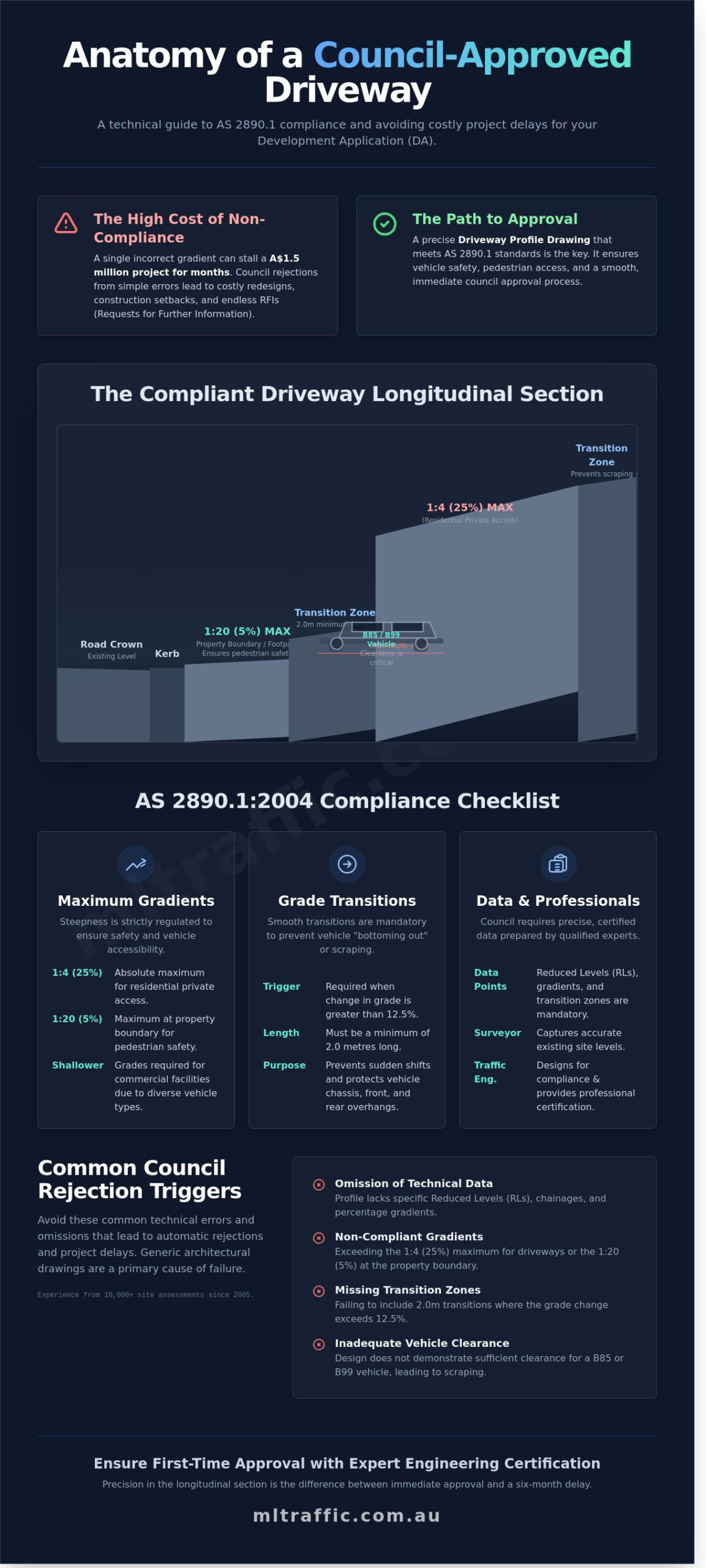
Gradients are expressed as ratios or percentages. A critical requirement is the 1:20 (5%) maximum grade at the property line. This relatively flat section ensures vehicles don’t launch onto the public footpath, which protects pedestrians and maintains sightlines. For residential private access, the absolute maximum grade allowed is 1:4 (25%). Any transition between different grades that exceeds 12.5% must include a 2.0-metre transition scale. These segments act as a buffer to prevent the vehicle nose or tail from scraping the pavement.
The Critical Ground Clearance Check
Engineers use B85 and B99 design vehicle templates to verify clearance. The B85 template represents the 85th percentile of cars on Australian roads, while the B99 represents the 99th percentile. We use these models to calculate the break-over angle. This is the maximum angle a vehicle can drive over without the apex of the ramp touching the undercarriage. Your driveway profile drawing for council must demonstrate that the vehicle clears the pavement at every point, including the front and rear overhangs. This technical proof is vital for steep sites where vertical curves are tight. If you’re struggling with these complex calculations, you can contact our senior engineers for a direct assessment of your site levels.
Why Council Rejects Driveway Profiles (and How to Avoid It)
Councils across Australia issue RFIs (Requests for Further Information) when a driveway profile drawing for council lacks critical technical data. A frequent failure is the omission of the connection to the existing road crown or kerb. Engineers must demonstrate how the proposed grade integrates with the public asset; if the drawing stops at the property boundary, it’s technically incomplete. Inaccurate site survey data often results in unbuildable designs. We’ve seen cases where survey levels are off by 50mm, making a compliant ramp impossible to construct once the formwork is laid. Designers must also account for existing street trees and utility pits. Councils won’t approve a profile that requires removing a healthy 20-year-old canopy tree or relocating a NBN pit without prior written consent from the relevant authority.
- Longitudinal section errors: Failure to show the full length from the road centreline to the garage floor.
- Asset interference: Ignoring the location of water meters, power poles, or drainage pits within the verge.
- Survey discrepancies: Using old contour data instead of a site-specific levels survey with 0.01m accuracy.
- Boundary levels: Neglecting to match the exact level of the existing footpath.
Insufficient Detail on Vertical Curves
Straight-line approximations don’t work on steep sites. AS 2890.1 requires parabolic curves for smooth transitions between different grades. If your driveway profile drawing for council shows a sharp “V” at a grade change, the assessor will reject it immediately. You must show the length of the vertical curve, typically 2.0m for most residential applications, and clearly label the change-of-grade points. This ensures the vehicle’s suspension can handle the transition without the chassis making contact with the pavement. Precise labeling at 1-meter intervals is the standard for professional compliance.
Ignoring the Scraping Risk
Council’s primary concern is liability. If a vehicle scrapes on a public footpath, the council faces potential legal action for approving a non-compliant design. A Swept Path Analysis provides the necessary evidence that the design works for the B85 or B99 design vehicle. Consider a project where a 1% error in a longitudinal section led to a failed inspection. The driveway was built at a 21% grade instead of the approved 20%. This resulted in a A$12,000 rectification cost for the developer to grind down the concrete and re-pour the transition. We provide the exact levels to ensure the builder has no room for interpretation on-site.
The Step-by-Step Process of Creating a Compliant Profile
Producing a driveway profile drawing for council approval requires a systematic, technical approach. You can’t rely on guesswork or visual estimates. The process begins by engaging a qualified land surveyor to capture precise site levels. This data forms the foundation of the entire design. Without it, your application will likely fail the first stage of Council review.
You must identify the specific design vehicle required by your local government area. Most residential applications focus on the B85 or B99 vehicle templates as defined in AS 2890.1. However, commercial developments or multi-unit sites often require clearance for heavy rigid vehicles (HRV) or waste collection trucks. Drafting the longitudinal section using specialized CAD software allows us to simulate these vehicle movements with millimetre precision.
Data Collection and Site Surveying
Accuracy depends on using Australian Height Datum (AHD) levels. We’ve seen projects delayed by months because developers used “assumed levels” that didn’t align with the Council’s road infrastructure. A surveyor must record levels at these critical points:
- The road centerline and the top/bottom of the kerb
- The property boundary line and any existing footpaths
- The proposed garage floor level (RL)
- Critical points 5 to 10 metres inside the property to ensure internal clearance
Recording these levels ensures the transition between the public road and private property is seamless and compliant with safety standards.
Drafting the Longitudinal Section
We draft the longitudinal section using standard scales, typically 1:100 horizontal and 1:20 vertical. This vertical exaggeration is necessary to clearly show grade changes that might cause a vehicle to scrape. Every driveway profile drawing for council must include clear labels for percentage grades, transition lengths, and Reduced Levels (RLs) at every break point.
The most critical step is the vehicle template overlay. We place a 2D model of the design vehicle onto the profile to test for bottoming out or “grounding.” AS 2890.1 requires a minimum 120mm ground clearance for the B85 vehicle. If the drawing doesn’t show this clearance at the apex or the base of the ramp, the design must be revised. We also cross-reference the draft against local Council crossover policies, as many LGAs have specific rules regarding the width and material of the verge section.
Our team provides the technical expertise needed to secure your permit. View our full range of traffic engineering services to see how we assist with driveway compliance.
Professional Engineering Certification for Your Development
Standard drafts often fail to meet the rigorous scrutiny of local government planning departments. A driveway profile drawing for council isn’t just a sketch; it’s a technical document that must adhere to AS 2890.1 standards. When your project involves steep terrain, limited frontage, or complex site constraints, a certified drawing becomes a mandatory requirement rather than an optional extra. Local councils frequently issue Requests for Further Information (RFIs) when submissions lack professional validation, adding weeks or months to your timeline.
The role of a Traffic Engineer in the design process is to ensure the proposed grades don’t result in vehicle scraping or sightline obstructions. Council planners look for the professional stamp of an engineer to mitigate their own liability. Professional certification reduces the risk of Council delays by providing a “right first time” submission. At ML Traffic, we operate under a strict philosophy: the consultant who quotes, does the work. This ensures accountability and direct access to senior expertise throughout your application, avoiding the communication gaps found in larger firms.
Why RPEQ or Chartered Certification Matters
In jurisdictions like Queensland, the Professional Engineers Act 2002 mandates that professional engineering services be performed by a Registered Professional Engineer of Queensland (RPEQ). Similar high standards apply for Chartered status in other states. A standard drafter can produce a visually appealing plan, but they cannot provide the legal certification or the depth of technical assessment required for complex gradients. A certified driveway profile drawing for council provides peace of mind for builders and owners. It ensures the final construction is functional and compliant with Australian Standards, preventing costly rectification works after the concrete is poured. Our team brings between 30 and 40 years of experience to every certification.
Streamlining Your DA with ML Traffic
We take a hands-on approach to driveway ramp grade assessments. Our engineers don’t just use software; we apply decades of experience to find design solutions where others see dead ends. We integrate our profile drawings with Vehicle Swept Path Analysis to provide a comprehensive submission package. This holistic view ensures that if a vehicle can clear the ramp, it can also negotiate the turns safely. This technical rigor has supported over 10,000 successful site assessments since we began trading in 2005. Contact our senior engineers for a direct quote on your project to secure your development approval without unnecessary revisions.
Secure Your Development Approval with Technical Precision
Achieving council approval depends on technical accuracy and strict adherence to Australian Standards. A compliant driveway profile drawing for council must satisfy the rigorous requirements of AS 2890.1 and AS 2890.2 to prevent vehicle scraping and ensure safe access. Most rejections occur because of minor errors in ramp grades or vertical curves. You’ll avoid these costly delays by engaging specialists who understand the specific demands of local authorities. Professional certification removes the guesswork from your application.
ML Traffic Engineers brings over 15 years of experience to your development project. Senior engineers Michael Lee and Benny Chen personally handle every assessment. They ensure your plans meet all mandatory regulatory benchmarks. This direct approach means the consultant who quotes your job is the same expert who performs the technical engineering. It’s a reliable way to streamline your approval process. We’ve successfully handled over 10,000 sites across Australia. Our expertise covers everything from residential driveways to complex commercial loading docks. You’re in capable hands for your next submission.
Get a professional driveway profile assessment from ML Traffic Engineers
Frequently Asked Questions
What is a driveway longitudinal section?
A driveway longitudinal section is a technical 2D drawing that illustrates the vertical profile of a driveway from the property boundary to the parking space. It maps the change in elevation over distance to ensure the design complies with AS 2890.1 standards. Our engineers use these drawings to identify potential ground clearance issues before construction begins on site.
Why does Council need a driveway profile drawing?
Councils require a driveway profile drawing for council applications to verify that proposed access points don’t cause vehicle damage or safety hazards. This documentation proves the design meets specific local government and Australian Standard requirements for gradient transitions. Without this drawing, Council cannot assess if a standard B85 vehicle can safely enter and exit your property without bottoming out.
What are the maximum driveway grades allowed by AS 2890.1?
AS 2890.1 specifies a maximum gradient of 1 in 4 (25%) for domestic driveways. This limit only applies to the main ramp section. You must include transition grades of 1 in 8 (12.5%) for at least 2.0 metres at both the top and bottom of steep sections. These transitions prevent the vehicle’s chassis or bumper from striking the pavement surface during transit.
Can I draw my own driveway profile for a Council application?
You can attempt to draw your own profile, but Councils typically reject non-professional submissions that lack technical precision. Most Development Applications (DA) or Section 138 approvals require a drawing certified by a qualified traffic engineer or civil designer. Professional drawings ensure all vertical curves and clearance points are calculated using specialized software to meet AS 2890.1 criteria exactly.
How much does a professional driveway profile drawing cost?
A professional driveway profile drawing for council typically costs between A$750 and A$1,250 for a standard residential property. Complex sites with significant elevation changes or narrow access points may reach A$2,000. This fee covers the engineering site assessment, CAD drafting, and the formal certification required for your Council submission. The traffic consultant who provides the quote does the work.
What is a vehicle scraping assessment?
A vehicle scraping assessment is a technical check that simulates a B85 or B99 vehicle traversing the proposed driveway profile. We use a standardized vehicle template to ensure the overhang and ground clearance points don’t contact the driveway surface. This process identifies exactly where bottoming out will occur, allowing us to adjust the vertical curves before you pour any concrete.
What happens if my driveway is too steep for Council standards?
If your driveway exceeds the 25% maximum grade, you must redesign the access or apply for a formal variation. Councils rarely approve gradients steeper than AS 2890.1 limits due to safety and drainage concerns. Our engineers often solve this by lengthening the driveway or incorporating curved ramps to reduce the effective slope while maintaining compliant transition zones.
Do I need a survey before a driveway profile can be drawn?
You must provide a detailed topographical survey from a registered land surveyor before an engineer can draft an accurate profile. The survey provides the exact AHD (Australian Height Datum) levels for the road centreline, kerb, and property boundaries. Without these 0.01m accurate data points, any profile drawing is speculative and will likely be rejected by Council during the assessment phase.
Which areas do you cover?
We are traffic engineers servicing Melbourne, Sydney, Brisbane, Gold Coast, Hobart, Perth, Adelaide, Darwin, Canberra and surrounding areas.
Disclaimer
The content on www.mltraffic.com.au, including all technical articles, guides, and resources, is provided for general informational and educational purposes only. It is not intended to constitute professional advice in traffic engineering, transportation planning, development approvals, or any other technical or legal field.
While ML Traffic Engineers makes every reasonable effort to ensure the accuracy, completeness, and timeliness of the information published, we do not provide any warranties or representations (express or implied) regarding its reliability, suitability, or availability for any particular purpose. Any reliance you place on the content is strictly at your own risk.
In no event shall ML Traffic Engineers, its directors, employees, authors, or affiliates be liable for any direct, indirect, incidental, special, consequential, or punitive damages (including, without limitation, loss of profits, data, or business opportunities) arising out of or in connection with the use of, or inability to use, any information provided on this website.
The articles and guides on this site are not a substitute for engaging a qualified, registered professional traffic engineer (such as an NPER or RPEQ engineer) to assess your specific project requirements. For tailored advice, compliance assessments, or traffic engineering services, please contact a competent professional.
This disclaimer may be updated from time to time without notice. By accessing or using this website, you agree to be bound by the most current version of this disclaimer.
