
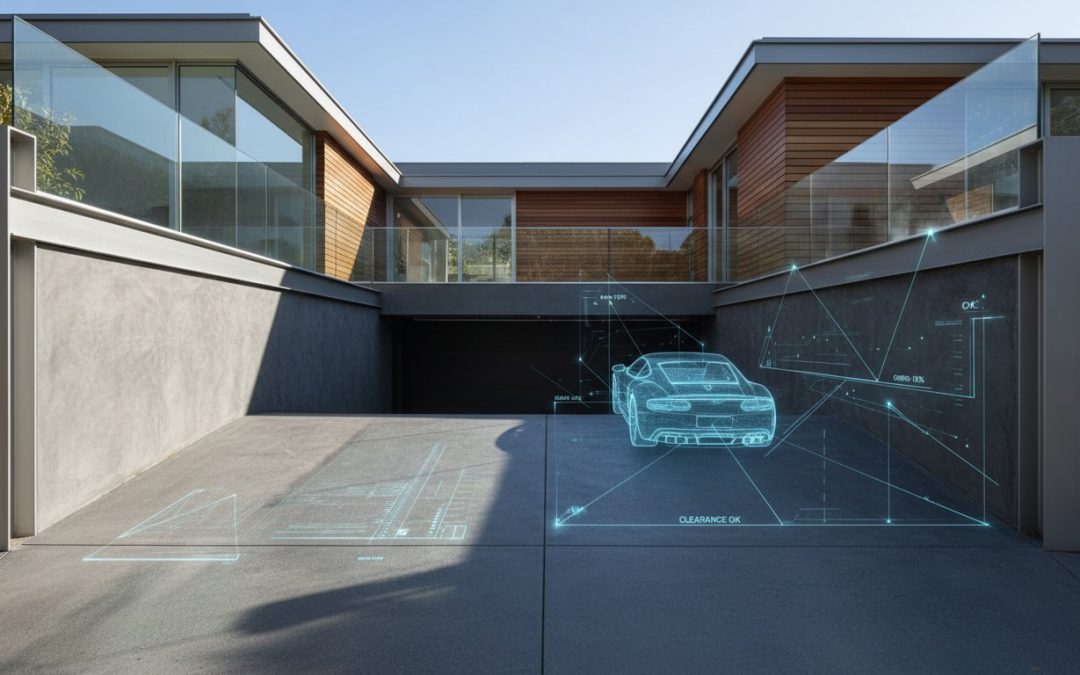
A non-compliant driveway design can stall a Development Application (DA) and result in costly, ongoing vehicle damage. The sound of an undercarriage scraping on concrete is a clear signal of a design flaw-one that frequently originates from a failure to meet the strict specifications of Australian Standard AS 2890.1. To navigate council requirements and ensure a functional design, a professional driveway ramp grade assessment is not just a recommendation; it is a critical requirement for project approval and long-term asset protection.
This guide delivers the technical clarity needed to achieve compliance. We will break down the essential components of a driveway assessment, demystifying critical terms like ‘transition grade’, ‘crest’, and ‘sag’. You will understand what planning authorities require for DA approval and see how a certified report provides the necessary evidence of compliance. Our objective is to equip you with the knowledge to secure a smooth, problem-free approval and a driveway that is safe, accessible, and built to standard.
What is a Driveway Ramp Grade Assessment (and What It Isn’t)?
A driveway ramp grade assessment is a professional technical analysis conducted by a qualified traffic engineer. Its primary purpose is to verify that a proposed driveway, ramp, or vehicle accessway complies with Australian Standard AS 2890.1, ensuring safe and functional vehicle passage. This is not a simple ‘rise over run’ calculation that can be performed with an online tool; it is a comprehensive evaluation of the entire vehicle path from the road to the parking space.
To better understand the practical challenges of steep grades, the following video demonstrates a vehicle test on a 20% slope.
Beyond a Simple Slope Calculation
A common misconception is that assessing a driveway is merely about calculating its maximum grade (slope). This approach is fundamentally flawed because it ignores the physical characteristics of vehicles. A professional assessment analyses the complete vehicle profile as it traverses the ramp, focusing on critical transition points. We use standardised vehicle templates, such as the B85 design vehicle specified in AS 2890.1, to simulate how a car’s front and rear overhangs, and its underbody, will interact with changes in grade. The analysis identifies potential for "scraping" or "bottoming out" at crests (top of the ramp) and sags (bottom of the ramp), which is where most access issues occur.
The Role in Development Applications (DA)
For property developers and architects, a formal driveway ramp grade assessment is a critical component of a successful Development Application (DA). Most local councils across Australia mandate this report as a condition of consent. The assessment serves as objective evidence that the proposed vehicle access design is:
-
Compliant: Adheres strictly to the geometric requirements of AS 2890.1.
-
Safe: Ensures adequate sight lines and prevents vehicle damage.
-
Functional: Guarantees that the intended users can access the parking facilities without issue.
By requiring this professional certification, councils mitigate their liability and ensure that developments do not create lasting access problems for future owners and tenants.
Why Driveway Grade Compliance is Non-Negotiable for Your Project
Ensuring your driveway design meets Australian Standards is not merely a box-ticking exercise; it is a fundamental component of a successful development. A compliant driveway protects your investment, guarantees functionality, and prevents significant financial and logistical issues. Ignoring these standards introduces unacceptable risks to your project’s timeline, budget, and long-term value.
Achieving Council Approval
Local councils across Australia reference AS 2890.1 as the definitive guide for vehicle access. A non-compliant driveway is one of the most common and avoidable reasons for a Development Application (DA) rejection. Submitting a certified report from an experienced traffic engineer demonstrates due diligence and compliance from the outset. This proactive step is crucial to avoid costly redesigns and significant project delays mandated by council.
Preventing Vehicle Damage and Ensuring Safety
Poorly designed driveways lead to tangible problems for users. The most common issue is vehicle ‘scraping’ or ‘bottoming out’, where a car’s undercarriage makes contact with the driveway surface. This is caused by abrupt changes in grade at the property line or ramp transitions, which can cause costly damage. The technical specifications within the Australian Standard AS 2890.1 exist specifically to prevent this. Furthermore, steep crests can create dangerous blind spots, compromising pedestrian and driver safety.
Protecting Property Value and Functionality
A property’s access is integral to its overall functionality and market value. A driveway that is too steep, difficult to navigate, or damages vehicles will be a significant deterrent to potential buyers or tenants. Ensuring compliant access guarantees that all standard vehicles can use the driveway without issue, preserving the asset’s usability. Proper grade design is also intrinsically linked to effective stormwater drainage, preventing water pooling and potential property damage.
Ultimately, commissioning a professional driveway ramp grade assessment is a critical risk mitigation strategy. It provides the necessary certification for council approval while safeguarding the property against functional defects and safety hazards. This upfront investment ensures the long-term viability and value of your project, preventing far greater costs associated with non-compliance down the track.
Decoding AS 2890.1: Key Driveway Grade Terminology
For any developer, architect, or builder in Australia, Australian Standard AS 2890.1 Parking facilities, Part 1: Off-street car parking is the definitive document governing design. Compliance is not optional; it is a mandatory requirement for council approval. A professional traffic engineer’s role is to interpret and apply this standard precisely, ensuring every component of a proposed driveway is safe, functional, and compliant.
Understanding the core terminology of AS 2890.1 is essential for appreciating the technical rigour involved in a driveway ramp grade assessment. These are not arbitrary rules but are based on the physical geometry of modern vehicles to prevent costly damage and ensure accessibility. The following terms are the critical elements we assess in every design.
Maximum Grades vs. Transition Grades
The primary concern for any ramp is its steepness. AS 2890.1 stipulates specific limits to ensure vehicles can safely navigate the slope. Two key concepts are:
-
Maximum Grade: This is the steepest part of the driveway ramp. For general public use, the absolute maximum grade permitted is 25% (or 1 in 4). However, for shorter ramps, a grade of 20% (1 in 5) is more common and often preferred by councils.
-
Transition Grade: A steep ramp cannot abruptly meet a flat surface. A transition grade is a section of reduced slope (typically half the maximum grade) inserted at the top and bottom of the ramp. Its purpose is to prevent the front or rear overhang of a vehicle from scraping the pavement.
Crest Gradients (At the Top)
A crest occurs where an upward-sloping driveway meets a flatter area, such as the street level at the property boundary or the entrance to a garage slab. If this change in grade is too sharp, a vehicle with a long wheelbase risks "bottoming out" or becoming beached, with its wheels losing traction. AS 2890.1 specifies minimum length requirements for these crest transitions to provide sufficient ground clearance for the vehicle’s underbody.
Sag Gradients (At the Bottom)
A sag is the opposite of a crest, typically found where a downward ramp meets a level basement floor. A poorly designed sag creates a sharp V-shape that can cause a vehicle’s front bumper or spoiler to hit the ground on entry, or the rear bumper and towbar to scrape on exit. This is a critical checkpoint in any basement car park design, as damage to vehicles can lead to significant liability. A correctly calculated sag transition ensures a smooth and scrape-free path. A detailed analysis of these elements is central to any compliant driveway ramp grade assessment.
The Professional Assessment Process: From Site Plan to Certified Report
Engaging a qualified traffic consultant transforms the challenge of compliance into a structured, predictable process. A professional driveway ramp grade assessment is not just a final check; it is a meticulous analysis that begins at the design stage to ensure your project meets all council and Australian Standard requirements without costly rework. This section outlines the key steps our experienced consultants take to deliver a certified report for your Development Application (DA).
Step 1: Review of Architectural Plans
The assessment process begins with a thorough review of your proposed architectural and civil plans. Before any physical work commences, our consultants scrutinise the driveway design on paper, identifying potential non-compliance issues related to grades, transitions, and sight lines. This initial desktop analysis checks the design against the specific requirements of the local council’s Development Control Plan (DCP) and the stringent criteria of AS 2890.1, preventing expensive construction errors.
Step 2: Vehicle Swept Path and Clearance Analysis
Once the initial plan review is complete, we conduct a detailed technical analysis. This is the core of the driveway ramp grade assessment, where we use industry-standard software like AutoTURN to simulate the precise movements of a design vehicle-typically the B85 car as specified in AS 2890.1. We meticulously assess vertical ground clearance at all grade changes, ensuring vehicles can pass over crests and through sags without scraping the undercarriage. This critical step validates the design’s real-world functionality.
Step 3: Preparation of the Assessment Report
The final deliverable is a comprehensive assessment report prepared for submission to the council. This formal document summarises the methodology and findings of the analysis, providing clear evidence of compliance. It serves as the definitive proof that your driveway design is safe, functional, and meets all regulatory standards.
-
Summary of Findings: A clear, concise overview of the assessment results.
-
Technical Diagrams: Detailed drawings showing the driveway’s longitudinal section, including all grades, transition lengths, and calculated vehicle clearances.
-
Statement of Compliance: An explicit declaration that the proposed driveway design complies with the relevant clauses of Australian Standard AS 2890.1.
This certified report provides the council with the necessary assurance to approve your development. Need a certified report for your DA? Contact our experts.
Secure Your Development Approval with a Compliant Driveway Design
Navigating the technicalities of driveway design is critical for the success of any development project. As we’ve outlined, compliance with AS 2890.1 is non-negotiable, dictating everything from transition grades to ground clearance to prevent vehicle damage and ensure safe access. A professional driveway ramp grade assessment is the definitive method to verify that your plans meet these stringent requirements, saving you from costly delays and potential council rejections.
At ML Traffic Engineers, we bring over 15 years of specialised experience to this precise task. We produce certified reports guaranteed to satisfy AS 2890.1 and all local council requirements. Our process is direct and accountable: the senior consultant who provides your quote is the expert who completes the work. This ensures a seamless, professional experience from initial contact to final certification.
Ensure your project proceeds without issue. Get a quote for your Driveway Ramp Grade Assessment Report today and secure the expert certification you need to move forward with confidence.
Frequently Asked Questions
What is the maximum allowable driveway grade in Australia according to AS 2890.1?
According to Australian Standard AS 2890.1, the maximum allowable grade for a domestic driveway is 25% (1 in 4). However, this is only permitted for short sections. More critical are the transitions between grades. The change in grade at a summit (crest) must not exceed 12.5% (1 in 8), and at a sag (dip) must not exceed 15% (1 in 6.7). These transition limits are essential to prevent vehicles from scraping their undercarriage or bumpers.
Do I need a driveway ramp grade assessment for a single residential house?
While not always mandatory, a formal driveway ramp grade assessment is frequently required by local councils during the Development Application (DA) process. This is especially true for properties with steep sites, basement car parks, or driveways accessing classified roads. Obtaining an assessment proactively ensures your design complies with AS 2890.1, preventing costly construction issues, council delays, and potential vehicle damage. It is a critical step for demonstrating due diligence and gaining approval.
How much does a professional driveway grade assessment and report cost?
The cost for a professional driveway grade assessment and certification report in Australia typically ranges from A$500 to A$1,500 plus GST. The final fee depends on the project’s complexity, the level of detail required by the local council, and whether a site visit is necessary. A straightforward design review based on architectural plans will be at the lower end of this range, while a complex site with challenging topography requires a more detailed investigation and a higher fee.
My car is scraping my existing driveway. Can an assessment help fix this?
Yes, an assessment is the essential first step to resolving vehicle scraping issues. A qualified traffic engineer will survey the existing driveway profile to identify the exact locations of non-compliant grade transitions causing the clearance problems. The resulting report will provide specific, actionable recommendations for remedial works, such as regrading sections of the ramp or introducing smoother transitions, to achieve compliance with AS 2890.1 and eliminate the scraping.
What is a B85 design vehicle and why is it important for my driveway design?
The B85 design vehicle is a template specified in AS 2890.1 that represents the dimensions of the 85th percentile of the Australian passenger car fleet. Its specific wheelbase, ground clearance, and front and rear overhangs are used as the standard benchmark for testing driveway designs. To be compliant, a driveway ramp must demonstrate that a B85 vehicle can traverse it without scraping its underbody or bumpers, ensuring the driveway is usable for the vast majority of cars.
Can my architect or builder perform the driveway grade assessment?
While architects and builders are responsible for the initial design, most local councils require the formal certification to be completed by a qualified and registered traffic or civil engineer. This provides an independent, expert verification that the design and construction adhere strictly to Australian Standard AS 2890.1. Using a specialist engineer ensures compliance is properly documented for council approval and mitigates liability for all parties involved in the project.
Which areas do you service?
We are traffic engineers covering Melbourne, Sydney, Brisbane, Gold Coast, Hobart, Perth, Adelaide, Darwin and surrounding areas.
