
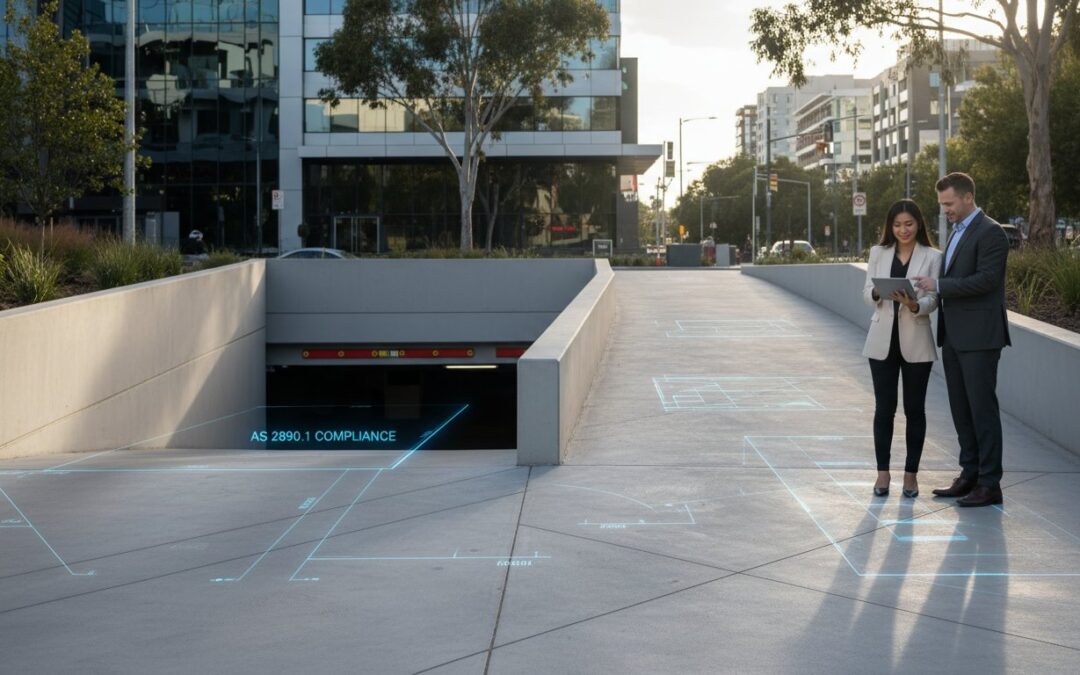
A single centimetre of error in your driveway transition design can trigger a formal Council RFI or a complete DA rejection. For developers and architects, the technicalities of AS 2890.1 often represent the difference between a seamless project handover and an expensive remedial site visit. You understand that non-compliant ramp grades don’t just look poor; they cause physical damage to vehicles and lead to long-term liability issues. It’s a technical bottleneck that stalls construction while you wait for revised engineering drawings.
This guide simplifies the complex technical requirements of the Australian Standards to ensure your project achieves immediate compliance. You’ll gain a clear understanding of the mandatory ramp grade limits and the specific geometric calculations required to prevent vehicle scraping. We draw on 19 years of traffic engineering experience to provide the exact benchmarks Council inspectors look for during site assessments. We’ll examine transition lengths, change of grade thresholds, and the precise design protocols needed for successful council DA approval.
Key Takeaways
- Understand why precise driveway transition design is the leading cause of Council DA delays and how to ensure your project meets AS 2890.1 compliance.
- Identify the maximum allowable ramp grades for both domestic and commercial developments to guarantee seamless vehicle access and safety.
- Learn to integrate critical stormwater drainage and material friction coefficients into your design without violating technical slope requirements.
- Avoid costly design pitfalls on steep sites by mastering the “scrape test” and calculating adequate transition lengths for diverse vehicle types.
- Discover how direct access to senior traffic engineers simplifies the assessment process and secures faster development approvals.
Understanding Driveway Transition Design in Australian Development
Driveway transition design refers to the engineered gradient change where a ramp meets a public road or an internal floor level. It’s the most complex part of a site’s vertical geometry. This zone determines whether a vehicle can enter or exit a property without physical damage. While Understanding Driveway Design covers the basic materials and general layout, the engineering behind the transition requires strict adherence to AS 2890.1. This Australian Standard dictates the maximum changes in grade allowed to prevent vehicle scraping and ensure safe operation.
Faulty transition design is currently the primary cause of Development Application (DA) delays across Australian local councils. Many developers submit plans with steep ramps that lack the necessary vertical curves. When a design fails to account for the B85 or B99 vehicle templates, councils will issue a Request for Further Information (RFI) or refuse the application entirely. Engaging a traffic engineer early in the project prevents these setbacks. Our team has assessed over 10,000 sites since 2005, ensuring every driveway meets these technical regulatory requirements before the first cubic metre of concrete is poured.
To better understand how these transitions are checked during the design phase, watch this technical overview:
The Purpose of a Transition Zone
The transition zone acts as a vital buffer between two different slopes. Without it, a vehicle will likely “bottom out” or “ground” its chassis at the crest or sag of the ramp. This zone facilitates a smooth weight transfer. It protects the vehicle’s suspension and prevents long-term cracking of the driveway surface caused by localized impact loads. It also manages the interface between private property and the public road reserve, ensuring the transition doesn’t interfere with existing gutter lines or critical drainage infrastructure. A well-designed transition ensures that the vehicle’s undercarriage maintains clearance throughout the entire movement.
Regulatory Framework: Why Design Matters
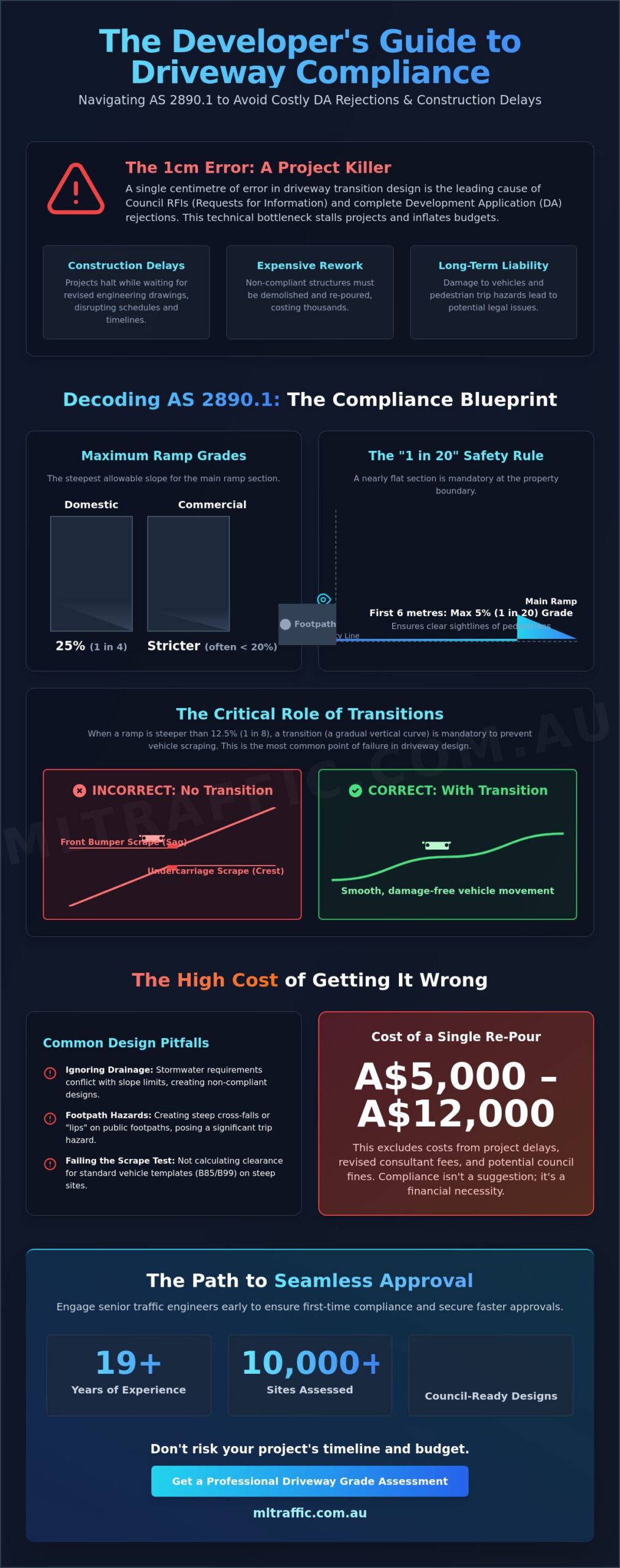
Local councils prioritize pedestrian safety and sidewalk continuity above all else. A poorly planned driveway transition can create “lips” or steep cross-falls on footpaths, posing a significant trip hazard for the public. If a transition is found to be non-compliant after construction, the financial consequences are severe. Re-pouring a single driveway crossover can cost between A$5,000 and A$12,000 in labor and materials, depending on the site’s complexity. Compliance isn’t a suggestion; it’s a structural and legal necessity. Our principals, Michael Lee and Benny Chen, personally oversee these assessments to ensure every design aligns with both AS 2890.1 and specific local government policies.
Technical Specifications: Ramp Grades and AS 2890.1 Requirements
AS 2890.1:2004 serves as the primary Australian Standard for off-street car parking. It provides the engineering framework for driveway gradients to prevent vehicle damage and ensure pedestrian safety. For domestic driveways, the maximum allowable grade is generally 1 in 4 (25%). Commercial environments often require more conservative slopes to accommodate diverse vehicle types and higher traffic volumes. Our team has applied these standards across 10,000 sites to ensure projects pass council inspections without costly redesigns.
The “1 in 20” (5%) rule is a critical safety requirement. It applies to the first 6 metres of a driveway starting from the property line. This relatively flat section ensures drivers have clear sightlines of pedestrians before crossing the footpath. When the main ramp grade is steeper than 1 in 8 (12.5%), a driveway transition design must be implemented to bridge the gap between the steep ramp and the flat road or parking floor. Failure to calculate these ratios correctly leads to vehicles “bottoming out” or scraping their bumpers.
The Mathematics of a Compliant Transition
Calculating a compliant transition requires determining the algebraic difference between two adjoining grades. If you’re moving from a 20% ramp to a 0% level garage floor, the total change is 20%. Because this exceeds the 12.5% threshold, a transition is required. A transition section is mandatory for any grade change exceeding 12.5% per AS 2890.1.
- Transition Length: AS 2890.1 requires a minimum transition length of 2 metres.
- Transition Grade: This section must be set at the average of the two joining grades.
- Example: A transition between a 20% ramp and a 0% floor requires a 2-metre section at a 10% grade.
This 2-metre rule is the industry standard for preventing chassis contact. We use precise calculations to ensure the driveway transition design accounts for the specific wheelbase of the design vehicle.
Domestic vs. Commercial Standards
Commercial standards are more rigorous because they must accommodate the B85 vehicle. This is the 85th percentile design vehicle, which represents the majority of cars on Australian roads. Commercial transitions often require longer horizontal lengths because the risk of property damage and liability is higher in public-facing car parks. Recent updates regarding Council Approval for Driveways show that even residential standards are evolving to prioritize streetscape safety.
Domestic driveways allow for slightly more flexibility, but they don’t escape the physics of vehicle clearance. If your project involves a steep site, you’ll need a detailed AS 2890.1 assessment to verify that the B85 vehicle won’t scrape. ML Traffic Engineers provides the technical documentation needed to satisfy council requirements and avoid DA rejections. You can view our full range of traffic engineering services to see how we handle complex grade transitions.
Beyond the Slope: Critical Elements of Functional Design
Effective driveway transition design involves more than simple gradient calculations. Engineers must evaluate how surface materials and geometric constraints interact with vehicle physics. Material selection impacts the friction coefficient, which is vital for traction on steep transitions. Concrete is the industry standard for durability; however, asphalt offers high initial grip. If you choose pavers, they must be laid on a reinforced concrete base to prevent displacement during heavy braking or acceleration cycles.
Driveway width plays a decisive role in vehicle accessibility. A wider entrance allows for a shallower approach angle, reducing the risk of “bottoming out” for low-clearance vehicles. We integrate swept path analysis early in the design phase to verify that the 99th percentile vehicle can navigate the transition without striking the pavement or encroaching on pedestrian zones. This simulation accounts for both the vertical curve and the horizontal turning radius simultaneously.
Technical considerations for material performance include:
- Concrete: Minimum 25 MPa strength for residential; 32 MPa for commercial.
- Asphalt: High friction but prone to “shoving” on steep grades under heavy loads.
- Pavers: Require high-strength bedding sand and edge restraints to maintain integrity.
Drainage and Stormwater Management
The “valley” transition, where a descending ramp meets a level surface, is a primary site for water accumulation. To prevent pooling and potential hydroplaning, we integrate trench drains at the base of the transition. These drains must be engineered to handle high-flow events without creating a physical “bump” that disrupts vehicle suspension. Most Australian Councils require that all private stormwater is captured at the property boundary to prevent runoff from entering the public gutter system. This often necessitates a grated drain across the full width of the driveway entrance.
Sight Distances and Safety
Compliance with AS 2890.1 requires strict adherence to sight distance standards at the driveway-footpath interface. The goal is to ensure drivers can see pedestrians before the vehicle crosses the walking path. Key requirements include:
- Maintaining a 2.0 metre by 2.5 metre clear sight triangle at the property boundary.
- Restricting fence heights and landscaping to a maximum of 0.9 metres within this zone.
- Ensuring the driveway transition design doesn’t tilt the vehicle nose upward, which can obscure the driver’s immediate foreground view.
Our team reviews site plans to ensure that pillars, letterboxes, and vegetation don’t compromise these critical safety lines. Failing to meet these standards often results in Council refusing the development application. We provide the necessary assessments to ensure every design meets both safety and regulatory benchmarks.
Avoiding DA Rejection: Common Driveway Design Pitfalls
Driveway design isn’t just about pouring concrete; it’s a precise engineering requirement. Many Development Applications (DA) fail because the driveway transition design doesn’t account for the physical reality of vehicle movement. A frequent error involves ignoring the specific “crossover” levels provided by the local council. If your design doesn’t match the invert levels at the kerb and the boundary levels set by the authority, the entire ramp geometry becomes invalid. This oversight leads to costly site re-works or outright rejection from council planners.
The “Scrape Test” represents the ultimate hurdle for developers. If a vehicle scrapes its chassis during the final inspection, you won’t receive your Occupation Certificate. Designers often fail to account for the “worst-case” vehicle. While a standard sedan might clear a sharp peak, a long-wheelbase van or a low-slung sports car will bottom out on a poorly designed transition. We’ve seen projects delayed by months because the transition lengths were too short for steep sites, a common error when developers prioritize floor space over functional access.
The Scrape Point Risk
Australian Standards require specific ground clearance checks to prevent vehicle damage. We analyze the “break-over angle,” which is the maximum supplementary angle a vehicle can drive over without the apex of the incline touching the undercarriage. Engineers use standardized vehicle templates to simulate this movement across the profile. A 1:8 grade is the absolute maximum for most residential transitions because steeper inclines inevitably cause under-chassis contact for standard vehicles. If your site is steep, you must increase the length of the transition to flatten the angle. Shortening these sections to save space is a guaranteed way to trigger a council requisition.
Council Compliance and Documentation
Councils require a formal Driveway Ramp Grade Assessment for any site with a gradient exceeding 1:20. You can’t rely on “standard” driveway drawings for non-level terrain. These generic plans don’t factor in the unique topography of your lot or the specific road crown heights. A professional certification within a Traffic Impact Assessment provides the technical assurance planning officers need. Many developers lose significant time because they submitted basic architectural lines instead of detailed engineering profiles. Accurate documentation must show the longitudinal section from the road centerline through to the garage floor to prove compliance with AS 2890.1.
Ensure your driveway transition design meets all regulatory standards before you lodge your application. Contact the experts at ML Traffic Engineers for a compliant ramp grade assessment.
Professional Driveway Grade Assessments for Council Approval
ML Traffic Engineers streamlines the Development Application (DA) process for developers by delivering technical precision and regulatory expertise. We focus on private clients who require fast, accurate assessments to satisfy council conditions. Our approach is principal-led. This means you have direct access to senior engineers Michael Lee and Benny Chen throughout your project. We don’t use junior staff as gatekeepers. The traffic consultant who provides your quote is the person who performs the work. This accountability ensures that complex driveway transition design requirements are met without the errors common in larger, more impersonal firms.
Our workflow moves from your initial quote to full compliance efficiently. We’ve traded since 2005 and completed assessments for over 10,000 sites across Australia. This extensive experience allows us to navigate the specific demands of local councils and ensure your project adheres to AS 2890.1 and AS 2890.2 standards. Whether you’re developing a residential apartment or a commercial warehouse, we provide the technical documentation required for approval. We understand the bureaucratic requirements of traffic engineering inside and out.
Our Assessment Process
We utilize advanced software for 3D ramp grade modeling to visualize and test every aspect of your access point. This technology allows us to identify potential scraping issues or clearance problems before they reach the construction phase. We specialize in solving complex access issues on steep blocks that other firms might label “impossible.” By applying the specific geometry allowed under AS 2890.1, we create compliant solutions for difficult terrain. Our team provides the necessary certifications to satisfy council conditions, backed by our professional registrations and decades of experience. Our assessments cover a vast range of land-use types, including:
- Residential apartments and townhouses
- Childcare centers and schools
- Medical clinics and hospitals
- Shopping centers and retail strips
- Warehouses and industrial subdivisions
- Places of public worship and community centers
Get Started with ML Traffic Engineers
Experience is your best insurance against DA rejection. With Michael Lee and Benny Chen each bringing between 30 and 40 years of engineering experience to the table, we understand the nuances of traffic planning. We provide a hands-on service that is dependable, meticulous, and results-oriented. A poorly executed driveway transition design can lead to costly redesigns or council refusal. Our direct-access model ensures your project stays on track. Contact Michael Lee or Benny Chen directly for project advice that cuts through bureaucracy and focuses on technical compliance.
Securing Your Development Approval with AS 2890.1 Compliance
Achieving a compliant driveway transition design is essential for any successful Australian development application. Precision in ramp grades and transition lengths prevents vehicle scraping. It ensures your project meets the rigorous technical specifications of AS 2890.1. At ML Traffic Engineers, we’ve assessed over 10,000 sites across Australia. This provides us the technical depth to handle complex site constraints and steep terrain. You’ll work directly with principals who possess more than 30 years of experience. We operate on a direct accountability model; the consultant who quotes the work, does the work. This ensures your assessment is accurate, professional, and ready for council scrutiny. Don’t let a technical oversight lead to a DA rejection or costly site modifications. Our authoritative approach provides the reliability you need to move your project forward without delays. It’s a straightforward path to compliance. We look forward to helping you secure your approval.
Ensure your driveway design is council-compliant—get an expert assessment today.
Frequently Asked Questions
What is the maximum grade for a driveway in Australia according to AS 2890.1?
The maximum grade for a private residential driveway is 1 in 4, which equals a 25 percent gradient. This limit applies specifically to domestic properties where traffic volume is low. For sections longer than 20 metres, the standard recommends a maximum gradient of 1 in 5 to ensure vehicle traction and safety. Local councils often enforce these specific ratios during the Development Application process to ensure compliance with Australian Standards.
How long should a driveway transition be to prevent car scraping?
A standard driveway transition design requires a minimum length of 2.0 metres at both the top and bottom of a steep ramp. These 2.0 metre sections use a gradient that’s exactly half the main ramp’s grade. For example, a 1 in 4 ramp requires a 1 in 8 transition. This specific geometry prevents the vehicle’s chassis or bumper from scraping the pavement surface as the car moves between different slopes.
Do I need a traffic engineer for a residential driveway DA?
You’ll need a traffic engineer for a residential DA if your site has a gradient exceeding 1 in 20 or if your council requires a formal Traffic Impact Statement. Many local government areas in New South Wales and Victoria mandate an RPEQ or NER certified engineer to sign off on driveway compliance. Professional assessment ensures your plans meet AS 2890.1 requirements before you submit them to council, which reduces the risk of costly redesigns.
What is a swept path analysis and do I need one for my driveway?
A swept path analysis is a computer generated simulation that tracks the path of a vehicle’s body and wheels during a turn. You need this for your driveway if the layout involves tight turns, narrow widths, or basement car parking. We use industry standard software like AutoTURN to verify that a B85 vehicle can enter and exit your property in a single forward motion. This is a common requirement for DA approval in urban areas.
Can I use a 1 in 4 grade for my driveway if I have a transition?
You can use a 1 in 4 grade for your driveway provided you include the mandatory 2.0 metre transitions at the summit and the base. AS 2890.1 Clause 2.5.3 states that any ramp steeper than 1 in 8 must have these transitions to prevent bottoming out. Without a 1 in 8 transition at each end, a 1 in 4 ramp will likely cause vehicle damage and fail a council inspection.
What happens if my driveway transition is built and it doesn’t comply with standards?
If your driveway transition is built and doesn’t comply with AS 2890.1, the local council can issue a rectification order. This often requires the total demolition and reconstruction of the concrete ramp at the owner’s expense. Non-compliant driveways also create liability risks. If a vehicle is damaged, insurance companies may deny claims because the structure doesn’t meet Australian Standards, leaving the property owner responsible for repair costs.
What is the B85 vehicle and why is it used in driveway design?
The B85 vehicle is a design template representing the 85th percentile of cars on Australian roads. It measures 4.91 metres long and 1.87 metres wide. Engineers use this specific model to test driveway transition design and ensure the majority of passenger vehicles can navigate the ramp without scraping. Designing for the B85 ensures your property is accessible to almost all standard cars, from sedans to large SUVs, as required by AS 2890.1.
How much does a professional driveway ramp grade assessment cost?
A professional driveway ramp grade assessment typically costs between A$900 and A$2,500 depending on the complexity of the site and the specific council requirements. This fee covers the site survey, compliance checking against AS 2890.1, and the provision of a certified report for your DA. Prices vary based on whether you require a simple longitudinal section or a full swept path analysis for a multi-unit development.

Disclaimer
The content on www.mltraffic.com.au, including all technical articles, guides, and resources, is provided for general informational and educational purposes only. It is not intended to constitute professional advice in traffic engineering, transportation planning, development approvals, or any other technical or legal field.
While ML Traffic Engineers makes every reasonable effort to ensure the accuracy, completeness, and timeliness of the information published, we do not provide any warranties or representations (express or implied) regarding its reliability, suitability, or availability for any particular purpose. Any reliance you place on the content is strictly at your own risk.
In no event shall ML Traffic Engineers, its directors, employees, authors, or affiliates be liable for any direct, indirect, incidental, special, consequential, or punitive damages (including, without limitation, loss of profits, data, or business opportunities) arising out of or in connection with the use of, or inability to use, any information provided on this website.
The articles and guides on this site are not a substitute for engaging a qualified, registered professional traffic engineer (such as an NPER or RPEQ engineer) to assess your specific project requirements. For tailored advice, compliance assessments, or traffic engineering services, please contact a competent professional.
This disclaimer may be updated from time to time without notice. By accessing or using this website, you agree to be bound by the most current version of this disclaimer.
