

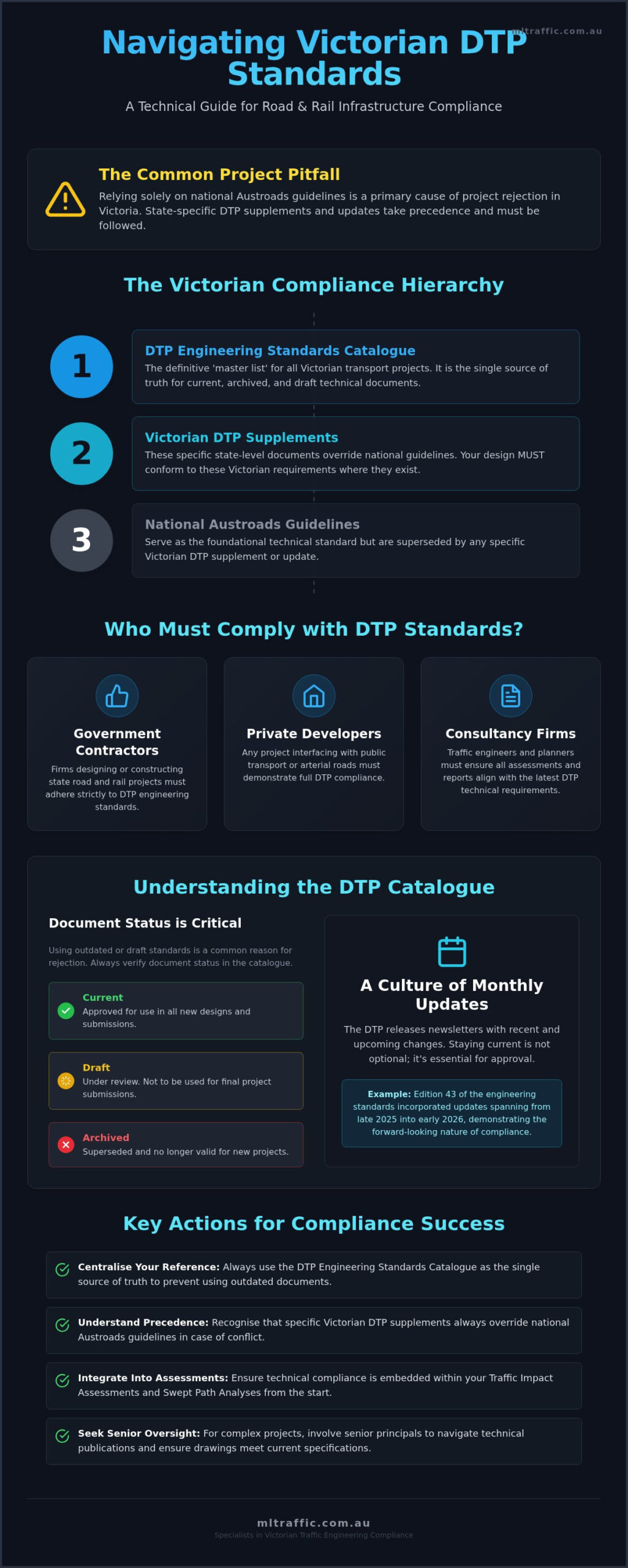
Relying solely on national Austroads guidelines is the fastest way to have your Victorian infrastructure project rejected during the first round of review. You likely understand the frustration of submitting a meticulous design only to find it fails to meet a specific Victorian supplement or a monthly technical update that wasn’t on your radar. Navigating the rigid hierarchy of the dtp standard is often more complex than the engineering work itself.
This guide provides a definitive technical overview of the Department of Transport and Planning (DTP) standards to ensure your next submission aligns with current regulatory expectations. We’ll clarify how DTP supplements override national codes, identify the exact publications required for road and rail compliance, and explain how to integrate these requirements into your Traffic Impact Assessments. We also detail the necessary steps to stay current with the monthly newsletter updates that frequently alter drafting and engineering specifications. By the end of this guide, you’ll have the framework needed to ensure every drawing and specification meets the latest Edition 43 requirements.
Key Takeaways
- Learn how the Department of Transport and Planning (DTP) functions as the central Victorian authority for infrastructure safety and uniformity.
- Identify the correct technical publications within the dtp standard framework using the Engineering Standards Catalogue to prevent project rejections.
- Understand the hierarchy between national Austroads guidelines and the specific Victorian DTP supplements that govern road and rail design.
- Discover how to integrate technical compliance into your Traffic Impact Assessment and Swept Path Analysis for successful development approvals.
- Recognise the importance of senior principal oversight when navigating complex technical publications to ensure all drawings meet current specifications.
Understanding the DTP Standard Framework
The Department of Transport and Planning (DTP) serves as the central authority for Victoria’s transport network. It oversees the planning, development, and management of road and rail assets. The dtp standard is not a single document. It is a comprehensive suite of technical publications designed to ensure all infrastructure is safe, uniform, and compliant. These standards govern the entire asset lifecycle. This includes initial concept design, construction, and long term asset management. By centralising these requirements, the DTP ensures that every project, regardless of scale, contributes to a cohesive transport system.
To better understand the scope of these technical requirements, watch this helpful video:
The Shift to Unified Transport Standards
The transition to a unified framework was a deliberate move to consolidate legacy standards from VicRoads and Public Transport Victoria (PTV). Previously, separate agencies often led to technical contradictions, particularly in multi-modal projects where road and rail interfaces overlapped. By integrating these disciplines, the DTP has created a streamlined system that reduces ambiguity for practitioners. A significant feature of the modern dtp standard landscape is the emphasis on digital engineering. This approach uses data-rich models to improve project delivery and asset performance. It ensures that technical specifications remain consistent across all transport modes, from tram networks to arterial roads.
Who Must Comply with DTP Technical Publications?
Compliance is mandatory for any entity interacting with state-managed transport networks. This includes:
- Government Contractors: Firms engaged in the design or construction of state road and rail projects must adhere strictly to DTP engineering standards.
- Private Developers: Any development project that interfaces with public transport assets or requires access to the arterial road network must demonstrate compliance.
- Consultancy Firms: Traffic engineers and planners must verify that their submissions, including professional assessments and design reports, align with the latest DTP technical requirements.
Failing to meet these standards often results in council rejection or significant delays in the planning approval process. The DTP updates its catalogue regularly. This means that what was compliant six months ago might not meet current specifications. Professionals at ML Traffic Engineers Australia remain vigilant regarding monthly technical updates to ensure project continuity and regulatory approval. Direct involvement from experienced principals is often required to manage this technical complexity effectively.
The DTP Engineering Standards Catalogue and Categories
Practitioners must treat the DTP Engineering Standards Catalogue as the definitive master list for all Victorian transport projects. This Excel-based repository serves as the primary reference point for engineers, designers, and planners. It organises technical publications into distinct categories, including Road, Rail, Digital Engineering, and Asset Management. Because the dtp standard is subject to frequent revisions, the catalogue distinguishes between current, archived, and draft documents. Using an archived version for a contemporary design is a common cause for project rejection. Maintaining compliance requires a disciplined approach to document control.
Staying aligned with these requirements involves more than a one-time download. The DTP operates a monthly update culture, releasing newsletters that summarise recent and upcoming changes. For example, Edition 43 of the engineering standards recently incorporated updates spanning from late 2025 into early 2026. These updates ensure that infrastructure reflects current best practices in safety and technology. If you are unsure whether your current project files are up to date, consulting with senior traffic engineering principals can help verify your submission against the latest catalogue release.
Core Engineering Disciplines
The catalogue breaks down technical requirements into specialised disciplines to ensure structural and operational integrity. These include:
- Pavements, Geotechnical, and Materials: Standards governing the structural layers of roads and the quality of raw materials used in construction.
- Bridges and Structures: Detailed specifications for civil infrastructure, including crossings, retaining walls, and gantries.
- Intelligent Transport Systems (ITS): Technical requirements for electrical and digital road management tools, such as lane control systems and CCTV networks.
Landscape and Urban Design (LUD)
Infrastructure compliance extends beyond bitumen and concrete. The Landscape and Urban Design (LUD) category manages the interface between transport corridors and the community. A critical component is the DTP Tree Policy, which dictates how vegetation is managed within road corridors to balance environmental goals with clear-zone safety. These guidelines ensure that urban design elements don’t compromise sight distances or structural clearances. Integrating LUD specifications early in the design phase prevents costly retrofits and ensures the dtp standard is met for both aesthetic and functional requirements. Professional oversight ensures these diverse specifications are consolidated into a single, compliant civil engineering plan.
Key Standards for Traffic Engineering and Road Design
The Traffic Engineering Manual (TEM) is the primary tool for transport planners. It provides the operational framework for the Victorian road network. While national standards exist, Navigating DTP Compliance requires a deep understanding of how Victorian supplements override or refine the national Austroads Guide to Road Design (AGRD). These supplements are critical. They address Victorian-specific legislative requirements and environmental conditions that national guides don’t cover. Relying only on national codes without checking the dtp standard usually leads to design failures during the audit phase.
The Traffic Engineering Manual (TEM) Volumes
The TEM is divided into three distinct volumes. Each serves a specific engineering purpose for practitioners:
- Volume 1: Focuses on traffic management and operational policy. It establishes the strategic direction for how traffic flows across the state network.
- Volume 2: Contains technical specifications for signs and pavement markings. Consistency here is vital for driver recognition and safety.
- Volume 3: Provides guidance on traffic signals and intersection control. This volume is the primary resource for signalised junction design.
Following these volumes ensures that every element, from a single line marking to a multi-phase intersection, functions safely within the broader network. It’s the only way to guarantee that a design will be accepted by the relevant road authority.
Road Design and Drainage Supplements
Victorian road design requires strict adherence to Technical Notes and Road Design Notes (RDN). These documents serve as mandatory supplements to the AGRD. They define Victorian-specific requirements for road geometry, safety barriers, and lane widths. Pavement Codes of Practice are also essential. They ensure the structural integrity and longevity of the road surface by dictating specific material qualities and construction methods.
Uniformity in water management is equally important. Standard Drawings for Drainage provide the technical blueprints for pits, pipes, and headwalls. These drawings ensure that every drainage asset on the state network is constructed to a uniform specification. This uniformity simplifies maintenance and ensures that water management systems perform predictably during heavy rain events. Adhering to the dtp standard for drainage is a non-negotiable requirement for any project involving state-managed road assets. Integrating these complex technical notes into a project requires precision. Many developers find that specialised traffic engineering services are necessary to ensure all designs meet the exact requirements of the Victorian DTP.
Navigating DTP Compliance for Development Applications
For developers and urban planners, the dtp standard is the non-negotiable benchmark for project approval. Any development that interfaces with the state road network or public transport assets undergoes a rigorous referral process. A Traffic Impact Assessment must do more than just project traffic volumes. It must demonstrate that the proposed site access and internal circulation align with DTP technical publications. This includes proving that car park designs meet both the national AS 2890.1 code and the specific DTP supplements that often dictate more stringent ramp grades and aisle widths. Managing the interface between private driveways and the public road network requires precise engineering to ensure safety isn’t compromised at the property boundary.
Proving site access compliance is impossible without a detailed Swept Path Analysis. This assessment uses specialised software to simulate the movements of design vehicles, such as waste collection trucks or emergency services, as they navigate the site. The DTP requires proof that these vehicles can enter and exit in a forward motion without crossing into opposing traffic lanes or striking kerbs. If your project involves a complex driveway or a tight loading bay, our senior engineers can provide a professional swept path assessment to guarantee your design meets Victorian regulatory requirements.
Common Compliance Pitfalls in Planning
Project delays often stem from using outdated VicRoads drawings instead of current DTP specifications. Because the Department updates its catalogue monthly, designers frequently miss changes to pavement markings or drainage pits. Another common failure is the incorrect application of sight distance requirements. DTP standards for Safe Intersection Sight Distance (SISD) often exceed the basic requirements found in local planning schemes. Failing to account for these specific metrics at the design phase leads to costly redesigns after the council referral response is received. Additionally, every construction phase must be supported by a Traffic Guidance Scheme (TGS) that complies with the latest DTP work-site safety codes.
Professional Certification and Reporting
Engaging a qualified Traffic Engineer is essential for signing off on compliant designs. Professional certification carries significant weight with referral authorities and can expedite the approval process. A detailed report provides the evidence needed to satisfy council queries regarding parking demand and vehicle movements. This reporting must also ensure that waste management plans align with vehicle access standards, preventing operational issues once the building is occupied. Meticulous documentation and adherence to the dtp standard are the only ways to ensure a seamless transition from the planning phase to construction. Direct principal involvement in these technical assessments ensures that every potential compliance hurdle is identified and resolved before submission.
Professional Consultancy for DTP Standard Compliance
Navigating the complex technical layers of the DTP Engineering Standards Catalogue requires more than just access to documents. It demands seasoned expertise to interpret how these regulations apply to specific site constraints. While government bodies provide the framework, they do not offer the project-specific design consultancy required for private development approvals. Professional traffic engineering is therefore indispensable. Meticulous adherence to the dtp standard is the only way to avoid the bureaucratic delays that often plague infrastructure projects during the referral process.
At ML Traffic Engineers Australia, we bridge the gap between complex regulatory requirements and successful council outcomes. With over 15 years of experience in transport planning and civil engineering, we understand the nuances of Victorian compliance. Our methodology is built on accountability and technical precision. We don’t just provide reports; we provide a clear pathway to approval by ensuring every design element aligns with current Department of Transport and Planning specifications. This direct involvement ensures that technical hurdles are resolved before they impact your project timeline.
The ML Traffic Engineers Australia Advantage
Our firm operates on a principle of personnel continuity. The expert who initiates your client relationship is the same professional who performs the technical work. This approach ensures that project knowledge is never lost in transition between junior staff and senior reviewers. We offer a comprehensive suite of services, including Traffic Impact Assessments, Vehicle Swept Path Analysis, and detailed Car Park Design. By focusing on a results-oriented methodology, we minimise unnecessary delays and ensure that your submission is robust enough to withstand the most rigorous referral audits. Our commitment to accuracy means your designs meet the dtp standard the first time.
Securing Your Project Approval
Early engagement is the most effective strategy for managing compliance risks. Initiating a professional traffic assessment during the preliminary design phase allows us to identify potential conflicts before they become costly construction issues. Whether you are managing a small-scale residential development or a large-scale commercial project, our senior leadership is available for direct, no-gatekeepers consultation. This direct access to expertise ensures that your queries are answered by the individuals actually performing the technical assessments. We provide the technical assurance needed to navigate the Victorian planning system with confidence and reliability.
To secure your project approval and ensure full compliance, contact our senior principals directly. We offer a transparent, hands-on service that prioritises your project’s success through meticulous engineering and regulatory expertise.
Securing Regulatory Approval for Transport Projects
Navigating Victorian transport infrastructure requires a rigorous commitment to the dtp standard and a proactive approach to the Department’s monthly technical updates. As established, the hierarchy between national guidelines and Victorian supplements is strict. Failing to align your technical reporting with these specific requirements often leads to council rejections and avoidable project delays. Compliance is an ongoing technical requirement that must be maintained from the initial design phase through to final asset management.
ML Traffic Engineers Australia provides the technical certainty needed for complex development approvals. With over 15 years of transport planning expertise, our senior principals manage every project personally to ensure your designs meet every regulatory benchmark. We provide national coverage with deep regulatory knowledge, ensuring your submissions are robust and compliant from the outset. Contact ML Traffic Engineers Australia for expert DTP compliance and traffic reporting to discuss your specific site requirements. We’re ready to help you achieve a seamless approval for your next infrastructure project.
Frequently Asked Questions
What is the difference between VicRoads standards and DTP standards?
DTP standards represent the unified framework that consolidated legacy VicRoads and Public Transport Victoria (PTV) technical documents. While many practitioners still refer to VicRoads drawings, these are now managed under the Department of Transport and Planning. The current dtp standard ensures a consistent approach across all transport modes. It’s essential to use the unified versions to avoid technical contradictions that occurred when agencies operated separately.
How often does the DTP Engineering Standards Catalogue get updated?
The DTP Engineering Standards Catalogue is updated on a monthly basis to reflect the latest safety and engineering advancements. For instance, Edition 43 recently incorporated technical revisions published between November 2025 and January 2026. Because these changes are frequent, practitioners must verify their project specifications against the most recent Excel catalogue. Working from outdated versions usually leads to council referral delays or project rejections.
Where can I find DTP standard drawings for road drainage?
You can access standard drawings for road drainage through the official DTP technical publications portal on the vic.gov.au website. These drawings are categorised within the Engineering Standards Catalogue under the drainage and civil structures sections. They provide uniform specifications for pits, pipes, and headwalls across the state network. Using these standardised designs is mandatory for any project that interfaces with public drainage assets managed by the Department.
Does a Traffic Impact Assessment need to reference DTP technical publications?
A Traffic Impact Assessment must reference relevant DTP technical publications whenever a development interfaces with state-managed road or rail corridors. Council and DTP referral officers require evidence that your project aligns with the current dtp standard for access and safety. This includes demonstrating compliance with specific Victorian supplements that override national Austroads guidelines. Professional reporting by a senior engineer ensures these technical references are accurate and up to date.
What are DTP supplements to the Austroads guides?
DTP supplements are mandatory technical documents that modify or refine the national Austroads Guide to Road Design (AGRD) for the Victorian context. These supplements address state-specific legislative requirements, environmental factors, and operational policies that national codes don’t cover. Practitioners must apply these Victorian-specific rules to ensure their designs are legally compliant. Relying solely on national standards without checking DTP supplements often results in designs failing the state audit process.
Can I use archived DTP standards for a current development application?
You cannot use archived DTP standards for a current development application. Referral authorities require all submissions to meet the specifications in the most recent monthly update. Using archived documents usually results in immediate rejection, as older standards don’t reflect current safety or structural requirements. Our senior principals always verify designs against the latest catalogue release to ensure that every drawing and specification meets the current regulatory benchmark.
How do I subscribe to the DTP Standards Newsletter for monthly updates?
You can subscribe to the DTP Standards Newsletter directly through the official Department of Transport and Planning technical publications webpage. This free monthly service provides a summary of all recent and upcoming changes to the engineering standards. It’s the most reliable way for traffic engineers and developers to stay informed about technical revisions. Subscribing ensures you don’t miss critical updates to drafting standards or pavement codes of practice.
Who is responsible for verifying DTP compliance on a construction site?
The responsibility for verifying DTP compliance on a construction site rests with the lead contractor and the project’s supervising engineer. However, the traffic engineer who prepared the initial designs is responsible for ensuring those plans meet the Department’s specifications before construction begins. On-site audits by DTP officers may also occur to verify that the physical infrastructure matches the approved technical specifications. Professional certification of the design is a critical first step.

Disclaimer
The content on www.mltraffic.com.au, including all technical articles, guides, and resources, is provided for general informational and educational purposes only. It is not intended to constitute professional advice in traffic engineering, transportation planning, development approvals, or any other technical or legal field.
While ML Traffic Engineers makes every reasonable effort to ensure the accuracy, completeness, and timeliness of the information published, we do not provide any warranties or representations (express or implied) regarding its reliability, suitability, or availability for any particular purpose. Any reliance you place on the content is strictly at your own risk.
In no event shall ML Traffic Engineers, its directors, employees, authors, or affiliates be liable for any direct, indirect, incidental, special, consequential, or punitive damages (including, without limitation, loss of profits, data, or business opportunities) arising out of or in connection with the use of, or inability to use, any information provided on this website.
The articles and guides on this site are not a substitute for engaging a qualified, registered professional traffic engineer (such as an NPER or RPEQ engineer) to assess your specific project requirements. For tailored advice, compliance assessments, or traffic engineering services, please contact a competent professional.
This disclaimer may be updated from time to time without notice. By accessing or using this website, you agree to be bound by the most current version of this disclaimer.
