
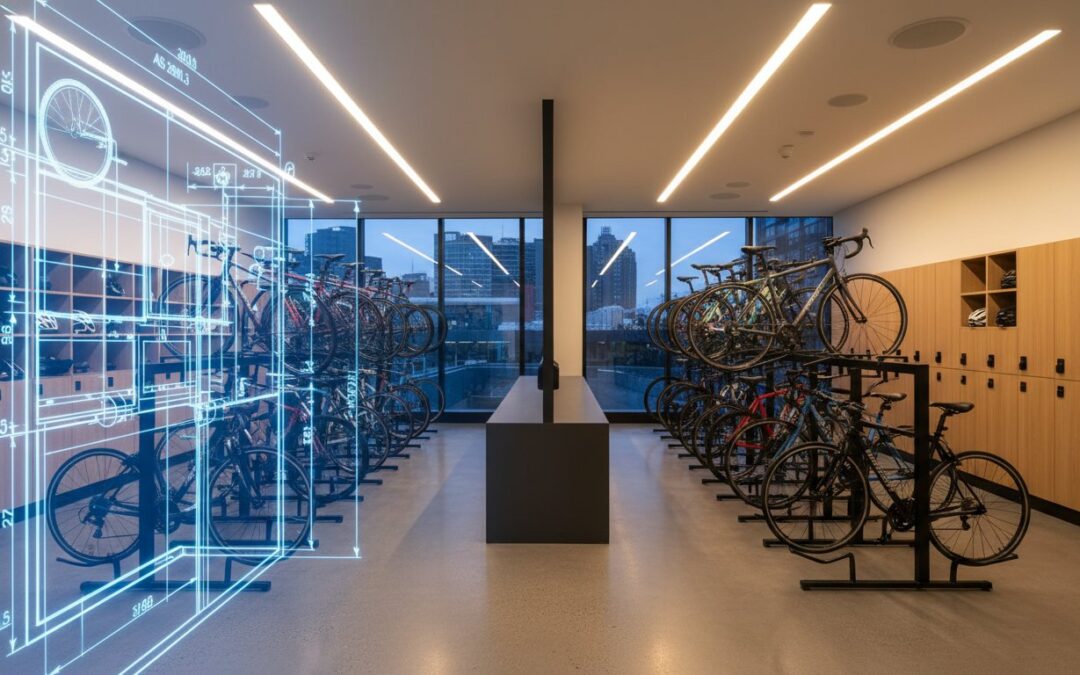
A single non-compliant aisle width or an overlooked spacing envelope in your bicycle parking layout can trigger a costly Development Application rejection. For developers and architects, end-of-trip facilities design for cyclists AS 2890.3 is a technical hurdle where precision is the only path to approval. You likely already know that balancing high-yield parking with genuine usability is a complex task, especially as local councils tighten their scrutiny on active transport infrastructure.
This comprehensive guide provides the authoritative technical breakdown you need to master AS 2890.3:2015 requirements and optimize your building’s floor plate. We’ll show you how to design compliant, high-performance facilities that satisfy both the National Construction Code and the expectations of premium tenants. You’ll learn the exact dimensions for various parking classes, necessary clearance zones, and how to integrate emerging requirements like e-bike charging stations to secure your project’s Green Star ratings. We provide the expertise required to move from complex regulatory text to a fully approved, functional design.
Key Takeaways
- Understand why AS 2890.3:2015 is the non-negotiable benchmark for all new Australian development approvals and Green Star ratings.
- Master the exact spacing envelopes and aisle widths required for compliant end-of-trip facilities design for cyclists AS 2890.3 to prevent costly redesigns.
- Differentiate between Class A and Class B parking grades to ensure your facility meets the specific security and access requirements of your project.
- Identify common compliance pitfalls, such as failing to meet the 20% minimum horizontal parking mandate or neglecting handle-bar clearance zones.
- Learn how to effectively document bicycle parking layouts within a Traffic Impact Assessment (TIA) to facilitate a more efficient certification process.
Table of Contents
-
The Fundamentals of AS 2890.3:2015 for Australian Developments
-
Core Design Requirements: Spacing Envelopes and Aisle Widths
-
Classification of Bicycle Parking Facilities: Selecting the Right Grade
-
Common Compliance Pitfalls in End-of-Trip (EoT) Facility Design
-
Integrating AS 2890.3 into Your Traffic Impact Assessment (TIA)
The Fundamentals of AS 2890.3:2015 for Australian Developments
AS 2890.3:2015 serves as the definitive national standard for bicycle parking in Australia. It provides the technical framework necessary for the design and installation of facilities that support active transport. Adhering to these specifications is mandatory for developers seeking compliance with the National Construction Code (NCC). Understanding The Fundamentals of Bicycle Parking is essential for any project requiring a Traffic Impact Assessment (TIA). Failure to meet these benchmarks often results in planning permit delays or outright rejection by local councils.
The 2015 update marked a significant shift from the previous 1993 version. While the older guidelines were highly prescriptive, the current standard adopts a performance-based approach. This allows for greater flexibility in end-of-trip facilities design for cyclists AS 2890.3, provided that the design meets specific safety and accessibility metrics. Local governments mandate strict adherence to ensure new developments contribute to sustainable urban goals. They look for evidence that storage areas don’t become congested or unusable over time.
To better understand this concept, watch this helpful video:
High-performance developments often target 5 or 6-star Green Star ratings. The Green Building Council of Australia (GBCA) incentivizes compliant facilities under the "Sustainable Transport" category. Similarly, NABERS ratings increasingly reflect the quality of active transport amenities. Integrating e-bike charging stations and ventilated lockers isn’t just a matter of compliance. It’s a strategic decision to attract premium commercial tenants who value employee wellness. Effective integration begins with a professional Car Park Design that accounts for these technical requirements from the initial drafting phase.
The Objectives of Compliant End-of-Trip Design
Compliant design focuses on three primary outcomes. First, it ensures the security of property through defined parking classes. Second, it facilitates ease of use by mandating specific spacing envelopes and aisle widths. Finally, it minimizes physical conflict between cyclists, pedestrians, and motor vehicles. This structured approach reduces the risk of accidents within shared parking environments and encourages more people to choose cycling for their daily commute.
Scope of Application Across Land Use Types
The standard applies differently across various land use categories. High-density residential projects prioritize long-term, secure storage for residents. Commercial office developments require a combination of high-security lockers and change-room facilities for daily commuters. Retail and education environments typically focus on visitor parking, which demands high visibility and rapid turnover. Distinguishing between these user needs is critical for optimizing the floor plate and ensuring the facility remains functional throughout the building’s lifecycle.
Core Design Requirements: Spacing Envelopes and Aisle Widths
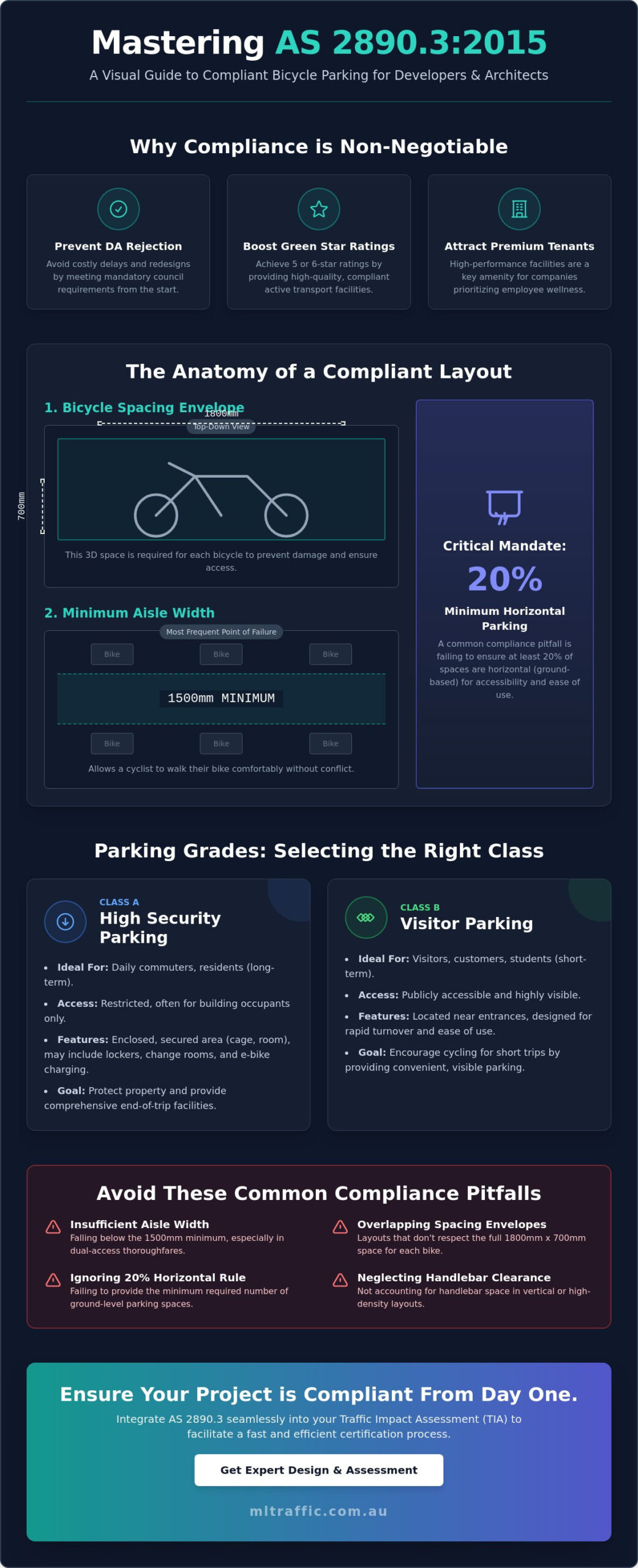
Precision in end-of-trip facilities design for cyclists AS 2890.3 starts with the bicycle spacing envelope. This envelope defines the three-dimensional space required to store a single bicycle without interference. A standard adult bicycle occupies a footprint of approximately 1800mm in length and 700mm in width. Designers must ensure these envelopes don’t overlap in a way that prevents access to locking points or causes physical damage to the equipment. Accurate mapping of these envelopes is the primary defense against DA rejection.
Aisle widths are the most frequent point of failure in development applications. A minimum aisle width of 1500mm is generally necessary to allow a cyclist to walk their bike comfortably. If the aisle serves as a dual-access thoroughfare, this width must often increase to accommodate passing traffic. Consult the Austroads Guidelines for Design and Installation for best-practice examples of maneuvering clearances. Effective aisle calculation must account for the "swept path" of a bicycle being turned into a rack, not just the static storage footprint.
Compliance mandates that at least 20% of all provided spaces are ground-level, horizontal racks. This requirement ensures accessibility for users who can’t lift heavy bikes or those using non-standard frames, such as cargo bikes or those with panniers. Over-relying on vertical storage to save space is a common error that leads to non-compliance. Integrating these requirements early into your professional car park design avoids the need for structural changes later in the development cycle.
Horizontal vs. Vertical Parking Configurations
Floor-mounted U-rails provide the highest level of stability and security. They accommodate the widest variety of bicycle types and are the preferred choice for visitor parking. Vertical wall-mounted systems are often used for high-yield requirements but introduce specific compliance hurdles. To meet AS 2890.3, vertical racks must be staggered in height, typically by 300mm, to prevent handlebar interference. While vertical systems maximize the floor plate, they require greater ceiling heights and aren’t suitable for all demographics.
Dynamic and Mechanical Parking Systems
Two-tier, gas-strut assisted racks are increasingly common in space-constrained urban developments. These systems have a dynamic operating envelope that extends into the aisle during the loading phase. You must ensure this temporary infringement doesn’t block primary egress routes or create safety hazards. Sliding or pivoting mechanical systems also require specific clearance zones to function. Engineering these systems requires a meticulous check of the manufacturer’s operating specifications against the spatial constraints of the site. The mechanical hardware must not reduce the effective width of the adjacent access aisles when the system is in its active state.
Classification of Bicycle Parking Facilities: Selecting the Right Grade
The standard categorizes bicycle parking into three distinct classes based on the level of security and the intended duration of use. Selecting the correct classification is a vital step in end-of-trip facilities design for cyclists AS 2890.3 compliance. Class A represents the highest security tier, consisting of individual lockers that protect the entire bicycle and accessories from theft and weather. Class B facilities are locked compounds or shared cages with restricted access, typically intended for long-term employee use. Class C covers publicly accessible racks and rails, such as U-frames, designed for short-term visitor parking. Most local council Development Control Plans (DCPs) mandate a specific ratio of these classes based on the building’s total floor area and land use type.
Determining the appropriate mix requires a detailed understanding of the intended user journey. A 2025 national survey indicated that 38% of commuters view secure storage as a primary motivator for cycling. Under-specifying Class B facilities in a commercial development often leads to tenant dissatisfaction and potential non-compliance with modern planning permits. Integrating these classes into a formal Traffic Impact Assessment (TIA) Report ensures the proposed mix meets specific council requirements and supports the project’s Green Star objectives.
Class A and B: Long-Term Security for Employees
Secure cages for Class B parking must meet rigorous construction standards to be considered compliant. This includes specifying a minimum fencing height and a mesh size that prevents unauthorized persons from reaching through to manipulate locking mechanisms. Access control should be integrated with the building’s main security system, utilizing RFID, mobile app technology, or secure key-based systems. High-tier end-of-trip rooms also require adequate lighting and ventilation to maintain a safe, professional environment. Effective design ensures the layout allows for efficient cleaning and maintenance of both the flooring and the racks.
Class C: Visitor Parking and Short-Stay Accessibility
Class C facilities must be positioned in highly visible locations close to the main building entrance. They should be sheltered from weather where possible to encourage use during inclement periods. It’s essential that these racks don’t obstruct pedestrian footpaths or create hazards for people with limited mobility. Designers must also verify that the placement of Class C rails does not interfere with vehicle sightlines at driveway exits. Using durable, corrosion-resistant materials is a requirement for any outdoor infrastructure to ensure long-term functionality and a professional appearance.
Common Compliance Pitfalls in End-of-Trip (EoT) Facility Design
Many development applications fail at the final assessment stage due to fundamental errors in spatial planning. Inadequate aisle widths remain a primary cause for DA rejection. Designers often calculate minimum widths based on the bicycle frame alone, neglecting the 700mm to 800mm span of handlebars or the additional width of loaded panniers. When end-of-trip facilities design for cyclists AS 2890.3 is executed without these tolerances, the facility becomes functionally unusable during peak commute times. This leads to congestion and potential damage to equipment.
Another recurring pitfall is the disproportionate use of vertical wall-mounted racks to maximize yield. AS 2890.3:2015 mandates that at least 20% of spaces are ground-level, horizontal racks. Failing to meet this minimum requirement is a direct breach of the standard. It frequently results in "not fit for purpose" findings during the certification process. Access routes that force cyclists to navigate stairs or ramps with steep grades also trigger non-compliance. Any path of travel must be logical, safe, and accessible to all users regardless of their physical strength.
Engineers must apply Vehicle Swept Path Analysis principles to bicycle access routes to ensure maneuverability. It’s not enough to provide a wide aisle; the path from the property boundary to the storage area must accommodate the turning circle of a standard bicycle. If a cyclist cannot navigate a corner without striking a wall or obstructing a pedestrian zone, the layout is flawed. Technical certification requires documented proof that the cyclist’s journey is seamless and collision-free from the street to the rack.
Accessibility and the "Cyclist Journey"
Designing the path of travel requires a holistic view of the user’s movement. Doorways must be at least 900mm wide, and automated entry systems are necessary for hands-free access. In multi-level developments, lift dimensions must be verified to ensure an 1800mm long bicycle fits comfortably alongside the user. Any bottleneck in this journey reduces the effectiveness of the building’s active transport strategy and can lead to non-compliance with accessibility mandates.
The Cargo Bike Challenge
The Australian e-bike market is projected to reach USD $5,179.5 million by 2035, growing at a CAGR of 16.24%. This expansion includes a significant rise in electric cargo bicycles and child-carrying trailers. These vehicles require oversized spatial envelopes that exceed standard AS 2890.3 dimensions for adult bicycles. Providing dedicated bays for three-wheeled bikes ensures your facility remains future-proof. Ignoring this demographic leads to cluttered aisles as users park oversized bikes in thoroughfares, creating safety hazards and non-compliance issues.
Integrating AS 2890.3 into Your Traffic Impact Assessment (TIA)
The final phase of any development application involves documenting the proposed infrastructure within a formal Traffic Impact Assessment (TIA). This report serves as the official record that your end-of-trip facilities design for cyclists AS 2890.3 meets all state and local planning requirements. A traffic engineer from ML Traffic Engineers Australia doesn’t simply count racks. They certify that the entire active transport network within the site functions without compromising safety or operational efficiency. Professional certification provides councils with the assurance that the project is compliant and ready for approval.
In tight basement configurations, engineers utilize Swept Path Analysis to verify bicycle access routes. This technical assessment proves that cyclists can navigate turns and enter storage areas without colliding with structural elements or vehicles. While most designers focus on car movements, failing to demonstrate bicycle maneuverability is a common cause for council information requests. Documenting these paths within the TIA eliminates ambiguity and demonstrates a high level of design competence. It’s a necessary step for securing a permit in high-density urban environments.
Optimising Yield Through Professional Design
Professional car park design involves balancing the competing requirements of AS 2890.1 for motor vehicles and AS 2890.3 for bicycles. Traffic engineers often identify "dead space" around structural pillars or at the ends of parking rows where bicycle bays can be installed without reducing the total number of car spots. This optimization is crucial for maintaining the commercial value of the floor plate. For example, resolving the conflict between loading dock operations and cyclist entry points requires segregated paths that only an experienced traffic consultant can effectively layout. These designs prevent the safety hazards that often lead to permit refusals and costly redesigns.
Next Steps for Your Development Application
Engaging a traffic consultant during the early schematic design phase is the most effective way to ensure compliance. Waiting until the final DA submission risks the need for structural revisions that can delay your project timeline. To prepare for a compliant traffic report, you should have the following documents ready:
-
Current architectural floor plans showing basement and ground levels.
-
Proposed site access points for both vehicles and pedestrians.
-
Estimated tenant or resident numbers to determine required parking ratios.
-
Details of any specific Green Star or NABERS targets for the project.
Contact ML Traffic Engineers Australia for a peer review of your bicycle parking plans. Our senior leadership remains involved in every project to ensure that your end-of-trip facilities design for cyclists AS 2890.3 is both compliant and optimized for maximum yield.
Securing Approval Through Technical Precision
Successful development approvals rely on the meticulous application of national standards. As established, precision in spacing envelopes and aisle widths prevents the common pitfalls that lead to DA rejection. You must ensure the correct ratio of Class A and B facilities to meet both council mandates and tenant expectations. Integrating these technical details into your Traffic Impact Assessment provides the documented proof required for certification. It’s the only way to guarantee that your active transport infrastructure is functional from day one.
Achieving excellence in end-of-trip facilities design for cyclists AS 2890.3 requires more than a checklist; it demands a strategic engineering approach. ML Traffic Engineers Australia offers over 15 years of experience in Australian traffic engineering. Every assessment benefits from direct Senior Principal involvement; this ensures your project meets the rigorous demands of AS 2890.1, 2890.2, and 2890.3. This level of oversight guarantees that your design is both compliant and optimized for maximum yield.
Ensure your end-of-trip design is fully compliant—Contact ML Traffic Engineers Australia today. We look forward to helping you secure your next planning permit with confidence and technical certainty.
Frequently Asked Questions
What is the minimum aisle width required for bicycle parking under AS 2890.3?
The minimum aisle width required for bicycle parking under AS 2890.3:2015 is 1500mm. This dimension allows for the safe maneuvering of a standard adult bicycle without obstructing other users or equipment. In high-traffic environments or dual-access corridors, this width must often increase to facilitate passing traffic. Accurate calculation of these widths is a critical component of end-of-trip facilities design for cyclists AS 2890.3 to ensure the facility remains functional under peak load conditions.
Does AS 2890.3 require a certain percentage of ground-level parking?
AS 2890.3:2015 mandates that at least 20% of all provided bicycle parking spaces must be ground-level, horizontal racks. This requirement ensures the facility is accessible to users who cannot lift their bicycles or those with non-standard frames, such as heavy e-bikes. Designers must prioritize these spots to meet inclusion benchmarks. Failing to meet this 20% threshold is a frequent cause for non-compliance findings during the development approval process and can lead to costly redesigns.
Can I use vertical racks for all my bicycle parking spaces?
You cannot use vertical racks for 100% of your bicycle parking spaces under current Australian standards. Compliance requires a minimum of 20% horizontal, ground-level parking to accommodate all user demographics and bicycle types. While vertical systems are effective for maximizing the floor plate, they must be integrated with compliant horizontal options. A balanced approach ensures the end-of-trip facilities design for cyclists AS 2890.3 satisfies both regulatory benchmarks and the practical needs of the building occupants.
What are the dimensions of a standard bicycle parking envelope?
A standard bicycle parking envelope measures 1800mm in length and 700mm in width. These dimensions represent the static footprint of a standard adult bicycle and must be maintained as clear, unobstructed space within the parking layout. For vertical parking, the height of the envelope is a critical factor, typically requiring a minimum of 2200mm to allow for staggered heights. Accurate mapping of these envelopes prevents physical interference between bicycles and ensures users can access locking points easily.
How does AS 2890.3 impact Green Star certification?
Compliance with AS 2890.3:2015 is a prerequisite for achieving points under the Green Star Sustainable Transport category. The Green Building Council of Australia rewards developments that provide high-quality end-of-trip amenities that exceed minimum regulatory standards. This includes secure Class B parking and integrated facilities like showers and lockers. Achieving a high Green Star rating often requires a certified traffic report that verifies the bicycle layout meets all national performance and accessibility benchmarks.
Is a traffic engineer required to certify bicycle parking for a DA?
A traffic engineer is typically required to certify the bicycle parking layout as part of a formal Traffic Impact Assessment (TIA) for a Development Application. Councils require professional verification that the design adheres to AS 2890.3 spacing and access requirements. An engineer performs a swept path analysis to prove that the cyclist journey is safe and collision-free from the street to the rack. Professional certification expedites the approval process by addressing technical compliance issues before submission.
What is the difference between Class B and Class C bicycle parking?
The primary difference between Class B and Class C parking is the level of security and the intended user. Class B facilities consist of locked compounds or shared cages with restricted access, designed for long-term storage by employees or residents. Class C facilities are publicly accessible racks, such as U-rails, intended for short-term visitor use. Class B requires integrated access control systems, while Class C focuses on high visibility and proximity to the main building entrances.
How do I accommodate e-bikes and cargo bikes under the current standard?
Accommodating e-bikes and cargo bikes requires providing oversized spatial envelopes that exceed the standard 1800mm by 700mm dimensions. Cargo bikes, particularly three-wheeled models, need wider bays and larger turning circles to maneuver safely through access aisles. Best practice in 2026 also involves integrating dedicated e-bike charging stations within secure Class B areas. While the 2015 standard doesn’t explicitly mandate charging, these features are essential for future-proofing developments and meeting premium tenant expectations in modern urban centers.
Which areas do you cover?
We are traffic engineers servicing Melbourne, Sydney, Brisbane, Gold Coast, Hobart, Perth, Adelaide, Darwin, Canberra and surrounding areas.

Disclaimer
The content on www.mltraffic.com.au, including all technical articles, guides, and resources, is provided for general informational and educational purposes only. It is not intended to constitute professional advice in traffic engineering, transportation planning, development approvals, or any other technical or legal field.
While ML Traffic Engineers makes every reasonable effort to ensure the accuracy, completeness, and timeliness of the information published, we do not provide any warranties or representations (express or implied) regarding its reliability, suitability, or availability for any particular purpose. Any reliance you place on the content is strictly at your own risk.
In no event shall ML Traffic Engineers, its directors, employees, authors, or affiliates be liable for any direct, indirect, incidental, special, consequential, or punitive damages (including, without limitation, loss of profits, data, or business opportunities) arising out of or in connection with the use of, or inability to use, any information provided on this website.
The articles and guides on this site are not a substitute for engaging a qualified, registered professional traffic engineer (such as an NPER or RPEQ engineer) to assess your specific project requirements. For tailored advice, compliance assessments, or traffic engineering services, please contact a competent professional.
This disclaimer may be updated from time to time without notice. By accessing or using this website, you agree to be bound by the most current version of this disclaimer.
