

The most expensive mistake in your development isn’t the construction; it’s a poorly designed car park that triggers a council RFI and stalls your project for 60 days. You already know that every square metre of Gross Floor Area (GFA) is vital for project feasibility, yet navigating the technicalities of AS 2890.1 often feels like a high-stakes gamble. It’s common to feel frustrated when confusing standards lead to wasted site space or unexpected redesign fees that eat into your margins. This guide provides the exact technical requirements and strategic steps for ensuring first-time DA approval for traffic, allowing you to bypass costly setbacks and maximize your commercial outcomes. We’ll break down the essential compliance checks, vehicle swept path assessments, and driveway ramp grades that satisfy council planners on the first submission. By following this professional framework, you can move from application to construction without the typical bureaucratic friction.
Key Takeaways
-
Learn how to bypass the "Request for Information" (RFI) cycle and avoid the hidden timeline costs that stall traffic and parking approvals.
-
Identify common technical pitfalls, such as incorrect "Design Vehicle" swept paths, that frequently trigger council delays and rejections.
-
Follow a proven developer’s checklist for ensuring first-time DA approval for traffic by integrating expert engineering advice during your preliminary design phase.
-
Discover how a site-specific Car Parking Demand Assessment can successfully justify parking shortfalls against standard DCP rates to protect your yield.
-
Understand the "quoted by, done by" advantage of working directly with senior principals to guarantee report quality and compliance with Australian Standards.
Table of Contents
-
Why First-Time DA Approval for Traffic is Your Project’s Biggest ROI
-
Decoding the Essential Technical Reports for Council Compliance
-
The Hidden Reasons Councils Reject Traffic Reports (And How to Avoid Them)
Why First-Time DA Approval for Traffic is Your Project’s Biggest Time-Saver
Securing a Development Application (DA) approval on your first attempt isn’t just about pride. It’s a critical financial strategy. In the Australian development landscape, traffic and parking assessments are often the final hurdles that catch developers off guard. Ensuring first-time DA approval for traffic prevents your project from falling into the "Request for Information" (RFI) cycle, which can stall a site for months. With the upcoming 2026 planning regulations demanding higher precision in congestion modelling and pedestrian safety, a "near enough is good enough" approach will no longer pass council scrutiny.
When you submit a report that’s technically bulletproof, you change the psychology of the council planner. A professional assessment signals that the developer is serious about compliance and safety. This builds a level of trust that can smoothen the path for the rest of the application. Planners are under pressure to clear backlogs; they’ll always prioritise a clear, compliant file over one that requires tedious technical corrections.
The High Cost of DA Delays
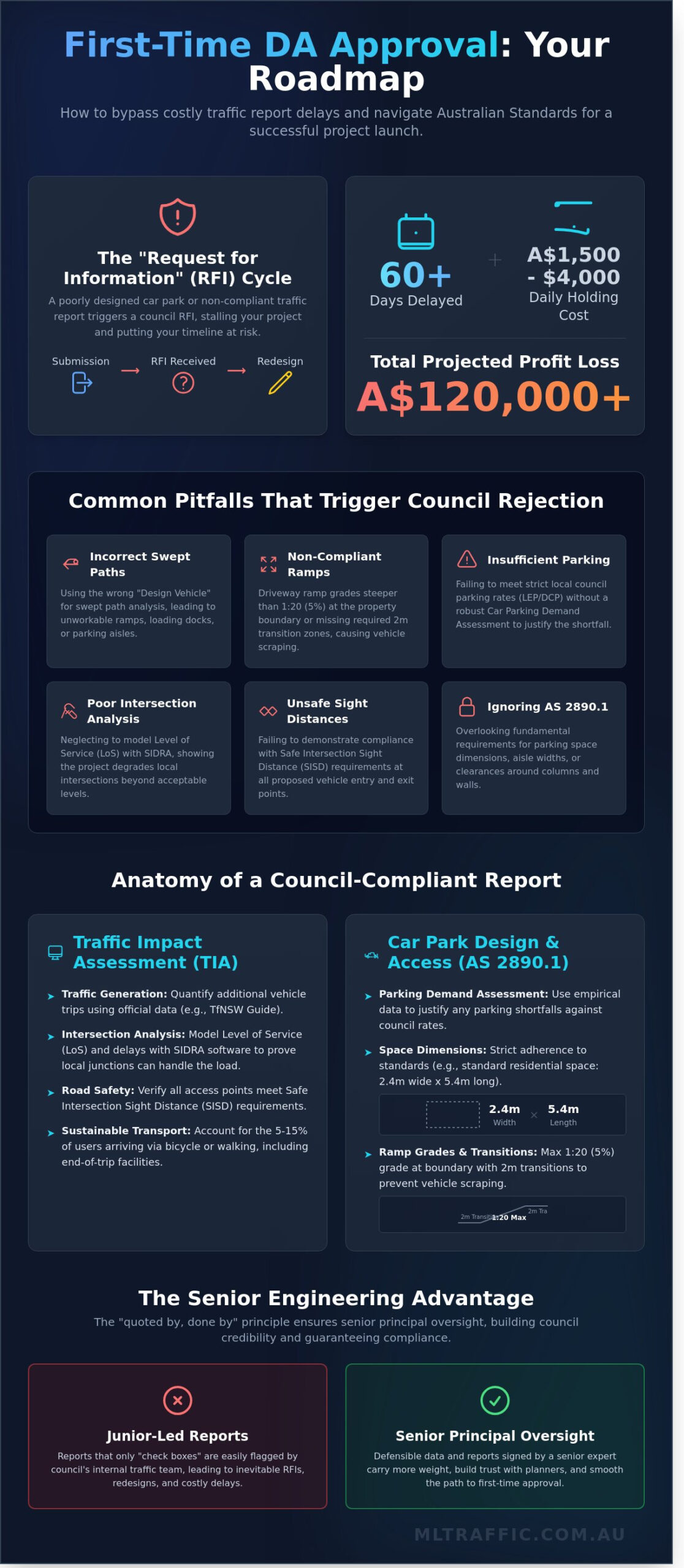
Delays aren’t just inconvenient. They’re expensive. For a standard multi-unit residential project in an Australian metro area, daily holding costs—including land tax, interest, and overheads—can range from A$1,500 to over A$4,000. If a council officer identifies a flaw in a vehicle swept path assessment, it might force a total redesign of the basement or driveway. This doesn’t just cost you engineering fees. It creates a ripple effect that can void your existing construction quotes and force a renegotiation of your finance terms. A 60-day delay caused by a poorly prepared traffic statement can easily wipe A$120,000 off your projected profit margin.
Building Credibility with Council Planners
Your first submission sets the tone for your entire relationship with the local council. Providing a comprehensive traffic report for da shows that you aren’t just meeting the minimum requirements; you’re demonstrating full compliance with Australian Standards like AS 2890.1. There’s a significant difference between a report that checks boxes and one that provides defensible data. Reports backed by senior-level signatures carry more weight. They reduce the likelihood of a council’s internal traffic team digging for errors because the expertise is evident on the page. Ensuring first-time DA approval for traffic is the most effective way to protect your timeline and your reputation with the authorities.
The Essential Anatomy of a Council-Compliant Traffic Report for DA
A Traffic Impact Assessment (TIA) serves as the primary evidence that your project integrates safely with the existing road network. It’s the technical roadmap for your development’s interaction with the street. The core objective is to quantify the additional vehicle trips your site will generate and demonstrate that local intersections can handle the load without failing. Without a robust TIA, ensuring first-time DA approval for traffic becomes an uphill battle against council objections.
Key Components of a Traffic Impact Assessment
Council engineers look for data backed by the Transport for NSW (TfNSW) Guide to Traffic Generating Developments or similar state-based benchmarks. We calculate traffic generation rates based on specific land-use categories, whether it’s a 20-unit apartment block or a 1,500sqm warehouse. This isn’t about guesswork; it’s about applying the right data to the right context.
-
Intersection analysis: We use SIDRA software to model Level of Service (LoS) and average delays, ensuring the project doesn’t push a local junction from a ‘B’ to a ‘D’ rating.
-
Sustainable transport integration: Modern DAs must account for the 5% to 15% of users who arrive via bicycle or walking, requiring dedicated end-of-trip facilities.
-
Road safety: Assessing sight distances at proposed entry points to ensure compliance with safe intersection sight distance (SISD) requirements.
Parking and Access Compliance
Parking is often the most contentious part of a DA. If your site can’t meet the strict local environmental plan (LEP) requirements, a Car Park Design & Demand Assessment is vital. This report uses empirical data and local surveys to justify a lower parking provision, preventing a refusal based on "insufficient parking" claims.
Every design element must align with Australian Standards (AS 2890). For instance, a standard residential parking space must be 2.4m wide by 5.4m long, but these dimensions change based on the angle of parking and the presence of structural columns. We also focus heavily on driveway ramp grades. A ramp steeper than 1:20 at the property line or failing to include a 2m transition grade can lead to vehicle scraping. This is an automatic red flag for council inspectors.
Finally, Swept Path Analysis provides the visual proof engineers demand. By using CAD-based software to simulate a B99 vehicle or a heavy rigid vehicle (HRV) moving through your site, we prove that cars won’t be reversing into oncoming traffic or clipping curbs. It’s a non-negotiable step for ensuring first-time DA approval for traffic and avoiding costly redesigns after submission.
If you’re unsure about your current site layout, our team can review your plans against AS 2890.1 to identify any compliance gaps before you lodge. Speak with our senior engineers today for a direct assessment.
Common Traffic Engineering Pitfalls That Trigger Council RFIs
Council planners often issue Requests for Further Information (RFIs) because submitted plans lack technical precision. A frequent mistake is the "Design Vehicle" trap. If your swept paths use a 6.4m Small Rigid Vehicle (SRV) but the local waste contractor utilizes an 11.4m Heavy Rigid Vehicle (HRV), your application will fail. Ensuring first-time DA approval for traffic requires matching simulations to the exact vehicle specifications mandated by the specific local government area.
Another oversight involves ignoring the cumulative impact of nearby developments. You can’t assess your site in a vacuum. If three separate 50-unit developments are proposed within a 200m radius, the Council expects your Traffic Impact Statement (TIS) to account for that combined 2025 or 2026 traffic volume. Failing to include these projected trips in your SIDRA modeling suggests a lack of due diligence.
Parking layouts often look functional in 2D but fail real-world maneuverability tests. We see many designs where a B99 vehicle technically fits into a bay but requires a 7-point turn to exit. This creates internal congestion and safety risks. Waste collection and service vehicle access must be integrated into the initial site layout. If a 10.2m garbage truck can’t enter and leave the site in a forward direction, the Council will likely reject the proposal based on AS 2890.2 compliance issues.
Technical Errors in Swept Path Analysis
Standard turning templates often fail in tight urban sites because they don’t account for structural columns or 300mm safety clearances. We use AutoTURN software to run precise simulations that reflect actual vehicle physics. Blind spots in sight-line assessments are another common trigger for RFIs. You must demonstrate clear visibility for both pedestrians and vehicles at the property boundary, typically measured 2.5m back from the kerb line. Landscaping and signage often obstruct these lines, leading to safety-based refusals.
Misinterpreting Council Traffic Requirements
Conflict frequently arises between rigid Australian Standards like AS 2890.1 and flexible local Development Control Plans (DCPs). While a standard might allow a specific ramp grade, the local DCP may demand a more gradual 1 in 20 transition for the first 6m. If you need a parking "departure," you must provide a data-driven justification. This involves a parking demand assessment showing that the 85th percentile occupancy remains within manageable limits. Council planners look for safety and efficiency in equal measure. Success in ensuring first-time DA approval for traffic depends on demonstrating that your "departure" won’t result in overspill onto local streets.
Your Step-by-Step Checklist for Securing Traffic Approval
To stop your project from stalling at the Council desk, you need a technical roadmap that leaves no room for ambiguity. Ensuring first-time DA approval for traffic requires more than just a basic report; it demands a proactive approach to compliance and design. Follow these non-negotiable steps to protect your timeline:
-
Engage early: Hire a traffic consultant during the preliminary design phase, not after the plans are finished.
-
Justify shortfalls: Conduct a site-specific parking demand study if your design can’t meet the standard DCP rates.
-
Test the geometry: Run swept path simulations for the largest expected service vehicle, such as an 8.8m Medium Rigid Vehicle (MRV) or a 12.5m Heavy Rigid Vehicle (HRV).
-
Audit the standards: Verify all driveway grades and aisle widths against AS 2890.1 for cars and AS 2890.2 for commercial vehicles.
-
Prioritise clarity: Review the final report for plain English. Planners shouldn’t need an engineering degree to understand your proposal.
Early Engagement: The Developer’s Secret Weapon
Involving a traffic expert during the concept stage prevents expensive redesigns. If an architect draws a basement that doesn’t work, you might lose 15% of your Gross Floor Area (GFA) just to fix a ramp grade later. That mistake can cost upwards of A$80,000 in lost value or architectural redesign fees. A pre-DA meeting with Council identifies their specific concerns before you lodge. This allows you to use hard traffic data as a tool to negotiate better outcomes with your architects, ensuring the design is both functional and profitable.
Final Quality Assurance for Your Submission
Discrepancies between the traffic report and architectural plans are a leading cause of RFI letters. If your plans show 22 spots but the report says 20, Council will flag it immediately. Every report must be tailored to the specific land use. A childcare centre has vastly different peak-hour profiles compared to an industrial warehouse. Before you hit submit, have an experienced traffic engineer review the final draft. This final check is critical for ensuring first-time DA approval for traffic by catching small errors that cause months of delays.
Ready to move forward? Contact our senior engineers for a technical review of your site plans.
Partnering with Senior Experts to Streamline Your DA Journey
Getting your development application through Council shouldn’t feel like a gamble. At ML Traffic Engineers, we’ve refined a process over 15 years that prioritizes technical accuracy and direct accountability. You won’t be passed off to a junior graduate after signing a contract. Instead, you get direct access to our principals, Michael Lee and Benny Chen. This "quoted by, done by" approach is central to ensuring first-time DA approval for traffic. When the person who understands your site constraints is the same one drafting the Traffic Impact Statement (TIS), the quality of the report remains high. We’ve applied this methodology across more than 10,000 successful projects, ranging from small residential subdivisions to massive industrial warehouses.
-
Direct principal involvement on every project.
-
Over 30 years of individual experience per senior engineer.
-
Proven track record across all land-use types including childcare, retail, and medical.
-
Fixed-fee quotes delivered rapidly to keep your project moving.
Accountability in Traffic Engineering
Many large firms use a junior-heavy model where a senior partner only signs the cover page. This creates a dangerous gap. A graduate might miss a subtle requirement in AS 2890.1, leading to Council objections that stall your project for months. We don’t work that way. Our hands-on senior involvement ensures that every Vehicle Swept Path Assessment and driveway ramp grade is calculated correctly the first time. We focus on providing practical, buildable traffic solutions that satisfy both the developer’s yield goals and the Council’s safety standards. Our deep knowledge of Australian Standards means fewer RFIs and a smoother path to approval.
Ready to Secure Your Approval?
Starting the process of ensuring first-time DA approval for traffic is straightforward. We provide fixed-fee quotes so you can manage your project budget without hidden surprises. To get started, simply provide your site plan and a brief project description. During your initial consultation, you’ll speak directly with our senior engineers to identify potential site challenges before they become expensive problems. Contact ML Traffic Engineers today to discuss your project requirements and leverage our 15 years of industry-leading expertise.
Secure Your Development Timeline Today
A successful Development Application depends on technical precision. You’ve seen how a single oversight in a swept path assessment or a missed Australian Standard 2890.1 requirement stalls projects for months. By focusing on data-backed accuracy and addressing RFI triggers early, you are ensuring first-time DA approval for traffic and protecting your project’s bottom line.
Our team has completed over 10,000 sites nationwide since 2005. This volume of work means we don’t just write reports; we navigate the specific council hurdles that often derail developers. You’ll get direct access to principals with over 30 years of experience. The engineer who provides your quote is the same expert who completes the work, which eliminates the bureaucracy found in larger firms. We specialise in resolving complex council RFIs that others find too difficult.
Don’t let avoidable delays eat into your project margins. Get a Fixed-Fee Quote from Our Senior Engineers. We look forward to streamlining your next successful application.
Frequently Asked Questions
How long does it typically take to prepare a traffic report for a DA?
Most traffic reports for a Development Application take between 5 and 10 business days to complete once we receive your final architectural plans. If your project requires 24-hour traffic counts or complex intersection modeling, expect a timeline of 15 business days. We prioritize accuracy because a rushed report often leads to Council requests for further information, which can delay your project by 4 to 8 weeks.
Can I use a general civil engineer for my traffic impact assessment?
You can use a general civil engineer, but most Australian Councils prefer reports signed by a specialist traffic engineer or an RPEQ-certified professional. Generalists often miss specific local government area requirements or the latest updates to AS 2890.1. Engaging a specialist is a key step in ensuring first-time DA approval for traffic, as it prevents technical errors that lead to costly redesigns during the assessment phase.
What happens if the council rejects my traffic report?
If a Council rejects your report, they’ll typically issue a Request for Further Information (RFI) or a Section 8.2 review notice. This adds an average of 45 days to your approval timeline and requires you to pay additional consultant fees for revisions. In 2023, approximately 22% of DA delays were caused by insufficient traffic data. Our team addresses these issues upfront to keep your project moving toward a successful determination.
Do I need a traffic report for a small-scale residential development?
You generally need a traffic report for any residential development involving 3 or more dwellings or sites with difficult driveway access. Even a small dual occupancy might require a basic Traffic Impact Statement if it’s located on a state-controlled road or a sub-arterial route. Providing this documentation early demonstrates to the assessing officer that your proposal complies with safety standards and won’t negatively impact local street parking.
How much does a professional traffic impact assessment cost in 2026?
In 2026, a standard Traffic Impact Assessment for a medium-scale development typically costs between A$3,500 and A$7,500 plus GST. Smaller Traffic Impact Statements for minor works often range from A$1,800 to A$3,200. These figures reflect the technical requirements for data collection and the specialized software used for SIDRA intersection modeling. Investing in a high-quality assessment early saves you from the A$10,000 plus costs of late-stage design changes.
What is the difference between a Traffic Impact Statement (TIS) and a TIA?
A Traffic Impact Statement is a concise report for low-impact developments, while a Traffic Impact Assessment (TIA) is a comprehensive study for larger projects. A TIS focuses on site-specific issues like parking and access. A TIA goes further, analyzing broader network impacts and intersection performance using empirical data. Choosing the right report type is vital for ensuring first-time DA approval for traffic without overspending on unnecessary technical analysis.
Is a Swept Path Analysis mandatory for all commercial DAs?
Swept Path Analysis is mandatory for 95% of commercial DAs to prove that delivery vehicles and waste trucks can enter and exit in a forward direction. Council engineers look for specific clearances for an 8.8-meter Medium Rigid Vehicle or a 12.5-meter Heavy Rigid Vehicle depending on your business type. If your plans don’t show these maneuvers, the Council will likely flag your application as non-compliant within the first 14 days of lodgement.
How does AS 2890.1 affect my car park layout design?
AS 2890.1 is the Australian Standard that dictates the minimum dimensions for parking spaces, aisle widths, and driveway gradients. For example, a standard User Class 1A space must be 2.4 meters wide by 5.4 meters long. Failing to meet these specific measurements by even 100mm can result in a flat refusal from the Council. We ensure every layout we review adheres strictly to these codes to eliminate technical roadblocks before they happen.
Which areas do you cover?
We are traffic engineers servicing Melbourne, Sydney, Brisbane, Gold Coast, Hobart, Perth, Adelaide, Darwin, Canberra and surrounding areas.
Disclaimer
The content on www.mltraffic.com.au, including all technical articles, guides, and resources, is provided for general informational and educational purposes only. It is not intended to constitute professional advice in traffic engineering, transportation planning, development approvals, or any other technical or legal field.
While ML Traffic Engineers makes every reasonable effort to ensure the accuracy, completeness, and timeliness of the information published, we do not provide any warranties or representations (express or implied) regarding its reliability, suitability, or availability for any particular purpose. Any reliance you place on the content is strictly at your own risk.
In no event shall ML Traffic Engineers, its directors, employees, authors, or affiliates be liable for any direct, indirect, incidental, special, consequential, or punitive damages (including, without limitation, loss of profits, data, or business opportunities) arising out of or in connection with the use of, or inability to use, any information provided on this website.
The articles and guides on this site are not a substitute for engaging a qualified, registered professional traffic engineer (such as an NPER or RPEQ engineer) to assess your specific project requirements. For tailored advice, compliance assessments, or traffic engineering services, please contact a competent professional.
This disclaimer may be updated from time to time without notice. By accessing or using this website, you agree to be bound by the most current version of this disclaimer.
