

Your planning permit shouldn’t fail because a junior staffer’s traffic report crumbled under cross-examination at the tribunal. It’s a common fear for developers facing council refusals based on "unacceptable" traffic or parking impacts. You likely already know that VCAT is a high-stakes environment where technical precision is the only currency that matters. With the Victorian Civil and Administrative Tribunal (Fees) Regulations 2026 increasing cost recovery to 11 percent by June 28, 2026, the financial risk of an unsuccessful hearing is more significant than ever.
We are traffic engineers servicing Melbourne metropolitan area, Mornington Peninsula, Geelong and the rest of Victoria.
Hiring a specialized traffic consultant for VCAT submission is the most effective way to ensure your evidence is prepared by the same senior expert who will defend it in court. This article explains how a robust, data-backed Expert Witness Statement provides the technical foundation necessary to win your appeal. We’ll preview the steps to navigating complex tribunal procedures and securing a planning permit with workable conditions. You’ll see how senior-level expertise helps you avoid the pitfalls of junior-authored reports that fail to meet strict evidence deadlines or survive the scrutiny of a practice day hearing.
Key Takeaways
- Understand how independent expert evidence resolves disputes with planning authorities regarding parking shortfalls and traffic safety concerns.
- Identify the technical requirements for a robust Expert Witness Statement, including compliance with Australian Standards (AS 2890.1) and empirical data.
- Discover why engaging a principal-led traffic consultant for VCAT submission ensures the engineer who prepares your report is the same expert who defends it.
- Navigate the tribunal timeline with confidence by understanding the transition from council refusal review to the formal Memorandum of Opinion.
- Learn how direct access to senior engineers with 15+ years of experience minimizes the risk of reports failing under cross-examination.
Table of Contents
The Role of a Traffic Consultant for VCAT Submissions
A traffic consultant for VCAT submission acts as an independent expert witness. Their primary function is to provide technical evidence that resolves conflicts between permit applicants and local councils. When a project is refused due to car parking shortfalls or perceived traffic safety risks, the consultant provides the technical clarity needed for the tribunal to make an informed decision. This role is distinct from a standard designer; it requires a deep understanding of the Victorian Civil and Administrative Tribunal (VCAT) and its rigorous evidentiary standards.
The consultant’s paramount duty is to the tribunal rather than the party paying their fee. This impartiality is critical for credibility. Evidence must be based on sound engineering principles, empirical data, and current planning schemes. The scope of work typically begins with a preliminary assessment and evolves into a formal Expert Witness Statement, followed by oral testimony during the hearing. Precision is non-negotiable. Every claim must be backed by data that can survive a technical challenge.
To better understand how these cases are decided, watch this helpful video:
When Should You Engage a Traffic Expert for a Tribunal?
Engaging a professional early is a strategic necessity. You should secure an expert immediately upon receiving a Notice of Refusal or a Notice of Decision with unworkable conditions. Waiting until the final hearing date is a mistake. Early involvement allows the consultant to participate in compulsory conferences or mediations. This provides the technical leverage required to reach a settlement before the case proceeds to a full hearing. With the new Victorian Civil and Administrative Tribunal (Fees) Regulations 2026 taking effect before June 28, 2026, the financial stakes of a hearing are higher. If objectors raise complex concerns about sightlines or traffic volume, a senior engineer can address these issues with data that council officers may have overlooked.
The Difference Between a Council TIA and Tribunal Evidence
A standard Traffic Impact Assessment (TIA) used for a council application isn’t the same as tribunal evidence. Expert evidence must strictly adhere to VCAT Practice Note PNPE9, which governs the conduct of expert witnesses. The level of detail is significantly higher. It includes exhaustive reviews of Australian Standards (AS 2890.1), driveway ramp grades, and specialized traffic engineering services like swept path analysis. Most importantly, the report must be court-ready. It must be robust enough to withstand aggressive cross-examination from opposing counsel. Experience matters in these environments. A report that lacks technical depth will likely fail under scrutiny, jeopardizing the entire planning permit.
The Anatomy of a High-Quality Expert Witness Statement
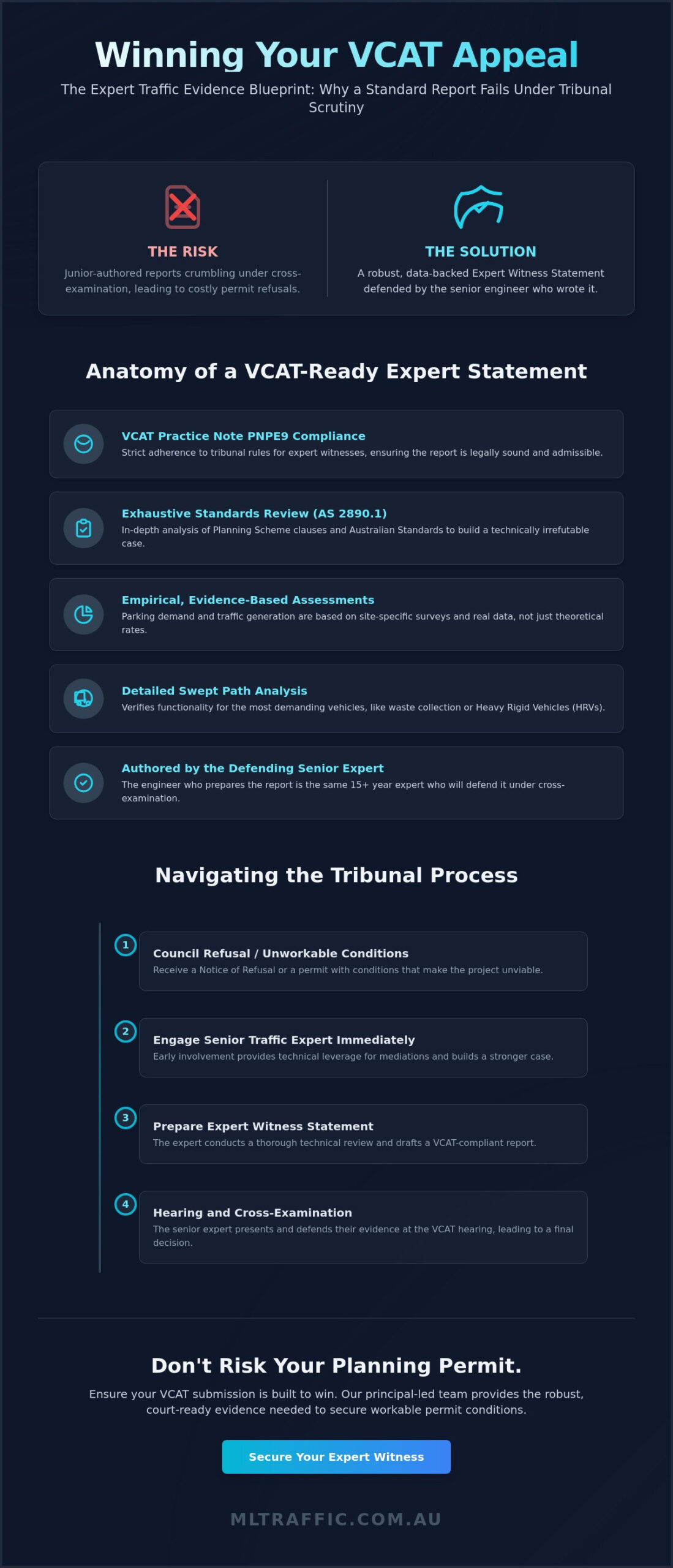
An Expert Witness Statement is a specialized legal document designed for the tribunal environment. It is not a standard Traffic Impact Assessment. While a standard report supports a planning application, the statement prepared by a traffic consultant for VCAT submission must comply with VCAT’s requirements for expert reports. This document provides technical finality. It directly addresses the council’s specific grounds of refusal with empirical evidence and declarative conclusions. The objective is to remove ambiguity for the tribunal member.
A high-quality statement includes several critical components. It begins with a comprehensive review of the relevant Planning Scheme clauses and Australian Standards. It must also feature evidence-based parking demand assessments. These assessments use empirical data from similar land-use types or site-specific surveys rather than theoretical estimates. Finally, it includes detailed swept path analysis. These diagrams show vehicle maneuvers for the most demanding scenarios, such as waste collection or heavy rigid vehicle (HRV) access, ensuring the design is functional in practice.
Technical Compliance and Australian Standards
Technical precision is the foundation of successful tribunal evidence. AS 2890.1 compliance serves as the mandatory baseline for any car park design evidence. A senior traffic consultant evaluates driveway ramp grades and sight distance assessments to ensure they meet safety requirements. We use AutoTURN software to generate all technical diagrams. This certification ensures accuracy and prevents the common error where diagrams show maneuvers that are physically impossible in real-world conditions. If your project requires a technical review of these standards, you can contact our senior engineers for a preliminary assessment.
Car Parking Demand and Traffic Impact Analysis
Council refusals frequently cite "unacceptable" parking shortfalls. We counter these claims by using data to justify parking rate reductions under the relevant planning clauses. This involves a granular analysis of the surrounding road network’s capacity to absorb additional traffic volume. Our process often includes providing peer reviews of the council’s internal traffic engineering assessments. By identifying technical flaws or overly conservative assumptions in the council’s internal reports, we provide the tribunal with a more accurate representation of the project’s impact. This evidence-based approach is essential for securing permit approval with workable conditions.
Why Principal-Led Advocacy Matters in Tribunal Hearings
A common risk in tribunal proceedings is the "Junior Draftsman" scenario. Many large engineering firms utilize senior staff to win the contract, only to delegate the technical drafting to junior subordinates. This approach often fails during cross-examination. If the person standing in the witness box didn’t perform the underlying analysis, their testimony will likely crumble under technical scrutiny. A specialized traffic consultant for VCAT submission must be the primary author of the evidence they present. Accountability is the cornerstone of a successful appeal.
Our philosophy is straightforward: the consultant who provides the quote is the one who does the technical work. This ensures deep site knowledge that cannot be gained through a screen. An expert must personally inspect the site and surrounding traffic conditions to understand the nuances of local parking patterns and sightline constraints. Direct access is equally vital. Developers and planning lawyers need a direct line to the expert engineer, not a series of administrative gatekeepers. This ensures technical responses are immediate and accurate as the hearing date approaches.
The Value of Senior Experience
Success at the tribunal requires more than just technical knowledge. It requires the authority that comes from decades of practice. Senior engineers with over 30 years of experience understand the expectations of seasoned tribunal members. They adopt a no-nonsense, fact-based approach that prioritizes engineering data over emotional advocacy. This experience allows them to identify "fatal flaws" in a project’s design well before the hearing begins. Identifying these issues early saves time and prevents the rejection of a permit based on avoidable technical errors.
Independence and Credibility
The credibility of an expert witness depends on their perceived impartiality. According to VCAT’s official expert evidence practice note, an expert’s primary duty is to the tribunal. They aren’t a "hired gun" for the developer. Maintaining this reputation for independence ensures the tribunal trusts the findings presented in the report. A professional consultant must be willing to recommend design changes to make a project "approvable." This integrity is what ultimately secures a planning permit. You can learn more about the role of a traffic engineer in developments to see how this technical oversight improves project outcomes.
Navigating the Tribunal Process: A Step-by-Step Timeline
The path to a successful tribunal outcome follows a structured timeline. Missing a single procedural deadline can jeopardize your entire application. Engaging a traffic consultant for VCAT submission early ensures that technical evidence is integrated into the legal strategy from day one. This process moves through five distinct stages designed to provide the tribunal with maximum clarity.
-
Step 1: Initial Review. We analyze the council’s Notice of Refusal and project documents to determine the technical strength of the case.
-
Step 2: Memorandum of Opinion. Our engineers prepare a preliminary document for your legal team. This outlines whether the traffic and parking impacts are defensible.
-
Step 3: Site Inspection and Data. We personally visit the site to collect supplementary traffic or parking data. This ensures the evidence reflects current real-world conditions.
-
Step 4: Formal Filing. We draft and file the Expert Witness Statement. This must be served to all parties by the tribunal’s strict deadline.
-
Step 5: Oral Testimony. We attend the hearing to answer questions from the tribunal member and defend the findings under cross-examination.
Managing Deadlines and RFIs
Tribunal procedures are rigid. You must serve your expert evidence at least 10 business days before the hearing starts. This is a non-negotiable rule. During the lead-up, the tribunal or opposing parties may issue ‘Requests for Information’ (RFIs). We respond to these queries directly to prevent delays. If technical flaws are identified, we coordinate with your architects to produce ‘Amended Plans’. These revisions ensure the project remains compliant with Australian Standards while addressing the council’s concerns. You can speak with our principal engineers to discuss your specific tribunal deadlines.
The Hearing Day: What to Expect
The hearing day is intense. You may encounter ‘Concurrent Evidence’, also known as ‘hot-tubbing’. This is where experts from both sides discuss technical issues together in front of the member. It requires a traffic consultant for VCAT submission who can think on their feet and maintain technical authority. You must also prepare for cross-examination by council lawyers or objector representatives. The expert’s role extends beyond the hearing room; they often assist the tribunal member during an official site visit to explain technical constraints in person. This hands-on advocacy is why principal-led representation is vital for a positive decision.
Choosing ML Traffic for Your VCAT Expert Evidence
ML Traffic Engineers Australia provides a direct, principal-led service for developers and planning lawyers. Our firm has been trading since 2005. In that time, we have assessed more than 10,000 sites across Australia. This extensive history includes work on diverse land-use types such as apartments, warehouses, bars, and medical centers. When you engage a traffic consultant for VCAT submission from our firm, you receive technical representation backed by decades of senior-level experience. We don’t use junior staff to draft our evidence. Principal engineers Michael Lee and Benny Chen personally handle every tribunal matter from the initial quote to the final hearing testimony.
Our comprehensive service range ensures every technical requirement is met. This includes providing Swept Path Analysis for complex vehicle maneuvers and full Traffic Impact Assessments for major developments. We provide consistent, high-standard evidence for tribunals nationally. Our reputation for reliability is built on a no-nonsense, fact-based approach that focuses entirely on technical compliance and engineering data. This accountability is what sets us apart from larger, more impersonal firms where the project lead may be disconnected from the technical work.
Our Approach to Tribunal Success
Success at VCAT requires meticulous attention to detail. We review every car park and access assessment against the latest Australian Standards and Planning Scheme requirements. Our engineers maintain clear communication with your legal team. This coordination ensures that the technical evidence supports the broader legal strategy for the appeal. We provide honest and realistic advice. If our initial assessment identifies technical risks, we recommend necessary design changes before the hearing begins. This commitment to technical integrity protects our reputation and increases the likelihood of a successful permit approval.
-
Direct involvement of principal engineers on every project.
-
A proven track record spanning 15 years and 10,000 sites.
-
Strict adherence to Australian Standards and VCAT practice notes.
-
Accountability: the engineer who quotes the work does the work.
Next Steps: Get a Quote for Your Appeal
To start your submission, provide your project documents and the council’s grounds of refusal for a rapid initial assessment. We offer a "Principal Access" guarantee. This means you speak directly to the senior engineer who will be in the witness box defending your project. This direct line of communication eliminates gatekeepers and ensures technical accuracy throughout the tribunal process. You can Contact ML Traffic Engineers Australia today to discuss your specific requirements and secure a quote from a senior traffic consultant for VCAT submission.
Secure Your Planning Approval with Technical Precision
Success at the tribunal requires more than just a standard report. It demands a court-ready Expert Witness Statement backed by empirical data and strict adherence to Australian Standards. You now understand how principal-led representation eliminates the technical risks associated with junior staff drafting. Engaging a qualified traffic consultant for VCAT submission ensures that your project’s traffic and parking impacts are defended by an engineer with deep site knowledge and cross-examination experience.
ML Traffic Engineers Australia brings over 15 years of firm history to your appeal. Our individual engineers possess between 30 and 40 years of senior experience each. We have assessed 10,000+ sites nationally, providing a level of reliability that impersonal firms cannot match. When you work with us, you receive direct mobile access to our Principal Engineers. This ensures your legal team has immediate technical support throughout the appeal process. Don’t leave your project’s future to chance. Secure Principal-Led Expert Evidence for Your Submission and move forward with confidence.
Frequently Asked Questions
What is an Expert Witness Statement in a VCAT context?
An Expert Witness Statement is a formal technical document that satisfies VCAT Practice Note PNPE9. It details the expert’s professional opinion on the traffic and parking impacts of a development. Unlike a standard application report, this statement must be court-ready and include a formal declaration of the expert’s primary duty to the tribunal. It provides the technical foundation for the expert’s oral testimony during the hearing.
Can a traffic consultant guarantee that my permit will be approved?
No professional traffic consultant can guarantee a permit approval. The final decision rests entirely with the presiding tribunal member. However, a senior traffic consultant for VCAT submission significantly improves your prospects by providing robust, data-backed evidence. We identify technical flaws in council refusals and present empirical parking surveys that often prove more persuasive than the theoretical models used by local authorities.
How much does it cost to hire a traffic expert for a tribunal hearing?
Costs vary based on project complexity and the scope of required data collection. Based on April 2026 industry benchmarks, a court-ready expert report from a registered engineer starts at $1800 plus GST. Appearance fees for the hearing typically begin at $350 per hour plus GST, often with a minimum three-hour booking. You should request a project-specific quote that covers the initial review, report drafting, and hearing attendance.
What happens if the council’s traffic engineer disagrees with my consultant?
Disagreements between experts are standard in tribunal proceedings. VCAT resolves these through the concurrent evidence process or technical cross-examination. Your consultant defends their findings using empirical data, such as site-specific swept path assessments or parking demand surveys. The presiding member then weighs the conflicting technical evidence to determine which engineering argument is more robust and compliant with the relevant planning scheme.
Is a new traffic report required for VCAT if I already have one for the council?
Yes, you usually require a new Expert Witness Statement. A standard Traffic Impact Assessment (TIA) prepared for a council application rarely meets the strict evidentiary requirements of VCAT Practice Note PNPE9. The tribunal version requires deeper analysis, updated site data, and a formal declaration of independence. We use the existing data where possible but must reformat and expand the analysis to ensure it survives legal scrutiny.
Can a traffic consultant assist with mediation before a full hearing?
Traffic consultants are essential during the compulsory conference or mediation stage. We provide technical leverage that can lead to a settlement without a full hearing. By presenting clarified parking data or amended access designs during mediation, we often resolve the council’s concerns early. This saves time and avoids the increased costs associated with the new June 28, 2026 VCAT fee structure. A traffic consultant for VCAT submission is your most effective tool for early dispute resolution.
What is ‘hot-tubbing’ in a tribunal hearing?
Hot-tubbing is the informal term for concurrent evidence. It involves the tribunal member questioning the applicant’s traffic expert and the council’s traffic expert simultaneously. This allows for a direct technical discussion between professionals. It requires an expert who can think quickly and maintain technical authority under pressure. This process often clarifies complex engineering disputes faster than traditional sequential testimony.
Does the expert witness work for me or the tribunal?
An expert witness has a paramount duty to the tribunal, not the party that pays their fee. This is a legal requirement under the VCAT Act. While we represent your project’s technical merits, our credibility depends on being impartial. We provide honest engineering advice and will recommend design changes if they’re necessary to ensure the project meets Australian Standard AS 2890.1. This impartiality is what makes the evidence reliable for the member.
Which areas do you cover?
We service Abbotsford, Aberfeldie, Aintree, Airport West, Albanvale, Albert Park, Albion, Alphington, Altona, Altona Meadows, Altona North, Ardeer, Armadale, Arthurs Seat, Ascot Vale, Ashburton, Ashwood, Aspendale, Aspendale Gardens, Attwood, Avondale Heights, Balaclava, Balwyn, Balwyn North, Bangholme, Bayswater, Bayswater North, Beaconsfield, Beaumaris, Bellfield, Bentleigh, Bentleigh East, Berwick, Bittern, Blackburn, Blackburn North, Blackburn South, Bonbeach, Boronia, Box Hill, Box Hill North, Box Hill South, Braeside, Braybrook, Brentford Square, Brighton, Brighton East, Broadmeadows, Brooklyn, Brunswick, Brunswick East, Brunswick West, Bulla, Bulleen, Bundoora, Burnley, Burnside, Burwood, Burwood East, Cairnlea, Camberwell, Campbellfield, Canterbury, Carlton, Carlton North, Carnegie, Caroline Springs, Carrum, Carrum Downs, Caulfield, Caulfield East, Caulfield North, Caulfield South, Chadstone, Chelsea, Chelsea Heights, Cheltenham, Chirnside Park, Clarinda, Clayton, Clayton South, Clematis, Clifton Hill, Coburg, Coburg North, Cocoroc, Coldstream, Collingwood, Coolaroo, Craigieburn, Cranbourne, Cranbourne East, Cranbourne North, Cranbourne South, Cranbourne West, Cremorne, Croydon, Croydon Hills, Croydon North, Croydon South, Dandenong, Dandenong North, Dandenong South, Deer Park, Delahey, Derrimut, Diamond Creek, Diggers Rest, Dingley Village, Docklands, Doncaster, Doncaster East, Donnybrook, Donvale, Doreen, Doveton, Eaglemont, East Melbourne, Edithvale, Elsternwick, Eltham, Eltham North, Elwood, Emerald, Endeavour Hills, Epping, Essendon, Essendon Fields, Essendon North, Essendon West, Fairfield, Fawkner, Ferntree Gully, Ferny Creek, Fitzroy, Fitzroy North, Flemington, Footscray, Forest Hill, Frankston, Frankston North, Frankston South, Gardenvale, Gladstone Park, Glen Huntly, Glen Iris, Glen Waverley, Glenroy, Greensborough, Greenvale, Guys Hill, Hadfield, Hampton, Hampton East, Hampton Park, Harkaway, Hawthorn, Hawthorn East, Heathmont, Heidelberg, Heidelberg Heights, Heidelberg West, Highett, Hillside, Hoppers Crossing, Hughesdale, Huntingdale, Hurstbridge, Ivanhoe, Ivanhoe East, Jacana, Kalkallo, Kealba, Keilor, Keilor Downs, Keilor East, Keilor Lodge, Keilor North, Keilor Park, Kensington, Kew, Kew East, Keysborough, Kings Park, Kingsbury, Kingsville, Knoxfield, Lalor, Langwarrin, Laverton, Laverton North, Lilydale, Lower Plenty, Lynbrook, Lyndhurst, Lysterfield, Macleod, Maidstone, Malvern, Malvern East, Maribyrnong, McCrae, Meadow Heights, Melbourne, Mentone, Mernda, Mickleham, Middle Park, Mill Park, Mitcham, Mont Albert, Mont Albert North, Montmorency, Moonee Ponds, Moorabbin, Mooroolbark, Mordialloc, Mornington, Mount Waverley, Mulgrave, Murrumbeena, Narre Warren, Narre Warren North, Narre Warren South, Newport, Niddrie, Noble Park, Noble Park North, North Melbourne, Northcote, Notting Hill, Nunawading, Oak Park, Oaklands Junction, Oakleigh, Oakleigh East, Oakleigh South, Officer, Ormond, Pakenham, Parkdale, Park Orchards, Pascoe Vale, Pascoe Vale South, Patterson Lakes, Plenty, Point Cook, Port Melbourne, Portsea, Prahran, Preston, Princes Hill, Reservoir, Richmond, Ringwood, Ringwood East, Ringwood North, Ripponlea, Rosanna, Rosebud, Rowville, Roxburgh Park, Rye, Sandhurst, Sandringham, Scoresby, Seabrook, Seaholme, Seddon, Seaford, South Kingsville, South Melbourne, South Morang, South Wharf, South Yarra, Southbank, Spotswood, St Albans, St Helena, St Kilda, St Kilda East, St Kilda West, Strathmore, Sunshine, Sunshine North, Sunshine West, Surrey Hills, Sydenham, Tarneit, Taylors Hill, Taylors Lakes, Templestowe, Templestowe Lower, Thomastown, Thornbury, Toorak, Tottenham, Travancore, Truganina, Tullamarine, Vermont, Vermont South, Viewbank, Wantirna, Wantirna South, Watsonia, Watsonia North, Werribee, Werribee South, West Footscray, West Melbourne, Westgarth, Wheelers Hill, Wildwood, Williamstown, Williamstown North, Windsor, Wonga Park, Wyndham Vale, Yallambie, Yarraville.

Disclaimer
The content on www.mltraffic.com.au, including all technical articles, guides, and resources, is provided for general informational and educational purposes only. It is not intended to constitute professional advice in traffic engineering, transportation planning, development approvals, or any other technical or legal field.
While ML Traffic Engineers makes every reasonable effort to ensure the accuracy, completeness, and timeliness of the information published, we do not provide any warranties or representations (express or implied) regarding its reliability, suitability, or availability for any particular purpose. Any reliance you place on the content is strictly at your own risk.
In no event shall ML Traffic Engineers, its directors, employees, authors, or affiliates be liable for any direct, indirect, incidental, special, consequential, or punitive damages (including, without limitation, loss of profits, data, or business opportunities) arising out of or in connection with the use of, or inability to use, any information provided on this website.
The articles and guides on this site are not a substitute for engaging a qualified, registered professional traffic engineer (such as an NPER or RPEQ engineer) to assess your specific project requirements. For tailored advice, compliance assessments, or traffic engineering services, please contact a competent professional.
This disclaimer may be updated from time to time without notice. By accessing or using this website, you agree to be bound by the most current version of this disclaimer.
