

Your project’s survival at tribunal doesn’t depend on the volume of data you present; it depends on whether that data can withstand a cross-examination that would break a junior engineer. A council refusal based on unsubstantiated claims about parking or traffic flow isn’t just a setback. In NSW, an inefficient site layout on a 20-lot residential project can cost upwards of $185,000 in lost saleable land. Securing a successful outcome at VCAT or the NSW LEC requires more than a standard assessment. It demands a specialized expert witness report for traffic-related planning disputes that serves as a defensible legal instrument.
You’re likely tired of project delays that can cost over $20,000 in monthly holding costs and consultant fees at current interest rates. We understand the high stakes of tribunal proceedings and the necessity of satisfying a primary duty to the court through independent, objective evidence. This guide explains how to leverage rigorous data to overcome council objections and secure planning approval. You’ll learn the impact of the latest 2024 NSW and 2025 ACT TIA guideline updates, the importance of AS 2890.1 compliance, and why direct access to a senior traffic principal is the only way to ensure your technical work remains beyond reproach.
Key Takeaways
- Understand the mandatory duty an expert witness owes to the court and how this professional obligation ensures the report’s credibility.
- Identify the technical requirements for a defensible report, including SIDRA Intersection modelling and Vehicle Swept Path Analysis.
- Learn the procedural requirements for an expert witness report for traffic-related planning disputes, covering the Statement of Evidence and the expert conclave.
- Discover why senior principal involvement is essential for defending technical data during cross-examination at VCAT or the NSW LEC.
- Realize how direct accountability and a no-gatekeepers approach prevent the critical errors often associated with junior-prepared assessments.
The Role of Expert Witness Reports in Australian Planning Appeals
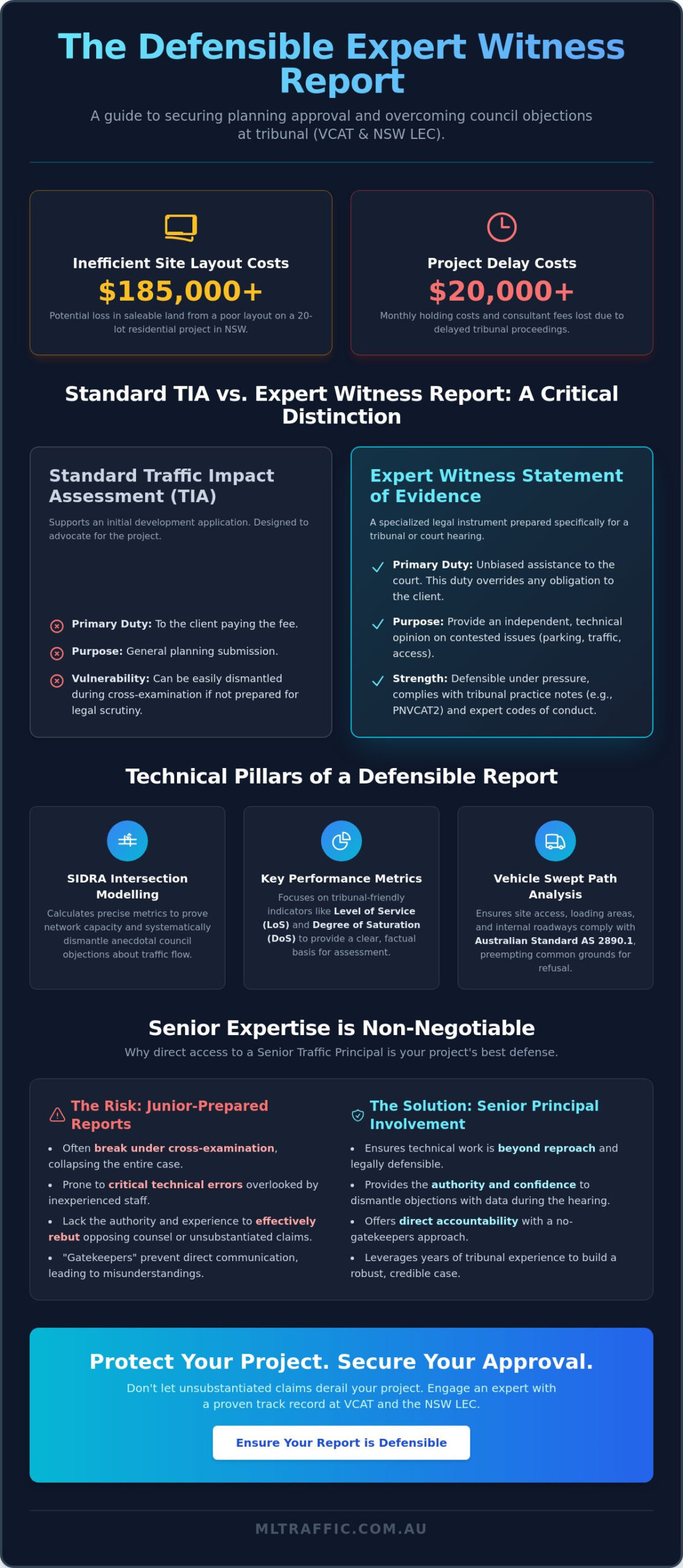
An expert witness report for traffic-related planning disputes is a specialized legal instrument. It differs fundamentally from a standard planning submission. While a Traffic Impact Assessment (TIA) supports a development application, a Statement of Evidence is prepared specifically for a tribunal or court. The document provides an independent, technical opinion on contested issues such as parking demand, intersection performance, or site access. Unlike a consultant’s report designed to advocate for a project, the role of an expert witness is defined by a primary duty to the court. This means the expert’s first responsibility is to provide unbiased assistance to the tribunal. This duty overrides any obligation to the party paying for the report.
To better understand the legal framework of this role, watch this overview:
The distinction between a standard TIA and expert evidence is critical for project success. A TIA follows guides like the NSW Guide to Transport Impact Assessment, specifically Version 1.1 which became effective on November 4, 2024. In contrast, an expert report must also comply with specific tribunal practice notes, such as VCAT’s PNVCAT2 in Victoria. These documents require a higher level of scrutiny. They must address the specific grounds of refusal or the technical objections raised by the council. Failure to adhere to these procedural requirements can result in the evidence being struck out. This leads to project delays that can cost a developer over $20,000 in monthly holding costs at current interest rates.
When is an Expert Traffic Engineer Required?
Developers typically engage an expert when a council issues a refusal based on traffic generation or parking shortfalls. You may also require an expert witness report for traffic-related planning disputes to appeal onerous permit conditions in a Notice of Decision. Third-party objector claims regarding safety often require technical rebuttal. A senior principal provides the necessary authority to dismantle unsubstantiated objections through rigorous data. You can find more information on these specialized assessments on our services page.
National Standards and State Codes of Conduct
Expert evidence in Australia is governed by harmonized codes of conduct across the Federal Court and the Supreme Courts of NSW, Victoria, and the ACT. These codes mandate professional independence. Your expert must declare they have read the code and agree to be bound by it. Non-compliance undermines credibility during cross-examination. Meticulous adherence to these standards ensures the report remains a defensible asset. It protects the project from the risks associated with junior-prepared reports that fail under legal pressure.
Technical Components of a Defensible Traffic Engineering Report
Technical rigor determines whether a tribunal accepts your evidence. An expert witness report for traffic-related planning disputes must provide more than raw data. It must offer a defensible interpretation of how a proposed development interacts with the existing road network. We use industry-standard software like SIDRA to analyze intersection performance. This modelling proves network capacity by calculating precise metrics that councils cannot easily dismiss with anecdotal objections.
Advanced Intersection and Traffic Flow Modelling
Tribunal members rely on specific technical indicators to assess traffic impact. We focus on Level of Service (LoS) and Degree of Saturation to interpret intersection performance for a legal audience. These metrics allow the tribunal to see the actual impact of additional project trips. We address “worst-case scenario” objections by simulating peak-hour congestion. This data-driven approach removes ambiguity. It provides a factual basis for success at VCAT or the NSW LEC by showing exactly how the infrastructure will behave under load.
Compliance with Australian Standards for Access and Parking
Every defensible report must benchmark against national standards. This includes the 2021 update to AS 2890.1 for off-street parking and AS 2890.2 for commercial vehicles. A detailed Swept Path Analysis is essential for complex site layouts. It demonstrates that the largest expected vehicles can navigate the site safely and efficiently. When justifying departures from standard rates, adherence to the Expert Witness Code of Conduct ensures the assessment remains impartial and authoritative.
Empirical parking demand surveys often provide a stronger foundation for an expert witness report for traffic-related planning disputes than generic council tables. We conduct these surveys to challenge rigid or outdated requirements. This is particularly effective in urban environments where actual usage patterns differ from standard formulas. We also provide specialized Driveway Ramp Grade Assessments to resolve disputes regarding site access. These technical components work together to form a report that is both compliant and strategic. If your project faces refusal over technicalities, you should consult with a senior traffic principal to review your site’s compliance.
- Intersection Analysis: Proving capacity through SIDRA modelling.
- Vehicle Swept Path Analysis: Demonstrating safe entry and exit for all design vehicles.
- Sight Distance Assessment: Ensuring compliance with safety requirements at all access points.
- Car Parking Demand Assessment: Justifying parking provisions through empirical data.
Expert Witness vs. Traffic Consultant: Navigating the Difference
Choosing the right professional is the difference between a project’s approval and its total rejection. While a traffic consultant provides technical data, an expert witness provides a defensible opinion that must survive legal scrutiny. An expert witness report for traffic-related planning disputes is not a marketing document. It is a technical analysis bound by the Expert Witness Code of Conduct. This impartiality is actually a developer’s strongest tool. Objective evidence from a seasoned principal silences unsubstantiated council objections more effectively than biased advocacy. When an expert acknowledges technical limitations while providing a solution, their credibility with the tribunal increases.
Key differences between a general consultant and a tribunal expert include:
- Primary Duty: A consultant answers to the client; an expert answers to the court.
- Level of Scrutiny: Consultant reports are reviewed by council officers; expert reports are cross-examined by legal counsel.
- Professional Standing: Consultants may be junior staff; experts must possess significant industry tenure and recognized authority.
The Problem with Junior-Led Traffic Reports
Large firms often delegate technical work to junior engineers. These templated reports frequently lack site-specific nuance. This delegation creates a significant risk during tribunal proceedings. If a junior engineer performed the modelling or swept path analysis, the person in the witness box may struggle to defend the underlying assumptions. Cross-examination quickly exposes these gaps. A defensible report requires the senior expert to be intimately involved in every calculation. This ensures they can explain and justify every data point under pressure. Junior engineers often lack the experience to handle aggressive questioning regarding car parking demand or intersection saturation levels.
Professional Longevity and Tribunal Reputation
Credibility in the witness box is earned over decades. A track record of 15+ years builds essential trust with tribunal members at VCAT or the NSW LEC. They recognize experts who consistently provide reliable, unbiased evidence. Peer reviews further strengthen a developer’s position by validating the technical findings before the hearing. At ML Traffic Engineers Australia, our core philosophy is direct access to principals. This means the senior expert who provides your initial quote is the same person who conducts the analysis and appears at the hearing. This personnel continuity promise eliminates the gatekeeper problem found in larger, impersonal firms. It ensures that your expert witness report for traffic-related planning disputes is backed by decades of practical experience rather than a junior’s first attempt at complex modelling. Professional longevity translates to a deep understanding of state-specific guidelines. This level of senior accountability is non-negotiable for high-stakes developments.
The Tribunal Process: From Statement of Evidence to Expert Conclaves
The tribunal process follows a structured legal sequence designed to filter out technical noise and focus on contested planning issues. This sequence transforms an expert witness report for traffic-related planning disputes into a primary Statement of Evidence. In jurisdictions like Victoria, this document must be filed with VCAT at least 10 business days before the hearing. The report sets the technical boundary for the case. It contains the expert’s full analysis of parking demand, intersection performance, and site safety. Every claim made in this initial filing must be defensible under intense legal scrutiny.
The progression from filing to determination involves several critical milestones:
- Preparation of Evidence: Drafting the formal Statement of Evidence based on rigorous data.
- The Expert Conclave: A private meeting between opposing traffic experts to find common ground.
- The Joint Report: A collaborative document detailing points of agreement and disagreement.
- Oral Testimony: Providing evidence-in-chief and responding to cross-examination in the witness box.
- Final Determination: The tribunal’s decision based on the weight of the expert testimony.
Surviving the Expert Conclave
The expert conclave is often the most pivotal stage of a planning appeal. During this session, traffic engineers meet without lawyers or clients to discuss their technical findings. The objective is to narrow the issues in dispute. This process saves significant time and legal costs by eliminating agreed-upon facts. Technical integrity is paramount. A senior expert must be able to justify their SIDRA results or swept path analysis to their peers. If your project is approaching a tribunal date, contact our senior principals to ensure your evidence is ready for the conclave.
Oral Evidence and the Witness Box
The witness box requires a specific skill set that goes beyond technical calculation. An expert must translate complex traffic engineering into plain English for the judge or tribunal member. This clarity is essential for a successful outcome. Opposing lawyers frequently use aggressive cross-examination to find inconsistencies in the data. They may challenge assumptions regarding trip generation rates or driveway ramp grades. Composure and deep site knowledge are the only effective defenses. The original expert witness report for traffic-related planning disputes serves as the foundation for this testimony. If the original report was prepared by a junior staff member who is not present, the case’s credibility can collapse. This is why we ensure the principal who prepares the report is the same expert who defends it in court. This continuity protects the technical work and provides the tribunal with a reliable, authoritative source of truth.
Why Senior Expertise is Non-Negotiable for High-Stakes Planning Disputes
High-stakes planning disputes involving significant capital investment demand more than just technical accuracy. A single error in a SIDRA model or a misinterpretation of the 2021 update to AS 2890.1 can lead to a project’s permanent rejection. Mitigating this risk requires an expert witness report for traffic-related planning disputes authored by a professional with a national track record. We provide expert evidence across all Australian jurisdictions, ensuring that site-specific assessments remain defensible whether they are presented at the Land and Environment Court of NSW, VCAT in Victoria, or equivalent tribunals in Queensland and Western Australia.
Our “No Gatekeepers” approach ensures that you have a direct line to the senior principal responsible for your case. We don’t delegate technical work to junior staff who lack the authority to defend their data under cross-examination. This direct accountability is critical when defending technical assessments such as Car Parking Demand Assessments, Vehicle Swept Path Analysis, and Driveway Ramp Grade Assessments. When millions of dollars in saleable land or holding costs are at risk, senior-level oversight is the only reliable safeguard against technical failure.
The ML Traffic Engineers Australia Advantage: Reliability and Accountability
Every project we undertake is managed by a senior principal with over 15 years of industry experience. This seniority is the foundation of our ability to convert council refusals into planning approvals. Unlike larger firms where the lead expert may be disconnected from the raw data, our principals perform the technical analysis themselves. This ensures that the expert witness report for traffic-related planning disputes is not just a summary of data, but a cohesive technical argument. We provide a comprehensive range of traffic services designed to withstand the highest level of scrutiny from council engineers and opposing legal counsel.
Contact an Expert Traffic Engineer
Early engagement is the most effective way to protect your project timeline. You shouldn’t wait until a hearing date is set to secure your technical defense. Initiating an expert witness report for traffic-related planning disputes during the initial appeal phase allows for a thorough preliminary review of the council’s objections. This proactive approach identifies technical vulnerabilities before they reach the witness box. It also provides the opportunity to conduct empirical surveys that can silence objector claims regarding traffic flow or safety.
To begin the process, provide our team with your current site plans and council refusal documentation. We will conduct a rigorous technical review to determine the most effective strategy for your tribunal appeal. Secure your planning approval. Contact our senior experts today to ensure your development is defended by seasoned professionals with deep-seated expertise in Australian planning law.
Secure Your Planning Approval at Tribunal
A successful appeal relies on technical evidence that satisfies the tribunal’s primary duty to the court. As established, a rigorous expert witness report for traffic-related planning disputes provides the necessary foundation to dismantle council refusals regarding parking demand or intersection performance. Senior-level oversight ensures that every SIDRA model and swept path analysis remains defensible under cross-examination. This level of technical precision is essential for developments where holding costs can exceed $20,000 monthly at current interest rates.
With over 15 years of specialist traffic engineering experience, our senior principals personally handle every case to maintain technical accountability. We provide national coverage for all Australian planning tribunals, ensuring your project adheres to the latest 2024 NSW transport impact updates and national AS 2890.1 standards. This direct access to leadership eliminates the risks associated with junior-led assessments and ensures your expert is fully prepared for the expert conclave. Take the next step toward resolving your planning conflict today.
Get Expert Traffic Evidence for Your Tribunal Appeal
Your development’s success is within reach when backed by authoritative evidence that prioritizes technical integrity and professional reliability.
Frequently Asked Questions
What is the primary difference between a traffic report and expert evidence?
A standard Traffic Impact Assessment (TIA) is a planning document used to support an initial development application. Expert evidence, or a Statement of Evidence, is a specialized legal document prepared specifically for a tribunal or court. It must comply with strict codes of conduct and focuses on addressing the specific technical grounds of a council refusal.
Can any traffic engineer act as an expert witness in a planning dispute?
While any qualified engineer can technically provide evidence, tribunals prioritize witnesses with significant industry tenure and recognized authority. Junior engineers often lack the experience to survive intense cross-examination or negotiate effectively during a conclave. Most successful appeals utilize senior principals with at least 15 years of specialist experience to ensure technical credibility.
How much does an expert witness report for traffic-related planning disputes cost?
The cost of an expert witness report for traffic-related planning disputes depends on the complexity of the contested issues and the required technical analysis. Factors include the need for new SIDRA modelling, Vehicle Swept Path Analysis, or empirical parking surveys. You should request a project-specific fee proposal from a senior principal to account for your unique council refusal grounds.
What is an expert conclave, and do I need to attend?
An expert conclave is a private meeting between opposing traffic engineers designed to narrow the issues in dispute. Lawyers, developers, and council officers are not permitted to attend these sessions. This allows the experts to discuss technical data like intersection saturation levels or AS 2890.1 compliance without external influence or advocacy.
How long does it take to prepare a Statement of Evidence for a tribunal?
Preparation typically requires two to four weeks depending on the volume of technical work required. This timeline accounts for site visits, data collection, and the drafting of the formal report. Early engagement is essential because tribunals like VCAT require evidence to be filed at least 10 business days before the hearing date.
What happens if the traffic experts disagree in their joint report?
If experts cannot reach an agreement during the conclave, they document their “points of difference” in a joint report. The tribunal then reviews these conflicting technical positions during the hearing. The presiding member will weigh the oral evidence and cross-examination results to determine which expert’s analysis is more reliable and compliant with planning standards.
Is an expert witness report required for all planning appeals?
A formal report isn’t mandatory for every appeal, but it’s a practical necessity when a refusal involves traffic or parking grounds. Without an expert witness report for traffic-related planning disputes, a developer cannot technically challenge the evidence provided by a council’s internal engineers. It provides the only defensible basis for overturning a technical refusal.
Can an expert witness report help resolve a dispute before it reaches a hearing?
A rigorous expert report often facilitates a resolution during mediation or the conclave phase. If your expert provides undeniable data regarding intersection capacity or parking demand, the council’s engineer may move to a “consent position.” This can resolve the dispute and secure your planning permit without the costs associated with a full tribunal hearing.

Article by
Michael Lee
Practising traffic engineer with over 35 years experience.
Disclaimer
The content on www.mltraffic.com.au, including all technical articles, guides, and resources, is provided for general informational and educational purposes only. It is not intended to constitute professional advice in traffic engineering, transportation planning, development approvals, or any other technical or legal field.
While ML Traffic Engineers makes every reasonable effort to ensure the accuracy, completeness, and timeliness of the information published, we do not provide any warranties or representations (express or implied) regarding its reliability, suitability, or availability for any particular purpose. Any reliance you place on the content is strictly at your own risk.
In no event shall ML Traffic Engineers, its directors, employees, authors, or affiliates be liable for any direct, indirect, incidental, special, consequential, or punitive damages (including, without limitation, loss of profits, data, or business opportunities) arising out of or in connection with the use of, or inability to use, any information provided on this website.
The articles and guides on this site are not a substitute for engaging a qualified, registered professional traffic engineer (such as an NPER or RPEQ engineer) to assess your specific project requirements. For tailored advice, compliance assessments, or traffic engineering services, please contact a competent professional.
This disclaimer may be updated from time to time without notice. By accessing or using this website, you agree to be bound by the most current version of this disclaimer.
