

A Council objection to your development application isn’t a final verdict; it’s a technical challenge that requires a precise, data-driven response. Many developers face costly project delays and the fear of unviable consent conditions because they treat these hurdles as bureaucratic roadblocks rather than engineering negotiations. Effectively addressing council objections to traffic impact assessment requires more than just a revision of plans. It demands a rigorous application of Australian Standards and the deployment of expert witness protocols that hold regulatory authorities to the same technical standards they impose on you.
We understand the frustration of receiving inconsistent feedback from different authorities or being pressured into expensive, unnecessary road upgrades. This article provides a clear path to DA approval by outlining how to technically refute unreasonable demands and minimize infrastructure contribution costs. You’ll learn the specific strategies used by seasoned experts to navigate the complexities of the 12th Edition of the ITE Trip Generation Manual and current VMT mandates. We’ll examine how meticulous traffic data and authoritative testimony can transform a stalled application into a secured planning approval.
Key Takeaways
- Learn the technical framework for addressing council objections to traffic impact assessment by distinguishing between standard Requests for Information and formal refusals.
- Identify common technical triggers for project delays, including non-compliance with AS2890.1 standards and inadequate parking supply assessments.
- Discover how to use site-specific empirical data and Car Parking Demand Assessments to override generic Council parking rates and protect project viability.
- Understand the critical transition from consultant to expert witness and how professional testimony fulfills a primary duty to the Court to resolve complex engineering disputes.
- Secure planning approval by prioritizing high-quality, compliant reporting that minimizes infrastructure contribution costs and refutes unreasonable regulatory demands.
Understanding the Nature of Council Objections to TIAs
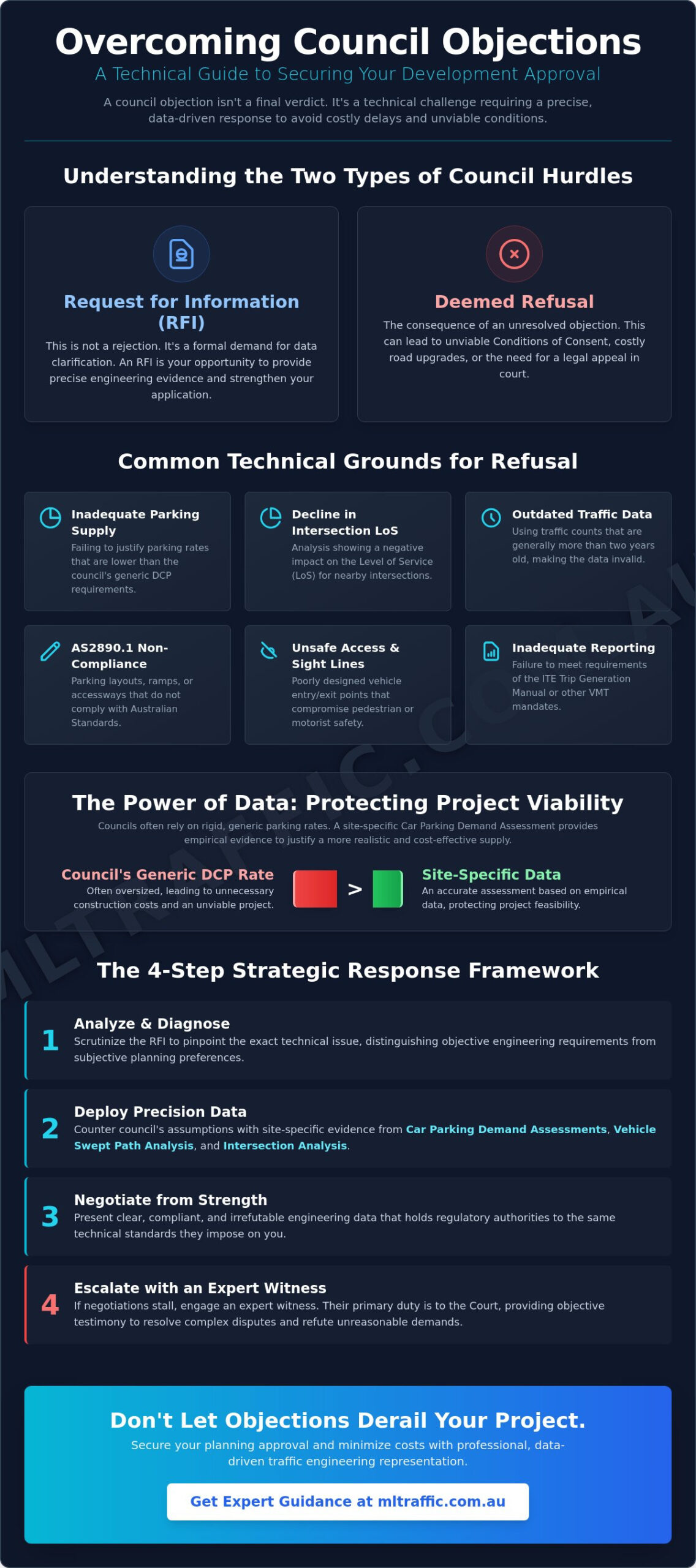
A Council objection to a development application usually originates as a Request for Information (RFI). This document is a formal demand for data clarification rather than a final rejection. Councils scrutinize traffic and parking more intensely than other environmental factors because these elements directly impact public safety and local infrastructure capacity. The Council Traffic Committee reviews these submissions to ensure the proposed development won’t degrade existing road performance or create safety hazards for pedestrians and motorists.
Major projects often require referral to state transport agencies. This happens when a development meets specific size criteria or impacts state-managed arterial roads. Current standards, such as the 12th Edition of the ITE Trip Generation Manual, guide these reviews. Addressing council objections to traffic impact assessment involves demonstrating that your project meets these rigorous benchmarks without placing an undue burden on the public network. Our Traffic Impact Assessment (TIA) Reports provide the technical foundation required to navigate these multi-agency reviews.
To better understand the fundamentals of this assessment process, watch this technical overview:
Procedural vs. Technical Objections
Procedural objections often center on data recency and completeness. Regulatory bodies generally reject traffic counts that are more than two years old. Technical objections focus on non-compliance with local Development Control Plans (DCP) or Australian Standards. You must differentiate between subjective planning preferences and objective engineering requirements. A successful response relies on factual evidence regarding Vehicle Swept Path Analysis and Intersection Analysis to refute generic concerns. Precise engineering data often reveals that Council’s initial assessments are based on overly conservative or outdated assumptions.
The Consequences of an Unresolved Objection
Unresolved objections lead to Deemed Refusal or unviable Conditions of Consent. These conditions might mandate expensive road upgrades or external infrastructure contributions that undermine project feasibility. When negotiations stall, the role of expert witness testimony becomes critical for legal appeals. This professional evidence provides a technical refutation of unreasonable demands in the Land and Environment Court. Addressing council objections to traffic impact assessment through expert representation protects your project from arbitrary planning decisions and excessive costs.
Common Technical Grounds for Traffic and Parking Refusals
Council refusals are rarely arbitrary. They usually stem from specific technical failures that provide regulatory authorities with the leverage to stall a project. Addressing council objections to traffic impact assessment requires a forensic understanding of how engineering standards are applied during the review process. When a development fails to meet the prescriptive requirements of local Planning Schemes, the resulting Request for Information (RFI) can quickly escalate into a formal refusal if not managed with technical precision.
One of the most frequent grounds for refusal is inadequate parking supply. Councils typically rely on rigid, generic parking rates defined in their Development Control Plans (DCP). If a project proposes a reduction in these rates without a robust Car Parking Demand Assessment, the application is likely to be flagged. Similarly, a decline in the Level of Service (LoS) at nearby intersections remains a primary concern for many local authorities. While some jurisdictions are moving toward Vehicle Miles Traveled (VMT) metrics, as seen in the Caltrans Guide for Traffic Impact Studies, many Australian councils still prioritize peak-hour intersection performance as a non-negotiable benchmark.
Technical objections also frequently focus on safety concerns, particularly sight distances at proposed driveway entry points. If a driveway fails to meet the minimum requirements for safe intersection sight distance (SISD), the Council will likely demand a complete redesign or refuse the application on safety grounds. Identifying these issues early through a professional Traffic Impact Assessment (TIA) Report is essential for project viability.
AS2890.1 and AS2890.2 Compliance Failures
Non-compliance with Australian Standards for off-street car parking is a common trigger for technical objections. Frequent errors include incorrect driveway ramp grades and inadequate transition zones, which lead to vehicle scraping or poor visibility. Addressing “tight” parking layouts that fail to accommodate B85 or B99 vehicle templates is critical. Our experts provide detailed reviews to ensure every design element meets the criteria outlined in our AS 2890.1 Explained resources.
Swept Path Analysis and Access Issues
Councils often object based on waste collection and service vehicle manoeuvrability. If a heavy rigid vehicle (HRV) cannot enter and exit the site in a forward direction, the project may be deemed non-compliant. We use AutoTURN software to prove compliance through meticulous Swept Path Analysis. This data-driven approach is the most effective method for addressing council objections to traffic impact assessment when access and circulation are questioned.
A Strategic Framework for Responding to Council RFIs
A coordinated response between traffic engineers and town planners is the foundation of a successful Request for Information (RFI) resolution. Addressing council objections to traffic impact assessment requires more than just technical data; it requires a strategic alignment with the broader planning objectives of the site. When a Council issues an RFI, they often rely on generic parking rates or conservative traffic growth assumptions. We use empirical, site-specific data through a Car Parking Demand Assessment to override these defaults and protect project ROI.
Negotiating road upgrade requirements is another critical phase. Councils often demand infrastructure improvements that are not proportional to the development’s impact. We apply Nexus and Proportionality arguments to ensure you only pay for what is fair. This technical negotiation ensures that the response is based on reliable methods and sufficient facts, aligning with the principles found in Federal Rule of Evidence 702 regarding expert testimony standards. This disciplined approach is essential for drafting a formal Response to Submissions (RtS) that Council can actually approve.
Step 1: Technical Deconstruction of the Objection
We begin by determining if the objection is rooted in a specific Australian Standard or a subjective planning preference. Subjective objections are easier to refute with hard data. We verify the accuracy of the Council’s traffic modelling, looking for “Quick Wins”, such as minor design tweaks that satisfy the RFI without requiring significant architectural changes. Identifying whether an objection lacks a technical basis allows us to challenge the Council’s position from a place of engineering authority.
Step 2: Evidence Gathering and Re-Modelling
If the initial data is insufficient, we conduct supplementary traffic counts or parking accumulation surveys. We utilize SIDRA intersection modelling to prove that the development has a minimal impact on the local network. We also perform a revised Swept Path Analysis to validate vehicle access and manoeuvrability. Addressing council objections to traffic impact assessment through updated modelling often resolves concerns regarding heavy vehicle access or intersection capacity. If you need a technical review of your current RFI, contact our senior principals directly to discuss your project requirements.
Expert Witness Testimony in Traffic Engineering Disputes
The transition from a consulting engineer to an expert witness occurs when a dispute escalates to a formal planning tribunal or court hearing. While a consultant provides advice to the applicant during the design phase, an expert witness has a primary duty to the Court that overrides any obligation to the client. This role requires an objective, technical assessment of the project’s impact based on engineering facts rather than advocacy. Addressing council objections to traffic impact assessment at this stage involves preparing a formal Expert Witness Statement. This document must withstand rigorous cross-examination and clearly demonstrate how the proposal complies with current safety and efficiency standards.
Joint expert conferences represent a critical phase in narrowing technical disputes. During these sessions, traffic engineers from both the applicant and the Council meet to identify points of agreement and disagreement. This process results in a joint report that streamlines the hearing by focusing only on the most significant engineering contentions. A well-prepared expert can often resolve complex issues regarding intersection capacity or parking supply during these conferences, potentially avoiding the need for a lengthy trial.
The Value of Senior Principal Involvement
Senior-level credentials are vital for establishing technical authority during a hearing. A principal engineer with decades of professional experience carries significant weight when defending a design against scrutiny. ML Traffic Engineers Australia provides a “Personnel Continuity Promise” to ensure the senior engineer who initiated the site assessment and drafted the initial report is the same individual who provides testimony. This ensures deep familiarity with the site-specific nuances and the data used in the original submission. You can review our leadership credentials at About ML Traffic Engineers Australia.
Mediation and Section 34 Conferences
Court-ordered mediation, such as Section 34 Conferences, offers an opportunity to reach a compromise before a full hearing. Traffic engineers facilitate these discussions by proposing technical solutions that meet Council safety standards without compromising the project’s commercial goals. We recently resolved a complex loading dock dispute where a Council objected to reversing manoeuvres on a narrow street. By providing evidence through a refined Vehicle Swept Path Analysis and suggesting operational management controls, we secured a technical compromise that allowed the development to proceed. Addressing council objections to traffic impact assessment through strategic mediation often provides the most efficient path to securing a planning permit.
If your development is facing a legal challenge or a tribunal hearing, contact our expert witnesses to secure authoritative technical representation.
Securing Approval: Why Professional Representation Matters
The financial impact of a low-quality traffic report often far outweighs the initial savings. Inexperienced consultants frequently produce documents that lack the technical depth required by regulatory authorities. These substandard submissions act as a catalyst for immediate Requests for Information (RFIs) and prolonged project delays. Addressing council objections to traffic impact assessment is significantly more difficult when the initial report fails to reference current national traffic engineering standards. A report that misses a single AS2890 compliance point or uses outdated trip generation data invites unnecessary scrutiny and costly design revisions.
ML Traffic Engineers Australia provides support throughout the entire development application (DA) lifecycle. We don’t just deliver a document; we manage the technical negotiations from initial site assessment through to final approval. Our approach prioritizes direct access to senior principals. This ensures that high-stakes discussions with Council staff or state transport agencies are led by experts with the authority and experience to defend your project’s technical merits. This senior-level involvement is the most effective way to minimize infrastructure contribution costs and secure viable conditions of consent.
Choosing the Right Traffic Consultant
Selecting a consultant requires evaluating more than just their engineering qualifications. You need a partner who understands the intersection of planning law, civil engineering, and local government policy. We bring a multi-disciplinary perspective to every project, ensuring that our traffic engineering services align with your town planner’s strategy and your legal counsel’s requirements. Our track record in handling complex Council RFIs across diverse land-use categories provides the reliability needed for high-value developments.
Final Checklist for Overcoming Objections
Before submitting your response to a Council objection, verify that your evidence meets the following technical benchmarks:
- AS2890 Compliance: Ensure all driveway ramp grades, transition zones, and parking space dimensions strictly adhere to current Australian Standards.
- Empirical Data Validation: Use site-specific parking accumulation surveys and traffic counts to refute generic Council rates that may be over-conservative.
- Technical Consistency: Verify that your Vehicle Swept Path Analysis matches the latest architectural plans and waste management requirements.
- Pre-Submission Review: Have your response reviewed by a senior principal to identify potential technical weaknesses before it reaches the Council Traffic Committee.
Securing a clear path to approval requires a proactive defense of your project’s traffic and parking outcomes. Addressing council objections to traffic impact assessment is a technical negotiation where data recency and engineering authority are your primary tools. If your project is currently stalled by regulatory hurdles, contact an expert for a pre-submission review to ensure your technical response is robust and compliant.
Secure Your Planning Approval Through Technical Authority
Successfully addressing council objections to traffic impact assessment requires a transition from passive compliance to technical authority. As established, data recency and strict adherence to Australian Standards are the primary levers in these negotiations. By utilizing site-specific empirical data and senior-level testimony, you transform a Request for Information into a clear path toward DA approval. This rigorous approach ensures that infrastructure contributions remain proportional and project ROI is protected from arbitrary planning demands.
ML Traffic Engineers Australia provides the meticulous oversight and multi-decade experience necessary to navigate these bureaucratic challenges. Our senior principals personally manage technical negotiations, ensuring that the same expert who initiates the project is the one who defends it. With specialists in Vehicle Swept Path Analysis and AS2890 compliance, we deliver the engineering certainty required for high-stakes developments across diverse project environments.
Don’t allow technical objections to compromise your project timelines or financial viability. Contact ML Traffic Engineers Australia for expert assistance with Council objections. Our team is ready to deploy the technical strategies and expert witness protocols needed to secure your planning approval and advance your development.
Frequently Asked Questions
What is the most common reason Councils object to a traffic report?
The most common reason for an objection is non-compliance with the AS2890 series for off-street parking and driveway design. Councils also frequently flag inadequate data regarding trip generation or the use of outdated traffic counts. Addressing council objections to traffic impact assessment often involves rectifying these technical deficiencies to meet the prescriptive requirements of local Development Control Plans.
How long does it take to respond to a Council Request for Information (RFI)?
Responding to a Council RFI typically takes between two and four weeks. This timeline depends on the complexity of the objection and whether new traffic counts or supplementary parking accumulation surveys are required. Objections involving intersection re-modelling or significant design changes to the car park layout may extend this period to accommodate the necessary engineering revisions.
Can I appeal a Council refusal based on traffic grounds?
You can appeal a Council refusal based on traffic grounds through the Land and Environment Court or the relevant state planning tribunal. This process usually requires the involvement of an expert witness to provide authoritative technical evidence. The appeal focuses on proving that the development meets safety standards and that the Council’s grounds for refusal lack a sound engineering basis.
Does every DA require an expert witness for traffic engineering?
Not every Development Application requires an expert witness. This role is reserved for formal legal disputes and planning tribunal hearings where a primary duty to the Court is required. Most standard applications only require a consulting engineer to prepare the initial Traffic Impact Assessment Report and manage technical negotiations during the standard assessment phase.
What is the difference between a Traffic Impact Assessment and a Traffic Statement?
A Traffic Impact Assessment (TIA) Report is a comprehensive analysis required for major developments that generate significant vehicle movements. A Traffic Statement is a more concise document used for minor developments with negligible impacts on the local network. Councils specify which document is necessary based on the project’s scale, location, and specific land-use category.
How much parking can I legally reduce from Council DCP requirements?
There is no fixed legal limit for parking reductions. Any deviation from the Council’s Development Control Plan must be technically justified through a site-specific Car Parking Demand Assessment. This assessment uses empirical data from similar land uses to prove that the proposed parking supply will satisfy actual demand without creating overspill onto local residential streets.
What happens if Council and Transport for NSW have conflicting objections?
When Council and Transport for NSW provide conflicting feedback, the requirements of the state transport authority generally take precedence regarding arterial roads and state infrastructure. Addressing council objections to traffic impact assessment in these scenarios requires a coordinated response that satisfies both agencies. Technical mediation is often used to resolve these conflicting engineering requirements and secure a path to approval.
Is a Swept Path Analysis mandatory for all Council submissions?
A Vehicle Swept Path Analysis is mandatory for most developments that include on-site parking or loading facilities. Councils use this analysis to verify that vehicles, including waste trucks and heavy rigid vehicles, can enter and exit the site in a forward direction. It is a critical tool for proving that the internal layout complies with the manoeuvrability requirements of AS2890.1 and AS2890.2.

Disclaimer
The content on www.mltraffic.com.au, including all technical articles, guides, and resources, is provided for general informational and educational purposes only. It is not intended to constitute professional advice in traffic engineering, transportation planning, development approvals, or any other technical or legal field.
While ML Traffic Engineers makes every reasonable effort to ensure the accuracy, completeness, and timeliness of the information published, we do not provide any warranties or representations (express or implied) regarding its reliability, suitability, or availability for any particular purpose. Any reliance you place on the content is strictly at your own risk.
In no event shall ML Traffic Engineers, its directors, employees, authors, or affiliates be liable for any direct, indirect, incidental, special, consequential, or punitive damages (including, without limitation, loss of profits, data, or business opportunities) arising out of or in connection with the use of, or inability to use, any information provided on this website.
The articles and guides on this site are not a substitute for engaging a qualified, registered professional traffic engineer (such as an NPER or RPEQ engineer) to assess your specific project requirements. For tailored advice, compliance assessments, or traffic engineering services, please contact a competent professional.
This disclaimer may be updated from time to time without notice. By accessing or using this website, you agree to be bound by the most current version of this disclaimer.
