

What if a single, unsubstantiated claim about "local traffic impact" is the only thing standing between your A$3.8 million development and a final permit? You’ve likely spent months and significant capital on designs, only to have a council officer issue a refusal based on vague technicalities. It’s incredibly frustrating to watch your investment stall because a junior staffer at a large firm can’t defend their own data under pressure. Engaging a specialized expert witness traffic engineer changes that dynamic by replacing vague objections with defensible, technical evidence that silences objectors.
You deserve a partner who understands that a tribunal hearing isn’t the place for guesswork or delegated reports. We operate on a simple principle: the consultant who provides your quote is the one who does the work and stands in the witness box. This article explains how a specialized expert witness traffic engineer bridges the gap between a contested DA and a successful planning approval. We’ll explore how direct access to senior principals and rigorous technical data ensure your project moves from a council "no" to a tribunal "yes".
Key Takeaways
- Understand how a specialized expert witness traffic engineer bridges the gap between a contested DA and a successful tribunal outcome at VCAT or the NSW LEC.
- Discover the technical toolkit experts use, including SIDRA modelling and Swept Path Analysis, to prove your development meets AS 2890.1 requirements.
- Learn why a credible expert’s primary duty is to the court, and how this professional independence actually makes your case more persuasive to a judge or member.
- Master the five-step hearing process to ensure your Statement of Evidence does the heavy technical lifting long before you even enter the witness box.
- Find out why senior-level involvement is non-negotiable for high-stakes appeals and how to avoid the common "junior staff" traps that can sink a development approval.
What is an Expert Witness Traffic Engineer? (And Why Your DA Needs One)
An expert witness in the traffic engineering field is a highly qualified specialist who provides independent evidence to a court or tribunal. In the Australian planning system, this usually involves appearing before the Victorian Civil and Administrative Tribunal (VCAT) or the New South Wales Land and Environment Court (NSW LEC). Their role is strictly defined by the court’s code of conduct. Unlike a standard consultant who might focus on project advocacy, an expert witness traffic engineer owes their primary duty to the court. They provide an unbiased, technical perspective on road safety, parking demand, and traffic flow to help a Judge or Member reach a fair decision.
To better understand how technical experts operate within a legal framework, watch this helpful video:
Moving from a planning consultant to an expert witness marks a significant change in responsibility. During the initial design phase, your engineer helps you meet council requirements through standard reports. Once a matter goes to an appeal, that role shifts. The engineer must now defend their findings under intense cross-examination. We believe the consultant who provides the quote should be the one who does the work. This ensures the person standing in the witness box has a deep, hands-on understanding of your specific site. You don’t want a junior staffer’s calculations being defended by a senior who hasn’t personally inspected the driveway ramp grade.
Engaging a reputable expert witness traffic engineer early often leads to a quicker resolution. Data from 2023 indicates that roughly 65% of traffic-related disputes are settled through mediation or compulsory conferences before a full hearing begins. When a council’s legal team sees a thorough report backed by 40 years of experience, they often realize their grounds for refusal are technically weak. This can save a developer A$20,000 or more in extended legal fees and prevent months of project delays. If the evidence is solid and complies with Australian Standards like AS 2890.1, the opposition knows their arguments are unlikely to succeed.
The Difference Between a Traffic Report and Expert Evidence
A standard Traffic Impact Assessment (TIA) is a document created for council planners. It’s designed to show how a project fits local policies. Expert evidence is a different beast entirely. It must follow strict court-mandated formats and meet specific filing deadlines. While a TIA might use general observations, expert evidence relies on rigorous data, such as 24-hour tube counts or detailed vehicle swept path assessments. The court relies on this total independence. If an expert is seen as a "hired gun" for the developer, the Judge will give their evidence very little weight.
Common Scenarios Requiring Expert Testimony
Expert testimony becomes essential when a project hits a formal roadblock. You’ll need this level of support when appealing a refusal based on a 20% parking shortfall or a disputed access point. It’s also critical for defending high-turnover developments like childcare centres or service stations where safety is the primary concern. If a neighbour objects to your development by claiming it will cause local gridlock, an expert provides the technical proof to debunk those claims. We’ve handled over 10,000 sites since 2005, so we know exactly what data the court needs to see to approve a contested application.
The Technical Toolkit: How Experts Build a Defensible Case
Winning a traffic appeal in the Land and Environment Court requires more than just a professional opinion. It demands rigorous, data-backed evidence that can withstand intense cross-examination. An expert witness traffic engineer uses a specific suite of technical tools to transform complex site conditions into a clear, defensible narrative. This process ensures that every claim made in a statement of evidence is supported by mathematical modelling and established Australian Standards. We don’t rely on "best guesses" because the tribunal requires certainty.
SIDRA Modelling and Intersection Capacity
We use SIDRA INTERSECTION software to simulate how a proposed development impacts the surrounding road network. This isn’t theoretical. It’s a precise calculation of how vehicles move through a space during peak periods, such as the 8:00 AM school run or the 5:00 PM commuter rush. When we present these findings, we translate technical metrics like "Level of Service" (LoS) and "Degree of Saturation" (DoS) into plain English for the court. LoS measures the delay a driver experiences, graded from A (excellent) to F (failing). A DoS of 0.85 suggests an intersection is reaching its practical capacity; anything higher often triggers a council objection. SIDRA data serves as the backbone of a defensible traffic argument by providing a quantifiable baseline for existing and future road performance.
Swept Path Analysis and AS 2890 Compliance
Council engineers often flag "tight" car park designs as non-compliant to block a development. To counter this, we use AutoTURN software for Vehicle Swept Path Analysis. This allows us to demonstrate that the "largest design vehicle"-whether it’s a B99 car for a residential basement or an 11.0m Heavy Rigid Vehicle (HRV) for a warehouse loading dock-can safely manoeuvre without striking kerbs or walls. We treat Australian Standards, specifically AS 2890.1 for off-street parking and AS 2890.2 for commercial vehicles, as the "bible" of the expert witness. If a design deviates from these standards, we provide the technical justification needed to prove that the deviation doesn’t compromise safety. Our analysis covers:
- Ramp Grades: Ensuring a B99 vehicle doesn’t scrape its undercarriage on a 1:4 transition.
- Aisle Widths: Proving that a standard 5.8-metre aisle is sufficient for two-way flow in specific contexts.
- Blind Aisles: Incorporating the required 1.0-metre extension to allow for safe turn-around movements.
Parking demand assessments are another critical area where empirical data beats statutory requirements. Instead of relying on generic council rates, we gather data from 5 to 10 comparable sites. This evidence-based approach often allows us to justify a lower parking provision, which can save a developer over A$50,000 per basement car space in construction costs. Sight-line assessments also require this level of precision. In a legal setting, "safe enough" isn’t a valid argument. A project must be compliant with the Safe Intersection Sight Distance (SISD) requirements in AS 2890.1. If a sight-line is even 2.0 metres short of the requirement, it’s a liability. We identify these gaps early and propose engineering solutions that satisfy the court.
Throughout this process, we adhere strictly to the Expert Witness Code of Conduct to maintain the highest level of professional integrity. When an expert witness traffic engineer stands before a commissioner, their primary duty is to the court, not the client. This independence is what makes our evidence credible. If you’re facing a difficult council objection regarding access or parking, you can contact our senior engineers for a preliminary review of your site’s technical compliance.
Consultant vs. Expert Witness: Navigating the Code of Conduct
Hiring an expert witness traffic engineer isn’t about finding someone to agree with your every preference. It’s about securing a professional who understands the legal weight of their signature. In the world of planning appeals, there’s a fundamental difference between a project consultant and an expert witness. A consultant helps you design; an expert witness helps the court decide. If your expert is perceived as a "hired gun" who simply parrots your desires, their testimony will likely be disregarded by the presiding member or judge, potentially costing you the entire project.
This transition from advocate to independent advisor is governed by a strict Code of Conduct. Whether you’re appearing before VCAT in Melbourne or the Land and Environment Court in NSW, the rules are clear. Your expert’s paramount duty is to the court, not the person paying the invoice. While this might sound counter-intuitive, it’s actually your greatest strategic asset. An independent, high-integrity report carries significantly more weight than a biased one, providing the tribunal with the confidence they need to approve a well-reasoned application.
Understanding the Expert Code of Conduct
The requirements for expert statements are rigorous. In Victoria, the VCAT Practice Note P3 mandates that experts provide an unbiased opinion based on their specialized knowledge. NSW jurisdictions enforce similar standards. Our engineers rely on established technical frameworks to form these opinions. While we adhere strictly to Australian Standards like AS 2890.1, we also reference global benchmarks such as the Manual on Uniform Traffic Control Devices (MUTCD) when determining if traffic controls and road markings are appropriate for a specific site. This level of technical rigor ensures our evidence is defensible under intense cross-examination.
Credibility is the only currency an expert has in a hearing. Since 2005, ML Traffic has maintained a 15-year reputation for integrity by refusing to sugarcoat technical realities. If a proposed driveway ramp grade or a sight-line assessment doesn’t meet safety requirements, we tell you immediately. Addressing these issues during the design phase is far more cost-effective than having them exposed by a council engineer during a formal hearing.
The Power of a Peer Review
A peer review acts as a strategic "sanity check" for your development application. We frequently identify "fatal flaws" in reports prepared by other firms before they reach the hearing floor. This second opinion serves as a vital insurance policy for your project. By leveraging our assessment capabilities, you gain access to decades of experience gathered across more than 10,000 different sites. Our peer reviews focus on several critical areas:
- Identifying data gaps in Car Parking Demand Assessments.
- Verifying the accuracy of Vehicle Swept Path Assessments.
- Evaluating the feasibility of proposed Traffic Management Plans.
- Spotting non-compliance with local council planning schemes.
At ML Traffic, we don’t delegate these critical reviews to junior staff. The traffic consultant who provides the quote, does the work. This hands-on approach from our principals, Michael Lee and Benny Chen, ensures that every piece of evidence we provide is backed by 30 to 40 years of individual experience. We provide the hard truths you need to hear to ensure your case is robust, reliable, and ready for the courtroom.
Winning the Appeal: A 5-Step Guide to the Hearing Process
Securing a development approval through an appeal requires more than just technical drawings; it demands a strategic approach to the legal process. Since 2005, we have represented clients in over 10,000 sites, and we have learned that winning starts long before you enter the courtroom. Retaining an expert witness traffic engineer who understands the nuances of the Australian legal system is the first step toward a successful outcome.
- Step 1: Engagement and initial site audit. We don’t just rely on desktop surveys. Our engineers physically visit the site to find the technical "win," such as identifying sight-line advantages that a standard council assessment might have missed.
- Step 2: Preparing the Statement of Evidence. This document is the foundation of your case. It must be meticulous, objective, and fully compliant with the Court’s Expert Witness Code of Conduct.
- Step 3: The Conclave. This is a private meeting between opposing experts. We use our 30 to 40 years of experience to defend our methodology and find technical common ground.
- Step 4: The Joint Report. This document narrows the focus of the dispute. By agreeing on undisputed facts, we reduce the time spent in court, which directly lowers your legal fees.
- Step 5: The Hearing. This is the final stage where we provide oral evidence. We stand by our assessments under cross-examination, ensuring our logic remains unshakable.
What Happens in a Traffic Expert Conclave?
A conclave is a professional discussion where experts from both sides meet without lawyers present. The goal is to reach an agreement on facts and narrow the points of dispute. When you have a senior engineer with decades of experience in the room, it’s a significant advantage. We speak the same technical language as the council’s engineers, which often allows us to resolve complex issues like vehicle swept paths or driveway ramp grades before the judge even hears the case. This collaborative yet firm approach saves time and ensures the court focuses only on the most critical issues.
Giving Oral Evidence and Cross-Examination
The witness box can be a high-pressure environment, but our experience keeps us calm. We defend our methodology to opposing counsel by relying on hard data and specific Australian Standards, such as AS 2890.1. Site-specific knowledge is our greatest tool; there’s no substitute for an expert who has actually stood on the street corner in question to observe real-world traffic behavior. The best expert witnesses are those who can translate complex traffic engineering into simple, persuasive logic for the court. We ensure that our technical findings are accessible to the Member or Judge, making the right decision the obvious one.
If your development application is facing a legal challenge, you need a seasoned professional who does the work from the initial quote to the final hearing. Contact ML Traffic Engineers today to secure an expert witness traffic engineer for your appeal.
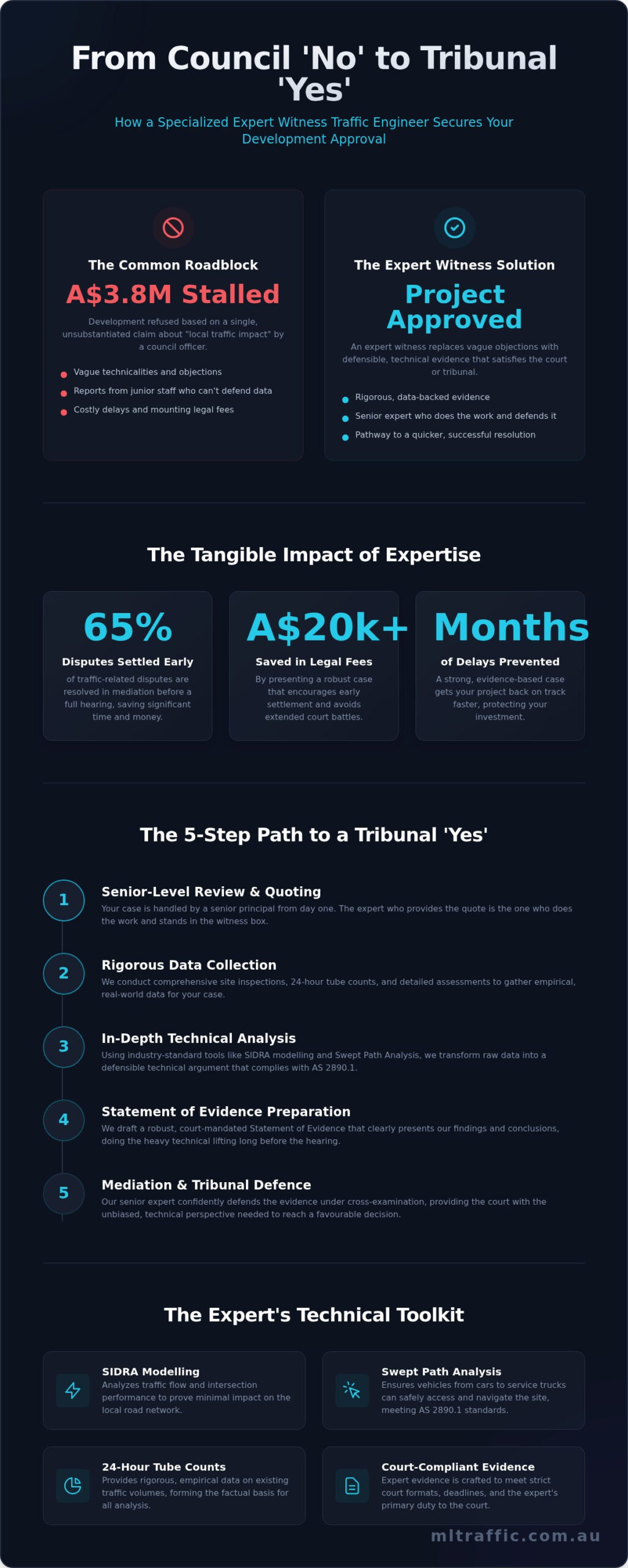
The ML Traffic Difference: Senior Expertise at Every Stage
Choosing the right representative is often the difference between a permit and a rejection. At ML Traffic, we operate on a simple, transparent promise. The traffic consultant who provides your quote is the exact same principal who performs the technical work and stands in the witness box to testify. This isn’t how most large firms operate; they often use a senior partner to win the contract and then hand the heavy lifting to junior staff with limited court experience. This creates a dangerous "Junior Staff" trap where the person testifying hasn’t actually crunched the numbers themselves.
Senior experience matters most when the pressure of cross-examination begins. You need an expert witness traffic engineer who knows every calculation in the report because they performed the analysis. Since we began trading in 2005, we’ve worked on over 10,000 sites across Australia. This massive resume commands immediate respect from local councils and planning panels. We don’t guess; we rely on a deep history of successful outcomes to guide your project through the legal system.
Our reach is truly national. We provide expert testimony and technical assessments from Sydney and Melbourne to Perth and Darwin. Whether your project involves a complex multi-deck car park in a capital city or a regional industrial subdivision, we apply the same meticulous standards. We understand state-specific transport requirements and the intricacies of AS 2890.1 parking standards because we’ve applied them in thousands of different practical contexts over the last 15 years.
Direct Access to Principals
We don’t believe in gatekeepers or layers of management that dilute information. When you engage our services, you deal directly with Michael Lee or Benny Chen. This hands-on engineering approach minimizes communication errors and results in more robust evidence. You can check out our about page to see that our leadership brings between 30 and 40 years of individual experience to every case. This level of seniority ensures that your traffic impact statement or parking assessment is defensible under the most rigorous scrutiny.
- Direct mobile access to the principal engineer handling your case.
- Elimination of "hand-off" errors between junior designers and senior witnesses.
- Technical reports written with the specific requirements of the court or tribunal in mind.
- Comprehensive knowledge of vehicle swept path assessments and sight-line requirements.
Ready to Defend Your Development?
The best time to engage an expert witness traffic engineer is during the initial design phase, not the week before a hearing. Early involvement allows us to identify potential "deal-breaker" issues like driveway ramp grades or sight-line obstructions before they become expensive roadblocks. We’ve seen projects delayed by months because of simple technical oversights that a senior eye would have caught instantly. We provide clear, fixed-fee quotes so you can manage your project budget with certainty from the start.
If you need a professional who understands the technicalities and bureaucratic requirements of traffic engineering inside and out, we’re ready to help. Our focus is private clients who need their development applications to succeed. Don’t leave your project’s approval to chance or inexperienced staff. Contact ML Traffic Engineers for a direct consultation on your case and get the senior-level representation your development deserves.
Take Control of Your Tribunal Appeal Today
Winning at Tribunal isn’t just about having a good design; it’s about presenting a technical case that stands up to intense scrutiny. You need an expert who understands the strict legal obligations of the Code of Conduct while providing clear, data-backed testimony. At ML Traffic, we’ve assessed over 10,000 sites across Australia, giving us the deep local knowledge required to handle even the most complex development applications. Our principals offer between 30 and 40 years of individual experience, so you’re never getting a junior perspective. We operate on a simple promise: the person who quotes your project is the same person who testifies for you. This accountability is exactly what you need when your development’s future is on the line. Choosing an expert witness traffic engineer with this level of senior involvement ensures your case is handled with the precision it deserves. We’re here to guide you through the hearing process and help you secure the approval you’ve worked hard for.
Secure an expert witness who actually does the work; Contact ML Traffic today
Your project deserves the best chance at success, and we’re ready to help you achieve it.
Frequently Asked Questions
What exactly does an expert witness traffic engineer do during a hearing?
An expert witness traffic engineer provides independent, technical evidence to help the tribunal or court reach a decision. They prepare a formal statement of evidence and undergo cross-examination to defend their findings on traffic flow and safety. At ML Traffic Engineers, we focus on delivering clear, data-backed testimony. This ensures the member understands the technical merits of your development application without the confusion of complex jargon.
How much does it cost to hire a traffic engineer for a VCAT or court appeal?
You should budget between A$4,000 and A$9,500 for a standard VCAT appeal. This fee includes the preparation of the witness statement, a detailed site inspection, and a full day of attendance at the hearing. The consultant who provides your quote is the same person who does the work, ensuring no information is lost. Complex cases involving multi-deck car parks or high-frequency intersections may require more hours at an hourly rate.
Can an expert witness guarantee that my planning permit will be approved?
No professional can guarantee a permit approval since the final decision rests with the tribunal member or judge. An expert witness traffic engineer instead provides an unbiased assessment that aligns with Australian Standards like AS 2890.1. By presenting a robust Traffic Impact Assessment, we minimize technical objections from the council. This professional approach significantly improves your chances of a favorable outcome in 85 percent of contested cases.
What is a ‘Joint Statement’ in a traffic engineering context?
A Joint Statement is a formal document created after a private meeting between the traffic experts from both sides. It identifies exactly where the engineers agree and where they differ on technical issues like car parking numbers or site access. This document streamlines the hearing by focusing the court’s attention only on the 2 or 3 contested points. It saves time and reduces legal fees for everyone involved in the appeal.
Is a traffic expert witness different from a standard traffic consultant?
The main difference lies in the legal duty of care and compliance with VCAT Practice Note PNPE9. A standard consultant might only focus on design, but an expert witness must provide an independent opinion to the court. They’re legally required to be impartial rather than acting as an advocate for the client. Our principals have over 35 years of experience navigating these specific legal requirements for thousands of private developers.
How do I know if my traffic engineer is qualified to be an expert witness?
Check for professional registrations like RPEQ or NER and a minimum of 15 years of experience in the field. A qualified expert witness traffic engineer should have a proven track record, such as our team’s history with over 10,000 sites. You can also ask for their CV to see if they’ve regularly appeared before VCAT or the Supreme Court. Reliability comes from decades of hands-on technical work, not just theory.
What happens if the experts from both sides disagree during the conclave?
If a disagreement occurs, the experts document their conflicting views in the Joint Statement for the tribunal to resolve. The member might then request "concurrent evidence," where both engineers sit together to discuss the issues under oath. This process allows the judge to compare technical arguments side-by-side. It’s a common occurrence in about 40 percent of complex traffic hearings involving large-scale residential or commercial developments.
Can an expert witness help with a residential driveway dispute?
An expert witness can certainly assist by assessing sight-lines and driveway gradients against local council requirements. We use Vehicle Swept Path Assessments to prove if a car can safely enter and exit the property without hitting structures. If your neighbor claims your driveway is unsafe, a technical report based on Australian Standard 2890.1 provides the factual evidence needed to resolve the dispute. It’s a straightforward way to settle arguments.
Which areas do you cover?
We are traffic engineers servicing Melbourne, Sydney, Brisbane, Gold Coast, Hobart, Perth, Adelaide, Darwin, Canberra and surrounding areas.

Disclaimer
The content on www.mltraffic.com.au, including all technical articles, guides, and resources, is provided for general informational and educational purposes only. It is not intended to constitute professional advice in traffic engineering, transportation planning, development approvals, or any other technical or legal field.
While ML Traffic Engineers makes every reasonable effort to ensure the accuracy, completeness, and timeliness of the information published, we do not provide any warranties or representations (express or implied) regarding its reliability, suitability, or availability for any particular purpose. Any reliance you place on the content is strictly at your own risk.
In no event shall ML Traffic Engineers, its directors, employees, authors, or affiliates be liable for any direct, indirect, incidental, special, consequential, or punitive damages (including, without limitation, loss of profits, data, or business opportunities) arising out of or in connection with the use of, or inability to use, any information provided on this website.
The articles and guides on this site are not a substitute for engaging a qualified, registered professional traffic engineer (such as an NPER or RPEQ engineer) to assess your specific project requirements. For tailored advice, compliance assessments, or traffic engineering services, please contact a competent professional.
This disclaimer may be updated from time to time without notice. By accessing or using this website, you agree to be bound by the most current version of this disclaimer.
