

A ‘cheap’ traffic report is often the most expensive document in an Australian development application. When a cut-price assessment leads to a Request for Further Information (RFI) or a flat rejection from council, the resulting delays and redesign costs far outweigh any initial savings. Understanding the factors affecting traffic engineering consulting fees is essential for developers who want to avoid hidden surprises and ensure their project stays on schedule. You likely already know that unpredictable council requirements can stall a site for months; receiving a quote that fails to account for necessary traffic surveys or complex software modelling is a risk most professionals cannot afford to take.
This article provides a technical breakdown of the variables that determine professional traffic engineering costs in 2026. We examine how regulatory requirements such as AS 2890 compliance, the complexity of intersection analysis using SIDRA or PTV Visum 2026, and the scope of vehicle swept path analysis influence your proposal. We also explain why direct access to the senior expert performing the technical work is the only way to ensure accountability and a council-compliant outcome delivered on schedule.
Key Takeaways
- Identify how development scale and specific land uses, such as medical centres or childcare facilities, increase the volume of required data analysis and parking demand assessments.
- Understand why technical modelling using SIDRA and AutoTURN is critical for satisfying council scrutiny and ensuring AS 2890 compliance for site accessibility.
- Analyse the primary factors affecting traffic engineering consulting fees, including the necessity of fresh traffic counts versus relying on historical council data.
- Evaluate the benefits of fixed-fee proposals over hourly rates to ensure project transparency and eliminate hidden costs during the RFI process.
- Learn how a principal-led approach and personnel continuity ensure technical accountability and reduce the risk of costly council rejections.
Land-Use Complexity and Development Scope
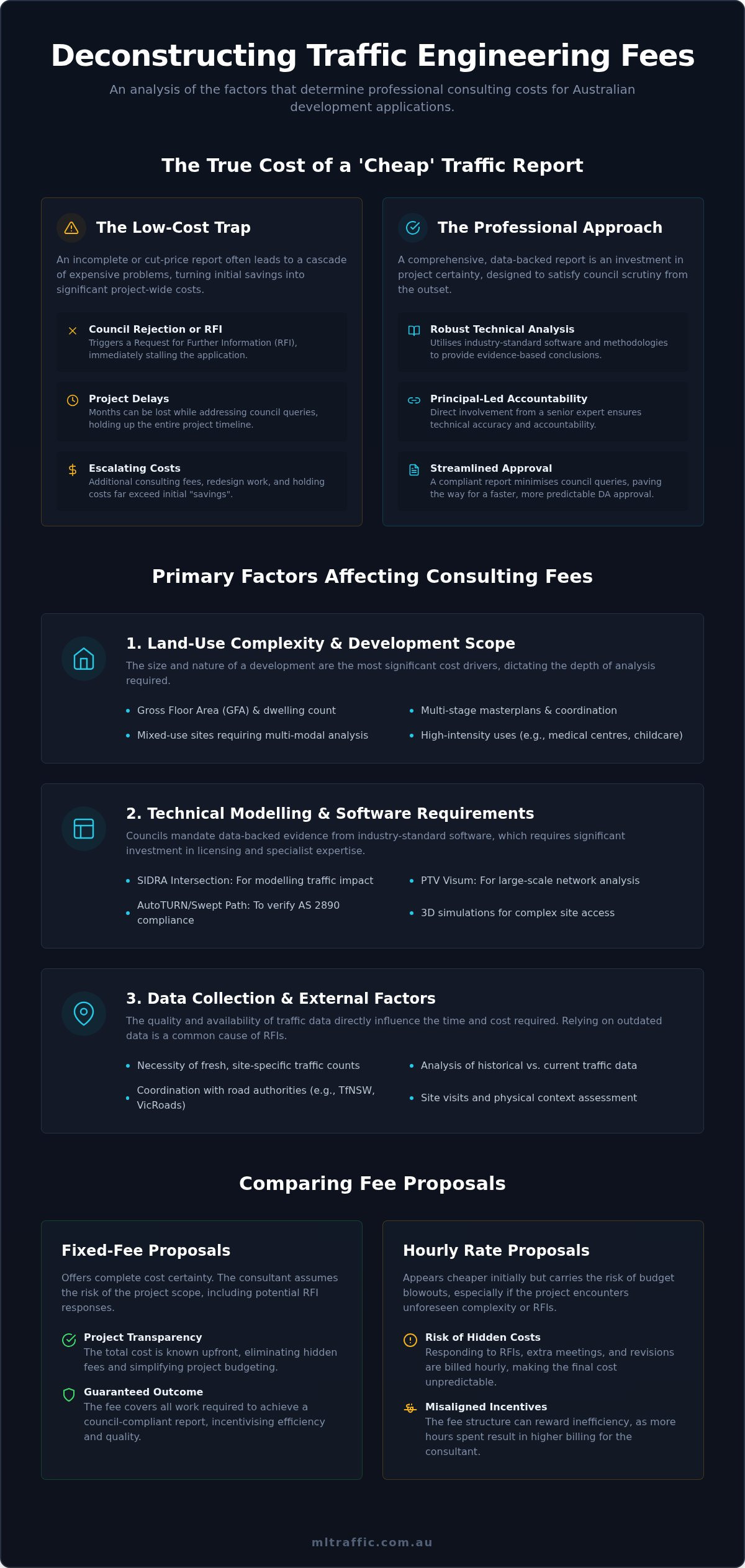
The Gross Floor Area (GFA) of a development is one of the most significant factors affecting traffic engineering consulting fees. A larger site requires more extensive data collection and analysis to determine trip generation rates. Council requirements often change based on the number of proposed dwellings or parking bays. For example, a small residential development might only require a basic assessment, but crossing a specific threshold often triggers a mandatory Traffic Impact Assessment (TIA). The field of traffic engineering dictates that these variables must be quantified to satisfy regulatory bodies and ensure network safety.
Complex land uses, such as medical centres or childcare facilities, demand specialised parking demand assessments. Unlike a standard residential block, these sites have unique peak hours and high turnover rates that require empirical data. Mixed-use developments further complicate the scope because they require multi-modal analysis. Engineers must account for pedestrians, cyclists, and public transport alongside private vehicles. This increased technical burden directly influences the time investment required from a consultant. Our traffic engineering services cover these complexities to ensure a report that stands up to council scrutiny.
To better understand the technical steps involved in these studies, watch this helpful video:
High-Intensity vs. Low-Intensity Land Use
High-intensity land uses like fast-food outlets and schools require rigorous traffic generation modelling. These sites create sharp peaks in activity that can overwhelm local intersections. In contrast, industrial warehouses often focus on heavy vehicle swept path analysis rather than raw volume. The priority shifts to the physical capability of the site to accommodate B-doubles or semi-trailers according to AS 2890.2 standards. Peak-hour trip generation remains the primary driver for intersection analysis requirements across all development types.
Multi-Stage and Large-Scale Masterplans
Coordinating traffic assessments for staged developments adds substantial coordination hours to a project. Consultants must account for how each stage impacts the broader network over several years. Master-planned communities require extensive network capacity studies and the design of internal link roads to manage future demand. Integrating public transport and active transport links into these larger precincts is a non-negotiable requirement for state and local authorities. These large-scale masterplans are significant factors affecting traffic engineering consulting fees because they necessitate broader studies that look well beyond the immediate site boundaries.
Technical Modelling and Software Requirements
Professional traffic engineering is defined by technical precision. Councils and road authorities rarely accept reports based on manual calculations or generic estimates. They require data-backed evidence generated through industry-standard software. The substantial costs associated with advanced software licensing and the specialised training required to operate these tools are significant factors affecting traffic engineering consulting fees. While basic 2D diagrams might suffice for simple driveway crossovers, complex developments often necessitate 3D swept path simulations to prove site accessibility and safety.
Public authorities rely on the specialised skills of consultants to ensure infrastructure projects meet rigorous safety standards. A report on State Use and Oversight of Engineering Consultants highlights that the need for niche expertise and high-level technical skills often drives the engagement of external firms. This expertise ensures that the modelling reflects real-world conditions rather than theoretical ideals. It’s this level of technical accountability that prevents project delays during the council assessment phase.
SIDRA Intersection Analysis
When a development is expected to impact the performance of surrounding roads, councils mandate a formal intersection capacity report. This requires the use of SIDRA Intersection software. Calibrating these models is a time-intensive process. Engineers must input existing traffic volumes, signal timings, and lane configurations to ensure the model matches current conditions. This meticulous approach prevents future road network bottlenecks and ensures that proposed mitigation measures are effective. Failure to calibrate these models correctly is a primary reason for council rejections.
Vehicle Swept Path and Access Assessments
Ensuring compliance with AS 2890.1 is a fundamental requirement for any Australian development application. Using AutoTURN for Vehicle Swept Path Analysis allows engineers to simulate the movement of B85 and B99 design vehicles through a car park. This process identifies potential conflicts before construction begins. For industrial or commercial sites, the complexity increases with AS 2890.2 requirements for heavy vehicle loading docks and service areas.
Precise Swept Path Analysis prevents expensive post-construction driveway modifications. It’s far more cost-effective to adjust a design on screen than to jackhammer concrete because a waste truck cannot make a turn. If you need a technical assessment that guarantees site functionality, consider our intersection analysis and car park design services. Meticulous planning at this stage ensures the project remains compliant with all national regulatory standards.
Data Collection and External Factors
Accurate data is the foundation of any compliant traffic report. Relying on historical data provided by councils is a risk because it often fails to reflect current traffic volumes or recent local developments. Fresh traffic counts are essential for SIDRA modelling accuracy and are one of the primary factors affecting traffic engineering consulting fees. Every additional intersection included in a study requires more hardware, more man-hours for data processing, and more complex analysis. Using outdated information often leads to council Requests for Further Information (RFIs), which creates expensive delays for the developer.
We coordinate with third-party data providers for tube counts and turning movement surveys. These are direct project costs that vary based on the duration of the study and the technology used. Additionally, data collected during the COVID-era requires specific adjustment factors to ensure modelling accuracy in 2026. Research into Examining Engineering Costs for Highway Projects indicates that these direct data collection costs and the subsequent analysis are significant drivers of the overall consulting budget. High-quality data prevents the ‘cheap’ report rejections that plague poorly planned applications.
Traffic Surveys and Site Inspections
Physical site inspections are mandatory for identifying sight distance constraints that satellite imagery cannot capture. We assess existing vegetation, power poles, and parked cars that might obstruct a driver’s view at a proposed driveway. Peak-period surveys, including AM, PM, and often weekend blocks, are mandatory for specific land uses like childcare centres or retail hubs. High-volume roads may necessitate specialised equipment such as pneumatic tubes or AI-powered camera sensors. These tools ensure data integrity and provide the granular detail required for a successful Traffic Impact Assessment (TIA).
Liaison with Councils and Road Authorities
Liaising with authorities involves significant time beyond the technical desk work. We attend pre-lodgement meetings to align the project scope with specific council expectations before formal submission. This early coordination reduces the likelihood of hidden surprises during the assessment phase. Managing stakeholder consultations for projects with high community impact adds another layer of coordination. Navigating different state-based regulatory frameworks requires an expert understanding of local variations. This ensures the professional who initiates the project is the one who defends the technical findings to the relevant road authority, maintaining accountability throughout the process.
Comparing Fee Proposals: Fixed-Fee vs. Hourly Rates
Choosing between a fixed-fee and an hourly rate structure depends on the clarity of the project’s parameters. Fixed-fee proposals provide transparency for defined scopes of work, such as a standard Traffic Impact Assessment. These are ideal for developers who require budget certainty from the outset. In contrast, hourly rates are often applied to projects with evolving scopes or uncertain council demands. This approach carries the risk of significant budget overruns if the assessment process becomes protracted. The primary factors affecting traffic engineering consulting fees often come down to how well the initial Traffic Engineering scope is defined. A vague brief leads to ‘scope creep’. Scope creep costs money.
The True Cost of ‘Cheap’ Traffic Reports
A ‘cheap’ report is a common trap that leads to a council Request for Further Information (RFI). RFIs cause delays. When a consultant delivers a report that lacks technical depth or fails to meet AS 2890 standards, the authority will stall the application. The financial impact of a three-month delay in Development Application (DA) approval is often far greater than the initial consultancy fee. These ‘off-the-shelf’ documents typically ignore site-specific constraints, such as unique sight distance issues or complex parking demand. Meticulous initial reporting by a seasoned expert prevents these delays. It ensures the project moves through the approval process without unnecessary friction.
What Should Be Included in a Professional Quote?
A comprehensive fee proposal must be granular and transparent. It should explicitly cover the following technical and administrative tasks:
- Physical site inspections to verify sight distance and local conditions.
- Technical software modelling using SIDRA or AutoTURN.
- Dedicated hours for council liaison and pre-lodgement meetings.
- A specific number of design revisions to accommodate minor layout changes.
If a quote doesn’t mention professional indemnity insurance, it’s a major red flag. This insurance ensures that the consultant is accountable for their technical findings and design recommendations. Our principal-led approach ensures that the expert who quotes the work is the one performing the analysis. This provides a level of continuity that larger, impersonal firms often lack. For a fixed-fee proposal with no hidden surprises, reach out to our team for a professional traffic engineering assessment.
Optimising Project Outcomes with ML Traffic Engineers
ML Traffic Engineers provides a direct response to the various factors affecting traffic engineering consulting fees by prioritising technical accountability. We leverage over 15 years of national experience to navigate council hurdles efficiently. Our approach focuses on high-quality Traffic Impact Assessments that prioritise DA approval speed. We understand that a meticulously prepared report is the most effective tool for avoiding expensive project delays. By ensuring technical precision from day one, we reduce the likelihood of councils issuing a Request for Further Information (RFI).
The ‘personnel continuity promise’ is a core component of our service delivery. This promise ensures that the senior expert who initiates the relationship and provides the project quote is the same professional performing the technical analysis. This eliminates the communication gaps that often occur in larger firms where work is delegated to junior staff. Continuity ensures that the technical nuances of your site are understood and addressed by a seasoned expert throughout the entire assessment process. This level of accountability is a significant factor in delivering a council-compliant report on schedule.
Principal-Led Technical Delivery
Our model eliminates the ‘junior engineer’ overhead typical of larger, impersonal firms. In many consultancies, senior principals act as gatekeepers while the actual desk work is performed by inexperienced staff. This often leads to errors that trigger council RFIs. Direct principal involvement ensures that the technical modelling and design recommendations are robust and accurate from the first submission. This seasoned expertise is invaluable when defending parking waivers or access departures. We provide a direct line to the expert doing the work, ensuring that technical questions from authorities are answered with authority and speed.
National Compliance and Expertise
National expertise is critical for developers operating across different Australian jurisdictions. We ensure every design meets AS 2890.1, AS 2890.2, and AS 2890.6 standards. Our track record includes providing compliant Traffic Engineering solutions for a diverse range of land uses. This includes residential developments, commercial offices, retail centres, childcare facilities, medical clinics, and industrial warehouses. We have assessed over 10,000 sites nationally, giving us a deep understanding of varied regulatory requirements. Contact our senior principals for a tailored fee proposal for your next development to ensure a fixed-fee outcome with no hidden surprises.
Securing Technical Compliance for Future Developments
Professional traffic engineering is a risk mitigation strategy that protects your development from costly council delays. The primary factors affecting traffic engineering consulting fees involve the complexity of land use, the depth of technical modelling required, and the integrity of fresh data collection. A report that fails to address site-specific constraints or national standards like AS 2890 will inevitably trigger a Request for Further Information. This leads to months of lost time and increased construction costs that far outweigh any initial savings on consultancy fees.
ML Traffic Engineers provides a principal-led delivery model that ensures the expert who quotes your project is the one performing the technical work. With over 15 years of national experience, we specialise in delivering council-compliant reports that streamline the approval process. Our focus on technical accountability and personnel continuity eliminates the gatekeepers found in larger firms. You can Request a Fixed-Fee Proposal from Our Senior Principals to ensure your next project benefits from meticulous planning and deep-seated expertise. We look forward to helping you achieve a successful and compliant development outcome.
Frequently Asked Questions
What is the typical timeframe for a Traffic Impact Assessment (TIA) report?
A standard Traffic Impact Assessment typically takes between two and four weeks to complete. This timeframe depends heavily on the requirement for fresh traffic data. Seven days of tube counts are often necessary to establish a baseline. Once the data is processed, our senior principals perform the technical modelling and report writing. Complex projects requiring extensive intersection analysis or stakeholder liaison may extend this schedule further.
Why do councils require SIDRA modelling for my development application?
Councils mandate SIDRA modelling to quantify the specific impact your development will have on the local road network. This software is the industry standard for intersection capacity analysis. It provides empirical evidence regarding delays, queue lengths, and level of service. Without this technical data, authorities cannot verify if the existing infrastructure can accommodate the additional trip generation without creating safety hazards or significant congestion.
Are traffic survey costs usually included in the consultant’s fee proposal?
Traffic survey costs are typically listed as a separate disbursement or a distinct line item. These costs involve third-party equipment hire and data processing for tube counts or turning movement surveys. Because they vary based on the number of intersections and the duration of the study, they are primary factors affecting traffic engineering consulting fees. We provide transparent quotes that clearly define these external data collection costs.
What happens if the council issues an RFI regarding my traffic report?
The traffic engineer must provide a formal response addressing the council’s specific technical concerns or requests for clarification. This may involve additional modelling iterations or further site-specific data. Our principal-led approach focuses on delivering meticulous initial reports to minimise the likelihood of a Request for Further Information (RFI). If an RFI occurs, having direct access to the senior expert who performed the work ensures a faster resolution.
Can a traffic engineer help reduce the required number of parking spaces?
Yes, we can justify a reduction through a formal Car Parking Demand Assessment. We analyse empirical data from similar land uses and compare it against the statutory requirements in the local planning scheme. If the actual demand is lower than the generic council rate, we provide a technical justification for a parking waiver. This process ensures the development remains functional while potentially reducing significant construction costs associated with excess parking.
Does my project need a full TIA or just a basic Traffic Statement?
The requirement depends on the scale of the development and the expected trip generation. Small projects with negligible impact on the road network often only require a basic Traffic Statement. Larger developments that exceed specific GFA or dwelling thresholds trigger the need for a comprehensive Traffic Impact Assessment (TIA) Report. We review your site plans against local council guidelines to determine the appropriate level of reporting required.
Why is AS 2890 compliance critical for car park design?
Adherence to AS 2890 standards is essential for ensuring the physical safety and functionality of a site. These standards govern the dimensions for parking bays, access ramps, and internal aisles for various vehicle classes. Non-compliance can lead to operational failures, such as vehicles scraping on steep ramps or being unable to navigate turns. Ensuring your Car Park Design meets these national standards is a non-negotiable requirement for gaining council approval.
How do I choose between a boutique traffic consultancy and a large firm?
A boutique consultancy provides direct access to senior principals and guaranteed personnel continuity. In larger firms, technical work is often delegated to junior staff, which can lead to communication gaps and technical errors. Choosing a specialist firm ensures that the expert who quotes your project is the one performing the analysis. This hands-on approach offers greater accountability and typically results in fewer council RFIs and a more efficient approval process.

Disclaimer
The content on www.mltraffic.com.au, including all technical articles, guides, and resources, is provided for general informational and educational purposes only. It is not intended to constitute professional advice in traffic engineering, transportation planning, development approvals, or any other technical or legal field.
While ML Traffic Engineers makes every reasonable effort to ensure the accuracy, completeness, and timeliness of the information published, we do not provide any warranties or representations (express or implied) regarding its reliability, suitability, or availability for any particular purpose. Any reliance you place on the content is strictly at your own risk.
In no event shall ML Traffic Engineers, its directors, employees, authors, or affiliates be liable for any direct, indirect, incidental, special, consequential, or punitive damages (including, without limitation, loss of profits, data, or business opportunities) arising out of or in connection with the use of, or inability to use, any information provided on this website.
The articles and guides on this site are not a substitute for engaging a qualified, registered professional traffic engineer (such as an NPER or RPEQ engineer) to assess your specific project requirements. For tailored advice, compliance assessments, or traffic engineering services, please contact a competent professional.
This disclaimer may be updated from time to time without notice. By accessing or using this website, you agree to be bound by the most current version of this disclaimer.
