

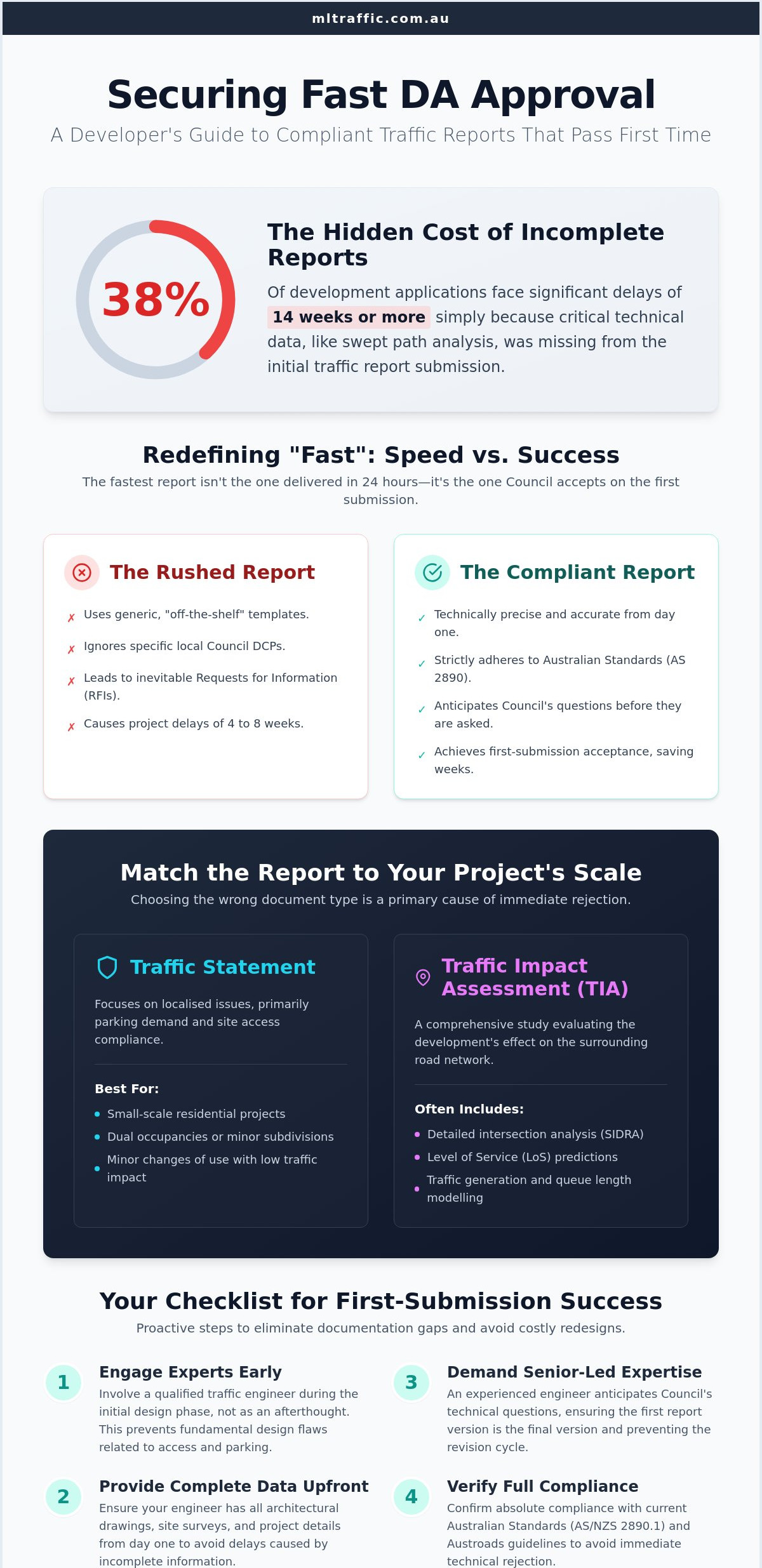
The fastest traffic report for DA approval is not necessarily the one delivered in twenty-four hours; it is the one that Council accepts on the first submission. While speed is a priority, a rushed document that ignores the May 2026 Austroads Guide to Temporary Traffic Management updates will inevitably trigger a Request for Information (RFI). Industry data shows that 38% of specific development applications face delays of fourteen weeks or more because technical data, such as swept path analysis, was missing from the initial filing.
You recognise that every week your project remains stalled in a planning queue represents a significant drain on capital and momentum. This guide provides the framework to secure a compliant traffic report quickly by focusing on technical precision and strict adherence to Australian Standards like AS/NZS 2890.1. We will examine the essential components of a robust Traffic Impact Assessment and explain how to eliminate the documentation gaps that lead to costly redesigns. You will learn how to streamline your application to achieve a successful DA determination without unnecessary bureaucratic friction.
Key Takeaways
- Understand the distinction between a Traffic Statement and a full Traffic Impact Assessment (TIA) to ensure your submission matches the scale of your development.
- Identify the specific triggers, such as significant land use changes or traffic generation thresholds, that mandate a formal report from Council.
- Learn how to secure a fast traffic report for DA approval by providing comprehensive site data on day one and engaging experts during the initial design phase.
- Minimise the risk of costly Requests for Information (RFIs) by adhering to current Australian Standards and Austroads guidelines.
- Access senior-led technical expertise that streamlines the approval process and helps avoid the financial impact of a “Deemed Refusal” period.
Accelerating Your Development Application with a Professional Traffic Report
A Traffic and Parking Assessment is a technical requirement under Australian planning law that evaluates the impact of a proposed development on the existing road network and on-site parking supply. For developers, understanding land-use planning regulations is essential; however, the technical translation of these rules into a compliant report is the responsibility of a traffic engineer. This document acts as the technical backbone of your Statement of Environmental Effects (SEE), providing the empirical evidence Council requires to verify that your project won’t compromise local safety or traffic flow.
To better understand how technical precision accelerates the process, watch this helpful video:
Speed is a commercial necessity. Every day a project sits in the assessment phase, holding costs accumulate. If a Council does not determine an application within the statutory “Deemed Refusal” period, the project enters a state of legal and financial limbo. A fast traffic report for DA approval ensures that your submission is complete from day one, preventing the assessment clock from stopping due to missing data.
The Relationship Between Traffic Reports and DA Approval
Council officers cannot legally determine an application that lacks sufficient technical justification. If your submission is incomplete, Council will issue a Request for Information (RFI). This doesn’t just add a few days of work; it typically sets a project back by 4 to 8 weeks as the application is pulled from the active queue. Absolute compliance with Australian Standards, specifically AS 2890 for parking and off-street facilities, is a non-negotiable factor. If your driveway gradients or swept paths don’t meet these metrics, the DA will stall immediately.
What Makes a Traffic Report “Fast”?
A truly fast traffic report for DA approval balances administrative turnaround with technical accuracy. Speed is useless if the report is rejected for using “off-the-shelf” templates that ignore local planning schemes. You need a qualified traffic engineer who understands the specific nuances of your local Council’s Development Control Plan (DCP). Real efficiency comes from senior-led assessments that anticipate Council’s questions before they are even asked. This ensures the first version of the report is also the final version, preventing the repetitive cycle of revisions that characterises slower, less experienced firms.
Traffic Statements vs. Full Traffic Impact Assessments (TIA)
Selecting the correct documentation level is a critical decision in the planning phase. If you submit a basic statement for a project that requires a full assessment, Council will reject the application immediately. Conversely, commissioning a full TIA for a minor change of use wastes both time and capital. Adhering to transportation impact analysis best practices ensures that the scope of work aligns with the anticipated traffic generation of the site.
A Traffic Statement focuses on localised issues, primarily parking demand and site access. It rarely involves complex computer modelling of the broader road network. In contrast, a Traffic Impact Assessment (TIA) is a comprehensive study that evaluates the development’s effect on the surrounding infrastructure. This involves detailed intersection analysis, often using software like SIDRA, to predict changes in Level of Service (LoS) and queue lengths. Misjudging these requirements is a primary cause of project stall.
When a Traffic Statement is Sufficient
Small-scale residential developments, such as dual occupancies or minor subdivisions, typically only require a Traffic Statement. This is the most efficient route to securing a fast traffic report for DA approval because the data collection is streamlined. If your project has minimal traffic generation but requires a Car Parking Demand Assessment to justify a shortfall, a Statement is usually the appropriate vehicle for compliance. It provides the necessary justification without the extended lead times of a full impact study.
When a Full TIA is Mandatory
Large-scale commercial, industrial, or multi-storey residential projects demand a higher degree of technical scrutiny. If your development impacts a classified road or a major intersection, Council and state road authorities will mandate a full TIA. This report includes Vehicle Swept Path Analysis for the largest anticipated vehicles and rigorous intersection modelling. For a deeper technical breakdown of these requirements, refer to our comprehensive TIA guide.
The risk of choosing incorrectly is high. An under-scoped report triggers an RFI, while an over-scoped one unnecessarily delays your submission date. Consulting with a senior engineer early allows you to define the exact scope Council expects. If you’re unsure which path fits your project, you can discuss your site plans with our principals to determine the most direct route to approval.
Key Triggers: When Does Council Require a Traffic Report?
Councils utilise a specific set of technical triggers to determine if a development requires formal traffic documentation. Identifying these triggers during the pre-lodgement phase is the most effective way to secure a fast traffic report for DA approval. If your project activates any of the following criteria, a professional assessment is mandatory:
- Significant change in land use: Converting a residential dwelling into a commercial premises, such as a medical centre or professional office, fundamentally alters the traffic profile of the site.
- Development scale: Most Councils set specific thresholds, such as the number of dwellings or total gross floor area, beyond which a report is automatically required.
- Parking non-compliance: Proposing fewer parking spaces than mandated by the Local Environmental Plan (LEP) or Development Control Plan (DCP) necessitates a formal justification.
- Infrastructure proximity: Sites located near classified roads, major intersections, or public transport hubs face higher levels of scrutiny from both Council and state road authorities.
- Local safety concerns: Known congestion issues or high accident rates in the immediate vicinity will trigger a requirement for a safety-focused assessment.
Failure to address these triggers before lodgement is the primary cause of project delays. A proactive approach allows you to submit a complete package that addresses Council concerns from the outset.
Assessing Your Site’s Traffic Potential
Traffic generation is estimated using industry-standard rates established by state transport authorities. We calculate the peak hour vehicle movements to determine the impact on the surrounding road network. A critical component of this process is Vehicle Swept Path Analysis. This technical simulation proves that the largest anticipated vehicles, such as council waste trucks or delivery vans, can safely enter and exit the site in a forward direction. Identifying “red flags,” such as restricted sight lines or narrow access points, during the design phase prevents costly redesigns after the DA is lodged.
Parking Demand and Supply Assessments
Required parking rates are dictated by the local planning scheme. When a development cannot physically accommodate the full quota of bays, a Car Parking Demand Assessment provides the empirical evidence needed to justify a shortfall. This often involves surveying similar developments to prove that actual demand is lower than the statutory requirement. Ensuring that the physical car park design adheres strictly to AS 2890.1 accelerates the approval process. Meticulous attention to ramp grades, aisle widths, and bay dimensions ensures that Council officers can approve the parking layout without issuing an RFI.
Strategies to Fast-Track Your Traffic Engineering Assessment
Achieving a fast traffic report for DA approval requires a developer to adopt an “Information First” approach. Speed is not merely a function of how quickly an engineer can type; it is a result of how efficiently technical data is provided and processed. When you supply a complete project brief from the outset, you eliminate the administrative friction that typically adds ten to fourteen days to the consultancy phase. This proactive preparation ensures that the technical work begins immediately without the need for clarifying emails or missing site data.
Early engagement is the most effective strategy for compressing your planning timeline. Consulting with a traffic engineer during the initial design phase, rather than after the architectural drawings are finalised, prevents the need for retrospective changes. We use specialised software like AutoTURN to generate precise swept path diagrams during the drafting stage. This allows us to verify that your proposed driveway and car park layouts are compliant with AS 2890.1 before you lodge your application. Direct communication with Council traffic officers also serves to pre-empt technical concerns, ensuring the final report addresses their specific local requirements.
Preparation Checklist for Developers
To facilitate a rapid turnaround, ensure your documentation package includes the following technical data on day one:
- Final architectural site plans and floor plans in CAD format.
- Detailed breakdowns of gross floor area (GFA) and specific land-use categories.
- Clear specifications for vehicle types, such as waste collection trucks or heavy rigid vehicles (HRVs).
- Existing site usage data and any previous traffic count information.
- Organising site surveys early to ensure current traffic volumes are accurately reflected.
RFI-Proofing Your Report
The fastest report is the one that avoids a Request for Information (RFI). We RFI-proof our documentation by anticipating common Council objections regarding driveway ramp grades and intersection sight distances. Every assessment is reviewed and signed off by a senior principal engineer to ensure technical integrity. This senior-led approach is essential because Council officers are less likely to challenge a report backed by decades of professional experience. Meticulous Traffic Engineering is not just about compliance; it is the ultimate speed tactic for developers who cannot afford delays.
If you have a pending submission deadline, you can request a technical fee proposal today to begin the information-gathering process immediately.
Ensuring DA Success with ML Traffic Engineers
ML Traffic Engineers provides a distinct advantage by prioritising RFI-prevention over mere administrative speed. While many firms focus on the initial delivery date, we focus on the final determination date. A report that is delivered in three days but requires three rounds of Council clarification is inherently slower than a technically robust document that secures approval on the first pass. This RFI-proofing strategy is built on over 15 years of practical experience in the Australian market, navigating the specific requirements of local Councils across all states and territories.
We operate with a “no-gatekeepers” philosophy. You have direct access to our senior principals throughout the life of your project. The engineer who initiates your project and reviews your site plans is the same professional who performs the technical work. This personnel continuity promise eliminates the communication gaps that often occur in larger, more impersonal firms. It ensures that the technical nuances of your development are not lost in translation between junior staff and senior reviewers, leading to a more reliable and authoritative submission.
Our Approach to Fast-Tracked Reports
Our internal processes are streamlined to support the delivery of a fast traffic report for DA approval without compromising technical integrity. We offer a comprehensive suite of services, including Traffic Impact Assessments (TIAs), Vehicle Swept Path Analysis, and specialised Car Park Design. By maintaining a deep understanding of national regulatory standards and current Austroads guidelines, we ensure your submission is compliant with the latest 2026 requirements. This strict adherence to Australian Standards is the most reliable way to avoid the holding costs associated with project delays.
Get Started on Your Traffic Report Today
Securing a professional assessment begins with a direct technical consultation. We provide detailed fee proposals that outline the specific scope required for your DA, whether it involves a simple Traffic Statement or a complex intersection analysis. Typical timeframes for the preparation of a TIA range from 14 to 28 days after we receive your final site plans. However, we recognise the commercial pressures of the development industry and offer direct contact with our senior principals for urgent project advice.
Our results-oriented approach is designed to deliver a compliant traffic report promptly, allowing you to focus on the broader aspects of your development. To discuss your specific DA requirements and ensure your project moves through Council without technical friction, Contact ML Traffic Engineers to request a fee proposal for your site.
Secure Your Development Timeline with Technical Precision
Success in the Development Application process depends on technical accuracy and strict adherence to Australian Standards. Identifying the correct reporting level and engaging in early site analysis prevents the administrative delays that cause projects to stall in the planning queue. Securing a fast traffic report for DA approval is a matter of providing comprehensive data on day one to eliminate the risk of a multi-week RFI cycle.
ML Traffic Engineers offers 15+ years of Australian consultancy experience to ensure your project remains on schedule. Our senior principals lead every assessment directly; you will work with the same expert from the initial fee proposal through to the final technical sign-off. This hands-on approach provides the reliability required to navigate complex Council requirements without unnecessary bureaucracy.
Get a Fast, Compliant Traffic Report for Your DA and move your project toward a successful determination today.
Frequently Asked Questions
How long does it take to get a traffic report for a DA?
The preparation of a formal report typically takes 14 to 28 days after the receipt of final architectural site plans. This duration allows for necessary data collection, site surveys, and technical modelling. Providing a comprehensive brief on day one is the most effective method to secure a fast traffic report for DA approval.
Can I submit my DA without a traffic report and provide it later?
Submitting an application without required traffic documentation is a high-risk strategy that usually leads to delays. Council will likely issue an immediate Request for Information (RFI), which stops the statutory assessment clock. It’s more efficient to lodge a complete submission to ensure the “Deemed Refusal” period remains active and the project maintains momentum.
What is the difference between a Traffic Statement and a Traffic Impact Assessment?
A Traffic Statement is a concise document focusing on parking and access for low-impact developments. In contrast, a Traffic Impact Assessment (TIA) is a comprehensive study required for larger projects. TIAs involve detailed intersection modelling and an analysis of the broader road network’s capacity to handle increased vehicle movements.
How much does a professional traffic report cost for a standard development?
Professional fees are determined by the project’s scale and the technical complexity of the required assessments. Factors such as the number of intersections requiring modelling and the necessity for multi-day traffic counts will influence the final cost. Developers should request a tailored fee proposal based on their specific site plans and Council requirements.
Will a traffic report guarantee my DA approval?
A traffic report provides the empirical evidence Council needs to justify an approval, but it’s not a guarantee. A compliant report demonstrates that the development adheres to Australian Standards, such as AS 2890.1 for parking. This technical justification removes traffic-related grounds for refusal, significantly increasing the likelihood of a successful determination.
What happens if Council issues an RFI for my traffic assessment?
A Request for Information (RFI) halts the assessment process and can delay a project by four to eight weeks. Your traffic engineer must then provide the specific data or design amendments requested by the Council officer. Engaging an expert to RFI-proof your initial submission is the best way to avoid these costly administrative interruptions.
Do I need a traffic report for a simple residential driveway modification?
Driveway requirements are dictated by the local Council’s Development Control Plan (DCP). While minor changes might only require basic plans, many Councils mandate a Driveway Ramp Grade Assessment or Sight Distance Assessment. These technical documents prove the crossing meets safety standards and protects the public road asset.
How do I know if my site needs a Swept Path Analysis?
Swept Path Analysis is mandatory if your development must accommodate specific vehicles like waste trucks or delivery vans. If your local planning scheme requires vehicles to enter and exit the site in a forward direction, a technical simulation is the only way to prove the car park layout is functional and compliant.

Disclaimer
The content on www.mltraffic.com.au, including all technical articles, guides, and resources, is provided for general informational and educational purposes only. It is not intended to constitute professional advice in traffic engineering, transportation planning, development approvals, or any other technical or legal field. While ML Traffic Engineers makes every reasonable effort to ensure the accuracy, completeness, and timeliness of the information published, we do not provide any warranties or representations (express or implied) regarding its reliability, suitability, or availability for any particular purpose. Any reliance you place on the content is strictly at your own risk. In no event shall ML Traffic Engineers, its directors, employees, authors, or affiliates be liable for any direct, indirect, incidental, special, consequential, or punitive damages (including, without limitation, loss of profits, data, or business opportunities) arising out of or in connection with the use of, or inability to use, any information provided on this website. The articles and guides on this site are not a substitute for engaging a qualified, registered professional traffic engineer (such as an NPER or RPEQ engineer) to assess your specific project requirements. For tailored advice, compliance assessments, or traffic engineering services, please contact a competent professional. This disclaimer may be updated from time to time without notice. By accessing or using this website, you agree to be bound by the most current version of this disclaimer.
