
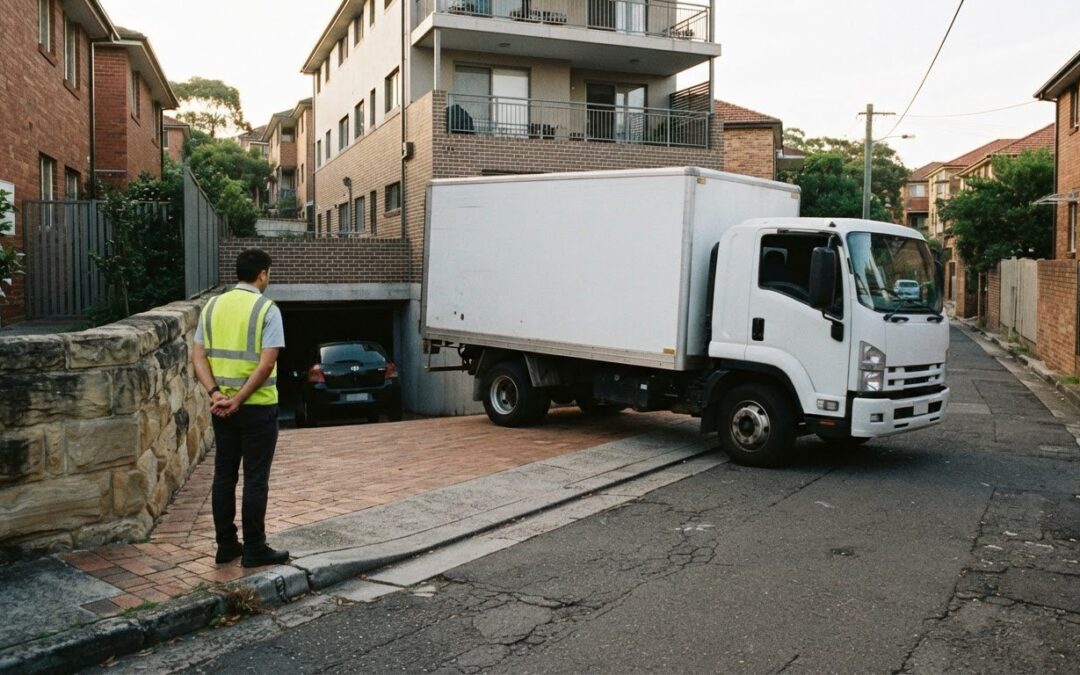
Traffic constraints can focus a solution rather than stop it. Finding creative solutions to traffic constraints starts with understanding the limits, then examining how existing road space, access arrangements and project resources can work together. The aim is a practical response to traffic needs, without assuming new infrastructure is the only option.
Limited space, competing access needs and vehicle movements can narrow a project’s options. These constraints matter, but they can also define the problem more clearly and direct attention towards workable alternatives.
This article explains how constraints can guide creative thinking, how existing resources can help develop options, and why each solution must be assessed against practical site conditions. It also shows how traffic impact assessments, swept path analysis and parking demand assessments can connect an idea to the requirements it needs to address.
Key Takeaways
- Start by identifying resources already within the problem, then consider how they could serve a different purpose.
- Use clear, workable constraints to focus exploration, while leaving enough room for alternative ideas.
- Assess potential solutions for desirability, feasibility and viability before adapting them to the traffic challenge.
- Explore how changes to access, movement and the use of existing road space may help address congestion in Australian cities.
- Learn how adaptive traffic signals respond to traffic conditions and where traffic assessments can help evaluate project impacts.
Using existing resources to generate solutions
Traffic constraints can clarify the problem and focus exploration on resources already available. Test whether existing space, infrastructure and travel choices can address the movement issue before assuming new capacity is the only option.
Congestion reduction measures
Congestion measures change when, how or by whom road space is used. Their value depends on the specific bottleneck, available alternatives and effects on nearby streets.
Road pricing or a congestion charge may influence travel choices by making drivers account for the cost of using busy roads at particular times. Whether this approach suits an Australian location depends on transport alternatives, network layout and the approval context. A charge alone does not resolve where displaced traffic would go.
Other options include bus priority, improved public transport, carpooling, park-and-ride and flexible work hours. Carpooling can reduce separate vehicle trips, while park-and-ride connects a car journey with public transport. Each option involves time, access and operating considerations, and its potential benefits depend on whether it suits people’s journeys.
Walking and cycling infrastructure can offer alternatives for shorter trips and reduce road pressure when routes connect useful destinations. Designs also need to consider safety, accessibility and people who cannot readily change their travel mode. Remote work and flexible hours can shift or remove some peak-period trips, although their effect depends on which activities can change.
For a proposed traffic management change, identify the road owner and relevant state or territory authority first. The approval pathway depends on the road, the proposed change and any council-managed assets involved.
Adaptive signals and dynamic lanes
Adaptive traffic signals adjust signal timing in response to changing traffic conditions. Dynamic lane management changes lane use to suit current demand. Both aim to use existing road capacity more effectively, so their suitability depends on corridor conditions and how movements interact.
Signal timing can respond to observed queues or traffic flows instead of relying only on a fixed plan. Dynamic lanes may reallocate available space, but any change needs clear operating arrangements and consideration of all road users. There is no universal Australian city model: success depends on the corridor, the measure and its local effects.
The Apollo 13 mission offers a useful example of resource-led problem solving: the team on the ground developed solutions using resources aboard the spacecraft carrying three men. Systematic Inventive Thinking’s Closed World Principle applies a similar idea: seek solutions using resources already within the problem world. In traffic planning, that means examining existing access points, road space, signal arrangements and travel patterns before adding new elements.
Constraints still need careful evaluation. A change that eases one queue may shift delays, affect access or create conflicts elsewhere. Compare options against the movement problem, practical feasibility and impacts on different road users. This turns creative exploration into a focused assessment, not a search for novelty alone.
The potential for constraints to focus creative exploration
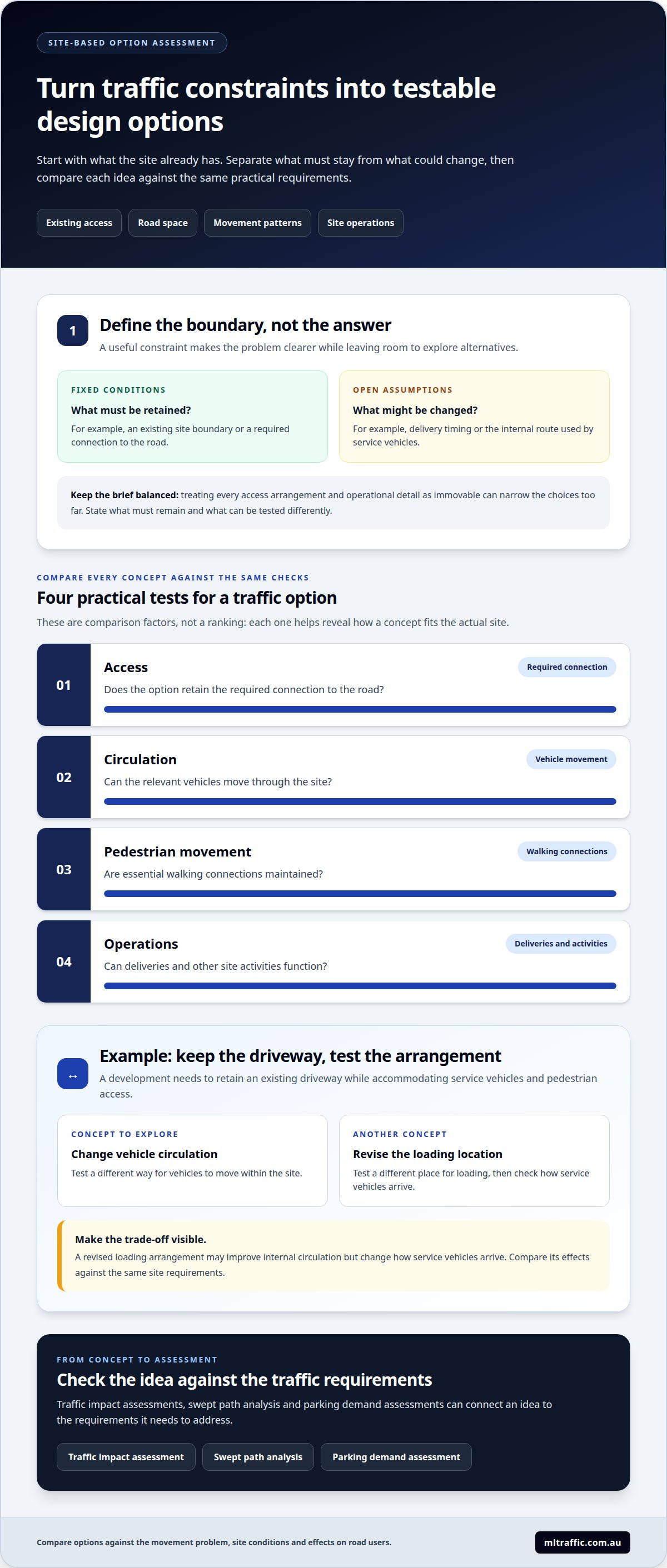
A constraint can define the problem without prescribing an answer. In a development proposal, limited frontage, retained access or required pedestrian connections can clarify which design decisions need attention. Identify how each condition shapes movement, then explore alternatives in the context of the actual site.
A familiar creative exercise shows how a boundary can focus attention. Six-word stories use a six-word limit to concentrate a writer’s choices. In a traffic workshop, a similar prompt could ask the team to describe the access problem in one sentence before proposing changes. This keeps discussion anchored to the issue instead of jumping straight to a preferred design.
For example, a development may need to retain an existing driveway while accommodating service vehicles and pedestrian access. These conditions can provide a shared test for each concept. One option might change vehicle circulation within the site; another might revise where loading takes place. The site’s requirements give the team a basis for comparison without assuming every option produces the same layout.
Separate fixed conditions from assumptions before exploring options. An existing boundary may be fixed, while delivery timing or the internal route for service vehicles may be open to change. This distinction helps a design team focus on decisions that can change, rather than treating every familiar arrangement as unavoidable.
Constraints work best when they leave room for alternatives. Treating every access arrangement and operational detail as immovable can make the design choices too narrow. A clear brief should state what must be retained and where a different approach can be tested. This balance keeps creative exploration connected to real site needs.
Use the same criteria to compare concepts:
- Access: Does the option retain the required connection to the road?
- Circulation: Can relevant vehicles move through the site?
- Pedestrian movement: Are essential walking connections maintained?
- Operations: Can deliveries and other site activities function?
These checks make trade-offs visible. A revised loading arrangement, for instance, may improve internal circulation but change how service vehicles arrive. Comparing each concept against the same requirements helps teams identify effects early and refine options that do not fit the site.
A useful constraint acts as a design prompt, not a predetermined answer. Define the problem, identify changeable assumptions and compare concepts against shared criteria to explore practical responses that stay focused on the development’s traffic needs.
A constraint guides attention without dictating a single outcome. Constraints may support creativity when they focus the search, but excessively restrictive constraints can make creative solutions less likely or impossible. Preserve meaningful choices by defining the conditions that matter, then leaving room to test different responses. Six-word stories use a six-word constraint to focus a story.
60 houses on Scheepstimmermanstraat followed the same design rules while varying in architectural style. In site planning, the same principle invites teams to hold essential requirements steady while exploring distinct arrangements. A constraint is productive when it gives concepts a common basis for comparison while allowing each to respond to the site in its own way.
Using constraints to prompt creativity
Constraints can focus creative work, but their effect depends on how they are framed. A review of research found an inverted-U relationship: moderate constraints may support creativity better than very few or very many constraints. In traffic planning, a defined access requirement can focus exploration, while treating every feature as fixed may leave too little room for alternatives.
The Integrated Constraints in Creativity model distinguishes between two functions. Exclusionary constraints say what to avoid; focusing constraints identify what to use. At a site with limited road frontage, an exclusionary prompt might rule out a new access point. A focusing prompt could ask how existing access can accommodate the required vehicle movements.
Exclusionary rules can also create fixation. People may focus on the very idea they’ve been told to avoid, then return to it once the restriction lifts. The nine-dots puzzle illustrates how assumptions can narrow a search: participants connect nine dots using four straight lines without lifting the pen. In a later experiment, 25% of participants solved it after being told to draw lines outside the imaginary square.
That example suggests a useful prompt for a traffic workshop: make an unstated assumption visible, then test whether it is genuinely fixed. Teams can explore three approaches:
- Break the rules: temporarily question a conventional layout assumption, then test realistic alternatives.
- Parallel worlds: consider how a comparable site or transport setting might handle the same movement problem.
- Random connections: use an unrelated object or process to prompt a different way of organising access or circulation.
Constraints can also provide a starting structure. Dr Seuss accepted a challenge to write a story using no more than 50 different words, producing Green Eggs and Ham. In traffic design, a prompt could limit exploration to existing access points or require concepts to retain pedestrian connections. The limit gives the team a defined brief, not a finished answer.
Research on special-occasion messages found that including a required word led to messages judged more creative than those written without that constraint. Participants who first completed the constrained task also produced more creative messages after the limit was removed. A short constraint-based exercise may therefore help a project team generate options before the wider design discussion.
Keep the constraint proportionate. A useful prompt narrows the search while leaving multiple plausible responses. Teams can then assess each concept for desirability, feasibility and viability, adapting options where needed. This comparison matters: an imaginative traffic concept still needs to address the site’s actual movement requirements.
Examples show how a narrow brief can still support invention. Phil Hansen created an image of Jimi Hendrix using 7000 matches, turning a material limit into an artistic resource. The Borneo and Sporenburg single-family housing plots were 4.2 to six meters wide, a physical constraint that shaped the design problem without dictating its solution.
A workshop can make that shift tangible: at the Kochi-Muzris Biennale, participants were given cardboard, two-colour cardstock, scissors and sketch pens to make social shields. A choice can also be framed at different scales, like an ice cream truck with six flavours versus a supermarket freezer offering 30 flavours.
What are creative ways to reduce traffic congestion in Australian cities?
Congestion strategies work best when they address the cause of delay, not just the visible queue. In Sydney, Melbourne, Brisbane or another Australian city, a bottleneck may reflect concentrated travel times, limited alternatives, turning movements or access conflicts. The right response depends on which condition is restricting movement and who relies on that route.
Start by matching the measure to the problem. If peak-period demand is the main pressure, staggered work hours, remote work and travel planning can shift some trips. If vehicles queue behind turning traffic, examine access arrangements or intersection operations. If a short trip can be made another way, connected walking or cycling routes may offer a practical alternative.
Road pricing and congestion charges are another possible demand-management tool. Their effect depends on the roads covered, the times charged and the travel alternatives available. A charge could change route, time or mode choices, but may redirect vehicles to nearby streets. Any proposal should consider who pays, who can change their journey and how surrounding roads may be affected.
Public transport measures can complement demand management. Bus priority can help buses move through constrained corridors, while park-and-ride connects drivers with public transport. Carpooling may reduce separate vehicle trips when people share a destination and schedule. These measures are more useful when service access, journey time and passenger needs align.
Walking and cycling improvements can support shorter journeys when routes connect homes, workplaces and services. A path that ends before a useful destination may not offer a practical alternative. Planning should also consider safe crossings, accessible connections and people who cannot walk or cycle. Remote work and flexible hours can help spread peak demand, but only for roles and activities that can shift.
Measures can be combined rather than treated as competing choices. For example, a corridor plan might coordinate bus priority with signal operations, while nearby walking links connect passengers to stops. A proposed road change may also need a Traffic Guidance Scheme to explain how temporary traffic arrangements will operate during works. The measure should suit both the problem and its implementation context.
Compare options using a consistent set of questions:
- Cause: Which movement or travel pattern creates the delay?
- Reach: Which road users and nearby streets could be affected?
- Alternatives: Can people realistically change time, route or mode?
- Trade-offs: Could reduced delay create access, safety or equity concerns?
This approach helps Australian cities assess congestion measures as connected network decisions. It also keeps creative options grounded in how people travel and how each road functions.
How do adaptive traffic signals improve traffic flow?
Adaptive traffic signals adjust signal timing in response to changing traffic conditions. At an intersection where queues vary during the day, this can help allocate green time to movements experiencing demand. The objective is to manage available capacity more responsively, not create extra road space or remove every source of delay.
A signal system uses traffic information to identify changing arrivals and queues, then alters phase timing within its operating parameters. For example, if one approach has a longer queue than a lightly used approach, timing may respond to that difference. The exact response depends on the intersection layout and signal plan.
Coordination matters across a corridor. A signal that clears one approach quickly can still contribute to stop-start travel if the next intersection cannot process arriving vehicles. Coordinated timing considers traffic between adjacent signals, including intersection spacing and the effects of turning movements. This makes the corridor, rather than one isolated junction, an important unit of analysis.
Adaptive operation also needs to account for people outside vehicles. Pedestrian crossings, turning vehicles and buses can all affect signal phases. For instance, extending a vehicle phase may change when pedestrians can cross. A sound operating plan balances competing movements while considering crossing opportunities and intersection function.
Before applying adaptive signals to a development-related traffic issue, distinguish recurring demand patterns from a local design problem. Signal adjustments may respond to fluctuating queues, but cannot resolve a driveway that creates conflicting movements or an intersection with limited physical capacity. Those conditions call for analysis of access, turning paths and how development traffic interacts with surrounding roads.
Assessment of an intersection can examine:
- Queue patterns: Which approaches experience delay, and when?
- Movement demand: Where do through, turning, bus and pedestrian movements conflict?
- Network effects: Does a change at one signal affect the next junction?
- Site access: Could entering or exiting vehicles interfere with intersection operation?
These checks help distinguish operational improvements from changes that require a broader traffic response. Consider a proposal alongside nearby access points and intersections, not as an isolated signal setting. This matters for a development beside a busy corridor, where added turning traffic may affect queues beyond the site frontage.
Adaptive signals are most relevant where demand varies and signal timing can respond to that variation. Their performance depends on suitable intersection operation, coordination and attention to all road users. For a development proposal, assess the site’s traffic effects alongside how access and nearby intersections function together.
ML Traffic Engineers Australia
ML Traffic Engineers Australia helps assess how development traffic interacts with existing roads, access points and site operations. A Traffic Impact Assessment (TIA) Report can evaluate potential effects on the surrounding network and inform planning decisions. Vehicle Swept Path Analysis and Car Parking Demand Assessment can address vehicle movement and parking needs within a proposal. Where works affect traffic arrangements, a Traffic Guidance Scheme (TGS) sets out the proposed traffic guidance.
These assessments are useful when a project must address limited access, competing vehicle movements or constrained parking. They provide a technical basis for comparing practical options against site conditions and traffic requirements.
For help assessing traffic constraints for your project, contact ML Traffic Engineers Australia.
Turn traffic constraints into a clear project brief
Before choosing a preferred traffic response, define the decision the project needs to make. Identify the site condition that cannot change, the movement that needs attention and the trade-offs the design must address. This gives the next assessment a practical purpose and keeps exploration focused on options that can work in context.
Finding creative solutions to traffic constraints means connecting a promising idea to the site’s access, vehicle movements and parking needs. A Traffic Impact Assessment (TIA) Report can assess effects on the surrounding network, while Vehicle Swept Path Analysis and Car Parking Demand Assessment address specific site requirements. The right assessment depends on the project question.
Bring that question to the next stage with ML Traffic Engineers Australia. A clear starting point can help turn a difficult traffic constraint into a considered design decision.

Disclaimer
The content on www.mltraffic.com.au, including all technical articles, guides, and resources, is provided for general informational and educational purposes only. It is not intended to constitute professional advice in traffic engineering, transportation planning, development approvals, or any other technical or legal field.
While ML Traffic Engineers makes every reasonable effort to ensure the accuracy, completeness, and timeliness of the information published, we do not provide any warranties or representations (express or implied) regarding its reliability, suitability, or availability for any particular purpose. Any reliance you place on the content is strictly at your own risk.
In no event shall ML Traffic Engineers, its directors, employees, authors, or affiliates be liable for any direct, indirect, incidental, special, consequential, or punitive damages (including, without limitation, loss of profits, data, or business opportunities) arising out of or in connection with the use of, or inability to use, any information provided on this website.
The articles and guides on this site are not a substitute for engaging a qualified, registered professional traffic engineer (such as an NPER or RPEQ engineer) to assess your specific project requirements. For tailored advice, compliance assessments, or traffic engineering services, please contact a competent professional.
This disclaimer may be updated from time to time without notice. By accessing or using this website, you agree to be bound by the most current version of this disclaimer.
