
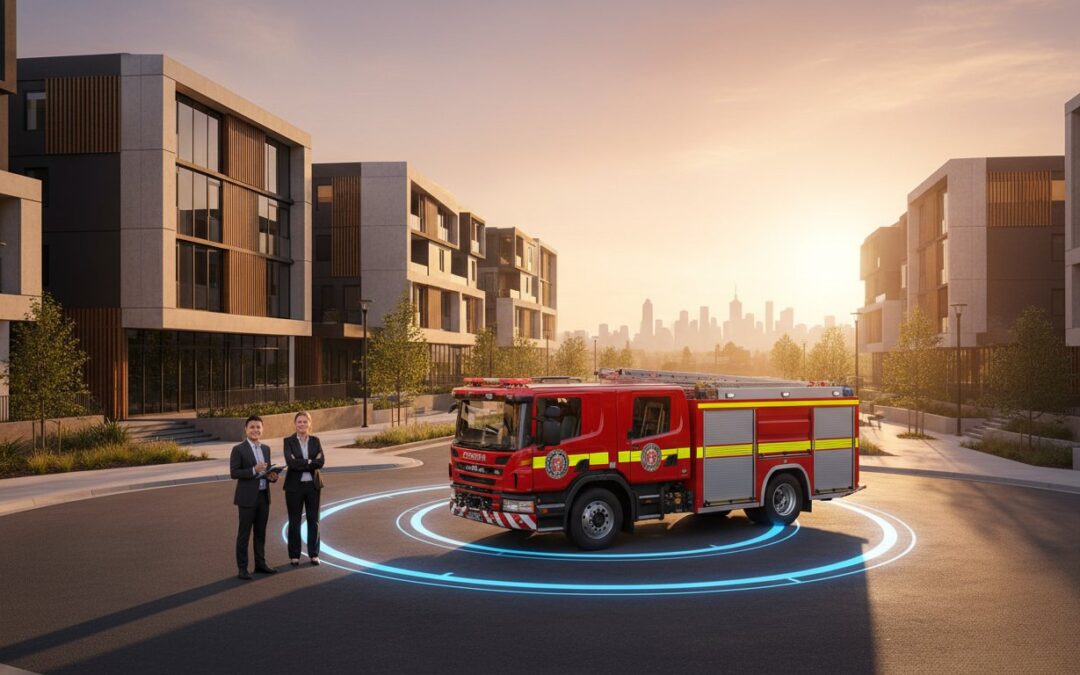
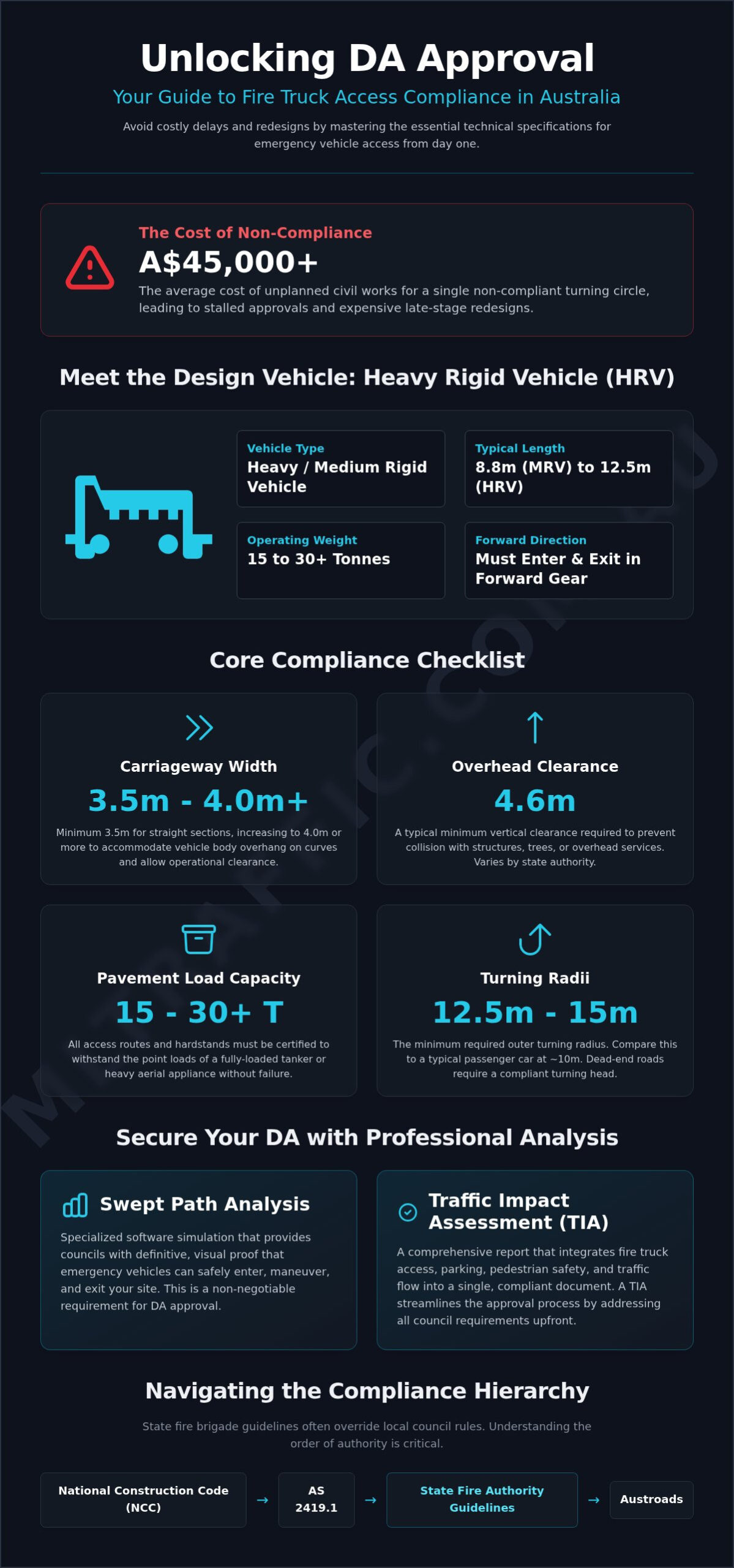
A single non-compliant turning circle can add A$45,000 in unplanned civil works to your project budget after the first Council review. It’s a frustrating reality for developers when site layouts fail to meet the rigid technical specs of state fire authorities. You’ve likely dealt with the stress of conflicting advice between Australian Standards and local fire brigade guidelines. These discrepancies often lead to stalled DA approvals and expensive late-stage redesigns.
We believe your project shouldn’t be delayed by avoidable technical errors. This guide clarifies the technical fire truck access requirements australia, providing you with the exact benchmarks needed for 2026 compliance. You’ll learn how to align your site plans with AS 2419.1 and specific state requirements to ensure a first-time pass at inspection. We break down heavy rigid vehicle swept paths and the latest hydrant spacing rules. This ensures you can design a cost-effective, compliant development from the start.
Key Takeaways
- Master the essential technical specifications for carriageway widths and overhead clearances to ensure your site layout aligns with AS 2419.1 and local brigade standards.
- Identify critical state-specific variations, such as the NSW 40m hose-reach rule and Victorian CFA requirements, to maintain compliance across different jurisdictions.
- Learn how to use professional Swept Path Analysis to provide Council with definitive proof that emergency vehicles can navigate your development safely.
- Discover how a comprehensive Traffic Impact Assessment (TIA) streamlines fire truck access requirements australia into a single, compliant report that accelerates your DA approval.
- Gain direct insights from senior traffic engineers on avoiding common design pitfalls that lead to costly RFI cycles and expensive site redesigns.
Understanding Fire Truck Access Requirements in Australia
Securing development approval in Australia requires more than just aesthetic appeal or structural integrity. It demands a rigorous approach to safety that begins at the site boundary. Fire truck access is a critical gateway requirement for any Development Application (DA). If your site doesn’t allow a 12.5-metre Heavy Rigid Vehicle (HRV) to enter, turn, and exit in a forward direction, your project will likely fail at the first hurdle. We’ve seen projects stalled for months because designers treated fire access as an afterthought rather than a primary constraint.
Standard vehicle access doesn’t cut it for emergency services. A typical passenger car has a turning circle of about 10 metres. An Australian fire tanker needs significantly more room. Most state fire authorities require a minimum outer turning radius of 12.5 metres to 15 metres, depending on the specific appliance. Meeting fire truck access requirements australia involves precise geometric planning that accounts for these massive swept paths. At ML Traffic Engineers Pty Ltd, we use specialized software to simulate these movements before you lodge your plans, ensuring the 20-tonne tankers can navigate your site without clipping curbs or structures.
The Legal Framework: AS 2419.1 and Beyond
The primary technical standard is AS 2419.1. It focuses on fire hydrant installations but dictates the hardstand areas and access routes required for fire brigades. The National Construction Code (NCC) mandates these provisions under Performance Requirement CP9. We rely on the Austroads guidelines to ensure road designs meet the necessary clearance and load-bearing capacities. State-based fire brigade guidelines often override local Council DCPs, creating a complex hierarchy of authority.
Why Fire Access is a ‘Make or Break’ for Your DA
In 2023, a medium-density project in Melbourne faced a six-month delay because the initial design lacked a compliant turning head. The developer had to sacrifice two visitor parking spots to create the required 12.5-metre radius. This late-stage change cost approximately A$85,000 in lost revenue and redesign fees. Early-stage traffic engineering prevents these expensive retrofits by identifying ‘Deemed-to-Satisfy’ or ‘Performance-Based’ solution pathways before construction begins.
The Traffic Engineer acts as your technical negotiator during the DA process. We speak the language of the fire authorities and use hard data to find a middle ground between safety and site efficiency. Whether it’s adjusting a driveway ramp grade or widening a gate, these technical tweaks ensure your application moves through the system without being sent back for a total overhaul. Don’t leave your project’s fate to guesswork when specific HRV swept path assessments are required by law.
Negotiating with emergency services requires a firm grasp of both the Australian Standards and the unique operational requirements of the local fire brigade. For example, a rural fire tanker has different clearance needs than an urban pumper. We’ve completed over 10,000 site assessments since 2005, giving us the experience to anticipate these requirements. We ensure that your site layout isn’t just compliant on paper, but functional for the first responders who might one day need to save your property.
Key Technical Specifications for Emergency Vehicle Access
Meeting fire truck access requirements australia involves more than just providing a wide driveway. Councils and fire authorities look for specific geometric and structural data before they grant development approval. A standard fire tanker is a heavy, cumbersome vehicle that requires significant space to operate safely. Most Australian states require a minimum trafficable width of 3.5 metres for straight sections, but this often increases to 4.0 metres or more to allow for operational clearance around the vehicle body.
Structural integrity is just as vital as the width of the road. A fully loaded fire tanker typically weighs between 15 and 20 tonnes, while heavy aerial appliances can exceed 30 tonnes. If your pavement isn’t designed for these point loads, it will fail during an emergency. Developers must provide certification that all access surfaces meet Fire Rescue Victoria hardstand requirements or the equivalent state-based standards. This ensures the ground doesn’t collapse or trap the vehicle when the stabilizers are deployed.
Dimensions and Turning Circles
We model access using the Medium Rigid Vehicle (MRV) as the standard design template, which usually measures around 8.8 metres in length. However, the wheel path is only part of the story. You must account for the "swept path," which includes the front and rear body overhangs as the truck turns. A standard 12.5 metre to 15 metre turning radius is common, but real-world physics means the truck needs extra "swing room" on the outside of curves. Dead-end roads longer than 15 metres must include a turning head, such as a T-head or Y-head, to prevent drivers from having to reverse long distances in smoky conditions.
Gradients and Vertical Clearances
Steep residential driveways are a frequent cause of application refusal. Maximum allowable ramp grades are generally capped at 1:8 (12.5%) for fire vehicle stability. If a driveway is too steep, the water in the tanker shifts, which can lead to a rollover. We also pay close attention to the approach and departure angles. If the transition between the road and a ramp is too sharp, the truck’s undercarriage or rear steps will bottom out, potentially disabling the vehicle.
Vertical clearance is another non-negotiable factor for fire truck access requirements australia. You must maintain a clear height of at least 4.5 metres along the entire access route. This height must be completely free of obstructions, including:
- Overhanging tree branches or dense canopies
- Protruding balconies or eaves from multi-deck developments
- Overhead power lines and communication cables
- Low-clearance archways or gate entries
Every millimetre counts in a technical assessment. We’ve seen projects delayed by months because a single overhanging eave was 200mm too low for the local fire authority’s liking. Reviewing your site levels and overhead structures with a qualified traffic consultant early in the design phase prevents these costly compliance errors. It’s much easier to move a balcony on a screen than it is to grind back a concrete slab after it’s been poured.
Why Swept Path Analysis is Non-Negotiable for DA Approval
A Development Application (DA) often lives or dies based on the quality of its traffic report. You can’t just sketch a driveway and hope for the best. Australian councils require rigorous proof that emergency vehicles can navigate your site without incident. This is where Swept Path Analysis becomes your most valuable tool. It’s a computer-generated simulation that tracks the movement of a vehicle through a specific turn or path. We use specialized software like AutoTURN to provide this level of accuracy. It’s the industry standard for a reason. It replaces guesswork with mathematical certainty.
Most architects rely on generic CAD blocks to represent vehicles. These blocks are often static and fail to account for the complex steering geometry of a heavy rigid fire appliance. When a council assessor sees a generic template, they see a risk. They’ll likely issue a Request for Further Information (RFI), which can delay your project by 4 to 8 weeks. Our analysis proves to the Council that a truck can actually maneuver. We don’t just show the vehicle fits; we show it can enter, turn, and exit in a single forward motion where required.
Identifying "pinch points" in your site layout early saves you from massive legal and construction headaches later. A pinch point might be a tight corner, a narrow gate, or a low-hanging structural beam. If these aren’t caught during the design phase, you might be forced to tear out concrete or move structural walls after the building is half-finished. This isn’t just about compliance; it’s about risk management. If a fire truck can’t reach a building during an emergency, the liability for the developer is astronomical.
We also look at how fire access integrates with other site requirements. Your site needs to accommodate more than just the fire brigade. We model the interaction between:
- 12.5m Heavy Rigid Vehicles (HRV) used by fire services.
- 8.8m Medium Rigid Vehicles (MRV) typically used for waste collection.
- Small Rigid Vehicles (SRV) for daily couriers and deliveries.
Designing for the largest vehicle ensures you meet all fire truck access requirements australia while simultaneously solving your garbage truck and delivery logistics. It’s a holistic approach to traffic engineering.
The Science of Vehicle Maneuvering
A swept path is the total area cleared by a vehicle’s body and wheels. For multi-axle fire vehicles, this calculation is technically demanding. We must account for the "kick-out" of the rear body and the "cut-in" of the inner wheels. Our models assume low-speed maneuvering, typically between 5 km/h and 10 km/h. This reflects real-world emergency scenarios where drivers navigate tight residential or commercial spaces. Generic CAD blocks simply don’t have the data to model these dynamics accurately.
Visual Evidence for Planning Authorities
Council planners need clear, visual evidence to sign off on a DA. A swept path diagram shows two distinct lines. The wheel path shows where the tyres go, while the body overhang shows the outer limits of the vehicle’s frame. The body overhang is what hits walls, mirrors, or bollards. We provide 2D and 3D simulations that support your Statement of Environmental Effects. This level of detail builds trust with authorities. Learn more about our Swept Path Analysis services to see how we help clients avoid costly design revisions. At ML Traffic Engineers, the traffic consultant who provides the quote, does the work. You get direct access to experts who understand the technicalities of AS 2890.2 and local council codes.
Navigating State-Specific Variations (NSW, VIC, QLD, WA)
Compliance isn’t a one-size-fits-all process. While national standards provide a baseline, state fire authorities impose rigorous local variations that can override general advice. Understanding fire truck access requirements australia wide involves more than just reading a single manual; it requires a deep dive into the specific technical bulletins issued by FRNSW, CFA, and QFES. If your development application doesn’t account for these nuances, you risk a formal objection during the referral process.
NSW and the 40-Metre Requirement
In New South Wales, Fire and Rescue NSW (FRNSW) enforces the 40m hose-reach rule with precision. Every point on the ground floor of a building must be accessible within 40m of a fire truck parked on a designated hardstand. This distance is measured as a "hose lay," meaning it follows the path a firefighter would walk, not a straight line. If your driveway is longer than 15m, it must support a 15-tonne Gross Vehicle Mass (GVM). For high-rise developments exceeding 25m in height, aerial ladder platforms require specific hardstand dimensions, often 6m wide and 11m long. FRNSW reviews Traffic Impact Assessments (TIAs) to ensure these swept paths are functional and that reversing distances don’t exceed 15m.
Victoria’s BMO and Rural Access
Victoria’s Country Fire Authority (CFA) focuses heavily on the Bushfire Management Overlay (BMO). For properties in these high-risk zones, access is governed by the Victorian Planning Provisions (VPP) Clause 44.06. Rules are strict for rural driveways. If a driveway exceeds 100m, you must provide passing bays at least every 200m. These bays must be 20m long and 6m wide. The CFA requires a minimum trafficable width of 3.5m; this must be clear of all encroachments like overhanging branches up to 4m high. The maximum pitch for any section of the driveway cannot exceed 15 degrees, ensuring heavy tankers don’t lose traction during an emergency.
Queensland Fire and Emergency Services (QFES) prioritize the intersection of hydrant proximity and hardstand durability. They require that any point on a building footprint is within 50m of a hydrant, or 90m if the building is fitted with fire sprinklers. For industrial complexes, QFES technical notes specify that hardstands must support a minimum 25-tonne point load for aerial appliances. In Western Australia, the Department of Fire and Emergency Services (DFES) mandates a 6m horizontal clearance for all fire access routes. Failure to meet specific fire truck access requirements australia jurisdictions set can lead to costly redesigns during the DA process.
The golden rule for any developer is to verify the specific technical notes of the local brigade before finalizing site plans. State-based requirements change frequently; for instance, Victoria updated several BMO guidelines in 2017 to improve emergency vehicle egress. Don’t guess. Rules change. Our engineers have seen it all and can ensure your site layout meets every local metric.
- NSW: 40m hose reach from the vehicle to the furthest point of the building.
- VIC: 15-degree maximum driveway gradient in BMO areas.
- QLD: 25-tonne point load capacity for aerial hardstands.
- WA: 6m wide clearances for all primary fire access routes.
If your site plan needs a professional review to ensure compliance with these complex state variations, you can get a quote from our expert traffic engineers today.
Securing Your DA with Professional Traffic Engineering
Securing a Development Application (DA) often hinges on how precisely you address fire truck access requirements australia. At ML Traffic Engineers, we don’t pass your project to a junior graduate or an offshore team. You deal directly with senior experts like Michael Lee or Benny Chen from start to finish. This direct access ensures the technical details of your site aren’t lost in translation during the design phase. We’ve been operating since 2005 and have successfully completed over 10,000 sites across Australia. This volume of work gives us a distinct advantage when negotiating with local councils. We know exactly what they expect and how to present data that wins approvals without unnecessary revisions.
Negotiating with Council requires more than just a friendly phone call. It demands a data-driven defense of your site constraints. Many urban sites have limited space, making "standard" fire truck turnarounds difficult to achieve. We use computer-aided design (CAD) and industry-standard swept path software to prove a design works, even if it doesn’t fit the typical cookie-cutter template. We defend your site layout using hard numbers and between 30 and 40 years of individual engineering experience. When a Council officer sees a certified report from ML Traffic, they’re looking at a document backed by a long history of successful, compliant applications.
The Value of an Integrated Traffic Report
Designing for fire access in a vacuum is a recipe for project delays. If you modify a driveway to accommodate a heavy rigid vehicle (HRV) without checking your waste collection or parking layout, you’ll likely create a new non-compliance issue elsewhere. Our Traffic Impact Assessment (TIA) bundles these elements together into a single, cohesive document. It’s a holistic approach that saves time and money. The same engineer who provides your initial quote is the one performing the Vehicle Swept Path Assessment and writing the final report. This "Principal-led" model eliminates the disconnect often found in larger, bureaucratic firms. You can Contact Michael or Benny for a direct quote on your project to see how this streamlined process works for your specific site.
Actionable Checklist for Your Next Project
Don’t leave your traffic planning until the last minute. Follow these three steps to ensure your submission moves through Council without being flagged for "further information."
- Step 1: Identify your jurisdiction. Determine which fire brigade jurisdiction applies (such as FRNSW, CFA, or QFES) and the specific vehicle dimensions they require for your building type.
- Step 2: Engage a traffic engineer early. Get a preliminary swept path check before your architect finalizes the building footprint. This identifies "deal-breaker" issues while they’re still cheap to fix.
- Step 3: Finalize and certify. Finalize the site layout only after the traffic report confirms all movements, including waste, parking, and fire access, are fully compliant.
You can read more About ML Traffic Engineers’ 15+ years of experience to understand how we’ve helped thousands of developers navigate these exact steps. We focus on private clients who need their development applications handled with precision and speed. Whether you’re building a small townhouse development or a large industrial warehouse, the requirements for fire truck access remain a critical hurdle. We provide the technical expertise and the registered engineering signatures (including RPEQ where required) to get your project over the line.
Secure Your DA Approval with Compliance-Ready Design
Navigating the complex landscape of fire truck access requirements australia doesn’t have to stall your project. You’ve seen how critical technical specifications and state-specific variations are for securing DA approval in 2026. A precise swept path analysis isn’t just a box to tick; it’s the technical evidence councils need to see. At ML Traffic Engineers, we’ve assessed over 10,000 sites across Australia, ensuring every driveway and access point meets rigorous standards. When you work with us, you get direct access to our principals, Michael Lee and Benny Chen. They bring RPEQ registration and expert witness experience to every report. This hands-on approach means the consultant who provides your quote is the expert doing the work. Don’t let compliance hurdles or technical errors delay your construction timeline. Our team provides the technical certainty required to move your development forward with confidence. We’re ready to help you clear the final hurdles of your application today. Get a professional Swept Path Analysis and Traffic Report for your DA today.
Your project deserves the reliability that only decades of engineering experience can provide.
Frequently Asked Questions
What is the minimum road width for a fire truck in Australia?
The minimum unobstructed road width for a fire truck in Australia is typically 4 metres. This standard ensures that heavy tankers can navigate the site without being blocked by vegetation or permanent structures. While 4 metres is the baseline for clear passage, many councils require 6 metres for passing bays or two-way traffic zones to prevent congestion during an emergency.
How far can a building be from a fire truck access point?
A building must be located within 45 metres of a fire truck access point or a dedicated hardstand area. This specific distance allows firefighters to reach any part of the structure using a standard hose length. If your building sits further back than 45 metres, you’ll need to extend the driveway or install an on-site hydrant system to meet fire truck access requirements australia.
Do I need a swept path analysis for a small residential development?
You often need a swept path analysis for small residential developments if the driveway includes tight turns, narrow entries, or complex geometry. Councils use this digital simulation to verify that a 12.5 metre Heavy Rigid Vehicle can enter and exit the site in a forward direction. We’ve completed over 10,000 site assessments where this technical proof was the deciding factor for DA approval.
What is the maximum gradient a fire truck can climb in a driveway?
The maximum gradient a fire truck can safely climb is generally 15 per cent, which is a 1 in 6.7 grade. Steeper driveways risk the vehicle bottoming out or losing traction during an emergency response. It’s vital to maintain a maximum 10 per cent grade for the first 6 metres of the driveway to ensure the truck safely transitions from the public road.
Are fire truck access requirements different for bushfire-prone areas?
Requirements are significantly stricter in bushfire-prone areas compared to standard urban zones. In these regions, you must comply with the Planning for Bush Fire Protection 2019 guidelines, which mandate specific turning circles and passing bays every 200 metres. These regulations ensure that emergency crews can safely evacuate residents while simultaneously fighting an active fire front.
How much overhead clearance does a fire tanker need?
A fire tanker requires a minimum vertical clearance of 4.5 metres to pass safely under trees, eaves, or structural archways. This height accounts for the vehicle’s equipment and the potential for vertical movement on uneven ground. If your site has low-hanging branches or structural overhangs below this limit, you’ll likely fail the compliance check during the final council inspection.
Can a fire truck use a standard driveway or does it need a heavy-duty pavement?
Fire trucks cannot use standard residential driveways and require heavy-duty pavement designed to support a 15-tonne or 23-tonne load. A typical 100mm thick concrete slab will crack under the weight of a fully loaded tanker. You must specify a reinforced concrete or asphalt surface that meets the load-bearing standards set by your local fire authority and AS 2890.1.
What happens if my development doesn’t meet the fire access standards?
If your development doesn’t meet fire access standards, your Development Application will likely be refused by the council. Fixing these issues after construction is finished can cost upwards of A$25,000 in demolition and earthworks. It’s much more efficient to engage an expert to perform a Vehicle Swept Path Assessment during the design phase to avoid these costly bureaucratic delays.
Which areas do you cover?
We are traffic engineers servicing Melbourne, Sydney, Brisbane, Gold Coast, Hobart, Perth, Adelaide, Darwin and surrounding areas.

Disclaimer
The content on www.mltraffic.com.au, including all technical articles, guides, and resources, is provided for general informational and educational purposes only. It is not intended to constitute professional advice in traffic engineering, transportation planning, development approvals, or any other technical or legal field.
While ML Traffic Engineers makes every reasonable effort to ensure the accuracy, completeness, and timeliness of the information published, we do not provide any warranties or representations (express or implied) regarding its reliability, suitability, or availability for any particular purpose. Any reliance you place on the content is strictly at your own risk.
In no event shall ML Traffic Engineers, its directors, employees, authors, or affiliates be liable for any direct, indirect, incidental, special, consequential, or punitive damages (including, without limitation, loss of profits, data, or business opportunities) arising out of or in connection with the use of, or inability to use, any information provided on this website.
The articles and guides on this site are not a substitute for engaging a qualified, registered professional traffic engineer (such as an NPER or RPEQ engineer) to assess your specific project requirements. For tailored advice, compliance assessments, or traffic engineering services, please contact a competent professional.
This disclaimer may be updated from time to time without notice. By accessing or using this website, you agree to be bound by the most current version of this disclaimer.
