

What if your traffic consultant’s final invoice actually matched the amount they quoted? Most developers expect a degree of cost creep during the development application process, particularly when technical reports trigger unexpected hourly charges for every minor clarification. This unpredictability doesn’t just affect your bottom line; it undermines your entire project pro-forma. At ML Traffic Engineers Australia, we’ve seen how traditional billing models often penalize developers for the very technical complexities they hired an expert to manage.
Choosing a fixed fee traffic impact assessment is a strategic decision to lock in project costs from the outset. This guide explains how price certainty eliminates budget blowouts while ensuring your report meets rigorous Australian Standards. You’ll learn why the "consultant who quotes, does the work" philosophy is critical for faster approvals and how direct access to senior engineers helps you navigate the bureaucratic hurdles of council submissions. We’ll show you how to secure a compliant, guaranteed-price assessment that preserves your project’s feasibility from the first site plan to the final decision notice.
Key Takeaways
- Understand how outcome-based pricing eliminates unpredictable hourly billing and provides total budget certainty for your project feasibility.
- Learn the technical requirements for council-compliant reports, including car parking demand assessments and vehicle swept path analysis using AutoTURN software.
- Identify the risks associated with the “Hourly Trap” where low initial quotes result in significant cost blowouts following council RFIs.
- Discover how a fixed fee traffic impact assessment accounts for critical factors like site scale and specific land-use requirements to prevent unexpected costs.
- Gain insights into the benefits of working directly with senior engineers who provide the quote and perform the work to ensure accountability.
Table of Contents
-
Fixed Fee vs. Hourly Rates: Mitigating the Risk of Budget Blowouts
-
Securing Your DA Approval with ML Traffic Engineers Australia
What is a Fixed Fee Traffic Impact Assessment (TIA)?
A fixed fee traffic impact assessment is a specialized technical report provided for a single, guaranteed price. By 2026, the transport planning industry moved decisively away from traditional hourly consulting toward outcome-based pricing models. This shift allows you to lock in costs before the project starts. It covers the full scope of traffic analysis required for a Development Application (DA) without the risk of billable hours increasing every time a consultant answers an email. These assessments are essential components of the broader transportation planning process. Australian councils mandate these reports for any development that changes land use or increases vehicle movements.
To better understand the technical requirements of these reports, watch this helpful video:
Whether you’re building a childcare center or a 50-unit residential complex, you must prove your project won’t compromise road safety or network efficiency. The core promise of a fixed-price model is the elimination of hidden charges. This includes standard revisions and internal technical reviews that often bloat invoices in hourly arrangements. Professional services from ML Traffic Engineers Australia provide this certainty by accurately scoping the project requirements at the quoting stage. This approach ensures that the "fixed" price actually covers the delivery of a council-compliant document.
The Role of a Traffic Consultant in Development Applications
Traffic consultants act as the technical bridge between developers and council town planners. We analyze how proposed developments interact with existing road networks, focusing on safety and capacity. Our primary goal is ensuring every design element complies with Australian Standards (AS 2890.1). This includes assessing driveway ramp grades, sight lines, and internal circulation to prevent costly RFIs later in the process. We use specialized data to justify departures from standard council codes when a project’s constraints require a tailored solution.
Why Budget Certainty Matters in Project Feasibility
Unpredictable engineering costs often derail small to medium developments. With TIAs for simple projects starting at $1,500 and complex ones exceeding $20,000, a 20% budget blowout can ruin a project’s pro-forma. Fixed fees provide the data needed for accurate feasibility modeling. By removing financial unknowns during the DA phase, developers can allocate capital more effectively. This is especially critical when Brisbane City Council compliance fees for major infrastructure can reach $11,782 for the 2024-2025 financial year. Knowing your fixed fee traffic impact assessment cost upfront protects your profit margins from administrative creep.
Technical Components Included in a Fixed Fee TIA
A fixed fee traffic impact assessment provides the technical verification required for site functionality. It isn’t a generic summary; it’s a data-driven document that addresses the specific constraints of your development. Every report we produce includes a car parking demand assessment tailored to your land use. We analyze everything from apartments and bars to temples and warehouses. We also perform intersection performance analysis using SIDRA modeling. This software evaluates current and future traffic volumes to ensure your project doesn’t paralyze the local network. This technical rigor aligns with international best practices for project safety, similar to the standards found in the Wisconsin DOT TIA Guidelines.
Our technical scope covers several critical areas:
-
Sight distance assessments to ensure safe visibility at all entry and exit points according to SISD and ASD requirements.
-
Review of parking layouts against AS 2890.1 for residential and AS 2890.2 for commercial vehicles.
-
Capacity analysis for surrounding road networks to determine the impact of peak hour trips.
-
Pedestrian and cyclist safety reviews to promote multi-modal transport options within the site.
AS 2890.1 Compliance and Car Park Design
Compliance with AS 2890.1 explained is the baseline for any successful development application. We verify that every aspect of your car park design meets Australian Standards. This includes checking bay dimensions, aisle widths, and driveway ramp grades. Failing to address these technicalities during the design phase leads to expensive retrofits or Council refusals. A certified design provides Council with the assurance that the site is safe and efficient for all users.
Swept Path Analysis: Ensuring Maneuverability
A functional site must accommodate more than just passenger cars. We use industry-standard AutoTURN software to perform swept path analysis. This proves that waste trucks and delivery vehicles can maneuver safely within the site boundaries. Integrating these paths into your fixed fee traffic impact assessment prevents Council from issuing an RFI regarding vehicle accessibility. If you’re unsure about your site layout, review our full range of technical services to see how we assist with complex maneuverability issues.
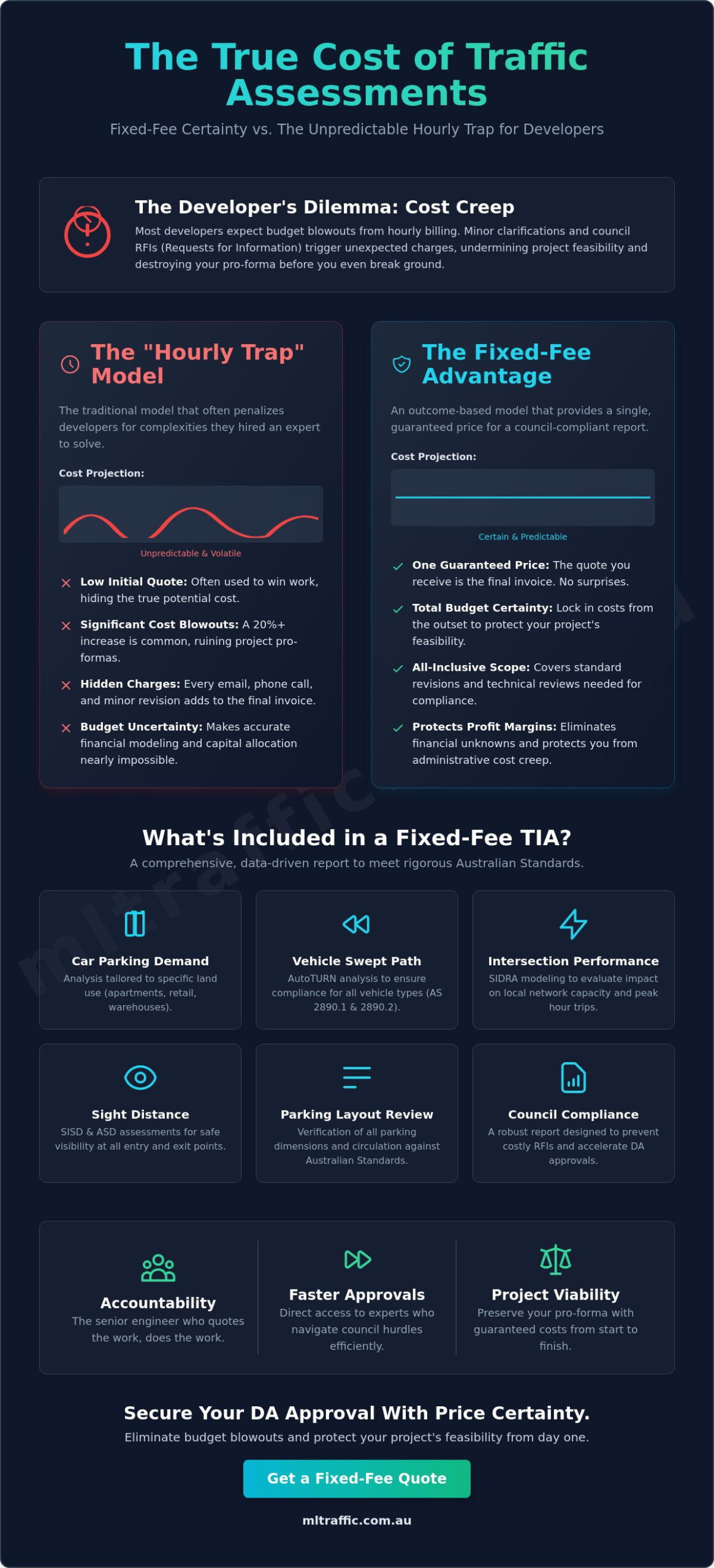
Fixed Fee vs. Hourly Rates: Mitigating the Risk of Budget Blowouts
The hourly billing model creates a fundamental misalignment of interests between a consultant and a developer. Many firms provide a low "indicative" quote to secure a project, only to trigger additional invoices every time a Council officer asks a question. This "Hourly Trap" can cause your initial estimate to triple by the time you reach a decision notice. A fixed fee traffic impact assessment eliminates this risk by providing a total cost of ownership upfront. This model forces the engineer to be precise during the initial analysis because they’re responsible for the outcome, not just the hours logged.
Choosing a cheap, junior-led report often results in the "RFI Trap." When a report lacks technical depth or fails to adhere to the Caltrans Transportation Analysis Framework or local equivalents, Council will issue a Request for Further Information. These delays are far more expensive than the initial consulting fee. While some firms claim rates 20% to 30% lower than traditional competitors through virtual business models, the real value lies in the engineer’s ability to get the report approved on the first submission. A fixed-price professional assessment ensures the consultant is incentivized to produce a compliant document that withstands rigorous scrutiny.
Handling Council Requests for Further Information (RFIs)
An RFI is a formal demand from Council for clarification or additional data regarding your DA. Traffic reports frequently trigger these requests if the parking demand or swept path analysis is unclear. A 60-day delay caused by an RFI doesn’t just stall your schedule; it impacts project financing and increases holding costs. Your agreement should specify that minor council clarifications are included in the price. This protection ensures that your fixed fee traffic impact assessment remains truly fixed, even when bureaucratic hurdles arise during the assessment period.
The Quality-Price Correlation in Traffic Engineering
High-quality traffic engineering requires senior-level oversight to navigate complex land-use codes. Junior-led reports often overlook critical details like driveway sight lines or specific AS 2890.1 requirements, leading to multiple expensive revisions. We believe the traffic consultant who provides your quote should be the one who does the work. This hands-on approach ensures that all necessary sub-services, from SIDRA modeling to parking layouts, are handled by experienced professionals. By investing in a senior-led fixed-fee quote, you’re buying the certainty that your project feasibility remains intact from submission to approval.
Critical Factors That Influence Your Fixed Fee Quote
Calculating a fixed fee traffic impact assessment requires a detailed analysis of project variables. We don’t provide "indicative" estimates that change later. Instead, we evaluate the specific technical requirements of your site to ensure the quote remains final. The most significant factor is the land-use type. A 50-place childcare centre or a fast-food outlet generates significantly more peak-hour trips than a warehouse of the same size. These high-turnover sites require intensive data collection and more complex modeling to satisfy Council requirements.
The scale of the development and the complexity of the surrounding road network also dictate the engineering hours required. Key factors include:
-
Site Scale: A 3-unit residential development involves standard parking reviews, while a major retail hub requires extensive traffic distribution analysis.
-
Intersection Performance: If your project sits near a busy signalized intersection, we must perform SIDRA modeling to prove the development won’t degrade the current Level of Service (LoS).
-
Data Acquisition: Costs vary depending on whether we can use existing Council data or if we need to commission fresh traffic counts.
-
Access Constraints: Sites on state-managed arterial roads face stricter scrutiny than those on local residential streets.
Land Use and Land-Use Complexity
Complexity increases with the intensity of the land use. Medical centres and gymnasiums often trigger "Change of Use" applications, which require a detailed comparison between the previous and proposed traffic generation rates. Providing clear, dimensioned site plans allows the engineer to accurately assess the work scope. This precision ensures your fixed fee traffic impact assessment covers every necessary technical review, from disabled parking compliance to loading bay functionality. For a tailored evaluation of your project, request a fixed-fee quote from our senior engineers today.
Location and Road Network Hierarchy
The hierarchy of the adjacent road determines which authority reviews the report. Impacting a local road is generally straightforward. However, developments fronting state-managed roads often require additional liaison with provincial transport departments. In construction-heavy projects, Council may also require a Traffic Management Plan (TMP) to manage heavy vehicle movements safely. Understanding whether your project needs a simple Traffic Impact Statement (TIS) or a full-scale TIA is the first step in maintaining your development budget.
Securing Your DA Approval with ML Traffic Engineers Australia
ML Traffic Engineers Australia has been trading since 2005. Our focus remains on assisting private clients with their development applications through technical precision and professional accountability. A primary marker of our service is the ML Traffic Engineers Australia signature: the traffic consultant who provides your quote is the person who performs the work. This approach eliminates the data loss that often occurs when projects are handed off to junior staff in larger firms. With over 15 years of experience and more than 10,000 sites assessed nationally, we understand the specific bureaucratic requirements of local councils and state road authorities. Our commitment to a fixed fee traffic impact assessment ensures you receive a council-compliant report without the risk of hidden administrative costs.
Direct access to our principals, Michael Lee and Benny Chen, is a standard feature of every engagement. We don’t utilize account managers or administrative gatekeepers to filter communications. This direct line to senior expertise is essential for maintaining project feasibility and momentum. Michael and Benny each possess between 30 and 40 years of experience in the field. When you commission a fixed fee traffic impact assessment from us, you’re enlisting seasoned experts who understand every technicality, from driveway ramp grades to complex intersection modeling. This senior-level involvement ensures your report is technically sound before it ever reaches a council planner’s desk.
The Advantage of Senior Engineer Involvement
Large engineering firms often operate with layers of gatekeeper bureaucracy that slow down the approval process. This structure frequently leads to communication breakdowns and reports that trigger unnecessary RFIs. Senior oversight from the project’s inception leads to fewer council objections and significantly faster approvals. We provide direct mobile access to the senior engineers performing the work on your site. This allows for immediate technical clarifications and faster design iterations. Having a senior engineer handle the technical details ensures that compliance with AS 2890.1 is achieved on the first submission, protecting your construction schedule from avoidable delays.
Next Steps: How to Get a Tailored Fixed-Fee Quote
To provide an accurate assessment, we require clear site plans and a detailed description of the proposed land use. We evaluate these documents to determine the necessary technical scope, including any requirements for AutoTURN swept path analysis or SIDRA modeling. Our team provides a standard professional turnaround for council-ready TIA reports, tailored to the scale of your development. Contact our senior traffic consultants to discuss your national project requirements and secure your fixed-price quote. We provide the technical assurance needed to move your development application forward with budget certainty.
Secure Your Development Feasibility with Expert Traffic Engineering
Budget certainty is the foundation of successful property development. By choosing a fixed fee traffic impact assessment, you remove the financial volatility associated with hourly consulting and unpredictable Council RFIs. This model ensures that technical compliance with Australian Standards like AS 2890.1 is prioritized from the initial design phase. It protects your project pro-forma and prevents the administrative creep that frequently stalls DA approvals.
ML Traffic Engineers brings 15+ years of Australian traffic engineering experience to every project. We have assessed over 10,000 sites nationwide, ranging from small residential subdivisions to complex retail hubs. Our promise is simple: the engineer who provides your quote is the person who does the work. You gain direct access to senior principals who understand the technicalities of vehicle swept paths and intersection modeling without any gatekeeper bureaucracy.
Don’t let technical delays derail your construction schedule. Get a Fixed Fee Quote for Your Traffic Impact Assessment and move your project forward with technical confidence. We look forward to helping you secure a successful council approval.
Frequently Asked Questions
What is the average cost of a fixed fee traffic impact assessment?
Basic reports for small-scale Australian developments typically start from A$1,500 to A$5,000. Larger projects requiring extensive traffic modeling and intersection analysis can range from A$5,000 to A$20,000 or more. These professional fees are separate from government charges, such as the Brisbane City Council compliance assessment fee for major infrastructure, which equates to $11,782 for the 2024-2025 financial year.
How long does it take to complete a TIA report?
A council-ready report typically takes between 10 and 15 business days to complete. This timeline depends on the complexity of the local road network and the availability of existing traffic data. If fresh traffic surveys are necessary, we commission data collection within 48 hours of project commencement to ensure the technical analysis remains on schedule and avoids unnecessary delays.
Does a fixed fee include responding to Council RFIs?
A professional fixed fee traffic impact assessment includes responses to minor Council clarifications to maintain your budget certainty. We address technical questions regarding parking layouts or swept paths as part of the initial agreement. If Council requests significant design changes that fundamentally alter the project’s scope, we provide a transparent variation quote before proceeding with the revised technical analysis.
Will a fixed-fee TIA be accepted by all Australian councils?
Every Australian council accepts these reports provided they adhere to Australian Standards (AS 2890.1) and local planning codes. Our assessments are performed by senior engineers with the necessary professional registrations. This certification ensures the technical rigor meets the specific requirements of road authorities across all states. We focus on delivering compliant documents that withstand the scrutiny of council town planners.
When is a Traffic Impact Statement (TIS) enough compared to a TIA?
A Traffic Impact Statement is typically sufficient for small-scale developments with minimal traffic generation, such as a single-dwelling change or minor retail fit-out. Larger developments that significantly increase vehicle movements or impact intersection performance require a full Traffic Impact Assessment. We determine the appropriate report level during the quoting phase based on your specific land-use intensity and site scale.
Do I need to provide traffic counts for my fixed-fee quote?
You don’t need to provide traffic counts if the quote includes data collection. We first check online portals, such as the ACT Government’s traffic data system updated in July 2023, to find existing counts. If verified data is unavailable or outdated for your specific location, we include the cost of fresh traffic surveys in our fixed-price proposal to ensure the analysis is accurate.
What happens if the project scope changes after the quote is accepted?
Quotes are based on the specific site plans and land-use data provided at the time of the agreement. If you increase the number of residential units or change the commercial use after work begins, we provide a transparent variation quote. This ensures the technical analysis remains accurate for the revised development application while maintaining the principle of price transparency for the new scope.
Can a fixed-fee TIA help reduce my required parking spots?
A TIA can justify a reduction in required parking spots through a formal Car Parking Demand Assessment. We use empirical data and land-use specific analysis to prove that actual parking demand is lower than generic rates in a Council’s planning scheme. This technical justification frequently allows developers to optimize their site layout and reduce construction costs by avoiding unnecessary parking infrastructure.
Which areas do you cover?
We are traffic engineers servicing Melbourne, Sydney, Brisbane, Gold Coast, Hobart, Perth, Adelaide, Darwin, Canberra and surrounding areas.

Disclaimer
The content on www.mltraffic.com.au, including all technical articles, guides, and resources, is provided for general informational and educational purposes only. It is not intended to constitute professional advice in traffic engineering, transportation planning, development approvals, or any other technical or legal field.
While ML Traffic Engineers makes every reasonable effort to ensure the accuracy, completeness, and timeliness of the information published, we do not provide any warranties or representations (express or implied) regarding its reliability, suitability, or availability for any particular purpose. Any reliance you place on the content is strictly at your own risk.
In no event shall ML Traffic Engineers, its directors, employees, authors, or affiliates be liable for any direct, indirect, incidental, special, consequential, or punitive damages (including, without limitation, loss of profits, data, or business opportunities) arising out of or in connection with the use of, or inability to use, any information provided on this website.
The articles and guides on this site are not a substitute for engaging a qualified, registered professional traffic engineer (such as an NPER or RPEQ engineer) to assess your specific project requirements. For tailored advice, compliance assessments, or traffic engineering services, please contact a competent professional.
This disclaimer may be updated from time to time without notice. By accessing or using this website, you agree to be bound by the most current version of this disclaimer.
