
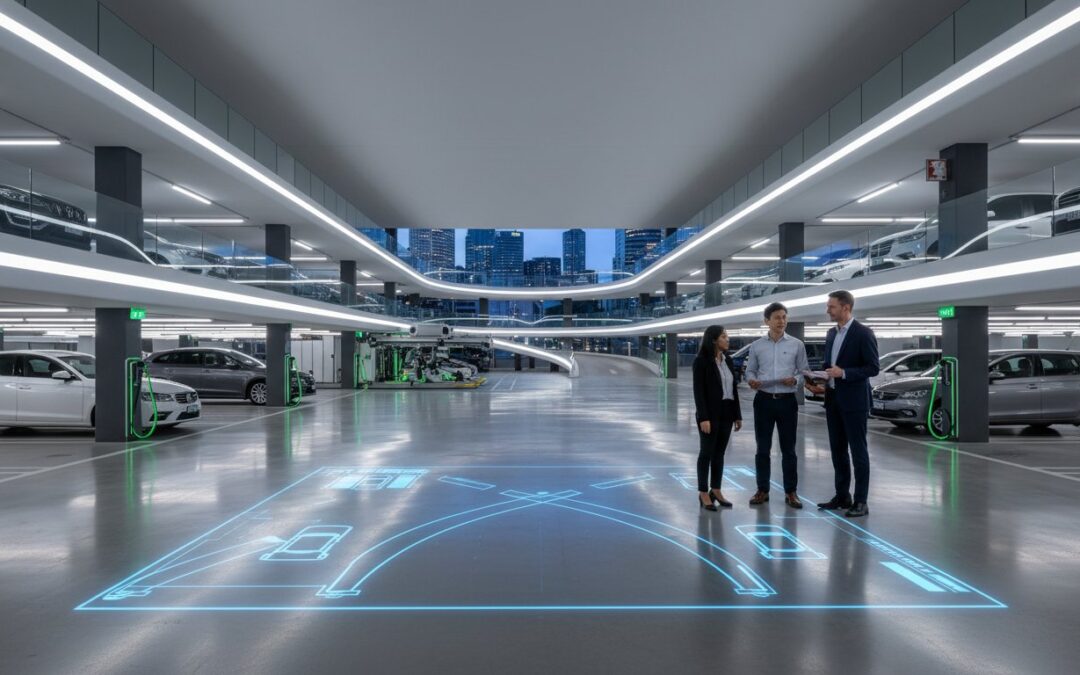
A standard car park designed today will be obsolete before its first structural audit if it relies solely on legacy dimensions. You’re likely already feeling the pressure of rising basement construction costs and the increasing complexity of EV requirements from local councils. Achieving successful future-proofing car park design 2026 requires more than just meeting the bare minimums of AS/NZS 2890.1:2004. It demands a proactive engineering approach that anticipates the heavier curb weights of modern electric vehicles and the specific spatial needs of automated parking systems.
This guide explains how to integrate the latest regulatory updates, including the TfNSW Supplement TS 05392 effective March 2, 2026, into your development strategy. You’ll learn how to navigate the 2.2 meter and 2.5 meter headroom requirements while optimizing your layout for maximum floor area and yield. We detail the technical steps to ensure your design avoids costly retrofits and secures rapid council approval through precise vehicle swept path analysis and compliant driveway ramp grade assessments. By aligning with current standards like AS 2890.6 for accessible spaces from the start, you protect your project from the risk of DA rejection and long-term structural liability.
Key Takeaways
- Integrate B85 and B99 vehicle templates to ensure geometric compliance with AS 2890.1 while accommodating evolving vehicle dimensions.
- Distinguish between EV Ready and EV Capable infrastructure to manage increased structural loads and scalable electrical reticulation requirements.
- Apply strategic engineering for future-proofing car park design 2026 to avoid expensive structural retrofits and secure long-term asset value.
- Utilize Car Parking Demand Assessments to effectively integrate smart sensor networks and micro-mobility solutions into multi-modal transport hubs.
- Minimize the risk of council Requests for Further Information (RFIs) by submitting a proactive Traffic Impact Assessment (TIA) during the DA phase.
Why Future-Proofing Car Park Design is Critical in 2026
Future-proofing in a modern engineering context refers to the integration of adaptable geometry and infrastructure during the initial planning phase. It’s a strategic response to the rapid evolution of vehicle dimensions and weight. Effective future-proofing car park design 2026 ensures a facility remains functional as Australian urban planning shifts toward multi-modal transport hubs. These hubs must accommodate more than just standard passenger vehicles; they require space for micro-mobility, ride-share zones, and heavy electric vehicle (EV) fleets.
Modern multistorey car park design must now account for structural loads that exceed historical benchmarks. Static storage is a concept of the past. As we enter 2026, the industry is seeing a transition where parking facilities serve as critical nodes in a broader infrastructure network. This transition demands a departure from rigid, minimum-compliance layouts.
To better understand how vehicle technology and parking needs are evolving, watch this helpful video:
The year 2026 serves as a critical pivot point for national parking standards. With the implementation of updated state-based supplements and more rigorous local council requirements, developers face a choice between proactive design or inevitable obsolescence. Retrofitting basement levels after construction is often financially unviable due to height constraints and structural limitations.
The Shifting Regulatory Landscape
Local councils are increasingly mandating “EV-ready” status for all new developments. This involves more than just power points; it requires specific electrical reticulation and fire safety measures. Anticipating updates to the AS 2890 series regarding larger vehicle templates is essential when implementing future-proofing car park design 2026. Future-proof compliance serves as a reliable hedge against future legislative changes that could otherwise render a facility non-compliant overnight.
The Financial Case for Adaptable Design
The cost-benefit analysis of adaptable design is clear. Increasing bay widths or floor-to-floor heights slightly during the design phase represents a fraction of the cost required for future structural modifications. Property valuations are now directly tied to a building’s ability to support modern fleets, including heavier EVs and automated systems. Avoiding the obsolescence trap requires professional oversight. Developers who fail to integrate these requirements risk holding assets that are unusable for a significant portion of the vehicle market. You can explore our full range of traffic engineering services to ensure your project meets these evolving demands.
Engineering for Geometric Flexibility and AS 2890 Compliance
Adherence to AS 2890.1:2004 provides the legal baseline for off-street parking, but it rarely accounts for the increasing footprint of modern Australian fleets. A standard 2.4 meter by 5.4 meter space meets the current code. It does not, however, guarantee long-term usability as consumer preferences shift toward larger SUVs and dual-cab utilities. Effective future-proofing car park design 2026 involves designing for the “maximum likely vehicle” rather than the minimum regulatory standard. This proactive approach centers on designing for future flexibility by anticipating changes in vehicle geometry before they become a structural hindrance.
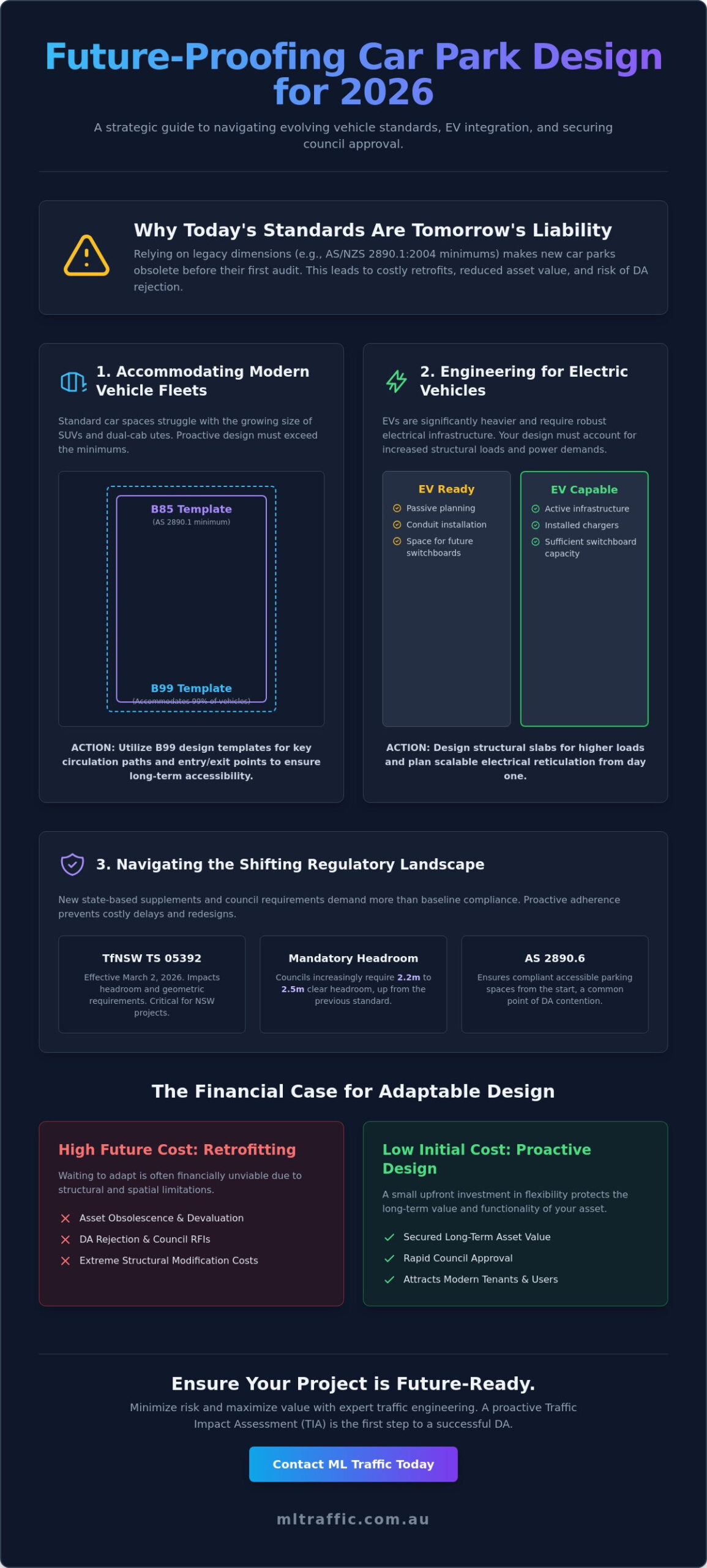
The distinction between B85 and B99 vehicle templates is critical for operational longevity. While AS 2890.1 allows for the B85 template in most circulation areas, using the B99 design vehicle for entry points and major turns ensures the facility remains accessible to 99% of cars on the road. Strategic column placement is another engineering priority. By positioning columns away from door-opening zones and increasing span lengths, developers allow for future bay reconfiguration without structural intervention. This flexibility is essential for maintaining asset value as vehicle widths evolve and future-proofing car park design 2026 becomes a market standard.
Beyond Minimum Clearance: Designing for Larger Profiles
The standard 2.2 meter headroom requirement is becoming a liability. Modern vehicle trends in 2026 favor taller profiles that frequently approach this limit, especially when roof racks or accessories are included. Increasing clearance to 2.5 meters throughout the facility accommodates the B99 vehicle and allows for the future installation of mechanical parking systems. These systems are projected to grow at a CAGR of 15.3% from 2022 to 2028. We utilize professional Swept Path Analysis to verify that these larger profiles can navigate the entire facility without conflict, even in high-density layouts.
Mastering Ramp Grades for Multi-Use Adaptability
Ramp design requires precision to accommodate the low-clearance battery packs of electric vehicles. Standard transitions must be carefully calculated to prevent scraping on the undercarriage. Additionally, future autonomous entry systems will require consistent gradients for reliable sensor operation and vehicle leveling. Ensuring your driveway grades meet AS 2890.1 while planning for these technologies is a core component of Driveway Ramp Grade Assessments. Getting these transitions right during the design phase is the most effective way to secure DA approval and avoid expensive post-construction remediation. If you are concerned about your current ramp layout, our team can provide a detailed compliance review of your plans.
Accommodating the EV Transition and Increased Vehicle Mass
Electric vehicle adoption has shifted the engineering focus from simple bay allocation to complex structural and electrical management. High-density EV parking requires reinforced concrete slabs to support the significant increase in curb weight compared to internal combustion engine vehicles. Designing for future-proofing car park design 2026 means moving beyond “EV Capable” provisioning to “EV Ready” infrastructure. This involves installing oversized electrical panels and load management systems during the initial build to avoid the prohibitive costs of invasive retrofits later.
Thermal management and fire safety are equally critical as battery technology evolves. 2026 standards require enhanced ventilation and specialized suppression systems to manage potential thermal runaway events in enclosed basement levels. Strategic placement of charging hubs near main electrical risers minimizes cable runs and reduces the structural impact of heavy conduit networks. These decisions directly affect the long-term viability of the asset and the speed of council approval.
Structural Implications of Heavy Electric Vehicle Fleets
The average vehicle mass is rising as battery capacities expand to meet consumer range expectations. Slabs designed for legacy vehicle weights risk deflection or structural fatigue under the load of high-density EV fleets. Professional structural audits in 2026 must account for a 20% increase in average vehicle mass to ensure the integrity of the facility over its 50-year design life. This is particularly vital for projects incorporating automated parking systems, which are projected to grow at a CAGR of 15.3% through 2028. These systems create concentrated point-loading that requires specific reinforcement patterns. We provide comprehensive car park design assessments to verify that your structural plans accommodate these shifting weight distributions.
Scalable Charging Infrastructure Without Major Redesign
Implementing a scalable electrical strategy is the most effective way to manage rising construction costs. While “EV Capable” designs only provide space for future conduit, an “EV Ready” approach ensures the backbone infrastructure is already in place for 100% saturation. Key considerations include:
- Load Balancing Technology: Advanced systems can manage electricity loads to reduce peak demand charges, though these can cost as much as $10,000 per stall.
- Solar-Ready Structures: Top-deck parking layouts should include structural points for future solar canopy integration to offset charging costs.
- Dedicated Switchrooms: Allocating additional floor area for expanded switchboards prevents the need for future basement excavations.
By integrating these features early, developers secure a significant advantage in property valuation. A facility that can handle the power and weight demands of 2026 fleets avoids the “obsolescence trap” where parking becomes a liability rather than an asset. If you are currently finalizing your basement layouts, our team can assist with a pre-DA design review to ensure your electrical and structural provisions meet the latest standards.
Integrating Smart Technology and Micro-Mobility Solutions
Smart technology in 2026 is no longer an optional amenity for user convenience. It’s a fundamental component of future-proofing car park design 2026. Static storage is insufficient. Developers now require IoT sensor networks to provide the granular data necessary for accurate Car Parking Demand Assessments. This enables real-time occupancy monitoring and more efficient management strategies. This data-driven approach replaces static estimations with precise metrics. It supports more efficient use of total floor area.
Wayfinding technology plays a critical role in reducing internal vehicle circulation. By directing drivers to available bays via mobile apps or digital signage, these systems minimize engine idling and associated emissions. This is particularly relevant as councils tighten environmental standards for basement ventilation. Integrating these systems early ensures that the necessary cabling and sensor mounts are included in the structural plans, avoiding the need for later surface-mounted conduits.
Preparing for Autonomous Vehicle Integration
Automated Valet Parking (AVP) is a significant trend; the global automated parking systems market is projected to grow at a CAGR of 15.3% through 2028. Transitioning to these systems can increase bay density by as much as 30% because vehicles don’t require door-opening clearance or pedestrian access ways in automated zones. Future-proofing car park design 2026 requires dedicated zoning for drop-off and pick-up points that accommodate V2I (Vehicle-to-Infrastructure) communication. These zones must be strategically located to prevent congestion at the facility entrance while maintaining clear Sight Distance Assessments.
Designing for Multi-Modal Transport
The shift toward multi-modal transport hubs requires specific allocation for micro-mobility solutions. Car parks must evolve to include secure storage and charging stations for e-bikes, scooters, and cargo bikes. Segregating these micro-mobility paths from heavy vehicle traffic is essential for site safety and liability management. Proactively including these facilities can often justify a reduction in the total number of required car spaces during the DA process, as councils favor developments that support diverse transport options. To ensure your project maximizes its yield through technology, contact our senior principals for a design consultation.
Securing Council Approval with a Future-Ready Traffic Report
A well-engineered design is only as effective as the documentation supporting the Development Application (DA). In 2026, local councils are scrutinizing car park submissions with higher intensity, specifically looking for compliance with the latest Transport for NSW supplements and EV safety standards. Adopting a proactive approach to future-proofing car park design 2026 significantly reduces the risk of costly Requests for Further Information (RFIs). By addressing potential bottlenecks in the initial submission, developers avoid the circular delays that often plague complex urban projects. It’s about presenting a design that’s already answered the assessor’s questions.
Senior-led consultancy is a requirement for navigating these bureaucratic hurdles. Direct access to principals ensures that the technical justifications provided to council are based on decades of practical experience rather than generic templates. This level of accountability is essential when your project involves non-standard geometries or high-density automated systems. We ensure that the same expert who designs your layout is the one who defends it during the approval process. This “no-gatekeepers” approach maintains technical integrity from the first draft to the final certification.
The Strategic Value of a Traffic Impact Assessment (TIA)
A comprehensive TIA serves as the primary evidence for a project’s viability. It’s the mechanism through which developers can demonstrate future-readiness to planning authorities. For instance, by integrating real-time data from IoT sensor networks, a TIA can provide the data-backed justification needed to deviate from rigid, outdated parking rates. This is detailed further in our Traffic Impact Assessment: The Definitive Guide. Using a robust TIA to argue for reduced parking requirements based on smart tech integration can unlock significant floor area for more profitable uses. It transforms a compliance hurdle into a yield-maximization tool.
Leveraging Swept Path Analysis for Long-Term Viability
Proving that a site can handle the vehicle fleet of 2030 and beyond is a core component of future-proofing car park design 2026. We use AutoTURN certification to provide precise Vehicle Swept Path Analysis for B99 templates and larger emergency vehicles. This level of simulation ensures that service and emergency access remains future-proofed even as vehicle models grow in size. Providing council with verified swept path overlays for the maximum likely vehicle demonstrates a level of meticulousness that speeds up the assessment clock. If you are ready to secure your DA with a compliant, expert-led report, contact our senior team today for a direct consultation.
Optimizing Asset Value through Strategic Engineering
Designing a parking facility for 2026 requires a departure from minimum compliance. Success depends on integrating B99 vehicle templates, structural reinforcement for heavier electric vehicle fleets, and scalable electrical infrastructure. These engineering choices protect projects from early obsolescence and the high costs of structural retrofitting. Professional future-proofing car park design 2026 ensures your development remains adaptable to autonomous systems and shifting micro-mobility trends. It’s a strategic investment in the long term viability of the asset.
A proactive approach to traffic engineering also accelerates the council approval process. By providing data backed Traffic Impact Assessments and precise swept path simulations, you minimize the risk of costly RFIs. We bring over 15 years of experience in Australian traffic engineering to every project. Our senior principals are involved in every technical assessment, having successfully assessed over 10,000 sites nationally. This high level of accountability ensures your design meets both current standards and future market demands. We remain committed to delivering meticulous, results oriented consultancy for every development.
Contact our senior traffic engineers to future-proof your next project. We look forward to ensuring your development achieves maximum yield and regulatory compliance.
Frequently Asked Questions
What are the minimum height clearances for car parks in 2026?
The minimum height clearance for standard off-street parking remains 2.2 meters for the B85 design vehicle under AS 2890.1. However, a 2.5 meter clearance is required for accessible spaces and at some entry points to accommodate the B99 vehicle. Effective future-proofing car park design 2026 often involves maintaining a 2.5 meter height throughout the facility to allow for future mechanical parking systems and larger electric SUVs.
How many EV charging spaces are required for new Australian developments?
Specific requirements for EV charging spaces are determined by local council Development Control Plans (DCPs) rather than a single national figure. Many metropolitan councils now mandate that 100% of bays in new residential developments be “EV Ready” with backbone conduit and switchboard capacity. Commercial developments often require a minimum percentage of active charging stations, frequently ranging from 5% to 10% of total spaces, depending on the jurisdiction.
Can future-proofing help reduce the total number of parking spaces required?
Yes. Proactive future-proofing car park design 2026 includes the integration of micro-mobility storage, ride-share zones, and smart parking sensors. When these features are documented in a formal Traffic Impact Assessment, they provide the data-backed justification needed to argue for a reduction in standard council parking rates. This approach allows developers to maximize floor area for other uses while still meeting actual transport demand.
What is the impact of heavier electric vehicles on car park slab design?
Electric vehicles typically possess a higher curb weight than internal combustion engine equivalents, requiring slabs to support increased structural loads. Engineers must account for a 20% increase in average vehicle mass when designing reinforcement patterns and slab thickness. This is particularly critical in facilities using automated parking systems where concentrated point-loading occurs, necessitating meticulous structural coordination during the design phase to prevent long-term fatigue.
How does AS 2890.1 differ from AS 2890.6 for future-proofing?
AS 2890.1 governs general off-street parking facilities while AS 2890.6 specifically addresses parking for people with disabilities. Future-proofing involves applying the more generous spatial principles of AS 2890.6, such as wider shared zones, to standard parking areas. This provides the geometric flexibility needed to accommodate larger vehicle profiles and vehicle-mounted ramps without requiring invasive structural modifications as Australian vehicle trends continue to evolve toward larger models.
What is a Car Parking Demand Assessment and why is it needed in 2026?
A Car Parking Demand Assessment is a technical report that analyzes site-specific data to determine the actual number of spaces required for a project. In 2026, these assessments are essential for justifying deviations from rigid council parking codes that don’t account for modern multi-modal transport habits. It uses real-time occupancy data and local transport metrics to ensure developers don’t waste capital on excessive, underutilized basement levels.
How do I integrate e-bike storage into an existing car park design?
Integration begins with identifying underutilized areas, such as dead space behind columns or at the end of parking aisles, for secure racks. The design must include dedicated charging circuits and clear segregation from vehicle swept paths to ensure user safety. Professional car park design ensures these micro-mobility zones don’t interfere with the required circulation space or sight distances mandated by AS 2890.1.
Will autonomous vehicles change the way we design ramps and bays?
Autonomous vehicles require consistent ramp gradients and high-quality surface finishes for reliable sensor operation and vehicle leveling. Future designs will likely incorporate narrower bays in designated automated zones because these vehicles don’t require door-opening clearance for passengers. These facilities prioritize V2I (Vehicle-to-Infrastructure) communication networks over traditional pedestrian access ways, allowing for significantly higher bay density within the same structural footprint.

Disclaimer
The content on www.mltraffic.com.au, including all technical articles, guides, and resources, is provided for general informational and educational purposes only. It is not intended to constitute professional advice in traffic engineering, transportation planning, development approvals, or any other technical or legal field.
While ML Traffic Engineers makes every reasonable effort to ensure the accuracy, completeness, and timeliness of the information published, we do not provide any warranties or representations (express or implied) regarding its reliability, suitability, or availability for any particular purpose. Any reliance you place on the content is strictly at your own risk.
In no event shall ML Traffic Engineers, its directors, employees, authors, or affiliates be liable for any direct, indirect, incidental, special, consequential, or punitive damages (including, without limitation, loss of profits, data, or business opportunities) arising out of or in connection with the use of, or inability to use, any information provided on this website.
The articles and guides on this site are not a substitute for engaging a qualified, registered professional traffic engineer (such as an NPER or RPEQ engineer) to assess your specific project requirements. For tailored advice, compliance assessments, or traffic engineering services, please contact a competent professional.
This disclaimer may be updated from time to time without notice. By accessing or using this website, you agree to be bound by the most current version of this disclaimer.
