
Investing millions into a development that requires an expensive retrofit within five years is a failure of planning, not just a financial risk. As the UNECE global technical regulation for Level 4 Automated Driving Systems (ADS) adopted in June 2026 begins to reshape global manufacturing, the pressure on local infrastructure is mounting. You likely share the industry’s uncertainty regarding future regulatory changes and the risk of designing parking or charging facilities that won’t meet upcoming needs. Implementing future-proofing developments for autonomous vehicles is no longer a speculative exercise; it’s a requirement for long-term asset viability.
This guide provides the technical clarity needed to align your current development applications with both the latest Australian Standards and the trajectory of autonomous transport. We’ll examine the specific physical design requirements for AV-ready access ways, including the role of precise Swept Path Analysis and adapted Traffic Impact Assessments (TIAs). You’ll learn how to transform traditional car parks into functional service hubs that account for autonomous traffic flow, ensuring your project remains compliant as we move toward the projected USD 5.4 trillion global AV market by 2035.
Key Takeaways
- Learn why designing for ‘Machine Vision’ requires higher contrast line-marking and reconfigured kerbside zones to support high-turnover autonomous drop-offs.
- Understand how AV technology enables increased parking density through valet-style configurations that remove the requirement for human door-clearance.
- Discover the technical requirements for future-proofing developments for autonomous vehicles by utilising advanced Swept Path Analysis to test diverse vehicle types.
- Identify how to adapt Car Parking Demand Assessments to reflect the transition from long-term vehicle storage to active autonomous staging areas.
- Ensure long-term compliance with Australian Standards by integrating senior-level engineering expertise into the early stages of your design and DA process.
The Shift to Autonomous Vehicles: Why Developers Must Act Now
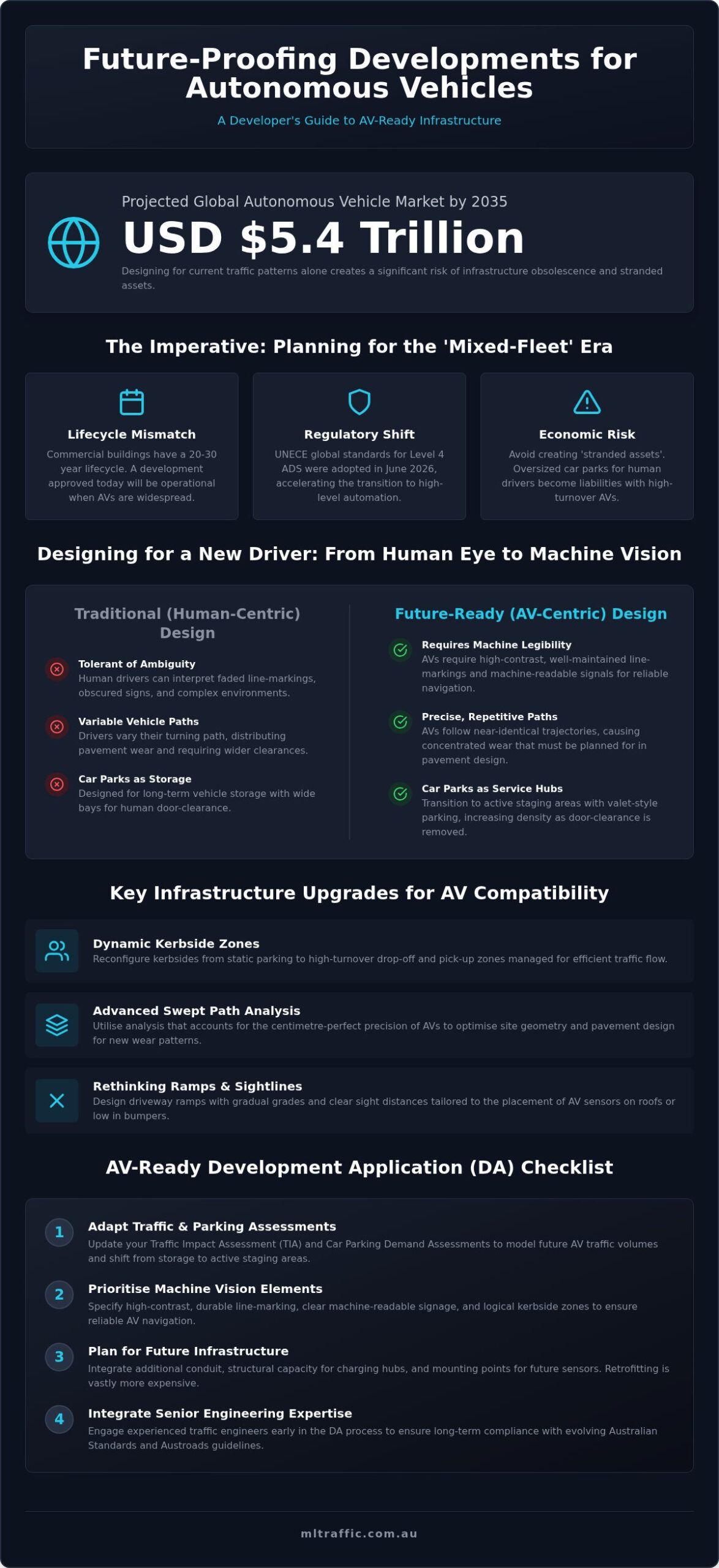
The average commercial building lifecycle spans at least 20 to 30 years. A development approved in 2026 will still be operational in 2050, by which time the global autonomous vehicle market is projected to exceed USD 5.4 trillion. Designing for current traffic patterns alone creates a significant risk of infrastructure obsolescence. Future-proofing developments for autonomous vehicles requires an immediate shift from human-centric design to machine-compatible infrastructure. This transition involves managing a ‘mixed-fleet’ era where manual drivers and automated systems share the same access ways and loading zones.
A professional Traffic Impact Assessment serves as the primary tool for identifying these future-proofing opportunities. It allows developers to evaluate how projected autonomous traffic volumes will affect site ingress and egress over the next two decades. By quantifying the expected shift in vehicle behaviour, engineers can recommend spatial adjustments that prevent future bottlenecks. If you don’t account for these shifts during the planning stage, you risk building a facility that is functionally outdated before its first major renovation.
Understanding AV Levels and Infrastructure Impact
Automation is categorised from Level 0 to Level 5. Level 3 systems allow conditional automation but require a human driver to take over. Level 5 represents full automation in all conditions. The UNECE World Forum for Harmonisation of Vehicle Regulations adopted global standards for Level 4 ADS in June 2026, signalling that high-level automation is no longer a distant concept. Sensor-reliant vehicles prioritise high-definition (HD) mapping and local connectivity over traditional road signage. Infrastructure must provide high-contrast line-marking and clear machine-readable signals to ensure reliable navigation through complex site environments.
The Economic Case for Future-Proofing DAs
Ignoring these trends leads to ‘stranded asset’ risk. Oversized car parks designed for permanent storage become liabilities as AVs shift toward high-turnover drop-off models. Integrating future-ready designs today increases the long-term valuation of a development. It is far more cost-effective to install additional conduit and structural capacity for future charging hubs and sensors during the initial build than to perform a total retrofit later. Proactive planning ensures your development remains functional and compliant with evolving Australian Standards and Austroads guidelines. Future-proofing developments for autonomous vehicles is an exercise in fiscal responsibility as much as engineering.
Physical Infrastructure: Designing Access for Machine Vision
Machine vision operates on different parameters than human perception. While a human driver can interpret faded line-marking or obscured signage, autonomous systems require high-contrast, well-maintained surfaces to function reliably. Future-proofing developments for autonomous vehicles means prioritising the clarity of the physical environment. This includes the implementation of machine-readable kerbside zones and high-visibility lane delimiters that support the latest Level 4 automation standards. Reliable navigation depends on the physical environment being as legible to a sensor as it is to an eye.
The kerbside is transitioning from a static parking asset to a high-turnover drop-off zone. This shift necessitates a re-evaluation of site geometry. Traditional Vehicle Swept Path Analysis remains critical but must now account for the centimetre-perfect precision of autonomous steering. Unlike human drivers who often vary their path, AVs follow a near-identical trajectory every time. This leads to concentrated pavement wear and specific clearance requirements that must be addressed during the design phase. To ensure your site geometry is compliant with these emerging trends, you can consult with our senior engineers for a detailed assessment.
Optimising Driveway Ramps and Sight Distances
Autonomous sensors are often located in arrays on the roof or low in the bumper. This placement fundamentally alters traditional sight distance assessments. Driveway ramps must be designed with gradual grades to prevent sensor damage and ensure a continuous line of sight for radar and LiDAR systems. While autonomous precision may eventually allow for narrower driveway widths, current designs must still accommodate the specific hardware footprints of early AV models to ensure safe site ingress and egress.
V2I and Smart Signage Integration
Infrastructure is no longer a passive component of the built environment. Vehicle-to-Infrastructure (V2I) connectivity requires the installation of dedicated sensors and transmitters within the site to facilitate real-time data sharing between the building and the vehicle. This shift eventually replaces physical signage with digital geofencing. Developers should consider the Federal Highway Administration’s automated vehicle resources for insights into how these systems are integrated into modern infrastructure. Provisioning for the necessary power and data cabling for Intelligent Transport Systems (ITS) today is a core component of future-proofing developments for autonomous vehicles.
Reimagining Car Park Design: From Storage to Service Hubs
Car parks have traditionally functioned as passive storage for idle assets. The introduction of AVs shifts this model toward high-density ‘valet-style’ parking. Because autonomous vehicles don’t require human door-clearance, vehicles can be parked with significantly reduced lateral spacing. This allows for increased density within the same structural footprint. This evolution is a core pillar of future-proofing developments for autonomous vehicles, transforming basements into active staging areas where vehicles recharge, receive software updates, and await their next dispatch.
Integrating EV charging infrastructure is no longer optional. As the global AV market scales, most autonomous fleets will be electric. Car park designs must account for the substantial power load and thermal management required for large-scale charging hubs. MIT’s research on autonomous vehicles and cities highlights how these shifts in parking demand will redefine urban land use, suggesting that centrally located developments can serve as critical nodes in autonomous transport networks. Designing these spaces as service hubs rather than just storage ensures long-term asset relevance.
AS 2890.1 vs. AV-Optimised Layouts
Current Australian Standards, specifically AS 2890.1, dictate a standard bay width of 2.4 metres for most user classes. Autonomous-only zones can operate with significantly narrower bays and tighter aisle widths. Machine-steering precision reduces the need for the generous turning circles required by human drivers. However, compliant car park design must now manage ‘dead-zones’ where human-driven vehicles and AVs might interact. Clear physical separation or digital geofencing is required to maintain safety during this mixed-fleet transition.
Designing for Adaptive Reuse
The long-term value of a development often depends on its ability to evolve. Future-proofing developments for autonomous vehicles involves designing car parks that can be repurposed as commercial or residential space if parking demand drops. Flat-floor designs are preferable to traditional ramped structures for this reason. Increasing floor-to-ceiling heights from the standard 2.1 or 2.2 metres to 3.0 metres or more facilitates future conversion. Structural engineers must also consider the load-bearing requirements for potential office fit-outs. Proper ventilation and lighting systems should be designed for hybrid-use environments, ensuring the asset remains viable regardless of transport trends in 2040.
Future-Proofing Your Development Application (DA) Today
Securing approval for a large-scale project requires demonstrating long-term site functionality to local government authorities. It is a rigorous process. Future-proofing developments for autonomous vehicles starts with a robust Car Parking Demand Assessment. This assessment must move beyond historical data to project how autonomous fleet adoption will reduce the requirement for permanent on-site parking spaces. Developers should use these projections to negotiate parking rate reductions with Councils, citing the transition toward shared mobility models.
The technical core of a future-ready DA involves four critical steps:
- Step 1: Conduct a forward-looking Car Parking Demand Assessment that accounts for reduced private vehicle ownership.
- Step 2: Utilise advanced Swept Path Analysis to test multiple vehicle types, including autonomous shuttles and delivery robots.
- Step 3: Incorporate ‘Flexible Kerbside Management’ into the Traffic Management Plan to allow for future conversion of parking to drop-off zones.
- Step 4: Consult with a professional traffic engineer early in the design phase to avoid expensive structural revisions.
Early engagement ensures that the physical constraints of the site do not prevent the integration of future technologies. To secure a compliant and forward-thinking design, contact our senior principals for a comprehensive site review.
Adjusting Traffic Impact Assessments (TIA)
Traditional TIA models often rely on static trip generation rates. In an AV-sharing economy, these rates will shift. Modelling must now account for ‘ghost trips’, which are zero-occupancy vehicles travelling between drop-off points and staging areas. These trips add volume to the surrounding road network without increasing on-site parking demand. Presenting a TIA that accurately reflects these dynamics justifies parking reductions and demonstrates a sophisticated understanding of future traffic flow to planning authorities.
Advanced Swept Path Modelling
Standard vehicle profiles are becoming less relevant. Advanced modelling using software like AutoTURN allows engineers to simulate AV-specific manoeuvring profiles. Autonomous vehicles can operate with higher precision than human drivers, potentially allowing for tighter radii in specific zones. However, loading docks must now be designed to handle autonomous delivery robots and smaller automated vans. Ensuring these areas are accessible for machine-guided steering prevents operational bottlenecks as delivery methods evolve. This focus on precision is mirrored in the aviation sector, where Menzies Aviation manages complex ground handling and cargo operations that require meticulous spatial planning. Future-proofing developments for autonomous vehicles requires this level of technical granularity in every submission.
ML Traffic Engineers provides the specialised technical expertise required to manage the transition to autonomous transport. We don’t merely observe industry shifts; we actively integrate them into our consultancy. Future-proofing developments for autonomous vehicles involves complex spatial and regulatory challenges that require senior-level oversight. Our firm operates on a ‘no-gatekeepers’ model. This means the senior principal who initiates your project is the same expert who performs the technical work, including Swept Path Analysis and Traffic Impact Assessments. This direct access ensures that the most complex aspects of your design receive meticulous attention from seasoned professionals.
We maintain a strict focus on national compliance with current Australian Standards, such as AS 2890.1 and AS 2890.2, while simultaneously eyeing future trends. This dual focus allows us to justify innovative designs to local Councils. We’ve assisted numerous developers in securing approvals for projects that deviate from traditional parking requirements by demonstrating the future-ready nature of their site plans. Our 15+ years of experience ensures that your development application is both technically sound and strategically positioned for the era of autonomous transport. We take accountability for every technical detail, ensuring your project remains a viable asset for decades.
Expert Consultancy for Long-Term Compliance
Navigating the Australian planning system requires more than just a basic understanding of traffic flow. It requires an ability to bridge the gap between rigid current regulations and the rapidly evolving technological landscape. Our role is to ensure your project isn’t just compliant today, but remains competitive and functional in the 2040 transport environment. We provide detailed assessments of site geometry, driveway ramp grades, and car park layouts to ensure they meet the specific requirements of machine-vision sensors and autonomous steering profiles. This meticulous approach prevents the risk of expensive retrofitting and ensures long-term asset viability. We focus on results-oriented design that satisfies both the developer and the regulatory authority.
Get Started on Your Future-Proofed Development
Securing a future-ready design begins with an initial site assessment. Whether you require a comprehensive Traffic Impact Assessment or a specialised Car Parking Demand Assessment, our team provides direct, professional consultation. The transition from an initial concept to Council approval is seamless when supported by senior-level engineering expertise. Our personnel continuity promise ensures that you have a single point of contact who understands the specific technicalities of your project from start to finish. We dislike unnecessary bureaucracy and focus on delivering clear, actionable engineering advice.
To discuss how we can support your project, contact our senior principals directly. You can also explore our full range of traffic engineering services to see how we manage complex urban planning requirements across Australia. Our expertise in future-proofing developments for autonomous vehicles provides the assurance you need for your next major project.
Securing Long-Term Asset Viability in the Autonomous Era
The shift toward autonomous transport requires a fundamental change in how we design and approve physical infrastructure. Prioritising machine-readable environments and adaptable car park layouts ensures that current developments remain functional as fleet dynamics evolve. Proactive planning today prevents the significant financial burden of future retrofitting and protects the long-term valuation of your asset. By integrating flexible kerbside management and advanced swept path modelling now, you avoid the risk of creating stranded assets that cannot accommodate the projected USD 5.4 trillion global AV market by 2035.
Implementing strategies for future-proofing developments for autonomous vehicles is an essential component of modern urban planning and fiscal responsibility. To ensure your project meets both current Australian Standards and future requirements, you need expert guidance from seasoned professionals. Contact the senior team at ML Traffic Engineers to future-proof your next development. We provide direct access to senior principals on every project, ensuring that your technical work is performed by an expert. With over 15 years of specialised traffic engineering experience across Australia, we have the expertise to navigate complex Council requirements. Your development represents a multi-decade investment that deserves a design capable of evolving with the technology it serves.
Frequently Asked Questions
What is the most important infrastructure change for autonomous vehicles?
The most critical change is the shift from human-centric to machine-readable infrastructure. Machine vision systems rely on high-contrast line markings and clear, unobstructed sightlines for LiDAR and radar sensors. Ensuring your site has the necessary conduits for real-time data transmitters is also vital. These changes are central to future-proofing developments for autonomous vehicles, as they allow automated systems to navigate complex private environments with the same reliability as public roads.
Will autonomous vehicles reduce the need for car parking in new developments?
AVs will likely reduce long-term parking demand but significantly increase the requirement for high-turnover drop-off zones. In the immediate future, a Car Parking Demand Assessment is required to justify reduced bay numbers to Council. The focus shifts from permanent vehicle storage to creating active staging areas. Developments that lack these flexible kerbside zones risk operational failure as tenant transport habits move toward shared, autonomous mobility models over the next decade.
How does swept path analysis change for autonomous vehicles?
Traditional analysis accounts for human error and varied driving lines. AVs operate with centimetre-perfect precision, following identical trajectories every time. This requires a more nuanced Vehicle Swept Path Analysis that considers concentrated pavement wear and specific clearance for roof-mounted sensor arrays. While AVs can theoretically negotiate tighter spaces, early-generation models still require standard clearances until Level 5 automation becomes the universal standard in Australian transport networks.
Can I get Council approval for reduced parking if I design for AVs?
Securing Council approval for reduced parking requires a sophisticated Traffic Impact Assessment (TIA) that demonstrates long-term site functionality. While Australian Standards still dictate minimums, Councils are increasingly open to data-driven justifications. By presenting a future-ready case that includes autonomous-ready drop-off zones and robust shared-transport provisions, developers can often negotiate lower parking rates. This approach is a key part of future-proofing developments for autonomous vehicles while maintaining regulatory compliance.
What are the power requirements for AV-ready developments?
Power requirements increase significantly due to the integration of large-scale EV charging and Intelligent Transport Systems (ITS). Autonomous fleets are primarily electric, requiring substantial electrical load capacity for rapid charging hubs. Additionally, the site must support the data cabling and power for V2I transmitters and sensors. Provisioning for these requirements during the initial build is far more cost-effective than attempting a structural retrofit once the building is operational.
How do I ensure my car park design is compliant with AS 2890.1 and future-proofed?
Compliance with AS 2890.1 remains mandatory for current DAs. To future-proof the design, you should incorporate flat-floor structures and increased floor-to-ceiling heights of at least 3.0 metres. This allows for the car park to be repurposed into commercial or residential space if parking demand decreases. Professional car park design involves balancing these current regulatory requirements with the structural flexibility needed to adapt to autonomous transport trends.
What is the difference between V2I and V2V communication in traffic engineering?
V2I (Vehicle-to-Infrastructure) involves communication between a vehicle and the built environment, such as traffic lights or site sensors. This is the primary focus for developers. V2V (Vehicle-to-Vehicle) allows cars to communicate with each other to prevent collisions and manage traffic flow. In traffic engineering, V2I is critical for managing site access and ensuring that autonomous vehicles can safely enter and exit private property without human intervention.
When should I engage a traffic engineer for an autonomous-ready project?
You should engage a traffic engineer at the initial concept stage. Early involvement allows for the integration of AV-ready geometry and structural requirements before the design is finalised. Waiting until the DA submission phase often leads to expensive revisions if the driveway ramps or basement heights don’t meet the specific needs of autonomous technology. Senior-level engineering input ensures that your project remains both compliant and competitive in the long term.

Disclaimer
The content on www.mltraffic.com.au, including all technical articles, guides, and resources, is provided for general informational and educational purposes only. It is not intended to constitute professional advice in traffic engineering, transportation planning, development approvals, or any other technical or legal field.
While ML Traffic Engineers makes every reasonable effort to ensure the accuracy, completeness, and timeliness of the information published, we do not provide any warranties or representations (express or implied) regarding its reliability, suitability, or availability for any particular purpose. Any reliance you place on the content is strictly at your own risk.
In no event shall ML Traffic Engineers, its directors, employees, authors, or affiliates be liable for any direct, indirect, incidental, special, consequential, or punitive damages (including, without limitation, loss of profits, data, or business opportunities) arising out of or in connection with the use of, or inability to use, any information provided on this website.
The articles and guides on this site are not a substitute for engaging a qualified, registered professional traffic engineer (such as an NPER or RPEQ engineer) to assess your specific project requirements. For tailored advice, compliance assessments, or traffic engineering services, please contact a competent professional.
This disclaimer may be updated from time to time without notice. By accessing or using this website, you agree to be bound by the most current version of this disclaimer.
