
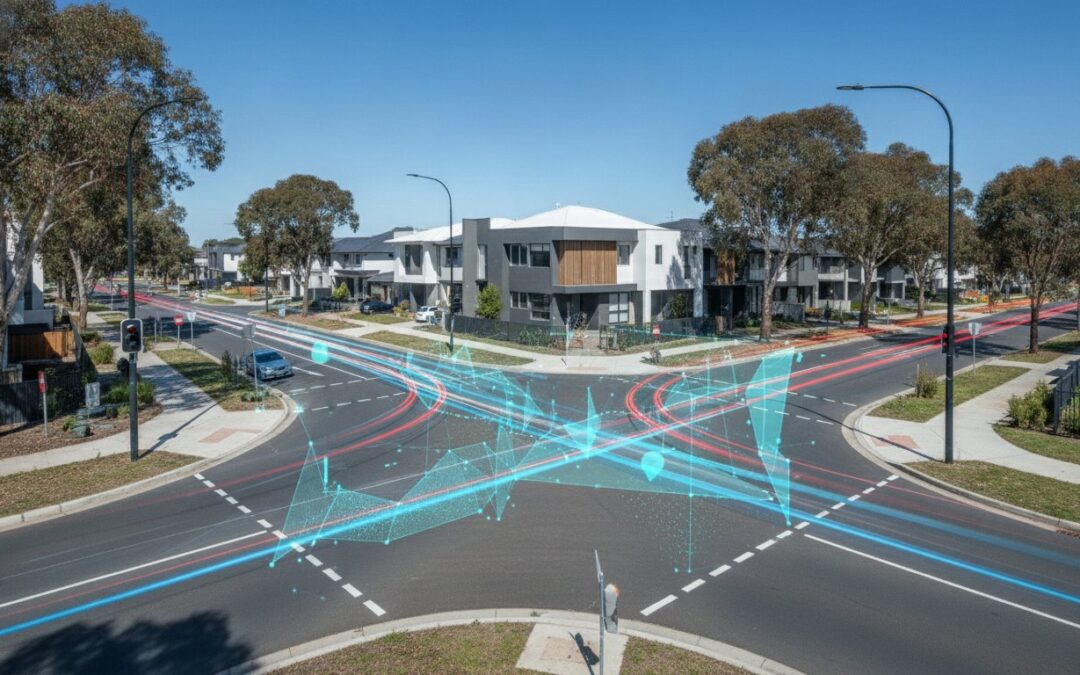
Proving that an unsignalised intersection is safe and functional is often the difference between a viable development and a project stalled by the prohibitive costs of unnecessary signalisation. When Council raises concerns about safety risks or traffic flow, a robust gap analysis for unsignalised intersections provides the technical evidence needed to justify a priority-controlled layout. We understand the frustration of receiving vague feedback regarding SIDRA analysis or feeling the pressure of complex technical jargon during a critical DA meeting. You need a report that stands up to scrutiny and clearly demonstrates compliance with national standards.
This article provides the clarity you need to master the technical requirements and safety justifications required to secure Council approval. We examine the latest Austroads Guide to Road Design Part 4A: Unsignalised and Signalised Intersections, Edition 4.0, and the specific modelling requirements within SIDRA 11.0.3. You’ll gain a comprehensive understanding of how to integrate gap analysis into your Traffic Impact Assessment (TIA) to ensure your project remains both compliant and cost-effective. From sight distance assessments to capacity modelling, we break down the metrics that satisfy regulatory authorities and move your project forward.
Key Takeaways
- Understand the technical distinction between gaps and lags to model driver behaviour accurately at priority-controlled intersections.
- Discover how to leverage gap analysis for unsignalised intersections using SIDRA INTERSECTION 11.0.3 to satisfy current Austroads compliance requirements.
- Master a structured two-step process for traffic counts and site-specific studies to defend your Development Application against safety-related objections.
- Prevent project over-engineering and unnecessary signalisation costs by providing robust technical justifications within your Traffic Impact Assessment (TIA).
- Learn how senior-level expertise in critical gaps and follow-up headway parameters ensures your intersection analysis stands up to rigorous Council scrutiny.
What is Gap Analysis for Unsignalised Intersections?
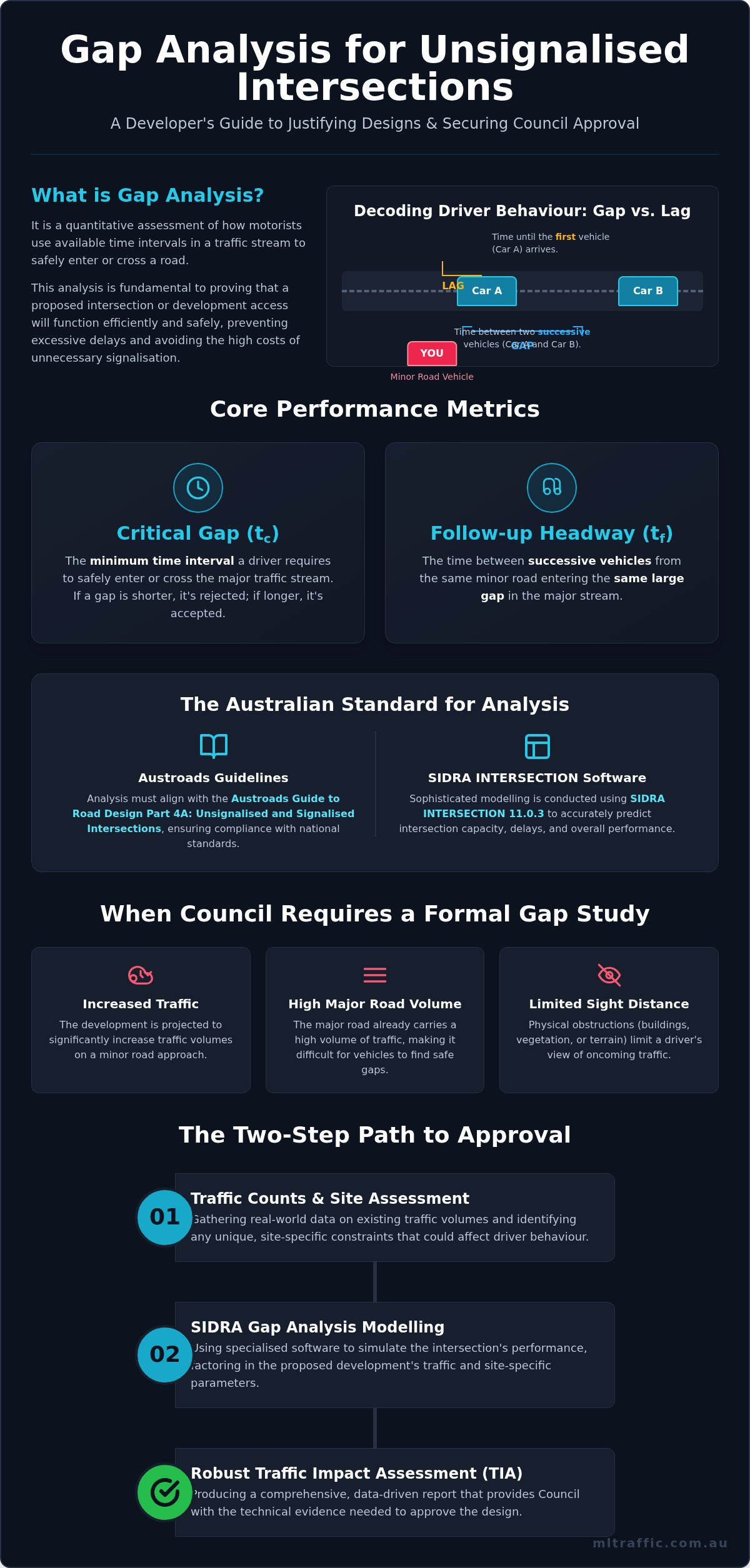
Gap analysis is a quantitative assessment used to determine how motorists evaluate and utilise available time intervals in a traffic stream to perform specific movements. At priority-controlled junctions, drivers must wait for a sufficient break in the through-traffic to enter or cross the road safely. Performing a gap analysis for unsignalised intersections allows engineers to predict whether a proposed development access will function without causing excessive delays or safety hazards. This study is fundamental to determining the practical capacity of an access point, which represents the maximum number of vehicles that can safely exit the minor road under prevailing traffic conditions.
To understand this technical process, you must distinguish between a “gap” and a “lag”. A gap is the time interval between two successive vehicles in the major traffic stream. A lag is the time interval between the arrival of a minor-road vehicle at the intersection and the arrival of the first vehicle in the major stream. Understanding these nuances is vital because driver behaviour changes based on whether they are accepting the first available opportunity, the lag, or waiting for subsequent spaces, the gaps. Accurate modelling depends on these distinctions to reflect real-world conditions.
Safety at these junctions relies entirely on gap acceptance. If you are unfamiliar with the basic operational principles of these layouts, it’s helpful to understand What is an Unsignalised Intersection? and how they differ from signalised or roundabout treatments. These intersections use Give Way or Stop signs, placing the burden of safety on the driver’s judgement of available space rather than automated control systems.
The Importance of Gap Acceptance in Australian Road Safety
In Australia, gap analysis is a primary tool for preventing right-angle and filtering accidents at priority-controlled junctions. When driver patience wears thin due to long delays, they often accept smaller, higher-risk gaps. This behaviour significantly increases the likelihood of collisions. Within the context of Austroads safety standards, gap acceptance is defined as the process by which a driver evaluates and decides whether a specific time interval is sufficient to safely complete a manoeuvre. Our analysis ensures that the intersection design provides enough “critical gaps” to maintain safety even during peak periods.
When Council Requires a Formal Gap Study
Council typically triggers a requirement for a formal study when a development significantly increases traffic on a minor road or when the major road carries high volumes. It’s also required if sight distance is limited, making it harder for drivers to judge oncoming vehicle speeds. These findings are a critical component of a Traffic Impact Assessment (TIA). Unlike simple traffic counts, which only record volume, gap analysis for unsignalised intersections uses sophisticated modelling to prove that your development won’t compromise the existing road network’s performance or safety.
Core Concepts: Critical Gaps and Follow-up Headway
The accuracy of any gap analysis for unsignalised intersections rests on two primary metrics: the critical gap and the follow-up headway. These parameters define the boundary between safe operation and intersection failure. The critical gap is the minimum time interval, measured in seconds, that a driver requires to safely enter or cross the major traffic stream. It is a probabilistic value. If a gap is shorter than this threshold, the driver will typically reject it; if it is longer, they will proceed. Conducting a precise gap analysis for unsignalised intersections requires adjusting these base values to reflect your site’s unique constraints and the latest 2026 Austroads standards.
Follow-up headway refers to the time between successive vehicles from the same minor road approach entering the same large gap in the major stream. While the first driver evaluates the critical gap, subsequent drivers only need the follow-up headway to follow through. This concept is explored deeply in the research on Core Concepts: Critical Gaps and Follow-up Headway, which highlights that these values are never static. They fluctuate based on several factors:
- Environmental Conditions: Heavy rain or poor lighting during night-time hours naturally increases the critical gap as drivers become more cautious and visibility decreases.
- Vehicle Type: A heavy vehicle requires a significantly larger gap to accelerate from a standstill compared to a passenger car.
- Incline: Steep driveway or approach grades can slow vehicle entry, necessitating larger time intervals.
Factors Influencing Critical Gap Values
Intersection geometry is a primary determinant of required gap sizes. A driver crossing a four-lane divided carriageway requires a longer critical gap than one crossing a simple two-lane road. This is due to the increased distance to travel and the complexity of monitoring multiple traffic streams. Speed environments further complicate this. In high-speed rural areas, drivers need larger gaps because the closing speed of approaching vehicles is higher. Local behaviour also matters. Urban drivers in Sydney or Melbourne may accept tighter gaps due to high congestion levels, whereas rural drivers often wait for more generous openings.
Follow-up Headway and Intersection Discharge
Follow-up headway is the metric that dictates the discharge capacity, or saturation flow, of an unsignalised movement. When multiple vehicles are queued at a Stop or Give Way sign, the efficiency of the “clear out” depends on how quickly drivers follow the lead vehicle into an available gap. If the follow-up headway is high, the intersection’s capacity drops, leading to queues that can spill back into your development. For projects involving frequent truck movements, we often integrate a Swept Path Analysis with our gap studies. This ensures that the physical space and the time intervals provided are sufficient for heavy vehicles to clear the intersection without obstructing through-traffic. If you are unsure how these technical parameters will affect your DA, our team can provide a detailed Intersection Analysis to clarify your requirements.
Australian Methodologies: Austroads and SIDRA INTERSECTION
Australian traffic authorities rely on a rigorous set of standards to evaluate intersection performance. The primary reference is the Austroads Guide to Traffic Management, specifically Part 3 and Australian Methodologies: Austroads and SIDRA INTERSECTION (AGTM02). These documents provide the framework for conducting a gap analysis for unsignalised intersections by defining how to measure traffic flow, queuing, and delay. While engineers once relied on manual gap acceptance calculations, modern requirements demand high-fidelity computer simulations to account for the complex interactions between multiple traffic streams. The 2026 updates to these guides ensure that assessments reflect current vehicle performance and driver habits.
Most local Councils and state road authorities mandate the use of SIDRA INTERSECTION for all technical reports. This software translates raw traffic data into performance metrics like Level of Service (LoS). LoS is a qualitative measure ranging from A (excellent) to F (failing). It is directly derived from the average delay experienced by drivers waiting for an acceptable gap. A successful DA relies on proving that your development maintains an acceptable LoS, typically C or better, without requiring expensive infrastructure upgrades.
The SIDRA Approach to Unsignalised Analysis
SIDRA models the probabilistic nature of gap acceptance by calculating the Movement Capacity for every individual turn at a junction. It evaluates the Degree of Saturation (DOS), which represents the ratio of arrival volume to available capacity. A DOS exceeding 0.85 often triggers Council concerns regarding intersection stability and potential queuing. SIDRA is the preferred software because its algorithms are specifically calibrated to the unique lane configurations and give-way rules found in Australian traffic engineering scenarios. The latest version, SIDRA 11.0.3, includes improved network model convergence which is essential for complex site access designs.
Austroads Standards vs. International Models
Australian driver behaviour differs significantly from North American or European patterns. This makes international models like the Highway Capacity Manual (HCM) unsuitable for local development applications. Australian drivers demonstrate different “critical gap” thresholds and follow-up headways due to our specific road rules and urban environments. Compliance with Australian Standards, particularly AS 1742.2, is essential when performing a gap analysis for unsignalised intersections. This standard governs the signage and line marking that influence how drivers perceive and accept gaps. TIA reports must use Australian-specific base values to ensure the results are defensible. Using generic international defaults will result in inaccurate capacity predictions and likely lead to a formal request for further information or a DA refusal.
Practical Application: Securing DA Approval with Gap Analysis
Securing DA approval requires a structured approach to technical evidence. Council engineers often prioritise main road through-flow and will reject any proposal that appears to compromise network stability. A robust gap analysis for unsignalised intersections provides the quantitative data needed to overcome these objections. We follow a rigorous five-step process to ensure your development access meets all regulatory requirements and safety standards.
- Step 1: Traffic Counts. Conduct peak hour traffic counts on both major and minor road approaches. This establishes the existing baseline and identifies the highest-stress periods for the junction.
- Step 2: Site-Specific Gap Study. If Council contests standard Austroads values, we perform an on-site study. This determines actual driver behaviour and local gap acceptance thresholds, which are often more favourable than generic defaults.
- Step 3: SIDRA Modelling. Input the collected data into SIDRA 11.0.3 to simulate the proposed development’s traffic impact. This modelling accounts for the 2026 updates to vehicle performance and network convergence.
- Step 4: Criteria Comparison. Compare the simulation results against Council’s specific Level of Service (LoS) and safety criteria. We look for Degree of Saturation (DOS) and average delay metrics.
- Step 5: Mitigation Strategy. If the analysis shows insufficient gaps, we propose targeted mitigation measures. This ensures the project remains viable without resorting to full intersection signalisation.
Addressing Council Concerns Regarding Safety and Delay
Council engineers frequently raise “worst-case scenario” objections regarding potential queuing on the main road. By providing a detailed gap analysis for unsignalised intersections, we demonstrate that minor road movements will not impede through-traffic. This technical justification is often the only way to defend a “Give Way” or “Stop” control against a Council demand for a costly roundabout or traffic signals. Our reports focus on the probability of queue clear-out, proving that the proposed access point functions safely under peak load. If you need to defend your project’s access design, our team provides expert Intersection Analysis to support your application.
Mitigating Poor Gap Availability
When initial analysis indicates poor gap availability, engineering solutions can often bridge the gap. Adding a central median refuge allows drivers to perform the manoeuvre in two stages, which significantly reduces the required critical gap size. Left-turn slip lanes or auxiliary lanes can also remove slow-moving vehicles from the through-traffic stream, improving overall safety. Improving sight distance by clearing obstructions or regrading verges can effectively increase the usable gaps for drivers by giving them more time to react. We only recommend signalisation when all priority-controlled options are exhausted, ensuring your project avoids unnecessary infrastructure costs.
Why Expert Intersection Analysis is Critical for Your Project
Expert analysis is the primary safeguard against over-engineering. Without a precise gap analysis for unsignalised intersections, developers often face demands for infrastructure that exceeds the actual traffic demand. Inaccurate modelling can lead to the forced installation of traffic signals or roundabouts; these are capital-intensive requirements that can jeopardise project feasibility. ML Traffic Engineers Australia leverages over 15 years of consultancy experience to ensure that every assessment is technically sound and commercially realistic. Our senior principals perform the technical work themselves. This level of accountability ensures that the findings presented to Council are defensible under rigorous questioning.
We maintain a policy of personnel continuity. The expert who initiates your project and collects the field data is the same professional who performs the SIDRA modelling and writes the final report. This approach eliminates the communication gaps that often occur in larger firms where work is outsourced to junior staff. ML Traffic Engineers Australia integrates these specialised gap studies into a broader Traffic Management Plan to provide a holistic view of site safety and operational efficiency.
Minimising Development Risk Through Technical Accuracy
Providing robust data upfront is the most effective way to avoid Request for Further Information (RFI) delays. An RFI can stall a project for weeks or months, increasing holding costs and delaying construction timelines. Our gap analysis for unsignalised intersections adheres to both national Austroads standards and state-specific guidelines, such as the Main Roads Western Australia supplements updated in July 2026. Direct access to our senior leadership means complex intersection issues are identified and solved during the design phase, not after the DA has been lodged. We ensure compliance across all Australian jurisdictions by applying the latest 2026 regulatory updates to every report.
Get Started with Professional Traffic Engineering
Early-stage traffic input is vital for site layout optimisation. Engaging an expert before finalising your site plan prevents costly redesigns if the proposed access point fails capacity testing. To prepare for your initial consultation, have your preliminary site plans and expected land-use categories ready for review. ML Traffic Engineers Australia provides national coverage, ensuring your project meets local requirements regardless of location. Contact ML Traffic Engineers Australia today to discuss your intersection analysis requirements with a senior principal who will be directly responsible for your project’s success.
Secure Your Development Approval with Technical Precision
Securing a DA requires more than just meeting minimum standards; it requires a strategic presentation of technical data that Council cannot ignore. By applying a rigorous gap analysis for unsignalised intersections, you provide the safety justifications needed to protect your project from unnecessary infrastructure costs. This data-driven approach ensures that your development access remains functional and safe, even as traffic volumes increase over the coming years. Providing this level of technical clarity upfront is the most effective way to streamline the approval process and mitigate the risk of costly delays.
ML Traffic Engineers Australia brings over 15 years of specialised consultancy experience to every project. Our senior principals ensure that every report is fully compliant with the latest 2026 Austroads guides and SIDRA INTERSECTION requirements. We deliver the technical rigour needed to move your development from the design phase through to final Council approval without the burden of over-engineered road requirements.
Request an Intersection Analysis for Your DA Approval
We look forward to assisting you with your next successful development application.
Frequently Asked Questions
What is the difference between a gap and a lag in traffic engineering?
A gap is the time interval between two successive vehicles in the major traffic stream. A lag is the time interval between a minor road vehicle arriving at the intersection and the arrival of the first vehicle in the major stream. Engineers distinguish these because driver behaviour often differs when accepting the first available space versus waiting for subsequent gaps.
How does SIDRA software calculate gap acceptance for unsignalised intersections?
SIDRA 11.0.3 uses a probabilistic model based on critical gap and follow-up headway parameters to determine movement capacity. The software evaluates the major road flow to calculate how many minor road vehicles can safely enter the available time intervals. It specifically accounts for Australian lane configurations and priority rules to ensure the output reflects local conditions.
What is a “good” Level of Service (LoS) for a priority-controlled junction?
A Level of Service ranging from A to C is considered good, indicating minimal delays for motorists. Most Australian Councils accept LoS D during peak periods as a functional limit. If a gap analysis for unsignalised intersections results in LoS E or F, the intersection is failing, and mitigation measures or upgrades are typically mandatory.
When is a formal gap study required by Australian Councils?
Councils require a formal study when a development significantly increases traffic on a minor road or when the major road carries high volumes. It’s also triggered by safety concerns such as restricted sight distance or a history of accidents at the location. This study is a critical component of a Traffic Impact Assessment (TIA) for securing DA approval.
Can gap analysis help avoid the need for traffic lights?
Yes, it’s a primary tool for justifying priority control over expensive signalisation. By providing quantitative proof that the junction operates safely and efficiently with Give Way or Stop signs, developers can avoid the high capital costs of traffic lights. This technical evidence is vital for defending a project against over-engineering requirements.
How do heavy vehicles impact gap acceptance at intersections?
Heavy vehicles require larger critical gaps because they have slower acceleration rates and take longer to clear the intersection. The presence of trucks reduces the overall capacity of the movement. We adjust modelling parameters to reflect the specific vehicle mix, ensuring the analysis accounts for the extra time needed for larger vehicles to perform manoeuvres safely.
Does Austroads provide standard values for critical gaps?
The Austroads Guide to Road Design Part 4A, Edition 4.0, provides base values for critical gaps and follow-up headways. These values serve as the industry standard for initial modelling but often require site-specific adjustments. Factors like approach speed and intersection geometry are used to refine these base values for a more accurate gap analysis for unsignalised intersections.
What happens if the gap analysis shows the intersection is over capacity?
If the analysis indicates the intersection is over capacity, we investigate engineering solutions to improve performance. This might include adding auxiliary turning lanes, installing a median refuge to allow two-stage crossings, or improving sight lines to increase usable gaps. If these measures don’t resolve the capacity issue, alternative access designs or signalisation may be required.

Disclaimer
The content on www.mltraffic.com.au, including all technical articles, guides, and resources, is provided for general informational and educational purposes only. It is not intended to constitute professional advice in traffic engineering, transportation planning, development approvals, or any other technical or legal field.
While ML Traffic Engineers makes every reasonable effort to ensure the accuracy, completeness, and timeliness of the information published, we do not provide any warranties or representations (express or implied) regarding its reliability, suitability, or availability for any particular purpose. Any reliance you place on the content is strictly at your own risk.
In no event shall ML Traffic Engineers, its directors, employees, authors, or affiliates be liable for any direct, indirect, incidental, special, consequential, or punitive damages (including, without limitation, loss of profits, data, or business opportunities) arising out of or in connection with the use of, or inability to use, any information provided on this website.
The articles and guides on this site are not a substitute for engaging a qualified, registered professional traffic engineer (such as an NPER or RPEQ engineer) to assess your specific project requirements. For tailored advice, compliance assessments, or traffic engineering services, please contact a competent professional.
This disclaimer may be updated from time to time without notice. By accessing or using this website, you agree to be bound by the most current version of this disclaimer.
