

What if the primary bottleneck in your development timeline isn’t the Council assessment phase, but the quality of your initial engineering brief? Many property developers face project delays because they aren’t sure exactly how to get a fast quote for a traffic report or how to bridge the gap between architectural concepts and technical road safety requirements. This uncertainty often results in a cycle of back-and-forth communication that stalls project momentum before the first report is even drafted.
ML Traffic Engineers Australia recognises that you need technical certainty and professional accountability to move your project forward. This guide identifies the exact information you must provide to secure a firm, fixed-price quote within 24 to 48 hours. By providing the right documentation upfront, you ensure your assessment meets national regulatory standards and proceeds without the typical administrative friction that plagues larger, multidisciplinary firms.
We will break down the essential site details required for a rapid turnaround and explain the critical differences between engineering assessments and legal records. You’ll also learn why direct access to senior leadership is vital for maintaining personnel continuity from the initial fee proposal through to the final Council submission.
Key Takeaways
- Distinguish between police incident reports and the technical Traffic Impact Assessments (TIA) required for property development and Council compliance.
- Discover how to get a fast quote for a traffic report by consolidating site plans and Council correspondence into a single data pack for immediate review.
- Understand how site-specific variables like intersection analysis and vehicle swept path requirements impact the final quote price and project lead times.
- Eliminate delays by bypassing gatekeepers and securing direct access to senior principal engineers who manage your project from the initial quote to final submission.
- Gain confidence in your project timelines by partnering with consultants who offer national coverage and a proven track record across more than 10,000 development sites.
Engineering vs. Legal: What Kind of Traffic Report Do You Need?
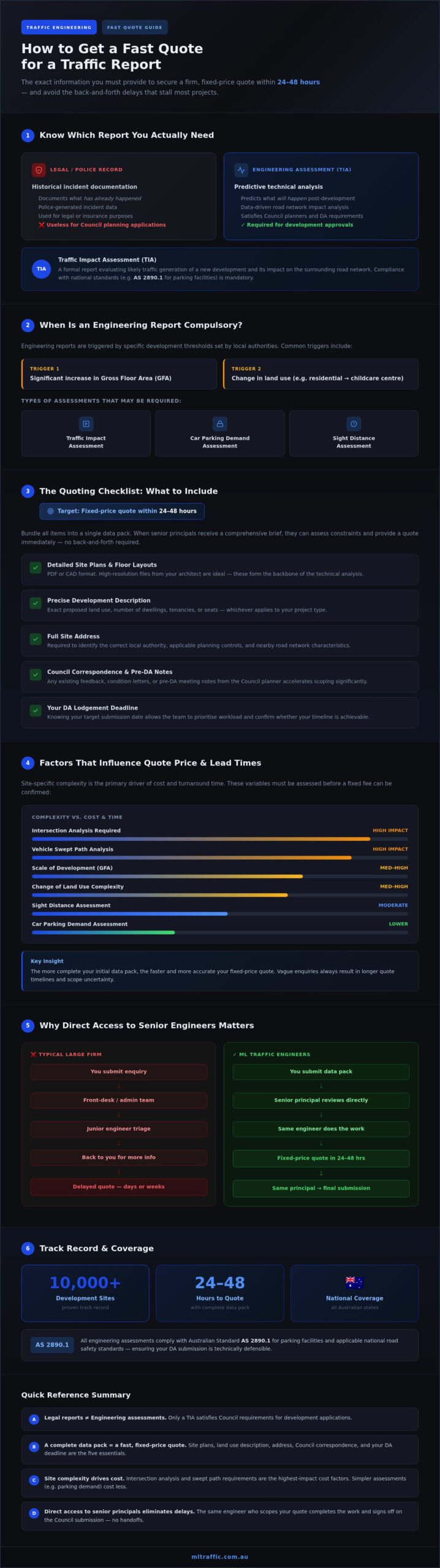
Developers frequently encounter search results for legal aid or police incident data when looking for traffic documentation. These records are functionally useless for a planning application. Understanding the distinction between a historical legal record and a predictive technical assessment is a prerequisite for knowing how to get a fast quote for a traffic report that satisfies Council planners. While a legal report documents what has already happened, an engineering assessment focuses on what will happen once your development is operational.
At ML Traffic Engineers Australia, our senior principals, Michael Lee and Benny Chen, specialise in these forward-looking documents. We provide the technical evidence required to prove that a proposed project can integrate safely with existing road infrastructure. This involves demonstrating compliance with national regulatory standards, such as AS 2890.1 for parking facilities. Our role is to act as a technical bridge between your architectural vision and the bureaucratic requirements of local government.
The discipline of Traffic engineering involves more than just counting cars. It requires an understanding of road geometry, traffic flow, and safety standards. By engaging an expert firm, you ensure that the data presented to Council is accurate and defensible. This level of technical rigour is essential for developers who need to maintain project momentum and avoid the delays associated with poorly prepared submissions.
The Traffic Impact Assessment (TIA) Explained
A TIA is a formal report that evaluates the likely traffic generation of a new development and its subsequent impact on the surrounding road network. Council planners prioritise these assessments because they provide a data-driven basis for decision-making. For a comprehensive overview of these requirements, you can refer to our Traffic Impact Assessment: The Definitive Guide for Australian Developers. Our approach ensures that the same senior principal who initiates your quote is the one performing the technical analysis, providing a level of accountability that larger, impersonal firms often lack.
When is an Engineering Report Compulsory?
Engineering reports are typically triggered by specific development thresholds defined by local authorities. These triggers often include a significant increase in Gross Floor Area (GFA) or a change in land use, such as converting a residential block into a commercial childcare centre. When you need to know how to get a fast quote for a traffic report, identifying these triggers early is vital. Whether your project requires a Car Parking Demand Assessment or a Sight Distance Assessment, our team provides national coverage to ensure your project meets the rigorous standards of traffic engineering. We focus on delivering compliant solutions that respect both your budget and your DA lodgement deadlines.
Essential Information for a Rapid Traffic Assessment Quote
The primary reason for delay in the fee proposal phase is incomplete project data. Knowing how to get a fast quote for a traffic report requires a shift from vague enquiries to a structured data pack. When our senior principals at ML Traffic Engineers Australia receive a comprehensive brief, they evaluate site constraints and regulatory requirements immediately without requesting additional files. This direct access to leadership ensures that no gatekeepers delay the technical review of your development.
Collaboration between your architect and the developer at this stage is critical. Architects possess the high-resolution CAD files and site layouts that form the backbone of our technical analysis. Providing these documents upfront eliminates the back-and-forth communication that typically stalls project timelines in the early stages. A well-prepared brief is the most effective way to expedite the engineering review.
The Quoting Checklist: What to Attach
- Detailed site plans and floor layouts in PDF or CAD format.
- A precise description of the proposed land use, such as childcare, industrial warehousing, or high-density residential.
- Current and proposed car parking numbers to facilitate a Car Parking Demand Assessment.
- Vehicle access points and internal circulation routes.
A complete pack allows us to assess the project scale accurately. Similar to the requirements found in a Traffic Impact Study Manual, the level of assessment depends on the intensity of the development and the projected trip generation. Larger projects involve higher quoting complexity due to the volume of data points required for Council compliance and national regulatory standards.
Detailing the Scope of Work
Clarity regarding the scope prevents “scope creep” and ensures the quote is firm and final. You must specify if your development requires a Swept Path Analysis for heavy vehicles, service trucks, or waste collection. If Council has already issued a Request for Information (RFI) letter, include it in your initial email. This allows our senior principals to address their specific concerns regarding intersection analysis, driveway ramp grades, or sight distances directly.
When considering how to get a fast quote for a traffic report, you should also determine if your project requires a Traffic Guidance Scheme (TGS) for the construction phase. Providing these details allows our senior engineers to provide a comprehensive response that covers all phases of your development application. If you have your site plans ready, you can send your project details directly to our team for an immediate technical review.
Factors That Influence Quote Price and Lead Times
Speed in traffic engineering should never come at the expense of technical precision. When developers ask how to get a fast quote for a traffic report, they must understand that the specific project triggers dictate both the price and the delivery timeline. A “Traffic Statement” for a minor residential change requires significantly less data processing than a full “Traffic Impact Assessment” for a mixed-use commercial development. Our senior principals ensure quote accuracy by reviewing these triggers before issuing a fee proposal. This prevents mid-project cost adjustments and ensures the scope aligns with Council expectations.
Site complexity is the primary driver of engineering hours. An isolated site with a single driveway is straightforward. Conversely, a development near a major signalised intersection requires detailed modelling to satisfy road authority requirements. Comprehensive resources, such as the Caltrans Guide for the Preparation of Traffic Impact Studies, highlight how the breadth of a study expands based on the potential impact on the broader road network. We evaluate these factors during the quoting phase to provide a firm, fixed price.
Technical Complexity and Data Requirements
The technical tools required for your report directly influence the quote. SIDRA intersection modelling involves complex data entry and multi-scenario simulations. This process naturally takes longer than a basic car park review. We also conduct rigorous AS 2890.1 compliance checks to ensure every parking bay and driveway gradient meets national standards. The number of vehicle types requiring swept path assessments also impacts the workload. Simulating the movements of heavy rigid vehicles for waste collection or articulated trucks for industrial docks requires more detailed analysis than standard passenger vehicles.
Urgency and Council Deadlines
You should clearly communicate your “DA lodgement” deadline during the initial inquiry. While we aim for a 24 to 48 hour turnaround on quotes, the engineering work itself must follow a logical sequence to remain compliant with national regulatory standards. With 15 years of specialised consultancy and experience across 10,000 sites, our team understands the local government expectations that others might overlook. A “cheap” quote often indicates a generic, templated approach. This frequently leads to expensive Request for Information (RFI) letters from Council. These letters can delay your project by months, making the initial saving irrelevant. Investing in a senior-led assessment is the most efficient way to protect your project timeline.
How to Request an Engineering Quote Today
Securing an accurate fee proposal requires a methodical approach. To understand how to get a fast quote for a traffic report, you must first consolidate your project documentation. Start by gathering high-resolution site plans and any formal Request for Information (RFI) letters from Council. These documents allow us to identify specific technical requirements, such as driveway ramp grade assessments or intersection analysis, immediately. Providing a complete data pack ensures our senior team can review the site constraints without requesting additional files.
The second step involves bypassing administrative gatekeepers. In large, multidisciplinary firms, your inquiry might sit with a business development manager for days. We provide direct contact with senior principals Michael Lee and Benny Chen. This ensures that the person reviewing your plans has the technical expertise to provide a firm, fixed-price quote. Clearly state your required turnaround time and DA lodgement deadlines in your initial message to ensure priority handling. Finally, review the provided fee proposal to ensure it aligns with your project scope. A comprehensive quote should explicitly list all required services, including Vehicle Swept Path Analysis or Waste Management Plans. This transparency prevents project stalls during the Council assessment phase.
Direct Access vs. Administration Hubs
Direct communication with a senior engineer is the most effective way to eliminate project friction. Large firms often separate the quoting team from the technical execution team. This leads to information loss and delays. Our personnel continuity promise means the engineer who initiates the relationship is the one performing the technical assessments. This hands-on approach ensures accountability and deep technical knowledge of your specific site constraints. You won’t be passed between junior staff; you’ll have a direct line to the expert doing the work.
Digital Submission Tips
Efficiency in the quoting phase depends on how you present your data. When emailing large attachments, PDF is the standard for layouts, while CAD files are preferred for detailed swept path modelling. If your files exceed standard email limits, use a secure cloud link. For the most streamlined inquiry process, use our Contact Page to upload your brief directly. Once received, our senior team will provide a formal fee proposal document that outlines the technical scope and guaranteed delivery timeframe. Knowing how to get a fast quote for a traffic report is simply a matter of providing clear data to the right expert. To move your project forward today, request a fixed-price quote from our senior engineers.
Why ML Traffic Engineers is the Choice for Rapid Approval
ML Traffic Engineers represents 15 years of specialised consultancy within the Australian development sector. Our track record includes the successful assessment of more than 10,000 sites, providing our team with the technical depth required to handle complex land-use categories. When you require information on how to get a fast quote for a traffic report, you receive a direct response from our senior principals, Michael Lee and Benny Chen. We eliminate administrative gatekeepers to ensure your project receives expert attention from the initial inquiry through to Council submission.
Our personnel continuity promise is a core signature of our professional service. We guarantee that the senior engineer who reviews your site plans and issues your fee proposal is the same expert who performs the technical work. This approach prevents the information loss common in larger firms where projects are often delegated to junior staff after the quoting phase. This hands-on, accountable philosophy ensures that the specific constraints of your development are understood and addressed with meticulous precision.
National Expertise, Personal Service
We provide national coverage, allowing developers with multi-state portfolios to maintain a consistent, authoritative approach to their traffic engineering requirements. Our deep knowledge of Australian Standards and local Council expectations ensures that every report is prepared for immediate acceptance. You can learn more about our full range of services, which includes technical assessments for a diverse range of environments:
- Traffic Impact Assessment (TIA) Reports
- Vehicle Swept Path Analysis
- Car Parking Demand Assessments
- Traffic Guidance Schemes (TGS)
- Driveway Ramp Grade Assessments
- Intersection Analysis
- Sight Distance Assessments
- Car Park Design
- Waste Management Plans
Streamlined Compliance for Faster DAs
Meticulous report preparation is the most effective strategy for reducing the risk of Council Request for Information (RFI) letters. Our experience with 10,000 customers translates to a highly efficient quoting process and a streamlined pathway to approval. We understand how to get a fast quote for a traffic report by focusing on technical compliance and data accuracy from the outset. This results-oriented approach protects your project timeline and ensures your development application proceeds without avoidable delays. To move your project forward, Contact ML Traffic Engineers now for a fast, fixed-price quote.
Move Your Development Forward with Professional Certainty
Securing a rapid approval for your development application requires technical precision and a transparent quoting process. You now understand that the secret to how to get a fast quote for a traffic report lies in the quality of your initial data pack and direct communication with a senior engineer. By providing comprehensive site plans and clearly defining your land use, you eliminate the back-and-forth delays that frequently stall project timelines.
ML Traffic Engineers provides the assurance of 15 years of specialised consultancy and a track record of over 10,000 completed sites. You won’t be passed to junior staff or administrative gatekeepers. Instead, you gain direct access to senior principals who manage your project from the initial fee proposal to final certification. This hands-on approach ensures your Traffic Impact Assessment meets national regulatory standards and satisfies specific Council requirements from the first submission.
Take the next step in your project’s lifecycle by engaging with experts who prioritise accountability and technical accuracy. We look forward to assisting with your next successful development application.
Get a Fast Quote from a Senior Traffic Engineer
Frequently Asked Questions
How long does it typically take to get a quote for a traffic report?
We provide a firm, fixed-price quote within 24 to 48 hours of receiving a complete data pack. This rapid turnaround is facilitated by our direct access model, where senior principals Michael Lee or Benny Chen review your inquiry immediately. Providing clear site plans and Council correspondence ensures we identify technical triggers like intersection analysis or sight distance requirements without the delays common in larger, administrative-heavy firms.
Can I get a quote if I only have a rough sketch of my site plan?
A fixed-price quote requires detailed site plans, usually in PDF or CAD format, to assess project complexity accurately. While we can review preliminary concepts, a rough sketch often lacks the dimensions needed for a Vehicle Swept Path Analysis or driveway ramp grade assessment. Knowing how to get a fast quote for a traffic report involves preparing high-resolution layouts that show proposed land use and parking configurations from the outset.
What is the difference between a Traffic Impact Statement and a Traffic Impact Assessment?
The primary difference lies in the scale of the development and the projected trip generation. A Traffic Impact Statement is typically sufficient for minor works with low traffic volume. A Traffic Impact Assessment is a more comprehensive technical report required for major developments, often involving complex SIDRA intersection modelling and detailed car parking demand assessments to meet national regulatory standards. We evaluate your project triggers to determine which level is required.
Does the quote include responding to Council questions after the report is submitted?
Our fee proposals clearly define the technical scope of work, which includes the preparation of the assessment based on provided plans. While we aim for meticulous report preparation to minimise Council RFIs, additional technical responses or design changes requested by Council after submission typically incur separate fees. We ensure personnel continuity, so the same senior engineer who wrote the report will handle any necessary technical clarifications with the relevant authorities.
How much does a standard traffic report for a DA cost in 2026?
The cost of a traffic report varies significantly based on technical complexity, site scale, and specific Council triggers. Factors such as the number of intersections requiring analysis and the variety of vehicle types for swept path simulations influence the final fee. We don’t provide generic pricing because every site presents unique infrastructure challenges. We issue fixed-price quotes only after a thorough engineering review of your specific site documentation and project plans.
Do you provide quotes for swept path analysis as a standalone service?
Yes, we provide Vehicle Swept Path Analysis as a standalone service for developers, architects, and planners. This is essential for verifying that heavy rigid vehicles, waste collection trucks, or standard passenger cars can safely manoeuvre within a site. We use industry-standard software to generate these diagrams, ensuring your car park design complies with AS 2890.1 and AS 2890.2 requirements for vehicle access, internal circulation, and safety.
What happens if Council requires changes to the design after the report is quoted?
If Council requires design modifications after we have quoted or completed the report, an addendum or revised assessment is usually necessary. Design changes, such as altering driveway locations or parking layouts, directly impact the technical findings of the original report. Our senior principals will provide a revised fee proposal to cover the additional engineering hours required to update the compliance checks and swept path diagrams to reflect the new site configuration.
How do I know if my project needs a senior traffic engineer or just a junior consultant?
Complex developments with multi-state portfolios or high-density requirements always benefit from senior expertise. At ML Traffic Engineers, we don’t delegate your project to junior staff or graduates. Every assessment is handled directly by a senior principal with over 15 years of experience. This ensures that your report carries the authority needed for Council approval and that you have a direct line to a seasoned expert throughout the entire Development Application process.

Disclaimer
The content on www.mltraffic.com.au, including all technical articles, guides, and resources, is provided for general informational and educational purposes only. It is not intended to constitute professional advice in traffic engineering, transportation planning, development approvals, or any other technical or legal field.
While ML Traffic Engineers makes every reasonable effort to ensure the accuracy, completeness, and timeliness of the information published, we do not provide any warranties or representations (express or implied) regarding its reliability, suitability, or availability for any particular purpose. Any reliance you place on the content is strictly at your own risk.
In no event shall ML Traffic Engineers, its directors, employees, authors, or affiliates be liable for any direct, indirect, incidental, special, consequential, or punitive damages (including, without limitation, loss of profits, data, or business opportunities) arising out of or in connection with the use of, or inability to use, any information provided on this website.
The articles and guides on this site are not a substitute for engaging a qualified, registered professional traffic engineer (such as an NPER or RPEQ engineer) to assess your specific project requirements. For tailored advice, compliance assessments, or traffic engineering services, please contact a competent professional.
This disclaimer may be updated from time to time without notice. By accessing or using this website, you agree to be bound by the most current version of this disclaimer.
