

Is your Green Travel Plan a legitimate strategy for sustainable transport, or is it a compliance liability waiting to stall your next project? For many developers, submitting a green travel plan for development application feels like a bureaucratic checkbox, yet failing to monitor it correctly can lead to costly non-compliance notices. You likely find Council requirements for annual reporting ambiguous and fear the ongoing expenses associated with data collection. It’s a common frustration to distinguish between essential hard infrastructure and the soft behavioural measures that actually satisfy planning conditions.
We understand that navigating these technicalities requires a disciplined, results-oriented approach. This guide provides the framework you need to master implementation and monitoring, ensuring your development remains compliant while keeping costs controlled. You’ll learn how to establish a clear reporting structure and implement cost-effective transport measures that secure long-term DA approval. We examine the specific thresholds for major LGAs and provide a technical roadmap for moving from initial submission to post-occupancy success.
Key Takeaways
- Understand the technical distinction between a Traffic Impact Assessment and a green travel plan for development application to ensure your project meets specific Council behaviour-change targets.
- Learn to integrate “hard” infrastructure and “soft” behavioural programmes during the design phase to simplify long-term compliance and reduce potential retrofit costs.
- Establish a robust monitoring framework to track actual travel patterns against DA targets for the mandatory three to five-year post-occupancy period.
- Master the annual reporting process to provide Council with the precise data required to avoid non-compliance notices and unnecessary project delays.
- Discover why bespoke plans tailored to site-specific demographics outperform generic templates in securing faster planning approvals and ensuring operational success.
Understanding Green Travel Plans in the DA Process
A Green Travel Plan (GTP) is a formal commitment to reduce single-occupancy vehicle trips. For developers, a green travel plan for development application is a technical necessity that manages site-specific transport demand. While civil engineering traditionally focuses on road capacity, a GTP targets user behaviour. It incorporates a suite of measures designed to shift travel patterns away from private cars toward sustainable modes like cycling, walking, and public transport.
GTP vs. Traffic Impact Assessment (TIA)
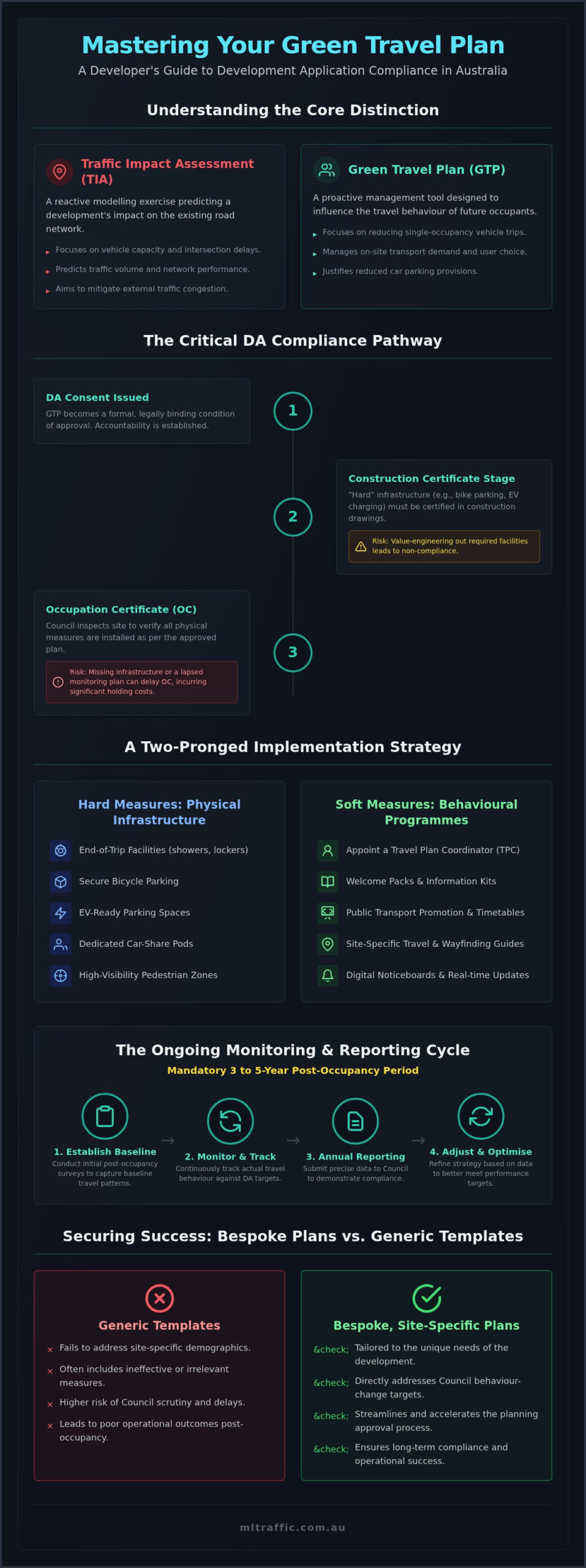
The distinction between these two documents is critical for DA approval. A Traffic Impact Assessment predicts the impact of a development on the existing road network, focusing on intersection delays and lane capacity. The GTP manages that impact. It bridges the gap between predicted vehicle movements and the actual travel behaviour of future occupants. It is a proactive management tool rather than a reactive modelling exercise.
The GTP often supports the findings of a Car Parking Demand Assessment. When a developer proposes a parking provision lower than the statutory requirement, the GTP provides the justification. It demonstrates how the site will remain functional through alternative transport options. Most Australian Councils now require both reports for high-density or complex projects to ensure a holistic approach to urban mobility and site accessibility.
The Legal Weight of Council Conditions
GTP requirements are usually formalised as conditions in the DA consent. These conditions are specifically worded to ensure the developer remains accountable long after the initial approval. Common clauses link the implementation of transport measures to the release of building stages. For example, bicycle parking and end-of-trip facilities must often be certified before a Construction Certificate is issued. This ensures that the physical infrastructure is not value-managed out of the project during the construction phase.
The most significant risk involves the Occupation Certificate (OC). Council officers frequently inspect the site to verify that “hard” infrastructure, such as electric vehicle charging points or bike repair stations, is installed as per the approved plan. If the monitoring schedule is not established or the initial baseline survey is missed, the OC can be delayed. This results in significant holding costs and potential legal disputes. Compliance is not a one-time event; it is an ongoing obligation that requires meticulous documentation and professional oversight to satisfy local government auditors.
Step-by-Step Green Travel Plan Implementation
Effective implementation does not begin when the building is finished. It starts during the design phase to ensure that physical infrastructure is integrated into the site layout before construction commences. A green travel plan for development application is a lifecycle document that evolves from a set of planning promises into a functioning transport strategy. Developers who treat implementation as an afterthought often face expensive retrofitting costs to meet Council conditions prior to the release of an Occupation Certificate.
Appointing a Travel Plan Coordinator (TPC) is typically the first mandatory requirement following DA approval. The Travel Plan Coordinator serves as the central point of contact for Council, building management, and future tenants to ensure all transport objectives are met. This role is responsible for overseeing both the physical rollout of infrastructure and the ongoing behavioural programmes required by the consent conditions.
Hard Measures: Designing for Sustainable Transport
Hard measures refer to the permanent physical infrastructure that supports sustainable travel. These must be detailed in the construction drawings to avoid compliance failures during final inspections. Key elements include end-of-trip facilities such as secure bicycle parking, lockers, and showers that exceed minimum statutory requirements to encourage active commuting. For residential projects, current best practice in many Victorian municipalities suggests that all parking spaces should be electric vehicle ready to future-proof the development.
Parking layouts must maintain strict compliance with AS 2890.1 while prioritising car-share pods and high-visibility pedestrian zones. Effective implementation also includes the installation of digital infrastructure, such as real-time public transport information displays in foyers and clear wayfinding signage. These physical assets provide the foundation upon which behavioural change is built.
Soft Measures: Encouraging Behavioural Change
Soft measures focus on the programmes and information systems that influence how people choose to travel. These are often cheaper to implement than hard infrastructure but require more consistent management. A primary tool is the “Welcome Pack” provided to new residents or commercial tenants. This pack includes local transport maps, cycling route guides, and information on car-pooling schemes. Some developments also offer subsidised public transport trials or bike-share memberships to incentivise the shift away from private vehicle use.
Establishing the digital framework for future monitoring is equally important. This involves setting up automated survey systems and data collection points to track how occupants use the provided facilities. Engaging an expert to design these behavioural programmes ensures they are realistic, cost-effective, and capable of meeting the specific performance targets set by Council.
Establishing a Robust Monitoring Framework
Monitoring is the technical process of verifying that the travel behaviours promised in a green travel plan for development application actually occur post-construction. It is not enough to simply install bike racks; Councils require evidence that these facilities reduce private vehicle dependency. Most Australian local government areas (LGAs) mandate annual monitoring for a period of three to five years after the development is occupied. This requirement is often a formal condition of consent that must be satisfied to maintain compliance.
Key Performance Indicators (KPIs) in these frameworks usually focus on “Modal Shift.” This metric tracks the percentage of users moving from single-occupancy vehicles to sustainable transport options. For instance, a common target is a 10% reduction in car use within the first three years of operation. All data submitted to Council must be defensible and collected using standardised Australian transport planning methodologies. Using non-standardised data collection often results in Council rejecting reports, leading to additional costs and administrative delays.
Data Collection Methods for Developers
Accurate data collection requires a combination of quantitative and qualitative methods. Developers must ensure the chosen technology is reliable and produces data in a format compatible with Council reporting standards. Common methods include:
- Annual travel surveys distributed to residents or employees to capture qualitative shifts and identify barriers to sustainable travel.
- Installation of driveway counters and car park sensors to provide 24/7 tracking of vehicle movements and peak demand periods.
- Monitoring the take-up rate of bicycle parking and end-of-trip facilities through physical inspections or electronic access logs.
Establishing Baseline Data
The first monitoring report, known as the Year 1 report, is the most critical document in the post-DA phase. It establishes the baseline against which all future progress is measured. If the initial baseline differs significantly from the predictions made in the original green travel plan for development application, the strategy may need adjustment. This enables developers to reallocate resources toward measures that are proving more effective for that specific site demographic.
Baseline data must be collected once the site reaches 80% occupancy to ensure the sample size is representative of the development’s full operational impact. Premature data collection often results in skewed results that do not reflect long-term travel patterns. By establishing a rigorous baseline at the correct occupancy threshold, developers can manage Council expectations and avoid penalties for failing to meet unrealistic targets early in the project’s lifecycle.
Annual Reporting and Adjusting Your Strategy
The annual monitoring report is the formal technical document submitted to Council to prove ongoing compliance with your planning permit conditions. It serves as a performance audit that compares the actual travel data collected on-site against the original objectives established in your green travel plan for development application. Submitting these reports according to the agreed schedule is a non-negotiable requirement. Consistent, transparent reporting builds significant professional trust with Council planners, which can streamline the approval process for future traffic engineering projects.
What to Include in a Monitoring Report
A professional monitoring report must provide a clear, data-driven analysis of how the site is performing. It is not enough to simply provide raw survey results; the document must interpret those results in the context of the development’s specific transport goals. Key components of a compliant report include:
- An executive summary of travel mode shares that clearly identifies the percentage of occupants walking, cycling, or using public transport versus those driving.
- A technical analysis of why specific measures succeeded or failed, such as the utilisation rates of secure bike storage or the effectiveness of car-share pods.
- Updated action plans for the following 12-month period, outlining any necessary refinements to the transport strategy.
Dealing with Missed Targets
Missing a specific modal shift target is not an automatic failure of the plan. Council officers generally recognise that travel behaviour is influenced by external factors, including changes to local public transport frequency or regional infrastructure projects. However, if targets are not met, the report must document the effort made and propose remedial measures. This might involve introducing new soft measures, such as additional transport incentives or more frequent communication with tenants to address specific transport gaps.
When targets are consistently missed due to unrealistic initial projections, an experienced traffic consultant can negotiate revised targets with Council planners. This negotiation relies on presenting defensible data that proves the original goals were unattainable despite the developer’s best efforts. Documenting this process correctly prevents Council from issuing non-compliance notices or withholding certificates for subsequent stages of the development.
If you require assistance with data interpretation or Council negotiations, contact our senior principals for help with your annual reporting to ensure your project remains fully compliant.
Why Expert Consultancy is Essential for GTP Compliance
Councils easily identify generic, template-based documents that lack site-specific rigour. A bespoke green travel plan for development application is more likely to be approved because it addresses the unique geographic constraints and transport access of the site. Professional engineers ensure that monitoring data is technically sound and defensible during Council audits. This technical accuracy prevents the bureaucratic delays that often occur when non-standardised data is submitted for review.
ML Traffic Engineers Australia provides continuity of service across the entire development lifecycle. We manage the transition from initial Swept Path Analysis and parking design through to long-term post-occupancy monitoring. This holistic oversight ensures that the transport commitments made at the DA stage are practically achievable and remain compliant throughout the mandatory reporting period. By maintaining a single point of technical accountability, we reduce the risk of non-compliance notices during the occupancy phase.
The Value of Senior-Level Accountability
At ML Traffic Engineers Australia, the principal you meet is the expert who writes your report. We avoid the junior engineer trap common in larger firms where technical work is often delegated to less experienced staff. Direct access to our senior leadership ensures a faster turnaround for urgent Council requests and more effective representation during planning negotiations. This hands-on approach guarantees that the person defending the report has a deep understanding of every technical detail and can provide immediate answers to planning officers.
National Expertise with Local Insight
Navigating the varied requirements of local government authorities across Australia requires a seasoned perspective. We leverage over 15 years of experience to solve complex transport planning hurdles and manage the administrative burden of annual reporting. Our team understands the specific nuances of municipal Environmentally Sustainable Development (ESD) policies and maintains a proven track record of navigating complex Council conditions. Contact our senior principals to discuss your project requirements and ensure your development achieves full compliance.
Securing Long-Term Compliance for Your Development
A green travel plan for development application is a lifecycle document that requires a transition from planning promises to data-driven performance. As we have examined, success relies on the seamless integration of physical infrastructure and behavioural programmes, backed by a robust monitoring framework. Adhering to annual reporting schedules not only satisfies Council conditions but also establishes the professional credibility necessary for future projects. By focusing on defensible data and proactive management, you protect your development from the legal and financial risks of non-compliance.
ML Traffic Engineers Australia offers the technical precision and senior-level accountability required to manage this complex process. With over 15 years of national experience and a proven record of securing DA approvals, we provide the continuity of service needed from initial submission through to final monitoring. Our principals personally oversee every report, ensuring your transport strategy is technically sound and professionally presented. Get a compliant Green Travel Plan for your project today and ensure your development meets all regulatory milestones with confidence. We look forward to delivering a reliable transport solution for your next site.
Frequently Asked Questions
Is a Green Travel Plan mandatory for all Australian developments?
Green Travel Plans are not mandatory for every project; requirements are triggered by specific thresholds set by local government authorities. For example, as of August 2026, the City of Yarra and City of Greater Geelong require a plan for developments with 10 or more dwellings. Other Councils, such as the City of Sydney, use discretionary performance-based approaches for complex sites. Developers must check the specific planning scheme of their relevant municipality to determine if a plan is required.
How much does it cost to monitor a Green Travel Plan annually?
Annual monitoring costs depend on the technical complexity of the data collection methods required by Council. Costs fluctuate based on whether the site uses qualitative resident surveys, physical driveway counters, or electronic car park sensors. Reporting requirements also vary between different local government areas. To ensure accuracy and compliance, developers should obtain a site-specific quote from a qualified traffic engineer who understands the particular monitoring conditions attached to the development consent.
What happens if our development fails to meet its sustainable travel targets?
Failing to meet specific modal shift targets is not an automatic breach of planning conditions, provided the developer documents their implementation efforts. If targets are missed, the annual report must propose remedial measures to address the shortfall. These might include new behavioural programmes or transport incentives. An experienced consultant can negotiate revised targets with Council planners by presenting defensible data that proves the original projections were unattainable despite best-practice efforts.
Can we use a template to create a Green Travel Plan for our DA?
Using a generic template for a green travel plan for development application often leads to rejection by Council planners who require site-specific analysis. Councils expect a bespoke document that considers the unique location, public transport accessibility, and future demographics of the development. A tailored plan ensures that the proposed transport measures are both realistic and cost-effective. Professional engineering oversight is essential to produce a defensible document that secures DA approval without unnecessary delays.
Who is responsible for the ongoing implementation of the GTP?
The developer is ultimately responsible for the ongoing implementation of the plan, though this duty is often delegated to building management post-occupancy. Councils typically mandate the appointment of a Travel Plan Coordinator (TPC) to oversee the strategy. The TPC serves as the primary point of contact for Council auditors and is responsible for distributing welcome packs, managing transport programmes, and coordinating the mandatory annual surveys required to track the project’s progress.
How long does the monitoring phase typically last for a new building?
The monitoring phase typically lasts between three and five years after the development reaches a specific occupancy threshold. Most Councils require the first monitoring report to be submitted once the building is 80% occupied to establish an accurate baseline. If the project consistently meets its sustainable transport targets throughout this period, Council may sign off on the requirement. However, persistent non-compliance or significant deviations from the plan may result in extended monitoring obligations.
Does a Green Travel Plan affect the number of car parks we are allowed to build?
A robust green travel plan for development application can justify a reduction in the number of car parks required by Council. By demonstrating that the site is supported by high-quality sustainable transport measures, developers can argue for a provision lower than the statutory minimum. This is particularly effective when the plan is submitted alongside a Car Parking Demand Assessment, proving that alternative transport modes will sufficiently mitigate the reduced on-site parking capacity.
What are the most effective “soft” measures for a residential development?
Effective soft measures focus on influencing occupant behaviour through information and incentives. Key examples include “Welcome Packs” containing local cycling route maps and public transport timetables provided to every new tenant. Other successful programmes involve subsidised public transport trials, car-pooling schemes, or memberships to local bike-share services. These measures are often more cost-effective than physical infrastructure changes and are essential for meeting the modal shift targets mandated by Australian Council planning conditions.

Disclaimer
The content on www.mltraffic.com.au, including all technical articles, guides, and resources, is provided for general informational and educational purposes only. It is not intended to constitute professional advice in traffic engineering, transportation planning, development approvals, or any other technical or legal field.
While ML Traffic Engineers makes every reasonable effort to ensure the accuracy, completeness, and timeliness of the information published, we do not provide any warranties or representations (express or implied) regarding its reliability, suitability, or availability for any particular purpose. Any reliance you place on the content is strictly at your own risk.
In no event shall ML Traffic Engineers, its directors, employees, authors, or affiliates be liable for any direct, indirect, incidental, special, consequential, or punitive damages (including, without limitation, loss of profits, data, or business opportunities) arising out of or in connection with the use of, or inability to use, any information provided on this website.
The articles and guides on this site are not a substitute for engaging a qualified, registered professional traffic engineer (such as an NPER or RPEQ engineer) to assess your specific project requirements. For tailored advice, compliance assessments, or traffic engineering services, please contact a competent professional.
This disclaimer may be updated from time to time without notice. By accessing or using this website, you agree to be bound by the most current version of this disclaimer.
