

A poorly structured Green Travel Plan is often the single biggest hurdle between your development application and a successful council approval. When you’re preparing a green travel plan for tenants, you likely understand the frustration of ambiguous council requirements and the constant pressure of car parking demands that exceed your site’s physical capacity. Coordinating multiple tenant types only adds another layer of technical complexity to an already bureaucratic process.
This guide provides the exact steps to develop a council-compliant plan that reduces car dependency and secures your DA approval. We’ll examine the essential components of a robust submission, including site audits, travel surveys, and the specific metrics needed to achieve a genuine modal shift. By the end of this article, you’ll know how to align your project with national regulatory standards while improving your ESG credentials, reducing on-site traffic congestion, and demonstrating professional accountability to planning authorities.
Key Takeaways
- Understand how a Green Travel Plan (GTP) facilitates a modal shift from private vehicles to sustainable transport to meet strict council requirements.
- Learn the technical process for preparing a green travel plan for tenants, including baseline transport assessments and the setting of measurable SMART targets.
- Identify the critical differences between hard infrastructure measures and soft organisational policies to tailor your strategy to specific tenant mixes.
- Recognise why engaging a senior traffic engineer is vital for ensuring technical data accuracy and securing fast-tracked development approval.
- Establish long-term compliance through structured monitoring and biennial reporting to prove the ongoing effectiveness of your travel strategy.
Understanding the Role of a Green Travel Plan for Tenants
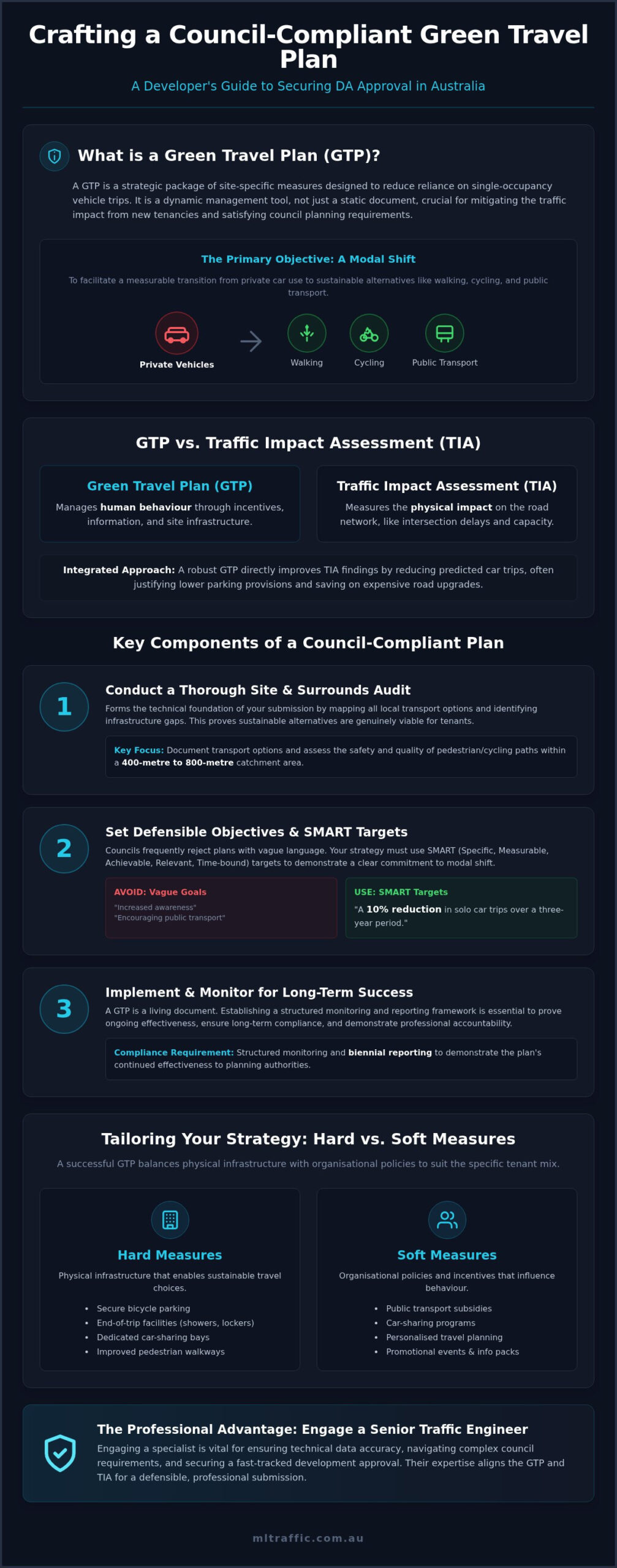
A Travel plan, often referred to as a Green Travel Plan (GTP) in the Australian planning context, is a strategic package of site-specific measures designed to reduce reliance on single-occupancy vehicle trips. When you’re preparing a green travel plan for tenants, the primary objective is to facilitate a “modal shift.” This technical term describes the transition from private car use to sustainable alternatives such as cycling, walking, car-sharing, and public transport. It’s a dynamic management tool rather than a static document, evolving as tenant needs and local infrastructure change.
Local councils across Australia mandate these plans to mitigate the cumulative traffic impact of new tenancies on the surrounding road network. A well-executed GTP does more than satisfy a planning checklist; it serves as a technical justification for developers seeking lower-than-standard car parking provisions. By demonstrating that tenant behaviour will be managed through sustainable initiatives, you can often reduce the physical footprint of on-site parking. This reduction directly lowers construction costs and maximises the useable floor area of the development.
Why Councils Require Tenant-Specific Plans
Councils utilise tenant-specific plans to manage peak-hour congestion in high-density urban centres and sensitive residential areas. These documents align individual developments with broader state-wide sustainable transport targets and net-zero commitments. Without a clear strategy, the influx of commuters or visitors to a new site could overwhelm existing transport infrastructure, leading to local bottlenecks. A GTP ensures that growth is sustainable and that the site remains accessible without exacerbating local traffic issues or reducing the level of service at nearby intersections.
GTP vs. Traffic Impact Assessment (TIA)
While often confused, a GTP and a TIA serve distinct but complementary roles in the planning process. A Traffic Impact Assessment measures the physical impact of a development on the road network, focusing on intersection delays and road capacity. In contrast, the GTP manages human behaviour through incentives, information, and infrastructure.
A robust GTP can directly improve the findings of a TIA. If the travel plan successfully reduces the predicted number of car trips, the TIA may show a reduced need for expensive road upgrades or intersection modifications. For complex DA submissions, these two documents must be prepared in tandem. This integrated approach ensures that the technical data in the TIA aligns with the behavioural targets set in the GTP, providing a defensible case to council planners and senior decision-makers.
Key Components of a Compliant Tenant Travel Strategy
A council-compliant strategy requires a structured approach to data collection and target setting. When preparing a green travel plan for tenants, you must move beyond generic suggestions and provide a site-specific evidence base. This ensures the plan is defensible during the development application (DA) stage and provides a clear roadmap for future site management. Every compliant plan must integrate a baseline assessment, measurable targets, and a clear chain of responsibility.
Conducting a Thorough Site and Surrounds Audit
You must map all local transport options within a specific catchment area, typically a 400-metre to 800-metre radius. This includes documenting bus, train, and light rail frequencies alongside safe walking distances. Don’t just list nearby stations; assess the safety and quality of pedestrian and cycling paths. Identifying infrastructure gaps, such as poorly lit walkways or a lack of secure bicycle parking, allows the plan to address real-world barriers to sustainable travel. This audit forms the technical foundation of your submission, proving that sustainable alternatives are viable for the specific tenant mix.
Setting Defensible Objectives and Targets
Councils frequently reject plans that use vague language like “increased awareness” or “encouraging public transport.” Instead, your strategy must use SMART (Specific, Measurable, Achievable, Relevant, and Time-bound) targets. A common example is a “10% reduction in solo car trips over a three-year period.” This methodology aligns with established international standards, such as the UK Government Guidance on Travel Plans, which emphasises robust monitoring and clear principles for sustainable development.
Use Australian Census data and local transport surveys to set these goals. It’s essential to align targets with the specific use-class of the tenant. A warehouse tenant with 24-hour shift patterns has different transport needs compared to a commercial office located in a metropolitan centre. If your project involves these complex tenant mixes, our traffic planning services provide the technical data and modelling required for a compliant submission.
Implementation and Personnel Roles
A compliant strategy balances “hard” measures, such as physical infrastructure like end-of-trip facilities and lockers, with “soft” measures. Soft measures focus on organisational policy, such as transit subsidies, flexible working hours, or car-pooling apps. Finally, the plan must designate a Travel Plan Co-ordinator. This individual, often the property manager or a senior tenant representative, is responsible for day-to-day implementation. They act as the primary point of contact for the council and oversee the annual or biennial monitoring reports required to prove the plan’s ongoing effectiveness.
Hard vs. Soft Measures: Tailoring Initiatives to Your Tenant Mix
Effective compliance requires a dual-pronged approach to transport management. Hard measures are the physical assets and infrastructure integrated into a development’s design. Soft measures are the management-led initiatives and organisational policies that influence how people choose to travel. When you’re preparing a green travel plan for tenants, combining these two categories is essential to remove both physical and psychological barriers to sustainable transport. Councils expect a balanced mix that reflects the site’s unique constraints and the specific needs of its occupants.
Physical Infrastructure (Hard Measures)
Hard measures provide the physical capacity for behavioural change. Secure, weather-protected bicycle parking is a foundational requirement for most modern developments. However, high-quality “End-of-Trip” (EoT) facilities, including showers, lockers, and change rooms, are what truly enable a modal shift for commuters. Integrating EV charging stations within the car park design ensures the development meets evolving national regulatory standards and tenant expectations. Additionally, improved wayfinding signage throughout the site enhances permeability for pedestrians and cyclists, making sustainable routes the most obvious choice.
Behavioural Initiatives (Soft Measures)
Soft measures address the human element of transport. “Travel Welcome Packs” are a cost-effective way to provide new tenants and staff with immediate information on local transit frequencies and cycling routes. Financial incentives, such as subsidised public transport passes or carpooling matching schemes, directly target the cost-benefit analysis of the daily commute. Implementing flexible working hours or staggered start times can also be a powerful tool to avoid peak-period traffic congestion, reducing the immediate load on the surrounding road network as identified in your Traffic Impact Assessment.
Tailoring Strategies to Industry Sectors
A generic strategy often results in council requests for further information, which delays your development approval. You must tailor your initiatives to the specific use-class of the site. Commercial office tenants prioritise EoT facilities and proximity to high-frequency transit. Industrial tenants, such as warehouse operators with shift-based workforces, often find carpooling schemes or private shuttle buses more effective than cycling incentives. Residential developments should focus on car-share pods and high-density, secure bicycle storage. By matching the measures to the tenant profile, you demonstrate to the council that the plan is both realistic and achievable.
Step-by-Step: How to Prepare a Robust Plan for Council Approval
Securing council approval requires a methodical approach to documentation and technical data. When you’re preparing a green travel plan for tenants, you must engage a qualified traffic engineer early in the process to oversee the technical data and ensure compliance with national regulatory standards. This professional oversight ensures that the plan remains defensible during the assessment phase. The drafting process involves three distinct phases: consultation, implementation scheduling, and regulatory cross-referencing.
Consultation and Data Collection
Effective plans are built on site-specific evidence. You must distribute travel surveys to prospective or existing tenants to identify current commuting patterns and the primary reasons for car dependency. This data allows you to define the “modal split,” which refers to the percentage of travellers using a particular mode of transport, such as public transit versus private vehicle use, based on current Australian travel data. Analysing these results ensures your proposed measures address actual barriers rather than perceived ones, making the plan more likely to achieve its targets.
Drafting the Implementation Schedule
Your GTP must include a clear timeline for when each measure will be introduced. It’s essential to distinguish between pre-occupation measures, such as the installation of end-of-trip facilities, and post-occupation initiatives like bike maintenance workshops or transit subsidies. You must also identify the “Travel Plan Co-ordinator” (TPC) and outline their specific reporting duties. This schedule should include a dedicated budget for ongoing programmes to ensure the plan remains a functional management tool rather than a static submission. Most councils require this schedule to be submitted as part of the DA or as a condition-clearing document before an Occupation Certificate is issued.
Ensuring Regulatory Compliance
Every GTP must align with broader planning frameworks to be considered valid. You must cross-reference your document with relevant Australian Standards for parking and access to ensure physical infrastructure is compliant with national requirements. You must also check for alignment with the local council’s Integrated Transport Strategy to verify that your modal shift targets are consistent with regional goals. If your submission lacks this technical rigour, it will likely face delays during the assessment phase. Contact our expert traffic engineers today to ensure your plan meets all regulatory requirements and secures your development approval without unnecessary bureaucracy.
Implementation and Monitoring: Ensuring Long-term Plan Success
Councils typically mandate monitoring reports on an annual or biennial basis to ensure the strategy remains operational. When you’re preparing a green travel plan for tenants, you must view the document as a living management tool rather than a one-off submission. Monitoring involves conducting repeat travel surveys to track actual commuter behaviour against the original SMART targets established during the DA phase. This data-driven approach allows you to prove the effectiveness of the plan and maintain compliance with your development consent conditions.
Continuous improvement is a core requirement of national transport planning standards. If your data shows that certain initiatives aren’t achieving the desired modal shift, the plan must be updated to reflect current site conditions. Transparent reporting builds significant trust with local planning authorities. This professional relationship can often assist in streamlining future DA applications for the same site or across your broader property portfolio.
The Role of the Travel Plan Co-ordinator
The Travel Plan Co-ordinator (TPC) is the individual responsible for the day-to-day execution of the strategy. They serve as the primary point of contact for tenants regarding transport issues and coordinate the delivery of soft measures. Key duties include organising promotional events, such as “Ride to Work Day,” to encourage participation in sustainable travel. The TPC also maintains the Travel Information Hub, whether as a physical noticeboard in a common area or a digital portal on the tenant intranet. This hub provides real-time data on local transit frequencies and cycling infrastructure.
What to Do if Targets are Missed
Missing a modal shift target does not necessarily mean the plan has failed, but it does require immediate technical analysis. You must identify why specific measures didn’t perform as expected. For instance, if cycling uptake is low, you might discover that the location of bike racks is inconvenient or perceived as insecure. Identifying these friction points allows you to introduce secondary contingency measures to get the plan back on track.
If targets are consistently missed, you should engage a traffic consultant to refine the strategy for the next reporting period. We can help you re-evaluate your baseline data and adjust your soft measures to better suit the evolving needs of your tenants. This proactive approach demonstrates to the council that you are committed to the long-term success of the development’s transport strategy and are taking accountable steps to mitigate local traffic impacts.
Securing Your Development Approval with a Defensible Strategy
A Green Travel Plan is a mandatory requirement for modern Australian developments seeking to mitigate traffic impacts and justify parking reductions. Success depends on the integration of site-specific data, measurable SMART targets, and a balanced mix of physical infrastructure and behavioural initiatives. When you’re preparing a green travel plan for tenants that aligns with national regulatory standards, you ensure your project remains viable and compliant throughout its operational life.
Continuous monitoring and professional oversight are essential to prove the effectiveness of these strategies to local councils. ML Traffic Engineers Australia provides expert traffic reports for council approval with national coverage across all Australian states. Every assessment benefits from direct principal involvement, ensuring your submission is technically robust and professionally defended. This hands-on approach removes the uncertainty of the planning process and provides a clear path to project commencement.
Secure your DA approval with a compliant Green Travel Plan from ML Traffic Engineers Australia. Taking these proactive steps now will streamline your planning process and deliver long-term operational efficiency for your site.
Frequently Asked Questions
Is a Green Travel Plan mandatory for all developments in Australia?
A Green Travel Plan is not universally mandatory for every Australian development. However, local councils frequently require one for projects expected to generate significant traffic or for those located in high-density urban centres. It is also a critical requirement if you are seeking a car parking dispensation. You should consult the specific Development Control Plan (DCP) for your local government area to confirm if a submission is necessary for your DA.
How much does it cost to prepare a Green Travel Plan for tenants?
The cost of preparing a green travel plan for tenants depends on the size of the development, the number of tenants, and the complexity of the required transport audits. Larger commercial or mixed-use sites require more detailed baseline data and extensive consultation. While we don’t provide fixed pricing without a site assessment, engaging a senior traffic engineer ensures the document is technically robust, which reduces the risk of costly council delays or requests for further information.
Can a Green Travel Plan help me reduce the number of required car parks?
Yes, a well-prepared GTP is a primary tool for justifying lower-than-standard car parking provisions. By demonstrating that sustainable transport initiatives will effectively reduce private vehicle demand, you can provide a technical case for council to approve a reduction in on-site spaces. This approach is particularly effective when supported by a Car Parking Demand Assessment, as it proves that the site’s transport needs are being managed through documented behavioural change strategies.
What happens if our tenants don’t meet the travel targets in the plan?
Missing targets does not immediately result in penalties, but it does require a proactive response. If your monitoring reports show that modal shift goals are not being met, you must analyse the failure points and introduce secondary contingency measures. This might include increasing subsidies for public transport or improving on-site cycling facilities. Councils generally look for a commitment to continuous improvement and will require you to update the plan to ensure it remains functional.
Who is responsible for managing the Green Travel Plan once the building is occupied?
The responsibility for day-to-day management lies with the designated Travel Plan Co-ordinator (TPC). This role is frequently filled by the property manager or a senior representative from the lead tenant organisation. The TPC is responsible for distributing travel information, organising promotional transport events, and serving as the official point of contact for the council. They also oversee the collection of data required for the periodic monitoring reports specified in the development consent conditions.
How often do we need to submit monitoring reports to the local council?
Monitoring requirements vary, but most councils mandate reports on an annual or biennial basis. This reporting period typically lasts for a minimum of five years post-occupation to ensure that sustainable travel habits become established. Each report must include fresh survey data to track progress against the original SMART targets. Failure to submit these reports can result in non-compliance with your DA conditions, which may complicate future planning applications for the site.
Can we use a generic template for our Green Travel Plan?
You cannot use a generic template to secure a compliant council approval. Every development has unique transport constraints, local infrastructure access, and tenant profiles that must be addressed through site-specific audits. A template lacks the technical rigour required by planning authorities and often leads to significant delays. Preparing a green travel plan for tenants requires a bespoke approach that integrates actual pedestrian network analysis and local transit frequencies to be considered defensible.
What is the difference between a GTP and a Workplace Travel Plan?
The difference is primarily one of terminology and scope. A Green Travel Plan is the broader term used in the planning process to describe the overall transport strategy for a development. In some Australian jurisdictions, a Workplace Travel Plan refers specifically to a strategy tailored for a single employer and their staff. While the core objectives of reducing car dependency remain the same, a GTP often coordinates multiple tenant types and residential components within a single mixed-use development.

Disclaimer
The content on www.mltraffic.com.au, including all technical articles, guides, and resources, is provided for general informational and educational purposes only. It is not intended to constitute professional advice in traffic engineering, transportation planning, development approvals, or any other technical or legal field.
While ML Traffic Engineers makes every reasonable effort to ensure the accuracy, completeness, and timeliness of the information published, we do not provide any warranties or representations (express or implied) regarding its reliability, suitability, or availability for any particular purpose. Any reliance you place on the content is strictly at your own risk.
In no event shall ML Traffic Engineers, its directors, employees, authors, or affiliates be liable for any direct, indirect, incidental, special, consequential, or punitive damages (including, without limitation, loss of profits, data, or business opportunities) arising out of or in connection with the use of, or inability to use, any information provided on this website.
The articles and guides on this site are not a substitute for engaging a qualified, registered professional traffic engineer (such as an NPER or RPEQ engineer) to assess your specific project requirements. For tailored advice, compliance assessments, or traffic engineering services, please contact a competent professional.
This disclaimer may be updated from time to time without notice. By accessing or using this website, you agree to be bound by the most current version of this disclaimer.
