
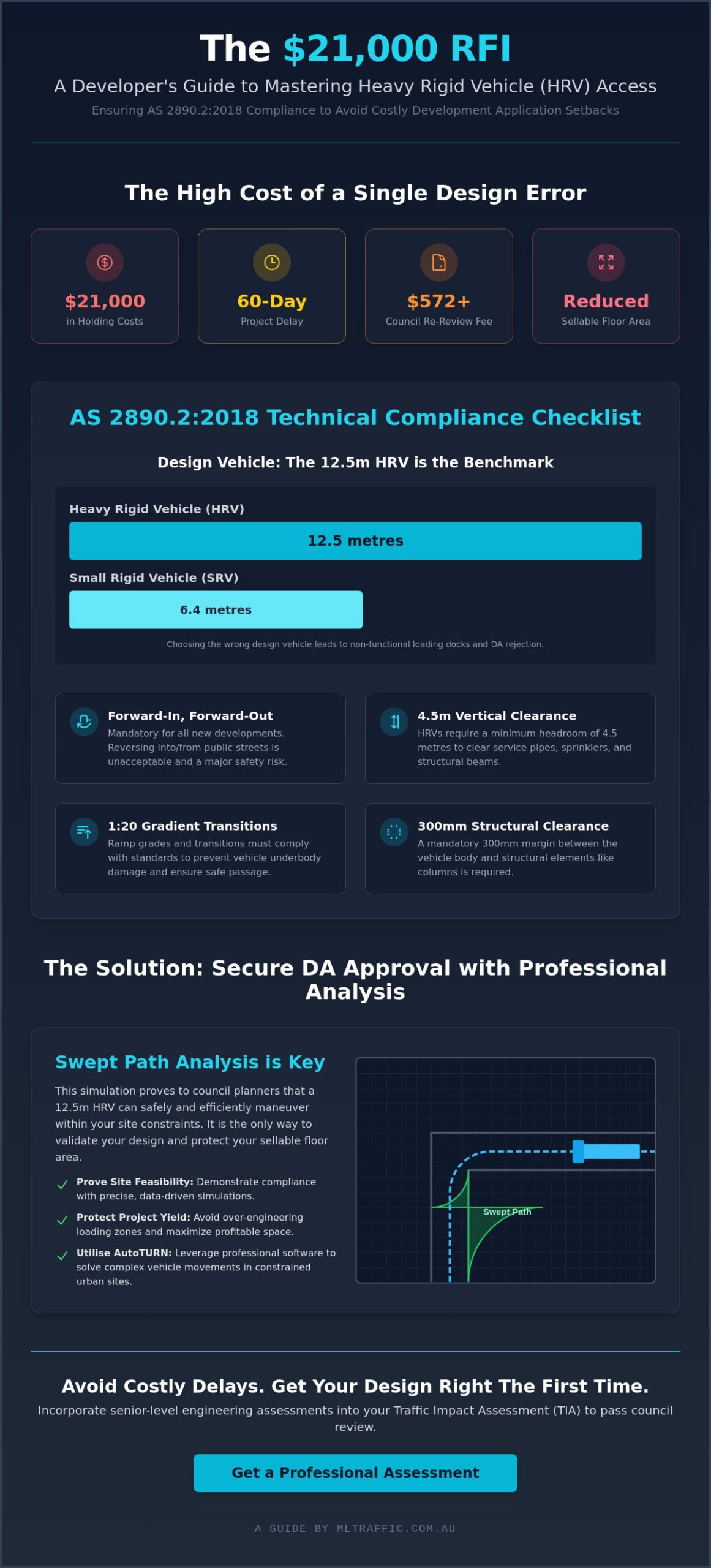
Is a single Request for Further Information (RFI) worth $21,000 in holding costs and a 60-day project delay? In 2026, developers frequently face these setbacks when Heavy Rigid Vehicle (HRV) Access designs fail to meet the strict technical standards of AS 2890.2:2018. Beyond the time lost, a non-compliant traffic design often triggers a $572 re-review fee and forces a late-stage redesign that eats into your sellable floor area.
We understand that every square metre of your site is valuable. You shouldn’t have to over-engineer loading zones or sacrifice yield just to satisfy council requirements for a 12.5-metre turning radius. This guide provides the technical clarity needed to master AS 2890.2 compliance and use precise Swept Path Analysis to secure DA approval on your first submission. We will examine the mandatory forward-entry requirements, specific HRV dimensions, and the documentation strategies that protect your project’s profitability while meeting all regulatory benchmarks.
Key Takeaways
- Identify the 12.5-metre Heavy Rigid Vehicle (HRV) Access benchmark and its mandatory application under the AS 2890.2:2018 standard.
- Utilise Swept Path Analysis to prove site feasibility to council planners while protecting your development’s sellable floor area.
- Apply the 4.5-metre vertical clearance rule and 1:20 ramp gradient transitions to ensure functional and compliant loading dock operations.
- Leverage professional AutoTURN simulations to resolve complex vehicle maneuvering requirements in constrained urban sites.
- Incorporate senior-level engineering assessments into your Traffic Impact Assessment (TIA) to avoid expensive RFIs and project delays.
Defining Heavy Rigid Vehicle (HRV) Access Requirements
In Australian traffic engineering, defining Heavy Rigid Vehicle (HRV) Access involves more than understanding a truck’s weight or axle count. It’s a precise geometric calculation based on the 12.5-metre design vehicle specified in AS 2890.2. Unlike smaller delivery vans, an HRV requires significant space to complete a maneuver safely. Achieving compliance starts with understanding the vehicle’s turning radius. If the site geometry doesn’t account for the swept path of a 12.5-metre truck, the development application will likely face an immediate RFI. These vehicles are the standard for retail logistics, waste collection compactor trucks, and fire appliance access.
Council planners in 2026 prioritize site designs that facilitate “forward-in, forward-out” movements. Reversing into a public street is no longer an acceptable design solution for new developments. If a design vehicle cannot exit the site in a forward direction, the DA is likely to be refused. This policy aims to minimize the risk of collisions with pedestrians and cyclists in increasingly dense urban environments. Professional traffic engineering services ensure these requirements are met during the initial design phase.
To better understand the technical principles behind these vehicle movements, watch this helpful video:
HRV vs SRV: Why Vehicle Classification Matters
Choosing the wrong design vehicle can lead to wasted floor space or a non-functional loading dock. A Small Rigid Vehicle (SRV) is typically 6.4 metres long. In contrast, a Heavy Rigid Vehicle (HRV) measures 12.5 metres. The difference isn’t just length. It’s also about vertical clearance and bay width. An HRV requires a minimum of 4.5 metres of headroom to clear service pipes, sprinklers, and structural beams. If your development expects major retail deliveries or requires on-site waste collection via a heavy compactor, you must design for the HRV. Designing for an SRV when an HRV is required results in a loading dock that standard logistics providers can’t use.
The 12.5m Design Vehicle Standard
The 12.5-metre HRV is the industry benchmark because it represents the largest rigid truck allowed on most urban roads without special permits. AS 2890.2 provides the exact wheelbases and overhangs for this vehicle. Developers often make the mistake of “eyeballing” a layout, assuming a truck can “just make the turn.” This guesswork is a primary cause of DA rejection. The 12.5-metre HRV serves as the critical design threshold for commercial loading docks and remains the standard for all compliant site access assessments. Using specialized software to simulate these movements is the only way to prove to council that your site functions as intended without compromising yield.
Technical Compliance with AS 2890.2:2026 Standards
AS 2890.2 sets the geometric requirements for all off-street commercial vehicle facilities. In 2026, successful Heavy Rigid Vehicle (HRV) Access relies on a strict technical distinction between the design vehicle and the check vehicle. The design vehicle is the standard 12.5-metre HRV that must maneuver through the site with ease. The check vehicle is a larger model used to ensure the site’s structural elements aren’t at risk during occasional, tighter movements. Most DA rejections occur because developers design for the absolute minimum without providing the mandatory 300mm clearance margin between the vehicle body and structural columns.
Council planners now mandate “Forward Entry, Forward Exit” for almost all new developments. Reversing from a public street into a site, or vice versa, creates unacceptable safety risks. If your swept path analysis shows a vehicle crossing the center line of a public road or requiring multiple shunts while blocking traffic, the council will likely issue an RFI. Achieving a compliant flow requires an integrated approach to site layout from the earliest architectural stages. You can speak with our senior engineers to review your preliminary site plan before it reaches the council.
Turning Radii and Swept Path Widths
Inner and outer turning circles aren’t static numbers. They vary based on the steering lock and the speed of the vehicle. For most basement and loading dock assessments, we use a crawling speed of 5km/h. This speed requires a wider swept path than a vehicle moving faster because the driver uses more of the steering lock. We utilize Austroads design vehicle templates to verify these paths. You must account for the front and rear overhang. During a tight turn, the body of the HRV will swing wider than the wheel tracks. Failure to map this overhang leads to vehicles clipping structural columns or fire sprinklers.
Service Area and Loading Bay Geometry
A standard HRV loading bay requires a minimum width of 3.5 metres, though 4.0 metres is preferred for operational efficiency. The apron area, where the truck maneuvers into the bay, is often the most space-consuming part of the design. For a 90-degree dock entry, the maneuvering space must accommodate the full 12.5-metre length plus the turning arc. If your site mixes service vehicles with residential or visitor parking, you must also ensure the layout complies with AS 2890.1. Combining these two standards is complex. It requires precise coordination to ensure a waste truck doesn’t block car park access or create blind spots for pedestrians.
The Role of Swept Path Analysis in HRV Access Approval
Swept Path Analysis (SPA) is the technical language of council planners. It’s a computer-generated simulation that maps the horizontal and vertical envelope of a vehicle as it moves through a site. For any development requiring Heavy Rigid Vehicle (HRV) Access, a professional SPA is the only way to prove that a 12.5-metre truck can maneuver without striking structural elements or crossing into opposing traffic lanes. Verbal assurances or simple geometric drawings won’t suffice; planners require the precise “envelopes” that show the wheel paths and the body swing of the design vehicle.
A professional report distinguishes between “Design” paths and “Check” paths. Design paths represent the standard, comfortable maneuver a driver makes at a crawling speed of 5km/h. Check paths simulate the absolute limits of the vehicle’s steering lock to ensure structural safety in extreme scenarios. By mapping these paths accurately, engineers identify “dead zones” in your site plan. These are areas the truck never enters, which can often be reclaimed for additional car parking bays or storage units, directly increasing your site’s yield.
AutoTURN Simulations for Accurate Planning
Our engineers use specialized software like AutoTURN to model specific HRV steering characteristics. We account for variables like the steering lock angle and the “lock-to-lock” time, which is typically 6 seconds for a standard heavy vehicle. This level of detail is critical for basement designs where columns and tight corners create high-risk zones. While 2D diagrams are standard, 3D swept path simulations are necessary for sites with complex ramp gradients to ensure the vehicle’s underside doesn’t “bottom out” or its roof doesn’t clip overhead services. Swept Path Analysis serves as the definitive evidence for council DA approval.
Common SPA Failures and How to Fix Them
The most frequent failures in DA submissions are “wheel clips” and “body scrapes.” A wheel clip occurs when the simulation shows a tyre hitting a kerb or island. A body scrape happens when the vehicle’s front or rear overhang swings into a wall or pillar. We resolve these issues by strategically adjusting pillar placement or widening driveway entries based on the simulation data. It’s much more cost-effective to move a column on a digital plan than to rectify a structural conflict during construction. For a deeper look at these technical requirements, read our Swept Path Analysis Guide. Integrating this analysis early allows you to maximize sellable area while maintaining full compliance with AS 2890.2.
Critical Design Factors: Headroom, Gradients, and Transitions
Achieving compliant Heavy Rigid Vehicle (HRV) Access requires a detailed assessment of vertical and longitudinal site geometry. While horizontal swept paths are the primary focus of council planners, vertical failures are often more costly to rectify post-construction. A standard 12.5-metre HRV requires a minimum vertical clearance of 4.5 metres throughout its entire travel path. This is a non-negotiable requirement under AS 2890.2. Vertical constraints don’t just include the ceiling height; they encompass every protruding element from fire sprinklers to overhead signage and service pipes.
Sight distance at the driveway interface is equally vital for DA approval. For a road with a 60km/h speed limit, an HRV exiting a site requires specific sight lines to ensure the driver can see approaching traffic and pedestrians clearly. Inadequate sight distance is a common reason for DA refusal in 2026, particularly in high-density urban areas where street furniture or landscaping often blocks the driver’s view. Our experts provide professional Driveway Ramp Grade Design to ensure your site meets these technical benchmarks before submission.
Vertical Clearance and Headroom Design
Architectural plans frequently show the slab-to-slab height but overlook the impact of overhead mechanical services. Fire sprinklers, ventilation ducts, and cable trays can easily reduce effective headroom by 600mm or more. When determining the lowest point in a basement loading dock, you must account for the vehicle’s suspension travel and any potential bouncing on ramps. AS 2890.2 mandates clear height warnings and overhead signage at all entries where clearance is less than the standard requirement. If the effective clearance falls below 4.5 metres, your site will be restricted to smaller, less efficient delivery vehicles.
Ramp Grades and Transition Zones
The maximum allowable grade for a heavy vehicle ramp is significantly stricter than for passenger cars. While AS 2890.1 allows steeper grades for cars, an HRV ramp should generally not exceed 1:6.5 (15.4%) for short distances. The transition zone is where most designs fail. A 1:20 transition is the industry limit to prevent the truck’s chassis from “grounding” or “bottom out” on the crest of a ramp. Calculating the breakover angle for a 12.5-metre HRV is a technical necessity. If the vertical curve is too sharp, the long wheelbase of the truck will cause the undercarriage to scrape the concrete, leading to structural damage and operational failure.
Securing Your DA with Professional Traffic Engineering
Securing DA approval for projects involving Heavy Rigid Vehicle (HRV) Access requires more than technical drawings. It requires a report that councils trust. While AS 2890.2:2018 provides the national framework, local councils often apply their own Development Control Plans (DCPs) which add layers of complexity. These local variations might include specific requirements for loading bay screening, noise mitigation, or restricted delivery hours that aren’t found in the national standards. A senior traffic engineer identifies these nuances before they become a reason for refusal.
Council planners prioritize reports backed by significant industry experience. Our principals, Michael Lee and Benny Chen, each bring between 30 and 40 years of expertise to every project. This seniority ensures that the technical justifications provided in your application are robust enough to withstand intense scrutiny. When a council officer sees a report from a seasoned professional, it reduces the likelihood of a Request for Further Information (RFI). An RFI regarding truck movements can stall a project for 30 to 60 days, adding thousands in holding costs.
Our operational philosophy is direct. The traffic consultant who provides the quote, does the work. This eliminates the communication gaps often found in larger firms where junior staff handle the technical modeling while senior staff only sign the cover page. By having a senior engineer perform the Swept Path Analysis and draft the TIA, we ensure every maneuver is yield-optimized and technically sound. We have successfully assessed over 10,000 sites, ranging from residential apartments to complex industrial warehouses.
The Traffic Impact Assessment (TIA) Process
Integrating HRV maneuvers into a comprehensive Traffic Impact Assessment Guide ensures that service vehicle movements don’t conflict with car parking demand or pedestrian safety. We certify that your site plans comply with all relevant Australian Standards, including AS 2890.1 and AS 2890.2. This holistic approach prevents late-stage redesigns that occur when loading docks are designed in isolation from the rest of the site’s traffic flow. Our reports provide the definitive evidence needed to prove your site is functional and safe.
Next Steps for Your Development Application
To begin the assessment, we require your current architectural site plans and basement layouts. We will then provide a quote for a professional Vehicle Swept Path Analysis and any necessary TIA reporting. Our focus is private clients who need reliable results for their development applications. You can Contact Michael Lee or Benny Chen directly for a technical consultation to discuss your project’s specific requirements and secure your DA approval without compromising your site’s leasable floor area.
Secure Your DA Approval with Technical Precision
Compliance with AS 2890.2:2018 is a technical necessity that directly impacts your project’s yield. Successful Heavy Rigid Vehicle (HRV) Access relies on precise Swept Path Analysis and strict adherence to 4.5-metre vertical clearances. By addressing these factors during the initial design phase, you avoid the $572 re-review fees and $3,500 weekly holding costs associated with council RFIs. A yield-optimised layout doesn’t just satisfy planners; it ensures your loading docks remain functional for the life of the development.
ML Traffic Engineers Australia brings over 15 years of operational history and a track record of assessing more than 10,000 sites nationally. You deal directly with senior RPEQ and accredited engineers who understand the technicalities of transport planning. We operate on a simple principle: the consultant who provides your quote is the expert who performs the work. This level of accountability ensures your Traffic Impact Assessment is accurate and defensible before any council committee.
Get a professional Traffic Impact Assessment for your project to move forward with confidence. We’re ready to help you navigate the approval process efficiently and secure your site’s future.
Frequently Asked Questions
What is the standard length of a Heavy Rigid Vehicle (HRV) for design purposes?
The standard design length for an HRV is 12.5 metres as specified in AS 2890.2:2018. This dimension represents the largest rigid truck typically operating on urban roads without special permits. Designers must also account for a 2.5-metre width and a 12.5-metre turning radius. Accuracy is vital here because even a 100mm error in plan can lead to structural conflicts during construction.
Is a Swept Path Analysis mandatory for all commercial development applications?
Swept Path Analysis is mandatory for any commercial DA where service vehicles are expected to maneuver. Council planners use these simulations to verify that the design vehicle can navigate the site boundaries without striking obstacles or structural elements. It’s the only way to prove your layout works before you commit to construction. Our reports provide these precise geometric proofs to ensure your submission meets regulatory expectations.
What is the minimum vertical clearance required for an HRV loading dock?
The minimum vertical clearance for an HRV travel path is 4.5 metres. This height must be clear of all obstructions, including fire sprinklers, cable trays, and overhead signage. Architectural drawings often overlook these mechanical services, which can reduce effective headroom by 500mm or more. Ensuring this clearance is maintained throughout the loading dock is a non-negotiable requirement for AS 2890.2 compliance in 2026.
Can an HRV reverse into a development from a public road?
Reversing into a site from a public road is generally prohibited by local councils. The “Forward In, Forward Out” rule is strictly enforced to protect pedestrians and maintain traffic flow. If your site plan relies on a vehicle reversing from the street, the council will likely issue an RFI or refuse the application. A compliant design must allow for all maneuvers to happen entirely within the site boundaries.
How do AS 2890.2 standards differ for HRVs compared to smaller delivery vans?
AS 2890.2 applies much larger geometric envelopes to HRVs than to Small Rigid Vehicles (SRVs). An SRV only requires a 6.4-metre length and lower vertical clearance. Designing for an HRV requires accommodating a 12.5-metre length and a significantly wider turning arc. These differences impact everything from the driveway width to the size of the loading bay apron and the placement of structural columns in a basement.
What happens if my site cannot accommodate a full 12.5m HRV turning circle?
If your site layout cannot accommodate a standard turning circle, you must redesign or risk DA refusal. Council planners rarely approve deviations for Heavy Rigid Vehicle (HRV) Access because these vehicles are essential for waste collection and logistics. We use Swept Path Analysis to identify “dead zones” in your plan, allowing you to reposition columns and reclaim floor area without losing compliance or site yield.
How do ramp gradients affect HRV access in basement loading areas?
Ramp gradients directly impact the breakover angle and the risk of the vehicle undercarriage grounding. AS 2890.2 specifies that transitions should not exceed 1:20 to prevent long-wheelbase trucks from bottoming out at the crest or base. Steeper ramps also require more horizontal space for the vehicle to regain stability before entering a bay. We certify these transitions to ensure functional access in constrained basement environments.
Does council accept AutoTURN simulations as proof of vehicle access?
AutoTURN simulations are the industry standard for proving vehicle access to council planners. When prepared by an experienced traffic engineer, these simulations provide the definitive proof required for DA approval. They map the wheel paths and body swing of the vehicle with precision. This documentation gives council officers the confidence that your development functions safely and meets all relevant Australian Standards during every maneuver.

Disclaimer
The content on www.mltraffic.com.au, including all technical articles, guides, and resources, is provided for general informational and educational purposes only. It is not intended to constitute professional advice in traffic engineering, transportation planning, development approvals, or any other technical or legal field.
While ML Traffic Engineers makes every reasonable effort to ensure the accuracy, completeness, and timeliness of the information published, we do not provide any warranties or representations (express or implied) regarding its reliability, suitability, or availability for any particular purpose. Any reliance you place on the content is strictly at your own risk.
In no event shall ML Traffic Engineers, its directors, employees, authors, or affiliates be liable for any direct, indirect, incidental, special, consequential, or punitive damages (including, without limitation, loss of profits, data, or business opportunities) arising out of or in connection with the use of, or inability to use, any information provided on this website.
The articles and guides on this site are not a substitute for engaging a qualified, registered professional traffic engineer (such as an NPER or RPEQ engineer) to assess your specific project requirements. For tailored advice, compliance assessments, or traffic engineering services, please contact a competent professional.
This disclaimer may be updated from time to time without notice. By accessing or using this website, you agree to be bound by the most current version of this disclaimer.
