
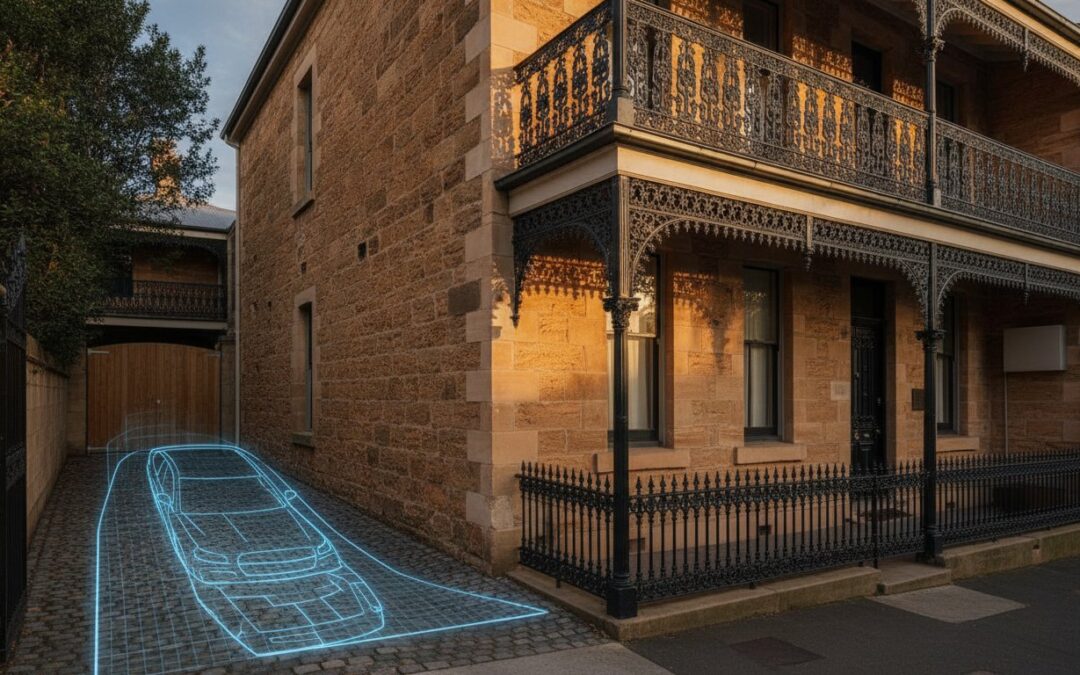
A Council refusal based on non-compliant driveway widths or insufficient parking often feels like a death knell for heritage development projects. You’re frequently caught in a standoff between rigid modern engineering standards and the non-negotiable preservation of historical fabric. Successfully balancing heritage constraints with traffic safety is difficult when standard traffic solutions don’t fit into a narrow 19th-century access point without destroying the very character you’re trying to save.
This guide provides a clear pathway to securing DA approval by using evidence-based traffic engineering to satisfy Council requirements while protecting historical assets. We’ll examine how tools like Vehicle Swept Path Analysis and specialised Car Parking Demand Assessments allow for non-standard designs that don’t compromise on safety. By leveraging over 15 years of technical expertise and senior-led consultancy, you can move past bureaucratic roadblocks and achieve a successful integration of modern infrastructure and heritage preservation.
Key Takeaways
- Identify the specific technical conflicts between Australian Standards (AS 2890.1) and historical site layouts to streamline the Council approval process.
- Master the methodology for balancing heritage constraints with traffic safety by providing evidence-based justifications for non-compliant driveway and parking designs.
- Utilise Vehicle Swept Path Analysis and AutoTURN simulations to demonstrate that modern safety requirements can be met without damaging original heritage fabric.
- Ensure your Traffic Impact Assessment (TIA) and Statement of Heritage Impact (SOHI) work in tandem to provide a robust, unified narrative for your DA submission.
- Leverage senior-led engineering expertise to navigate the complex regulatory environment and protect the financial viability of heritage-listed developments.
The Core Conflict: Heritage Preservation vs Australian Traffic Standards
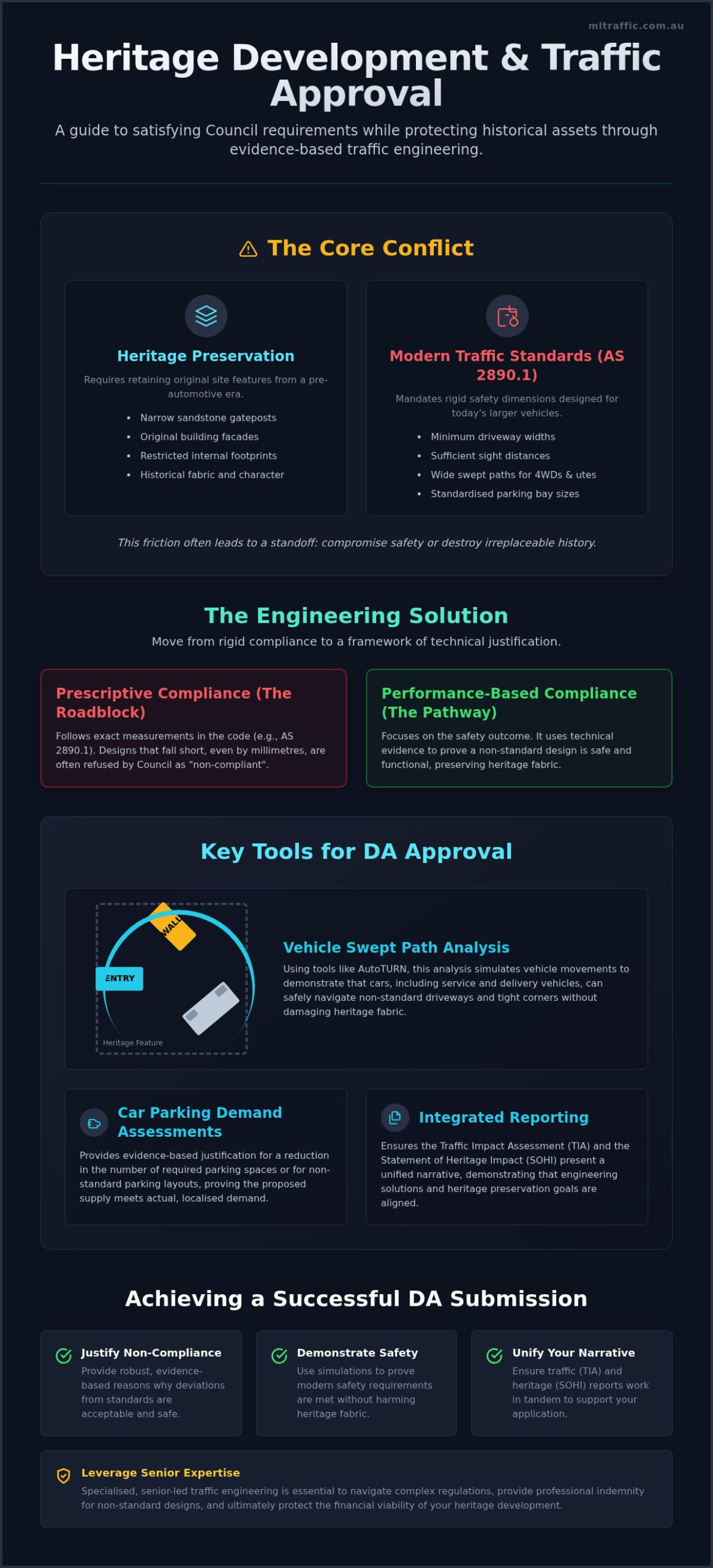
Modern development on historical sites creates an immediate friction between statutory safety requirements and the protection of cultural assets. Historical site layouts reflect an era of horse-drawn transport or significantly smaller motor vehicles; they don’t naturally accommodate the dimensions of modern SUVs or delivery vans. Local Councils use Australian Standards, specifically AS 2890.1 for off-street car parking, as the non-negotiable benchmark for safety assessments.
Adhering to heritage preservation principles often means retaining original features like narrow sandstone gateposts, original facades, or restricted internal footprints. These elements are frequently at odds with the minimum driveway widths and sight distance requirements mandated by current codes. Successfully balancing heritage constraints with traffic safety requires moving beyond rigid compliance toward a framework of technical justification.
To better understand why this balance is critical for modern development, watch this helpful video:
Why Standard Compliance Often Fails Heritage Sites
Modern vehicle trends have exacerbated the tension between safety and history. Large 4WDs and utes now dominate Australian roads, requiring wider swept paths and larger parking bays than the vehicles of the mid-20th century. When a site is heritage-listed, you can’t simply widen a driveway or demolish a facade to meet “Deemed to Comply” provisions. This often leads to immediate Council refusal if the developer cannot prove that a non-standard design is safe. Planners often face a “Lesser of Two Evils” scenario where they must choose between compromising traffic safety or destroying historical fabric. Technical precision is the only way to avoid this binary choice.
The Role of the Traffic Engineer in Heritage DA Approvals
A specialised traffic engineer acts as a technical advocate during the DA process. Instead of simply stating that a site is non-compliant, we justify why a deviation from the standard is acceptable without increasing risk. Early involvement is vital to prevent expensive design revisions later in the process. While a generalist might produce a standard report that fails at the first hurdle, a specialised assessment focuses on site-specific mitigation. ML Traffic Engineers provides senior-led consultancy to ensure that every Traffic Impact Assessment addresses these complexities directly. We use evidence-based data to show that safety and preservation can coexist through precise engineering.
Justifying Non-Standard Access and Parking Layouts
When heritage fabric like original gateposts or structural walls must be retained, prescriptive adherence to AS 2890 often becomes impossible. Developers frequently face pushback from Council when a proposed driveway width falls short of the standard. However, balancing heritage constraints with traffic safety isn’t about ignoring the rules; it’s about providing a technical justification that proves the safety intent is met. This approach involves a shift from “deemed to comply” solutions to performance-based assessments.
Performance-Based vs Prescriptive Compliance
Prescriptive compliance follows the exact measurements in the code. Performance-based compliance focuses on the outcome. For instance, a slightly narrower driveway ramp might be technically non-compliant, yet safer than destroying a structural heritage wall that provides essential site context. Senior-led traffic engineering reports provide the necessary certification to convince Councils that these deviations won’t lead to accidents. This level of professional indemnity and technical rigour is often what separates an approved DA from a refusal. This approach aligns with broader Transport for NSW heritage management strategies that prioritise the retention of significant structures while maintaining operational safety.
Managing Parking Demand on Restricted Footprints
Heritage sites often lack the physical space to accommodate modern parking quotas. We conduct site-specific Car Parking Demand Assessments to justify lower-than-code parking numbers. This involves analysing the historical use of the site against the proposed adaptive reuse. If a historical warehouse is being converted into a boutique office near a transit hub, the actual parking demand may be significantly lower than standard rates suggest. We use evidence-based data to prove that balancing heritage constraints with traffic safety is achievable without saturating the site with unnecessary parking bays.
Integrating shared zones or pedestrian-priority areas within the site footprint can also mitigate safety risks. These zones use physical cues to slow vehicles down, making narrow access points safer for all users. If you’re struggling with a complex site layout, our senior principals can provide the technical justifications needed to satisfy both heritage and safety requirements. This ensures the project remains financially viable while respecting the site’s historical significance.
Engineering Solutions: Swept Path Analysis and Technical Mitigation
Visual evidence is often the only way to overcome a Council’s safety concerns when a development footprint is restricted by historical significance. Technical simulations provide the objective data required to prove that vehicles can navigate tight spaces without damaging protected structures. By using industry-standard software like AutoTURN, we create precise models of vehicle movements to demonstrate that balancing heritage constraints with traffic safety is a matter of geometric precision rather than guesswork.
The Power of Swept Path Simulations
Vehicle Swept Path Analysis involves creating 2D and 3D overlays that show the exact path a vehicle’s body and wheels take during a turn. In heritage contexts, we test these paths using specific templates like the B85 vehicle (representing 85% of cars on Australian roads) and the larger B99 template. These simulations allow us to justify “tight” turns through original archways or between narrow gateposts that would otherwise be rejected for non-compliance. These technical justifications align with the South Australian Government Heritage Conservation Guidelines, which advocate for improving access while respecting the integrity of State Heritage Places. For a deeper look at the technical requirements of these reports, refer to our Swept Path Analysis Guide.
Innovative Loading and Access Strategies
When a site cannot accommodate modern service vehicles without extensive demolition, we look for alternative technical mitigations. This might include implementing one-way shared access systems or installing car turntables to allow vehicles to enter and exit in a forward direction on restricted footprints. If historical walls block standard vision lines, a formal Sight Distance Assessment can identify where mirrors, sensors, or signal-controlled driveways can bridge the safety gap.
Loading requirements often present the greatest challenge to heritage streetscapes. We mitigate this by proposing off-site loading zones or restricted delivery windows to ensure heavy vehicles don’t conflict with peak pedestrian activity. These strategies prove that balancing heritage constraints with traffic safety is possible through operational management and engineering innovation. Our senior principals ensure these solutions are robust enough to withstand the scrutiny of Council engineering departments, protecting both the heritage fabric and the developer’s commercial objectives.
Integrating the TIA with the Statement of Heritage Impact (SOHI)
A successful Development Application (DA) for a heritage site requires a unified narrative across all specialist reports. The Traffic Impact Assessment (TIA) shouldn’t exist in a vacuum. It must provide the technical evidence that supports the Statement of Heritage Impact (SOHI). When balancing heritage constraints with traffic safety, the traffic engineer, heritage consultant, and town planner must collaborate to ensure that safety solutions don’t create new heritage impacts. If the TIA proposes a specific safety mirror or sensor system, the SOHI must confirm these additions don’t detract from the site’s historical significance.
Creating a Unified Development Narrative
Ensuring consistency between reports is the most effective way to avoid a Council Request for Further Information (RFI). The TIA should explicitly reference any existing Conservation Management Plan (CMP) to show that traffic solutions respect the site’s established constraints. This alignment must extend to the Statement of Environmental Effects (SEE), where the broader planning justification is made. To maintain report consistency, developers should use the following checklist:
- Dimensional Alignment: Ensure the vehicle dimensions used in AutoTURN simulations match the physical clearances identified by the heritage consultant.
- Structural Compatibility: Verify that proposed driveway ramp grades or pavement changes don’t interfere with protected footings or historical sub-structures.
- Operational Synergy: Confirm that restricted delivery windows or shared-zone management plans are reflected in both the traffic and heritage documentation.
Navigating Council Objections and RFIs
Councils often raise objections regarding how modern service vehicles will access historical footprints without damaging original fabric. An expert-led Traffic Impact Assessment anticipates these questions by providing evidence-based answers before the RFI is even issued. Senior engineers use their experience as expert witnesses to defend non-standard designs during the assessment phase. This proactive approach proves that the safety intent is met without compromising preservation.
Conflicts between engineering standards and heritage listings are complex. Senior leadership involvement ensures that the technical justifications provided are robust enough to withstand legal and bureaucratic scrutiny. If your project involves a sensitive historical site, contact ML Traffic Engineers to ensure your traffic report and heritage strategy are perfectly aligned.
Securing Approval: Why Professional Traffic Engineering is Essential
Technical precision is the only reliable method for protecting both the financial and cultural value of a heritage asset. Developers often view traffic requirements as a hurdle that threatens the integrity of historical sites. However, balancing heritage constraints with traffic safety through professional engineering turns a potential refusal into a defensible design. A robust traffic report provides the evidence needed to satisfy Council engineers, significantly reducing the likelihood of expensive Land and Environment Court appeals. Without this technical rigour, developers risk losing both the historical character of their site and the commercial viability of their project.
The ROI of Expert Traffic Consultancy
Expert traffic consultancy prevents “over-engineering”—a common issue where standard, rigid designs are forced onto sensitive sites, destroying heritage value and reducing project yield. By using site-specific data and performance-based solutions, we ensure that every square metre of the site is utilised efficiently. Clear and defensible technical documentation leads to faster approval timelines, avoiding the holding costs associated with protracted RFI cycles. This technical rigour is essential for protecting the long-term viability of adaptive reuse developments, ensuring they remain functional in a modern transport environment. Investing in high-level engineering early in the process is far more cost-effective than attempting to fix a non-compliant design after a Council refusal.
Direct Access to Senior Expertise
Complex heritage projects cannot be left to junior staff. ML Traffic Engineers operates on a model of senior-led involvement, ensuring the expert who initiates the relationship is the one performing the technical work. This personnel continuity promise ensures that nuanced justifications for heritage sites are handled by professionals with over 15 years of experience in the field. Our principals have managed thousands of projects across diverse land-use categories, providing the deep-seated expertise required to navigate bureaucratic requirements. This hands-on, accountable approach distinguishes our consultancy from larger, impersonal firms where senior oversight is often minimal.
Early consultation in the design phase is the most effective way to identify potential access issues before they become permanent roadblocks. Engaging an expert early allows for the seamless integration of modern safety standards with historical preservation. Contact ML Traffic Engineers to discuss your specific heritage development constraints and secure a clear, evidence-based pathway to DA approval.
Streamlining Your Heritage Development Approval
Successfully navigating the DA process for a heritage site requires shifting from rigid compliance to technical justification. This guide has detailed how specialised tools like Vehicle Swept Path Analysis and performance-based parking assessments provide the evidence needed to satisfy Council engineers. By ensuring your Traffic Impact Assessment aligns with your Statement of Heritage Impact, you create a robust, unified narrative that resolves potential objections before they lead to costly delays.
Technical precision is the only reliable method for balancing heritage constraints with traffic safety while protecting the financial viability of your development. ML Traffic Engineers brings over 15 years of experience to every project, providing direct access to senior principals for all technical justifications. Our specialised swept path analysis ensures restricted historical sites meet modern safety standards without the need for destructive modifications. It’s about finding the bridge between what was and what’s required today.
Don’t let bureaucratic roadblocks stall your project. Get a Professional Traffic Assessment for Your Heritage Project today to ensure your development meets every regulatory benchmark. We look forward to helping you achieve a successful, compliant, and culturally sensitive outcome.
Frequently Asked Questions
Can I reduce the number of required parking spaces for a heritage-listed building?
Yes, you can justify a reduction in parking spaces by submitting a specialised Car Parking Demand Assessment. This report analyses the historical use of the site and compares it to the projected requirements of the new development. Councils often accept lower parking numbers if the site is near high-frequency public transport or if providing full compliance would destroy significant heritage fabric. We use evidence-based data to prove that the proposed yield remains functional without saturating the restricted footprint.
What happens if my historical driveway is narrower than the Australian Standard?
If a historical driveway fails to meet the prescriptive widths in AS 2890.1, you must provide a performance-based justification. This involves demonstrating that the safety intent of the standard is met through alternative means, such as signal-controlled single-lane access or passing bays. Balancing heritage constraints with traffic safety is achieved by proving that the narrow access point can safely accommodate the specific vehicle types expected to use the site without requiring demolition of original gateposts.
How does swept path analysis help with Council approval for heritage sites?
Swept path analysis provides the visual evidence Council engineers require to approve non-standard site layouts. By using AutoTURN software, we simulate the exact movement of a B85 or B99 vehicle through restricted historical openings. These 2D and 3D diagrams prove that vehicles can enter and exit the site in a forward direction without striking heritage fabric. It transforms a subjective argument into a technical certainty, significantly reducing the risk of a DA refusal based on perceived safety concerns.
Is a Traffic Impact Assessment mandatory for all heritage adaptive reuse projects?
A Traffic Impact Assessment (TIA) is generally required whenever a heritage project involves a change of land use or an increase in traffic generation. Even small-scale adaptive reuse projects often trigger this requirement because historical sites rarely align with modern safety codes. The TIA identifies potential risks and proposes technical mitigations that allow the project to proceed. Early engagement with a senior traffic engineer ensures the report addresses Council concerns regarding intersection performance and onsite safety from the outset.
What is the difference between a SOHI and a TIA in the planning process?
A Statement of Heritage Impact (SOHI) focuses on how a development affects the cultural and physical significance of a site, while a TIA focuses on vehicle and pedestrian safety. In the planning process, these reports must be integrated to ensure that proposed traffic solutions don’t inadvertently damage heritage assets. The TIA provides the technical engineering data that justifies the constraints identified in the SOHI, creating a unified narrative that supports the overall suitability of the development application.
Can I use a car turntable to solve access issues on a heritage site?
Yes, car turntables are an effective technical solution for heritage sites with restricted internal footprints. They allow vehicles to enter and exit the site in a forward direction, which is a key safety requirement for many Councils. This technology eliminates the need for complex reversing manoeuvres that might otherwise require the widening of historical driveway openings. We incorporate turntable specifications into our Car Park Design and Swept Path Analysis to ensure the mechanical solution meets all relevant Australian Standards.
How do modern SUV dimensions affect heritage access compliance?
Modern SUVs and utes are significantly larger than the vehicles for which historical sites were originally designed. This increase in vehicle dimensions means that many original driveway widths and turn radii are now technically non-compliant under AS 2890.1. Balancing heritage constraints with traffic safety requires using updated vehicle templates in our simulations to ensure that modern vehicles can safely navigate the site. We use these simulations to identify the exact point where modern dimensions conflict with historical preservation.
What should I do if Council rejects my traffic plan due to heritage constraints?
If Council rejects your plan, you should immediately engage a senior traffic engineer to review the refusal grounds and provide a more robust technical justification. Rejections often stem from a lack of evidence regarding safety mitigation. We can provide amended Traffic Impact Assessments or specialised Sight Distance Assessments that address specific Council concerns with data-driven solutions. Our senior principals have over 15 years of experience in negotiating these complex approvals, often avoiding the need for a full appeal process.

Disclaimer
The content on www.mltraffic.com.au, including all technical articles, guides, and resources, is provided for general informational and educational purposes only. It is not intended to constitute professional advice in traffic engineering, transportation planning, development approvals, or any other technical or legal field.
While ML Traffic Engineers makes every reasonable effort to ensure the accuracy, completeness, and timeliness of the information published, we do not provide any warranties or representations (express or implied) regarding its reliability, suitability, or availability for any particular purpose. Any reliance you place on the content is strictly at your own risk.
In no event shall ML Traffic Engineers, its directors, employees, authors, or affiliates be liable for any direct, indirect, incidental, special, consequential, or punitive damages (including, without limitation, loss of profits, data, or business opportunities) arising out of or in connection with the use of, or inability to use, any information provided on this website.
The articles and guides on this site are not a substitute for engaging a qualified, registered professional traffic engineer (such as an NPER or RPEQ engineer) to assess your specific project requirements. For tailored advice, compliance assessments, or traffic engineering services, please contact a competent professional.
This disclaimer may be updated from time to time without notice. By accessing or using this website, you agree to be bound by the most current version of this disclaimer.
