

A traffic report isn’t just a regulatory hurdle; it’s a financial instrument that can either safeguard your margins or quietly erode your site’s potential. Many Australian developers treat the Traffic Impact Assessment as a secondary compliance task, yet a flawed report often triggers a chain reaction of expensive Request for Further Information (RFI) cycles and council delays. Understanding how a poor traffic report can devalue a project is critical before you lodge your Development Application. When a report fails to account for site-specific constraints or uses outdated data, the result is often a forced reduction in developable area or unexpected infrastructure contribution costs.
We understand the frustration of losing yield to inefficient car park designs or facing project-stalling rejections from the council. You’ll discover how substandard traffic assessments lead to reduced yield and significant financial loss. This article explains how to secure fast-tracked approvals and maximise your site’s parking efficiency by prioritising technical accuracy from the outset. We will examine the specific engineering errors that devalue land and show you how senior-led expertise ensures your project remains viable and profitable.
Key Takeaways
- A Traffic Impact Assessment (TIA) functions as a critical financial instrument that protects developers from unexpected infrastructure levies and planning risks.
- Discover how a poor traffic report can devalue a project by triggering repetitive RFI cycles and significant holding costs during the DA process.
- Accurate car parking demand assessments prevent the over-provisioning of spaces, allowing for maximised site yield and more efficient land use.
- Senior-led technical work ensures strict adherence to AS 2890 standards, reducing the likelihood of council rejections and costly site redesigns.
- Direct access to senior principals eliminates communication gatekeepers, ensuring technical accuracy and fast-tracking your project through the regulatory approval phase.
Beyond the DA Checklist: Why Traffic Reports Drive Project Value
A Traffic Impact Assessment (TIA) is frequently viewed as a mere tick-box exercise for council approval. This is a narrow perspective that ignores the report’s role as a technical blueprint for site efficiency. As a specialised component of the broader Environmental Impact Assessment framework, a TIA quantifies exactly how a development interacts with the existing transport network. Beyond the standard checklist, a professional TIA provides:
- Detailed analysis of intersection capacity and future traffic growth.
- Optimised internal circulation patterns for diverse vehicle types.
- Empirical justification for parking rate reductions based on site-specific data.
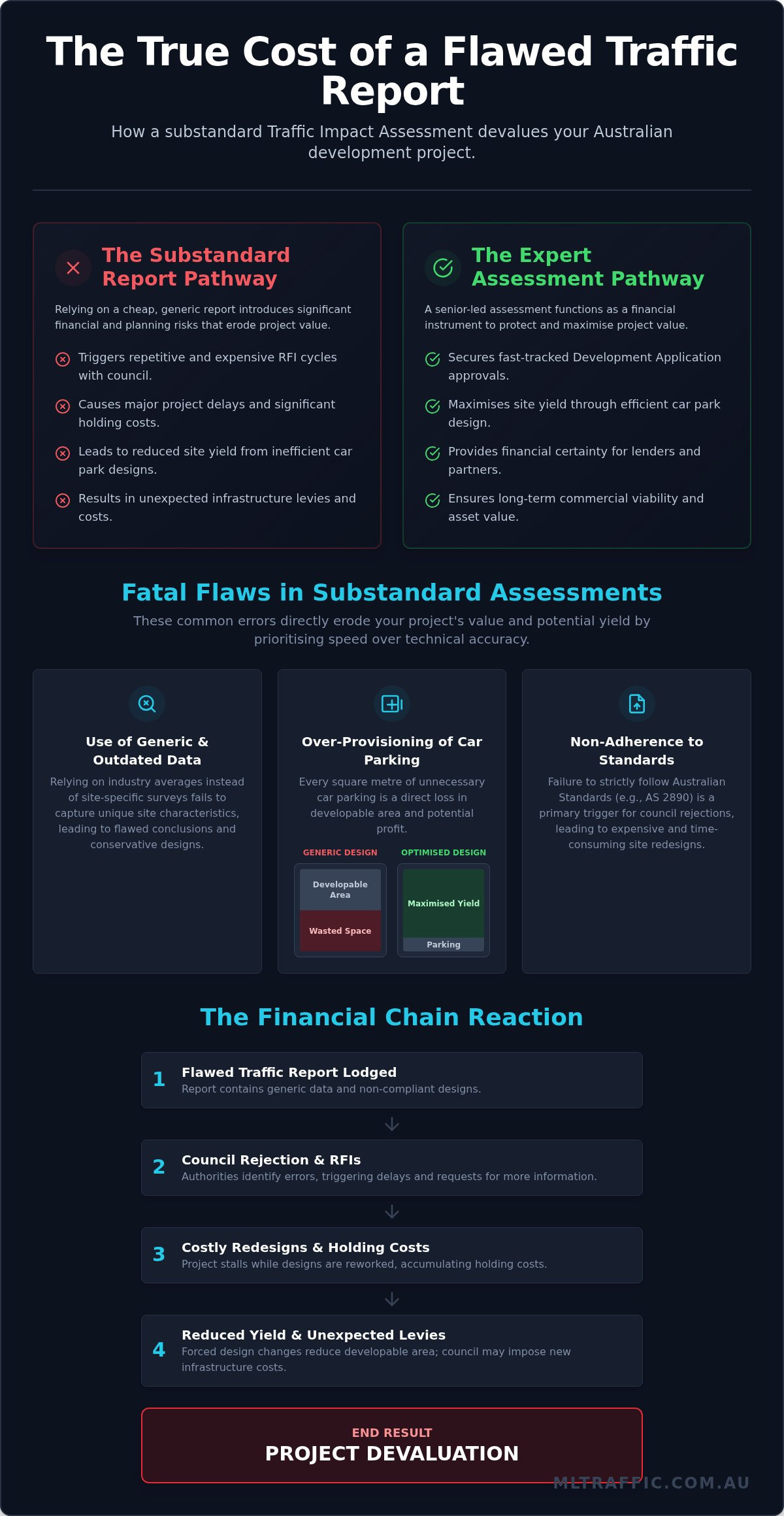
Developers must recognise how a poor traffic report can devalue a project by introducing avoidable planning risks and financial liabilities. Inaccurate data or flawed modelling often leads to unexpected infrastructure levies or council-mandated road upgrades that weren’t factored into the initial feasibility study. These unforeseen costs can immediately erode a project’s profit margin and projected return on investment.
Professional traffic engineering determines the “highest and best use” of a site by demonstrating its capacity to handle higher densities or high-traffic commercial tenancies. High-quality data provides essential certainty for lenders and joint-venture partners during the due diligence phase. It confirms that the site’s physical constraints won’t limit its future revenue potential or long-term operational viability.
The Link Between Traffic Flow and Commercial Viability
Efficient vehicle access directly dictates the desirability of retail and commercial tenancies. If a site features poor internal circulation or congested entry points, the commercial appeal diminishes, leading to lower rental yields and increased vacancy risks. Sophisticated vehicle swept path analysis ensures that delivery vehicles can navigate the site without disrupting customer flow. Traffic safety also influences long-term asset value and insurance premiums. A TIA serves as a primary risk-mitigation tool for investors by validating that the physical design supports the intended operational volume without creating safety hazards.
Traffic Engineering as a Value-Add, Not a Cost Centre
The cheapest report often leads to the most expensive construction outcomes. Low-cost consultants frequently rely on generic industry averages rather than site-specific surveys, resulting in conservative designs that waste developable area. For instance, over-designing a car park due to poor data can cost thousands in unnecessary excavation. Conversely, expert engineering can secure “bonus” yield through car parking demand assessments that justify departures from rigid council codes while maintaining compliance with AS 2890 standards. ML Traffic Engineers Australia has a 15-year history of protecting project value by ensuring technical assessments are led by senior principals who prioritise site efficiency. When assessing feasibility, ignoring how a poor traffic report can devalue a project is a risk no developer should take.
The Fatal Flaws: Common Errors in Substandard Traffic Assessments
Substandard reports prioritise speed over technical accuracy. They rely on generic industry averages for trip generation and parking demand. These reports fail to capture the unique characteristics of a specific site. This is how a poor traffic report can devalue a project. Over-provisioning parking spaces is a frequent and costly result. In the Australian market, land value is at a premium. Every square metre of wasted space represents a direct loss in developable area. Inaccurate data locks away land in unnecessary buffers and reduces your total yield.
Failure to adhere to Australian Standards is another way how a poor traffic report can devalue a project. Substandard assessments frequently overlook the requirements of AS 2890. This leads to designs that council planners will inevitably reject. Common errors include inadequate sight distances and incorrect commercial vehicle clearances. These technical oversights result in expensive redesigns after the DA has been lodged. A project’s financial feasibility can collapse under the weight of these avoidable errors.
Inaccurate Vehicle Swept Path Analysis
Many low-cost assessments use “optimistic” swept path simulations. These models do not work in the real world. If a simulation fails to account for the mandatory 300mm clearance on either side of the vehicle, the basement layout is flawed. A minor 500mm error in a turning circle calculation can eliminate two basement parking spots. This loss of yield directly impacts the bottom line. Accurate modelling requires precision and senior-led oversight. For more technical details on achieving precision, refer to our Swept Path Analysis Guide.
Non-Compliant Car Park Design
Functional car park design requires strict adherence to AS 2890.1 for off-street parking and AS 2890.2 for commercial vehicles. Common breaches include dead-end aisles without proper turn-around areas. Driveway ramps with excessive grades are another frequent failure. These errors are not just compliance issues; they create unworkable environments for future tenants. Fixing a narrow ramp mid-construction is prohibitively expensive. Senior oversight is critical during car park design and demand assessment to ensure layouts are compliant and efficient. If you are concerned about your current report’s accuracy, you should contact our senior principals for a technical review.
The Financial Fallout: How Poor Data Triggers Council Rejection
Council planners act as technical gatekeepers. They scrutinise every detail of a Development Application (DA) to ensure local infrastructure can support the proposed change. When a traffic report is incomplete or lacks technical depth, it triggers the “RFI Trap”. A Request for Further Information (RFI) isn’t just a administrative hurdle; it’s a project freeze. Every RFI cycle can add four to eight weeks to your timeline. For a developer, this is how a poor traffic report can devalue a project by inflating holding costs and delaying the start of construction.
The financial impact of these delays is compounded by high interest rates and ongoing site security costs. Beyond the immediate ledger, there is a significant reputational risk. If a consultancy consistently submits substandard data, council engineers will view every future application from that developer with increased skepticism. This friction often pushes projects toward an appeal to the relevant planning appeals tribunal. Attempting to defend a project before a tribunal with indefensible traffic data is a high-risk strategy that usually results in a costly dismissal or heavy conditions of consent.
The Cost of Council Delays and RFI Cycles
The RFI cycle is a primary source of project “leakage”. A standard response timeframe for council engineers often spans several weeks. During this period, your project momentum stalls while overheads continue to accrue. Robust data prevents this back-and-forth by addressing potential concerns before they are raised. A comprehensive Traffic Impact Assessment provides the technical justification required to close off lines of inquiry. It ensures that the first submission is the only submission needed for approval.
Yield Reduction and “Lost” Developable Area
Poor traffic advice frequently leads to unnecessary concessions. Councils may mandate excessive road widenings or deep setbacks based on conservative, generic data. You can challenge these requirements with better engineering and site-specific surveys. The financial difference between a 40-unit approval and a 35-unit approval is substantial. That loss of five units represents a direct hit to your gross realisation value. In one specific case study, senior-led engineering saved just three car spaces. While this sounds minor, it preserved A$150,000 in project value and prevented a total redesign of the basement levels. Accurate traffic data ensures you don’t sacrifice yield due to poor technical advocacy or conservative modelling. This is why understanding how a poor traffic report can devalue a project is essential for any developer focused on profit margins.
Securing Your Investment: Vetting a Traffic Engineering Consultancy
Selecting a traffic engineering partner based solely on the lowest quote is a false economy. A bargain-basement report often lacks the technical rigour required to withstand rigorous council scrutiny. This is exactly how a poor traffic report can devalue a project; it trades a small upfront saving for massive downstream risks. You must ensure your consultant has deep experience across varied land-use types and a proven track record in your specific local government area. National experience is equally vital, as it provides a broader perspective on compliance and innovative parking solutions.
Proficiency in industry-standard software like AutoTURN for vehicle swept paths is non-negotiable. However, software is only as reliable as the engineer operating it. Red flags in a proposal include unusually low fees, the use of generic report templates, and teams comprised entirely of junior staff. These factors indicate a “factory” approach that ignores the unique constraints of your site. Meticulous attention to detail at the vetting stage prevents the technical errors that lead to DA rejections.
Questions Every Developer Should Ask
To protect your site’s yield and timeline, you must interrogate the consultancy’s methodology. Ask these specific questions before signing a contract:
- “Who is actually performing the swept path analysis and driveway ramp grade checks?”
- “Does the report include site-specific traffic counts or just generic RTA/Council averages?”
- “What is your track record with this specific local government area?”
Reports relying on “industry averages” are easily picked apart by council engineers. Demand a commitment to site-specific data collection to ensure your DA is technically defensible. If the consultant cannot guarantee senior-led technical work, your project’s value is at risk.
The Value of Senior-Led Technical Work
Experienced engineers possess the foresight to identify “DA-killers” before the report is even submitted. This includes spotting non-compliant sight distances or unworkable waste collection arrangements that junior staff might overlook. Having a senior principal represent your project at council meetings provides a level of authority that junior consultants simply cannot match. They can negotiate technical concessions on the spot, potentially saving weeks of RFI back-and-forth. This direct involvement ensures that your site’s potential is fully realised rather than being limited by conservative, junior-level modelling.
At ML Traffic Engineers Australia, our leadership model ensures that senior principals perform the technical work themselves. This “no-gatekeepers” approach provides you with direct access to the experts who are actually signing off on your assessments. We have seen firsthand how a poor traffic report can devalue a project through avoidable design errors and planning delays. To ensure your next DA is backed by senior expertise and technical accuracy, you should request a technical fee proposal from our senior team today.
The ML Traffic Advantage: Senior Expertise in Every Assessment
ML Traffic Engineers Australia provides a streamlined consultancy model designed to eliminate the bureaucratic delays common in larger engineering firms. Our structure ensures that every technical assessment is performed directly by senior principals, rather than being delegated to junior staff. This high-level oversight is the most effective safeguard against the technical inaccuracies that lead to council rejections. We recognise exactly how a poor traffic report can devalue a project by introducing errors that compromise site yield or trigger expensive redesigns, and we mitigate this risk through hands-on leadership.
Our firm provides a comprehensive range of technical services tailored to the Australian development landscape. By maintaining senior-led control over every document, we ensure strict adherence to AS 2890 and local planning codes. Our core offerings include:
- Traffic Impact Assessment (TIA) Reports
- Vehicle Swept Path Analysis
- Car Parking Demand Assessments
- Traffic Guidance Schemes (TGS)
- Driveway Ramp Grade Assessments
- Intersection and Sight Distance Analysis
- Functional Car Park Design
- Waste Management Plans
This exhaustive range of services allows for a unified approach to site planning. We integrate traffic flow, parking efficiency, and waste logistics into a single, cohesive strategy. This prevents the conflicting advice that often arises when using multiple sub-consultants. We understand how a poor traffic report can devalue a project by failing to synchronise these critical elements, and we prioritise technical harmony to protect your investment.
Proven Results for Australian Developers
The technical work at ML Traffic Engineers Australia is backed by more than 15 years of specialised experience in the Australian market. Our “no-gatekeepers” communication policy ensures that developers have a direct line to the expert performing the technical analysis. This transparency facilitates faster project turnarounds and more effective negotiations with council engineers. Our personnel continuity promise means the principal who initiates your project remains the primary technical contact until approval is secured.
Senior-led engineering provides the technical defensibility required to navigate complex planning pathways with confidence. By prioritising accuracy and site-specific data, we ensure your project achieves its highest and best use. To secure your site’s commercial viability and avoid the pitfalls of substandard reporting, you should Contact ML Traffic Engineers Australia for a project-specific quote today.
Securing Your Site’s Future with Technical Precision
A Development Application succeeds or fails based on the technical integrity of its supporting documentation. As established throughout this guide, a traffic report serves as a critical financial instrument rather than a mere regulatory hurdle. Understanding how a poor traffic report can devalue a project enables you to mitigate planning risks before they manifest as costly RFI cycles or reduced site yields. Accurate engineering ensures that every square metre of your development is utilised effectively while maintaining strict compliance with AS 2890 standards.
Protecting your margins requires a partner who prioritises technical rigour over low-cost, generic templates. With over 15 years of traffic engineering experience, our team provides the senior-led oversight necessary to navigate complex council requirements. You gain direct access to senior principals on every project, ensuring your technical advocacy is authoritative and defensible. This hands-on approach eliminates communication delays and safeguards your project’s commercial viability from the initial assessment through to final approval.
Protect your project value – Contact ML Traffic Engineers Australia today to discuss your specific site requirements. It’s the most reliable way to fast-track your approval and maximise your site’s potential.
Frequently Asked Questions
How much does a poor traffic report actually cost a developer?
Costs manifest through RFI delays and daily holding costs. A stalled DA results in consistent interest accruals and site security overheads while the project remains stagnant. Additionally, inaccurate data frequently leads to council-mandated road upgrades that weren’t factored into the initial feasibility study. This is exactly how a poor traffic report can devalue a project by eroding the profit margin before construction even begins.
Can a traffic engineer help increase the number of units in my development?
Yes, through car parking demand assessments that justify a reduction in the required parking rate. By using site-specific data rather than generic council rates, we can often demonstrate that fewer spaces are technically required. This frees up floor area that can be converted into additional units or commercial space, which directly increases the site’s gross realisation value and total yield.
What is the most common reason councils reject a Traffic Impact Assessment?
The most frequent cause is the use of generic industry averages instead of site-specific traffic counts. Council engineers expect technical rigour and data that reflects actual local conditions. Reports that fail to address AS 2890 compliance for sight distances or vehicle clearances are also high-risk. These technical gaps demonstrate how a poor traffic report can devalue a project by triggering immediate rejection.
How long does it take to fix a non-compliant car park design?
Fixing a non-compliant design typically requires two to four weeks for the technical redesign, followed by a new council review cycle. A standard RFI response timeframe often spans four to eight weeks. If the error is discovered after construction has commenced, the timeline and financial impact become significantly more severe due to the complexity of retrofitting structural elements and ramps.
Is a Traffic Guidance Scheme (TGS) required for every Australian project?
A TGS is required whenever construction activities impact public roads, footpaths, or verge areas. While not always needed for the initial DA approval of the building’s use, it is a mandatory requirement for the Construction Certificate (CC) stage. It ensures the safety of all road users and pedestrians during the physical delivery of the project and maintains compliance with local regulations.
Why is senior-led traffic engineering better than a large firm approach?
Senior engineers identify “DA-killing” technical errors that junior staff often overlook during the modelling phase. In large firms, junior engineers frequently perform the technical work while seniors only sign off on the final document. Our model provides direct access to the expert performing the technical work. This ensures accountability and a higher level of technical accuracy throughout the entire assessment process.
What happens if my swept path analysis is found to be inaccurate during construction?
Inaccurate swept path analysis discovered during construction leads to prohibitively expensive retrofitting. If a delivery truck cannot navigate a ramp or turn, you may be forced to remove structural columns or lose multiple parking spots to create necessary clearance. These mid-construction changes can cost hundreds of thousands of dollars and significantly delay the project’s completion and eventual handover.
Does ML Traffic Engineers provide services across all of Australia?
Yes, ML Traffic Engineers provides senior-led services across all Australian states and territories. We maintain a deep understanding of varied local government requirements and national Australian Standards, including AS 2890. This national footprint allows us to support developers with multi-state portfolios while ensuring consistent technical quality and council compliance regardless of the project’s specific location or land-use category.

Disclaimer
The content on www.mltraffic.com.au, including all technical articles, guides, and resources, is provided for general informational and educational purposes only. It is not intended to constitute professional advice in traffic engineering, transportation planning, development approvals, or any other technical or legal field.
While ML Traffic Engineers makes every reasonable effort to ensure the accuracy, completeness, and timeliness of the information published, we do not provide any warranties or representations (express or implied) regarding its reliability, suitability, or availability for any particular purpose. Any reliance you place on the content is strictly at your own risk.
In no event shall ML Traffic Engineers, its directors, employees, authors, or affiliates be liable for any direct, indirect, incidental, special, consequential, or punitive damages (including, without limitation, loss of profits, data, or business opportunities) arising out of or in connection with the use of, or inability to use, any information provided on this website.
The articles and guides on this site are not a substitute for engaging a qualified, registered professional traffic engineer (such as an NPER or RPEQ engineer) to assess your specific project requirements. For tailored advice, compliance assessments, or traffic engineering services, please contact a competent professional.
This disclaimer may be updated from time to time without notice. By accessing or using this website, you agree to be bound by the most current version of this disclaimer.
