

Your development application’s traffic approval doesn’t just depend on the roads as they exist today; it relies on what those roads will look like in ten years. Understanding how future road network changes affect development applications is the difference between a project that breaks ground and one that stalls in Council. In the current 2026 planning environment, relying on current traffic counts is no longer sufficient for complex sites.
You likely recognise that a Traffic Impact Assessment (TIA) is a baseline requirement for any major project. However, the uncertainty of future road widening or rezoning often leads to significant delays or outright rejection when assessments are based on outdated data. Coordinating with state road authorities adds a layer of technical complexity that can derail even the most meticulously planned site access if future infrastructure shifts aren’t accounted for early in the design phase.
This article provides a clear framework for understanding how long-term transport planning can make or break your development application’s traffic approval. You will gain a technical understanding of the TIA process for future scenarios and learn specific risk mitigation strategies for site access. We cover everything from SIDRA intersection analysis to ensuring your traffic design remains compliant with 2026 regulatory standards.
Key Takeaways
- Understand why Councils mandate 10-year traffic growth projections to ensure long-term development compatibility with surrounding infrastructure.
- Learn how SIDRA modelling and Swept Path Analysis simulate future peak-hour performance to validate site access and intersection capacity.
- Discover how future road network changes affect development applications, particularly regarding new motorway interchanges and the introduction of clearway restrictions.
- Identify risk mitigation strategies, including pre-DA meetings and preliminary traffic feasibility studies, to avoid costly design revisions during the assessment process.
- Gain insights into navigating state road authority requirements through direct consultation with senior principal traffic engineers who perform the technical work.
Forecasting the Future: Why Road Network Changes Dictate DA Success
A Traffic Impact Assessment (TIA) report is a technical requirement that bridges the gap between a site proposal and long-term urban strategy. Councils don’t assess applications based on current conditions alone. They evaluate how a project integrates with the network as it’s projected to exist in ten years. Understanding how future road network changes affect development applications is vital for any project seeking approval in 2026. Infrastructure shifts, like road widening or new motorway ramps, can fundamentally alter site access viability. If your TIA fails to account for these shifts, you risk a refusal based on future non-compliance.
The 10-Year Horizon: Council’s Planning Benchmarks
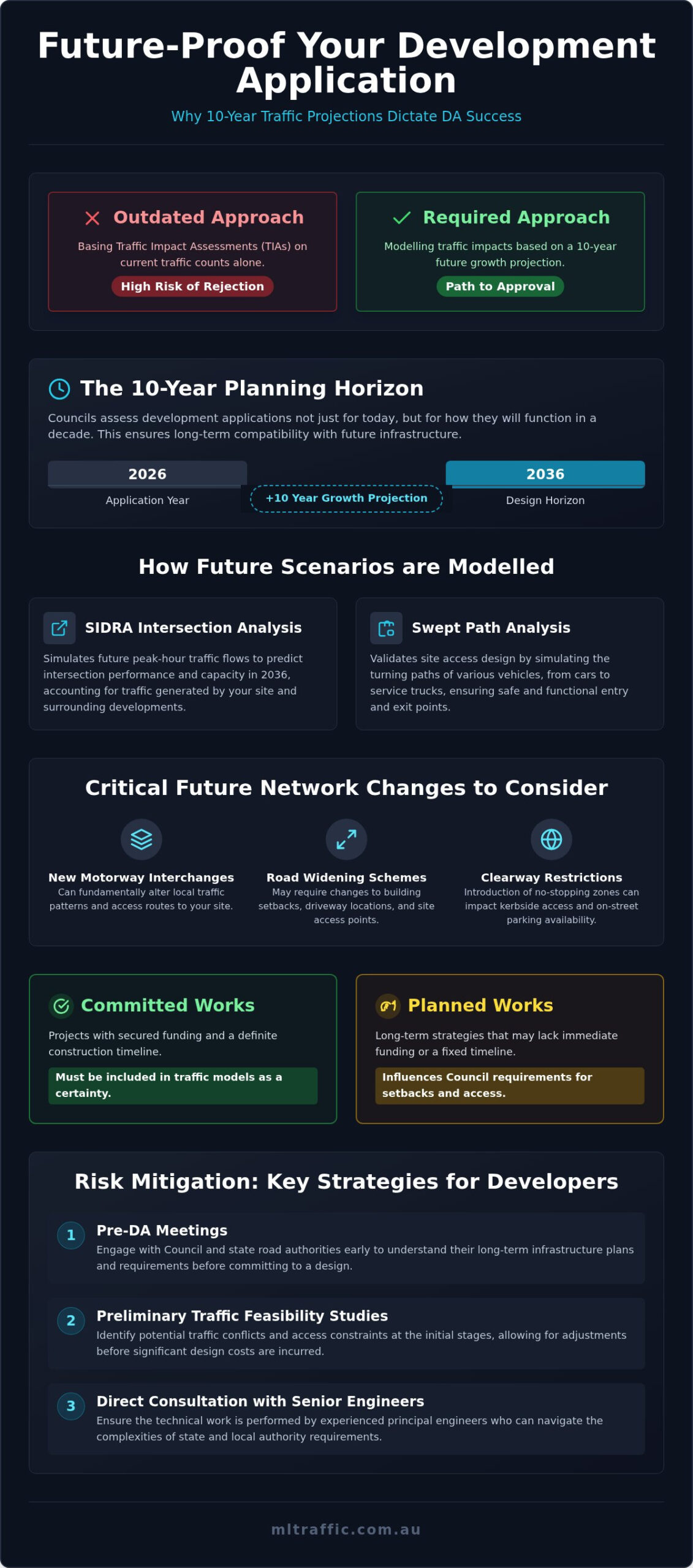
Planning authorities use a ‘Design Year’ concept to ensure infrastructure longevity. For applications submitted in 2026, the assessment often looks toward a 2036 horizon. This involves applying transportation forecasting models to current traffic counts to estimate background growth. In most Australian metropolitan areas, this growth isn’t a simple flat rate. It accounts for surrounding developments and regional population targets. Current traffic counts are merely the baseline. Our engineers use these figures to build a simulation of future peak-hour performance, ensuring the proposed development remains functional as the network matures.
State vs. Local Infrastructure Priorities
Developers must navigate conflicting requirements between local Councils and state road authorities, such as Transport for NSW or Victoria’s Department of Transport and Planning. State-level projects like new motorways or public transport corridors often dictate local access restrictions. A critical part of the Traffic Impact Assessment (TIA) process is identifying the status of nearby roadworks. Distinguishing between these categories is essential for accurate modelling:
- Committed Works: Projects with secured funding and a definite construction timeline. These must be included in traffic models as a certainty.
- Planned Works: Long-term strategies that may lack immediate funding. While less certain, they often influence Council’s requirements for building setbacks or driveway locations to allow for future road widening.
Failing to account for these priorities can lead to over-engineered solutions or, conversely, designs that become obsolete before construction finishes. Senior-level expertise is required to negotiate these complexities directly with authorities. At ML Traffic Engineers Australia, our senior principals perform the technical work on every project, ensuring that how future road network changes affect development applications is managed with precision and accountability.
The Technical Breakdown: How Traffic Engineers Model 2026 Horizons
Accurate modelling requires more than just current traffic counts; it demands a simulation of the network’s future state. Engineers use specialised software to determine how your project will interact with infrastructure that hasn’t been built yet. This technical rigour is essential because how future road network changes affect development applications determines the ultimate feasibility of your site access and parking design. If the model shows a failure in ten years, Council will likely require expensive redesigns or developer contributions before granting approval.
Intersection Capacity and Future Demand
SIDRA modelling’s primary role is predicting 2036 traffic flows by simulating intersection performance under high-volume future scenarios. This analysis must account for the cumulative impact of other approved or proposed developments in the immediate vicinity. When multiple projects are slated for a single corridor, the combined traffic can quickly degrade the Level of Service (LoS). While local regulations vary, many jurisdictions align with international Transportation Impact Study requirements that mandate rigorous forecasting for large-scale developments. If the projected LoS falls below acceptable thresholds, you may be required to fund physical upgrades, such as signalisation or additional turning lanes, to maintain network stability.
Swept Path Analysis for Future Road Alignments
Verifying vehicle access requires looking beyond existing kerb lines. We utilise AutoTURN to ensure your site remains accessible even after planned road widening or the introduction of new cycleway infrastructure. This is particularly critical for heavy vehicles. A loading dock that works today might become unusable if a future median strip or kerb extension restricts the turn circle. For a deeper technical dive, refer to our Swept Path Analysis: A Complete Guide.
Modern assessments also incorporate multi-modal shifts. As Australian cities move toward ‘active transport’ targets, TIAs must now account for pedestrian upgrades and cycling corridors that may reduce available road space for cars. Our engineers evaluate how these changes impact site visibility and safety. Ensuring your design is compliant with both current standards and future network layouts is the most effective way to mitigate risk. If you are concerned about your site’s long-term accessibility, you can speak directly with our principal engineers to discuss your project’s specific requirements.
Key Infrastructure Shifts Impacting Development Feasibility
Infrastructure development in Australia is currently focused on maximising existing road capacity through technology and priority lanes. These physical and operational shifts fundamentally change how vehicles interact with your site’s frontage. Understanding how future road network changes affect development applications is critical when evaluating site feasibility, as a project that seems accessible today may face significant restrictions once a planned clearway or motorway interchange is commissioned.
New motorway interchanges often redistribute regional traffic onto local collector roads. This frequently results in increased “rat-running” through previously quiet corridors, prompting Councils to implement traffic calming measures or turn restrictions. If your site relies on a specific turning movement that becomes restricted due to these network shifts, your Intersection Analysis must reflect these future constraints to avoid a DA refusal. Similarly, the introduction of clearways and no-parking zones on major corridors to improve peak-hour throughput can eliminate essential kerbside loading zones or visitor parking, forcing a total redesign of your internal car park and loading docks.
Smart Motorways and Intelligent Transport Systems (ITS)
Digital traffic management is becoming a standard feature of the Australian road network. Smart motorways utilise ramp metering and variable speed limits to regulate flow, which directly impacts how traffic queues form near commercial site entries. When performing a Traffic Impact Assessment (TIA) Report, we account for these ITS deployments. Future-proofing your design also requires considering autonomous vehicle (AV) infrastructure. While full adoption is still evolving, long-term commercial designs must allow for the sensors and lane markings required by emerging transport technologies to ensure the site remains functional over its 30-year lifecycle.
Active Transport and Pedestrianisation
Councils are increasingly prioritising “Green Travel Plans” and active transport over traditional private vehicle use. This shift often manifests as the expansion of separated bicycle lanes, which can physically isolate a development from the road. A new cycleway might prohibit a traditional driveway crossover or require a complex Vehicle Swept Path Analysis to ensure heavy vehicles can cross the lane safely without endangering cyclists. Many metropolitan Councils are moving toward parking maximums rather than minimums. Balancing car parking demand with these restrictive caps is a technical challenge that requires expert demand modelling to ensure the project remains viable while meeting strict environmental and planning targets.
At ML Traffic Engineers Australia, our principal engineers handle these technical negotiations directly. We ensure your project accounts for the exhaustive list of infrastructure shifts planned for your specific region, providing the accountability needed for a successful DA outcome.
Mitigating Risk: Strategies for Developers Facing Network Uncertainty
Developing land in an evolving urban environment requires a proactive approach to risk management. Developers must understand how future road network changes affect development applications to avoid investing in sites that may become technically unviable. A preliminary traffic feasibility study is the most effective tool for identifying potential deal-breakers, such as future median closures or restricted turning movements, before you commit to a purchase. These studies evaluate the site against current planning schemes and known regional transport strategies to ensure the land can support the intended use without facing insurmountable traffic objections.
Engaging with Council and state road authorities via pre-DA meetings allows for the early identification of network pinch points. These discussions provide technical insight into planned upgrades that may not be publicly gazetted or fully funded yet. Securing expert representation during these multi-agency negotiations ensures that your project’s interests are protected when Council and State requirements conflict. This high-level coordination is essential for securing approval on sites located near major infrastructure projects or transit-oriented development zones where the road hierarchy is expected to change.
Flexible Car Park Design and AS2890.1 Compliance
Designing internal circulation and ramps to accommodate future traffic volume increases is a core strategy for long-term project success. Driveway grades must remain compliant with AS2890.1 standards, even if future road widening results in altered street levels or kerb alignments. For a technical breakdown of these requirements, see our article on AS 2890.1 Explained. The most effective way to manage how future road network changes affect development applications is to design for flexibility from the outset. Ensuring your Car Park Design is adaptable prevents the need for expensive structural modifications if the surrounding network undergoes significant changes during the construction phase.
The Role of the Traffic Impact Assessment (TIA) Report
A Traffic Impact Assessment (TIA) report serves as a legal safeguard for the developer by documenting the technical justification for a site’s transport design. A robust TIA uses recent, high-quality traffic data to counter Council objections regarding future congestion by providing empirical evidence of a project’s minimal impact. This document is your primary defence against arbitrary refusals based on speculative network concerns. Our engineers utilise SIDRA analysis to demonstrate that a development can co-exist with 2036 traffic volumes without degrading the existing Level of Service. If you need a compliant assessment for your next project, you can request a TIA Report from our principal engineers today for expert technical advice.
Professional Traffic Engineering: Navigating Council and State Requirements
Professional consultancy is the final hurdle in securing a successful DA. General planning advice cannot replace the technical rigour of a qualified traffic engineer. When assessing how future road network changes affect development applications, Council officers look for precision in modelling and strict adherence to Australian Standards. Engaging a firm where senior principals perform the technical work ensures your project is handled with the necessary accountability. This no-gatekeepers approach allows for direct communication between the developer and the expert, facilitating faster resolutions to complex transport queries.
ML Traffic Engineers Australia provides over 15 years of experience in managing multi-agency negotiations. We ensure national compliance across all Australian planning jurisdictions, from local Council requirements to state-level road authority mandates. Our reports are structured to withstand rigorous scrutiny. We utilise industry-standard tools like SIDRA and AutoTURN to provide empirical evidence for our design recommendations. This ensures that every assessment, from a simple driveway grade check to a complex intersection analysis, meets the specific regulatory benchmarks of the target region.
Experience Across All Land-Use Categories
We provide tailored traffic responses for an exhaustive list of project environments. Whether you’re developing a local child care centre, a medical clinic, or a large-scale industrial warehouse, the traffic requirements differ significantly. We manage the technical documentation needed for DA approval, including:
- Traffic Impact Assessment (TIA) Reports
- Vehicle Swept Path Analysis
- Car Parking Demand Assessments
- Waste Management Plans
- Driveway Ramp Grade Assessments
Our team understands the specific nuances of each sector. We ensure that your Traffic Impact Assessment is both compliant and cost-effective. We tailor the response to the specific land use to avoid unnecessary over-engineering while maintaining safety.
Securing Your DA Approval in 2026
Success in the 2026 planning environment requires a results-oriented approach. We don’t just provide data; we provide solutions that mitigate the risks associated with future network uncertainty. Understanding how future road network changes affect development applications allows us to design site access that remains functional for decades. If you’re ready to proceed with your project, the first step is a site-specific assessment based on current and future traffic projections.
Our principals are available to discuss your specific site constraints and provide a clear path toward compliant traffic design. You can contact our senior engineers directly for a confidential project review to ensure your development application is supported by expert technical analysis.
Secure Your Site’s Future with Expert Traffic Modelling
Securing a development approval in 2026 requires more than just meeting current standards; it demands a technical understanding of the network’s 10-year horizon. We’ve explored how SIDRA modelling and Swept Path Analysis are essential for simulating future peak-hour performance and ensuring site access remains viable. Recognising how future road network changes affect development applications is the primary way to avoid costly redesigns or Council refusals based on projected congestion.
ML Traffic Engineers Australia provides over 15 years of Australian traffic engineering experience to help you navigate these technical complexities. Our senior principals perform the technical work on every project, ensuring comprehensive knowledge of AS2890.1 and national planning codes is applied to your specific site. This results-oriented approach provides the accountability needed for complex multi-agency negotiations. Speak directly with a Senior Traffic Engineer about your development today to ensure your project is future-proofed against upcoming infrastructure shifts.
Frequently Asked Questions
How far into the future does a Traffic Impact Assessment need to look?
A Traffic Impact Assessment typically adopts a 10-year planning horizon, known as the design year. For applications lodged in 2026, this requires modelling traffic volumes and network performance for 2036. This ensures the development remains functional as the surrounding population and background traffic grow. Understanding how future road network changes affect development applications at this 10-year mark is a standard requirement for most Australian local government authorities.
Can Council reject my DA because of a road project that hasn’t started yet?
Councils can reject a DA based on infrastructure projects that are gazetted or part of a committed transport strategy. If a proposed development interferes with a future road widening corridor or a planned intersection upgrade, it may be deemed incompatible. Our engineers review state and local infrastructure plans during the TIA process to identify these conflicts early, allowing for design adjustments that align with future network requirements before the application is lodged.
What happens if the road network changes after my DA is approved?
Once a DA is approved, the development generally retains its approved access and parking configurations. However, if a major infrastructure project physically prevents the execution of the approved design, a modification application may be necessary. This often occurs when state road authorities implement new clearways or median strips that restrict turning movements. In such cases, we provide updated technical analysis to support the modification and maintain site functionality.
Is a Swept Path Analysis required for all future road configurations?
Swept Path Analysis is essential whenever future road realignments, such as kerb extensions or new cycleways, impact the site’s entry and exit points. Using AutoTURN, we simulate vehicle movements against these future boundaries to ensure heavy vehicles can still enter and leave the site in a forward direction. This technical verification is a critical component of understanding how future road network changes affect development applications and ensuring long-term compliance with AS2890.1.
How do future public transport changes affect my car parking requirements?
Future public transport upgrades, such as new light rail or Metro corridors, often lead to a reduction in permissible car parking rates. Many metropolitan Councils implement parking maximums in transit-oriented zones to encourage active transport. A Car Parking Demand Assessment can determine if your site qualifies for these reduced rates, potentially lowering construction costs while still meeting the technical needs of the future occupants and visitors.
Does a Traffic Impact Assessment consider construction traffic for future roadworks?
A standard TIA focuses on the permanent operational impact of the development rather than temporary construction phases. However, if major roadworks are scheduled to occur simultaneously with your project, a separate Construction Traffic Management Plan (CTMP) is required. The CTMP must coordinate with the road authority’s schedule to manage site deliveries and worker parking without compounding the existing network disruption caused by the infrastructure project.
What is the difference between a planned and a committed road upgrade?
Committed road upgrades have secured funding and a defined construction timeline, making them a certainty in traffic modelling. Planned upgrades are strategic objectives identified in long-term transport documents but lack immediate funding or final designs. While both influence the assessment, committed projects must be included in the SIDRA base model, whereas planned projects may only influence building setbacks or the positioning of future site access points.
How can a traffic engineer help if my site access is restricted by new road rules?
Traffic engineers mitigate the impact of new road rules, such as “no right turn” restrictions, by redesigning site circulation or negotiating with road authorities. We use Intersection Analysis to demonstrate that alternative access points can handle the redistributed traffic volume without failing. This technical advocacy is vital when new clearway restrictions or median closures threaten the commercial viability of a site by restricting customer or delivery vehicle access.

Disclaimer
The content on www.mltraffic.com.au, including all technical articles, guides, and resources, is provided for general informational and educational purposes only. It is not intended to constitute professional advice in traffic engineering, transportation planning, development approvals, or any other technical or legal field.
While ML Traffic Engineers makes every reasonable effort to ensure the accuracy, completeness, and timeliness of the information published, we do not provide any warranties or representations (express or implied) regarding its reliability, suitability, or availability for any particular purpose. Any reliance you place on the content is strictly at your own risk.
In no event shall ML Traffic Engineers, its directors, employees, authors, or affiliates be liable for any direct, indirect, incidental, special, consequential, or punitive damages (including, without limitation, loss of profits, data, or business opportunities) arising out of or in connection with the use of, or inability to use, any information provided on this website.
The articles and guides on this site are not a substitute for engaging a qualified, registered professional traffic engineer (such as an NPER or RPEQ engineer) to assess your specific project requirements. For tailored advice, compliance assessments, or traffic engineering services, please contact a competent professional.
This disclaimer may be updated from time to time without notice. By accessing or using this website, you agree to be bound by the most current version of this disclaimer.
