
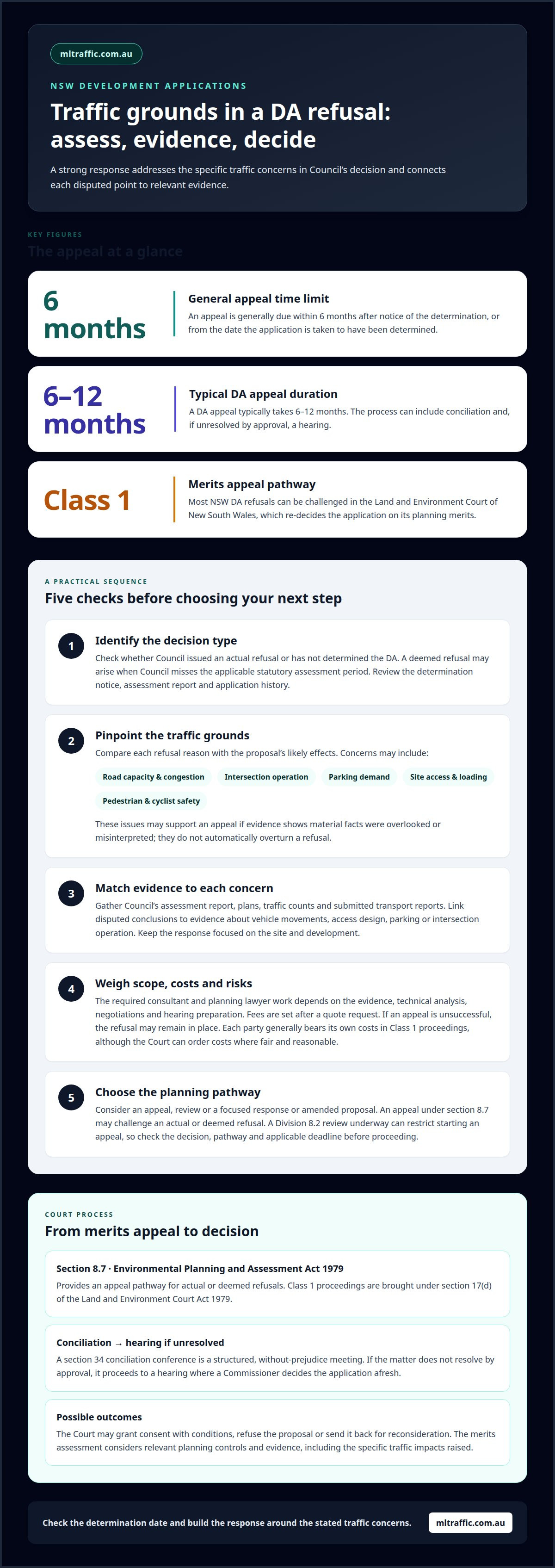
A traffic-related DA refusal can be challenged by appealing the decision, but the case must address the planning reasons behind it. In NSW, an applicant can generally appeal an actual or deemed refusal under section 8.7 of the Environmental Planning and Assessment Act 1979; most refusals can be challenged through a Class 1 merits appeal, which the Land and Environment Court of New South Wales uses to re-decide the application. The appeal is generally due within 6 months after notice of the determination, or the date the application is taken to have been determined.
A refusal that cites traffic impacts can leave you weighing whether to appeal, seek a review or revise the proposal. The right path depends on the decision, the applicable deadline and the evidence needed to respond to Council’s concerns. This guide explains what a development appeal is, how traffic grounds for appealing a DA refusal may be addressed, and which rights and time limits can apply in NSW. It also outlines the role of traffic evidence, the appeal process and the practical steps to organise your case.
Key Takeaways
- Identify whether Council refused your DA, imposed conditions or failed to determine it, as the decision type affects the available pathway.
- Understand how a Class 1 merits appeal lets the Land and Environment Court reconsider the planning decision.
- Build your response around the specific traffic concerns raised and the proposal’s supporting evidence.
- Compare appeal and review options carefully, and note the deadline that applies to your circumstances.
- Learn when a Traffic Impact Assessment (TIA) Report or other traffic analysis can help address issues raised in a refusal.
Council Refused My NSW DA – What Are My Options?
While ML Traffic Engineers Australia provides expert advice nationwide, when dealing specifically with a New South Wales development application, the available pathway depends on the determination, the refusal grounds and whether Council has made a decision. Use these steps to assess the traffic issues and prepare your response.
-
Identify the Refusal Type
Start by identifying whether Council issued an actual refusal or has not determined your development application. Under section 4.16(1) of the Environmental Planning and Assessment Act 1979, a consent authority grants consent or refuses an application. A deemed refusal may arise when Council misses the applicable statutory assessment period. Check the determination notice, assessment report and application history before choosing an appeal route.
-
Assess Traffic Grounds for Appeal
Compare each traffic reason in Council’s refusal with the proposal’s likely effects. Relevant issues may include road capacity, congestion, intersection operation, parking demand, site access, loading arrangements, and pedestrian or cyclist safety. These grounds may support an appeal if evidence shows that Council overlooked or misinterpreted material facts. They do not automatically overturn a refusal: the proposal’s merits and applicable planning provisions still matter.
-
Gather Evidence on Traffic Impacts
Gather the documents that address Council’s specific traffic concerns, including its assessment report, plans, traffic counts and submitted transport reports. Link each disputed conclusion to evidence about vehicle movements, access design, parking or intersection operation. For example, identify differences between the assumptions in Council’s assessment and those in the proposal’s analysis. Keep the response focused on the site and development, rather than relying on general claims about congestion.
-
Weigh Appeal Costs and Risks
Establish the likely scope of traffic consultant and planning lawyer work before deciding how to proceed. Fees depend on the evidence required, technical analysis, negotiations and hearing preparation, and are set after a quote request. If an appeal is unsuccessful, the refusal may remain in place. In Class 1 proceedings, each party generally bears its own costs, although the Court can order costs where fair and reasonable.
-
Choose the next planning step.
NSW planning law applies to a NSW DA; traffic grounds are assessed within that state’s appeal process, not under one national planning appeal system. An appeal under section 8.7 may challenge an actual or deemed refusal. A merits determination considers the application afresh, including relevant planning controls and evidence. If conciliation doesn’t resolve the application by approval, the matter proceeds to a hearing where a Commissioner decides it afresh. Consider whether a focused response or amended proposal addresses the refusal grounds.
Appeals to the Land and Environment Court of New South Wales
A Class 1 appeal lets the Court assess the planning merits of a refused proposal. Organise the case around the applicable planning controls, evidence and disputed issues.
- Confirm the appeal pathway. Most development application refusals in New South Wales can be challenged by a Class 1 merits appeal in the Land and Environment Court of New South Wales, which re-decides the application. Section 8.7 of the Environmental Planning and Assessment Act 1979 provides an appeal pathway for actual or deemed refusals. Class 1 proceedings are brought under section 17(d) of the Land and Environment Court Act 1979. Confirm which decision is being challenged before preparing documents.
- Frame the appeal as a merits case. A merits appeal asks the Court to reconsider the planning decision, rather than merely examine whether Council followed a lawful process. Explain how the proposal responds to relevant planning controls, including applicable LEP, DCP and SEPP provisions. For traffic concerns, connect the evidence to the specific impacts Council identified, such as how access design or intersection operation affects the assessment.
- Prepare the filing around the determination. Identify the consent authority, the determination being challenged and the outcome sought. Organise the refusal notice, Council’s assessment material, stamped plans and supporting technical reports. The statutory deadline generally runs from notice of the determination or the date the application is taken to have been determined. Use the correct date and appeal pathway when calculating it. A Division 8.2 review underway can restrict starting an appeal.
- Prepare for conciliation and hearing. The Court uses early conciliation stages to explore whether a development application appeal can resolve through an agreed outcome. A section 34 conciliation conference is a structured, without-prejudice meeting. If conciliation doesn’t resolve the matter by approval, it proceeds to a hearing where a Commissioner decides the application afresh. The Court may grant consent with conditions, refuse the proposal or send it back for reconsideration. A DA appeal typically takes 6-12 months.
- Use comparable decisions carefully. Look for Land and Environment Court decisions involving similar planning controls, traffic issues and site conditions. Compare the facts, not just the outcome. A case involving a constrained intersection may illustrate how evidence was considered, but differences in road layout, development scale or access can limit its relevance. Use comparable decisions to support a reasoned planning argument alongside evidence about your proposal.
Appeals against deemed refusals
In NSW, a Council’s failure to determine a development application may create an appeal pathway. Check the application’s status and statutory assessment period before treating silence as a refusal.
- Establish whether the refusal is actual or deemed. An actual refusal follows a Council determination refusing consent. A deemed refusal may arise when the consent authority has not determined the development application within the applicable statutory period. That period depends on the application and its circumstances, so identify it before taking the next step. A deemed refusal is not the same as a written refusal notice.
- Check the statutory basis and application timeline. Section 8.11 of the Environmental Planning and Assessment Act 1979 is cited for an appeal when Council fails to determine an application within the statutory assessment period. In NSW, that period can be as little as 42 days. Record the lodgement date, any requests or amendments, and Council correspondence. These details help establish when the relevant period began and whether it has expired.
- Identify what decision you want reviewed. An applicant may appeal a DA refusal, imposed conditions or a deemed refusal, but the pathway depends on the determination and applicable legislation. For an actual refusal, read the notice and assessment report to identify Council’s stated grounds. For a deemed refusal, identify the unresolved application and the decision you seek. Keep the appeal focused on the proposal and the planning issues in dispute.
- Check whether a review is underway. Since 21 March 2026, an applicant cannot lodge a development application appeal while a Division 8.2 review of the determination is underway. The review process is governed by the Environmental Planning and Assessment Act 1979. Confirm whether a review has been requested or commenced before preparing an appeal, and avoid treating review and court proceedings as simultaneous options.
- Assess designated development separately. Section 4.10 of the Environmental Planning and Assessment Act 1979 defines designated development by reference to an environmental planning instrument or regulations. That status can affect appeal rights and process. Check whether the application is designated before relying on the ordinary applicant pathway. For any refusal, condition or deemed refusal, organise the decision records, application documents and relevant planning evidence around the precise issue being challenged.
Appeal rights and statutory time limits
For a NSW DA, appeal rights and deadlines depend on the decision and pathway. Record the determination date and establish whether you need a Court appeal or a review.
Australia has no single DA appeal deadline for every state and territory. The rules depend on the jurisdiction and decision, so the NSW time limits below apply only to NSW applications.
-
Check Appeal Rights
Read the determination notice and identify whether Council refused the DA, imposed conditions, or has not determined it. In NSW, an applicant may appeal an actual or deemed refusal under section 8.7 of the Environmental Planning and Assessment Act 1979. Appeal rights are statutory, and the available route depends on the decision and legislation. Keep the notice and relevant application records together, then match the proposed challenge to the decision being appealed.
-
Identify the Applicable Time Limit
Record the date you received notice of determination, or the date the application is taken to have been determined. In NSW, an appeal under section 8.7 or section 8.9 is generally due within 6 months after the relevant date. Review requests may have a separate deadline, so check the applicable timeframe. A section 8.3 review deadline runs from determination and is shorter than the court appeal deadline. Don’t assume a review request extends the appeal period.
-
Check State or Territory Appeal Requirements
Apply the planning appeal rules for the state or territory where the development site is located. NSW provisions and deadlines don’t determine appeal rights for land in another jurisdiction. Identify the relevant consent authority, decision type and statutory pathway before calculating a deadline. For a NSW matter, note that section 8.9A restricts starting a development application appeal while a Division 8.2 review is underway. A lodged review and a court appeal therefore require careful sequencing.
- Organise the appeal process. Once the route and deadline are clear, prepare the appeal material around the refusal grounds and relevant evidence. Traffic evidence should address the issues Council relied on, rather than simply restating the original application. In a NSW Class 1 matter, early conciliation may provide an opportunity to resolve the dispute. If it remains unresolved, a Commissioner decides the matter at a hearing. Track each procedural date from the determination through conciliation and hearing.
Objector appeal eligibility and deadlines
Objectors and DA applicants have different appeal rights in NSW. Identify your role, the development type and the date of Council’s notice before taking action.
- Confirm whether you’re the applicant or an objector. An applicant may appeal a DA refusal, but objectors generally do not have merits appeal rights in NSW. The main exception is designated development. Raising traffic concerns with Council does not, by itself, create a right to appeal a later approval. The statutory pathway depends on the application’s classification and your participation in the assessment process.
- Check designated development status. Section 4.10 of the Environmental Planning and Assessment Act 1979 defines designated development by reference to an environmental planning instrument or regulations. If Council approved a designated development application, an objector may appeal under section 8.8. First establish that the specific application falls within this category; the development description alone doesn’t determine appeal eligibility.
- Locate your objection and Council’s notice. An objector appealing an approval must have submitted an objection to the DA during its submission period. Find a copy of that objection and the notice of determination. The appeal deadline is 28 days after notice of the determination is given. Record the notice date and organise proof of your submission, because both eligibility and timing depend on those records.
- Distinguish objector deadlines from applicant deadlines. An applicant’s appeal under section 8.7 or section 8.9 is generally due within 6 months after notice of determination, or the date the application is taken to have been determined. That period is different from the 28-day objector period under section 8.8. Don’t use the applicant deadline to calculate an objector appeal, or assume discussions with Council pause either period.
- Act promptly on eligibility and evidence. Seek legal advice early enough to assess standing, identify the correct statutory route and prepare within the applicable period. Keep your objection, Council notice and relevant traffic material together. Where an applicant’s Class 1 appeal proceeds, conciliation may offer an opportunity to resolve issues before a hearing; a conference doesn’t replace filing within the deadline. For traffic evidence support, discuss traffic assessment support.
ML Traffic Engineers Australia: Traffic Impact Assessment (TIA) Report
ML Traffic Engineers prepares Traffic Impact Assessment (TIA) Reports to assess transport effects relevant to a development proposal. If Council’s refusal raises concerns about traffic generation, access or intersection performance, a project-specific assessment can organise technical evidence around those issues. Vehicle Swept Path Analysis can examine vehicle movements through accessways, while a Car Parking Demand Assessment can address parking provision and demand. These assessments provide technical input; they do not determine appeal rights or replace legal advice about Court proceedings.
Turn to traffic assessment when the refusal identifies issues that require further analysis or when revised plans need supporting transport evidence. The appropriate scope depends on the concerns raised and the proposal’s details. Contact ML Traffic Engineers Australia to discuss traffic assessment support for your development application.
Turn the refusal into a focused next step
Before committing to an appeal, create a concise issue-and-evidence schedule. Copy each traffic concern from Council’s reasons, identify the plan or report that addresses it, and note what remains unresolved. This helps expose gaps and keeps technical analysis aligned with the planning case. If you revise the proposal, make sure the supporting material reflects the same plan version.
A case based on traffic grounds for appealing a DA refusal is strongest when each argument responds directly to a stated concern. Separate technical questions, such as vehicle movements or parking layout, from planning questions about the proposal’s impacts. The right response depends on the refusal reasons and the evidence available for the site.
For project-specific traffic analysis, contact ML Traffic Engineers Australia. A clear, organised next step can help you move from refusal reasons to a considered response.
Frequently Asked Questions
What is a development appeal?
A development appeal is a formal challenge to a planning determination. It explains why the decision should be reconsidered and supports that position with relevant application documents and evidence. An applicant’s case should identify the specific refusal reasons in dispute and explain how the proposal addresses them. This keeps the appeal focused on planning issues, rather than simply repeating objections or restating the original application.
Are there time limits to appeal?
Yes. Appeal rights are subject to statutory deadlines. Keep the dated determination notice, delivery records and correspondence about the application together. Record the event that starts the relevant period and plan backwards from the filing deadline. Discussions with Council or preparation of additional traffic evidence do not necessarily pause the clock. Missing a deadline can affect access to the appeal pathway.
Can I ask the council to review its decision instead of appealing to the Court?
In eligible cases, an applicant can seek a Council review instead of proceeding directly to a Court appeal. A review asks the consent authority to reconsider its own decision, while a Court appeal places the dispute before the Court. Consider what needs correction: a specific assessment issue may suit a focused review request, while a wider dispute about planning merits may call for another approach. Check the applicable review process before acting.
Can the Court approve a DA that Council refused?
Yes, the Court can grant consent to a refused DA. A strong case should show how the proposal can meet planning requirements and manage identified impacts. If vehicle access is disputed, for example, explain how the arrangement works and whether a suitable consent condition could address any remaining issue. A condition should relate to the development and its impacts, not replace evidence that the proposal is acceptable.
How (where) do I appeal?
For an eligible NSW development application appeal, the forum is the Land and Environment Court of New South Wales. Prepare a clear case record that identifies the determination, the outcome sought, the plans forming the proposal and the issues Council disputed. Keep document versions consistent so the evidence and drawings refer to the same scheme. If traffic impacts are contested, organise the supporting material against each relevant refusal reason.
How can a traffic impact assessment or transport modelling support a DA appeal?
A traffic assessment can make the reasoning behind a transport conclusion clear. It can explain the existing conditions used as a baseline, the proposed development scenario, key assumptions and how the results relate to the refusal concern. Modelling may help test different assumptions or proposal configurations. Comparing access arrangements, for example, can show how a design change affects vehicle movements and help decision-makers assess the transport issue.
What Australian planning tribunal or court decisions address traffic grounds in development application appeals?
Relevant NSW examples are Land and Environment Court planning decisions where traffic effects formed part of the dispute. Read the reasons and final orders, not just a case summary: the reasons show how the evidence was treated, while the orders show the outcome for that proposal. Note the applicable planning controls and any conditions. A decision is most useful when its reasoning addresses an issue materially similar to yours.
What are the deadlines, appeal rights, and process for appealing a DA refusal on traffic grounds in each Australian state?
In NSW, an applicant can generally appeal an actual or deemed DA refusal through a Class 1 merits appeal in the Land and Environment Court, usually within 6 months after notice of the determination or the date it is taken to have been determined. The Court reconsiders the application; address Council’s specific traffic concerns with relevant evidence, and note that an appeal generally involves conciliation before a hearing if unresolved.

Disclaimer
The content on www.mltraffic.com.au, including all technical articles, guides, and resources, is provided for general informational and educational purposes only. It is not intended to constitute professional advice in traffic engineering, transportation planning, development approvals, or any other technical or legal field.
While ML Traffic Engineers makes every reasonable effort to ensure the accuracy, completeness, and timeliness of the information published, we do not provide any warranties or representations (express or implied) regarding its reliability, suitability, or availability for any particular purpose. Any reliance you place on the content is strictly at your own risk.
In no event shall ML Traffic Engineers, its directors, employees, authors, or affiliates be liable for any direct, indirect, incidental, special, consequential, or punitive damages (including, without limitation, loss of profits, data, or business opportunities) arising out of or in connection with the use of, or inability to use, any information provided on this website.
The articles and guides on this site are not a substitute for engaging a qualified, registered professional traffic engineer (such as an NPER or RPEQ engineer) to assess your specific project requirements. For tailored advice, compliance assessments, or traffic engineering services, please contact a competent professional.
This disclaimer may be updated from time to time without notice. By accessing or using this website, you agree to be bound by the most current version of this disclaimer.
