

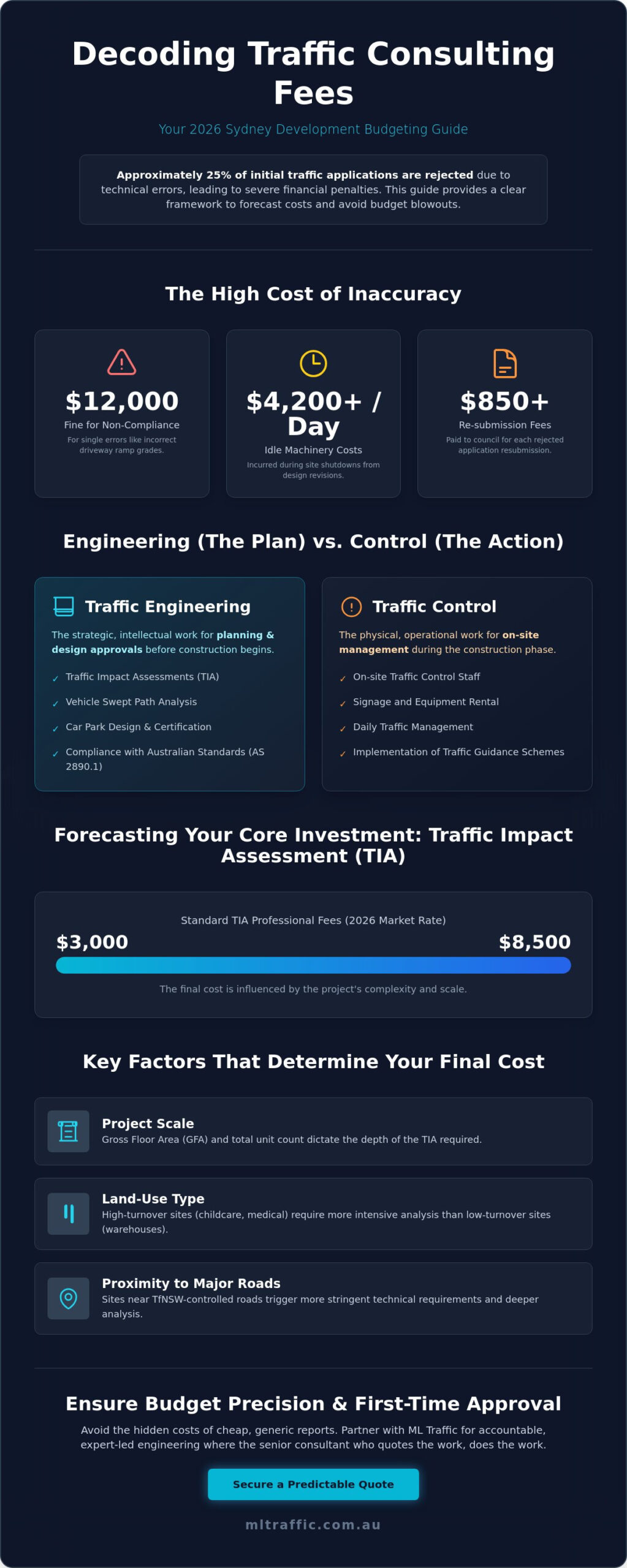
Approximately 25% of initial traffic management applications in Sydney are rejected due to technical inaccuracies. For a developer, a single error in a driveway ramp grade or sight-line assessment can lead to a $12,000 fine for non-compliance or idle machinery costs exceeding $4,200 per day. You probably already know that council requirements are rigorous, but the lack of transparency in professional fees often makes financial planning feel like guesswork.
Understanding how to budget for traffic consulting fees is about more than comparing hourly rates. It’s about scoping the specific assessments required for council compliance to avoid late-stage design changes. This guide provides a clear framework to accurately forecast engineering costs, such as the $3,000 to $8,500 range typical for a standard Traffic Impact Assessment. We’ll detail the components of a professional quote, explain the difference between traffic control and engineering, and show you how to secure a predictable budget for your planning approvals.
Key Takeaways
- Distinguish between traffic engineering consultancy for planning and operational traffic control staff to ensure your budget covers the correct professional services.
- Master how to budget for traffic consulting fees by forecasting standard costs for a Traffic Impact Assessment (TIA) and a Traffic Guidance Scheme (TGS) based on 2026 market rates.
- Evaluate how development scale, gross floor area (GFA), and proximity to major road networks dictate the depth and technical requirements of your traffic reports.
- Learn to compare lump-sum quotes effectively against hourly rates to identify hidden costs and manage potential post-RFI support fees.
- Ensure budget precision by working directly with senior RPEQ-certified engineers who provide both the initial quote and the final technical work.
Table of Contents
-
Understanding Traffic Consulting Fees: Engineering vs. Physical Control
-
The ML Traffic Difference: Accountability and Budget Precision
Understanding Traffic Consulting Fees: Engineering vs. Physical Control
Professional traffic engineering is a specialized consultancy focused on planning and design. It’s a discipline that applies Traffic engineering principles to ensure infrastructure is safe, efficient, and compliant. You must distinguish between professional fees and operational costs. Professional fees cover the technical reports and design certifications. Operational costs refer to the daily expenses for traffic control staff and equipment used during construction. If you confuse these two, your financial planning will be inaccurate from the start.
When you’re determining how to budget for traffic consulting fees, remember that these costs are a strategic investment in securing your Development Application (DA) approval. Traffic engineering involves rigorous technical analysis of Australian Standards like AS 2890.1 for off-street car parking. This work is the foundation of a successful planning outcome. It’s the intellectual effort that happens months before any physical traffic management occurs on-site.
To better understand the value of professional consulting and how it impacts your bottom line, watch this helpful video:
The Scope of Professional Traffic Engineering
Professional traffic engineers provide the technical documentation required by local councils and Transport for NSW (TfNSW). You can view our full range of traffic engineering services to see how these apply to your specific land-use. The scope typically includes:
-
Preparation of Traffic Impact Assessment (TIA) and Traffic Impact Statements (TIS) to evaluate road network capacity.
-
Detailed Vehicle Swept Path Analysis using software like AutoTURN to prove vehicle accessibility.
-
Car park design certification and parking demand assessments.
-
Sight-line assessments to ensure safe entry and exit from the property.
These tasks require senior-level expertise. At ML Traffic Engineers, we operate with a "no-gatekeepers" approach. The consultant who provides the quote is the one who does the technical work, ensuring accountability at every stage.
Why "Cheap" Reports Can Cost More in the Long Run
Selecting a consultant based solely on the lowest price often results in generic data. Sydney councils are no longer accepting non-site-specific traffic control plan templates. Approximately 35% of traffic reports fail because they lack detailed sight-line assessments or feature incorrect driveway ramp grades. This leads to a formal Request for Further Information (RFI). As of 2026, re-submission fees for rejected applications often exceed $850.
Professional expertise prevents expensive design revisions. If a junior engineer fails to assess a driveway ramp grade correctly, you may face a late-stage redesign of the building’s structural footprint. This can lead to site shutdowns where idle machinery costs exceed $4,200 per day. A consultant with decades of experience identifies these conflicts early. They ensure your budget remains predictable by getting the technical details right the first time.
Key Factors That Influence Traffic Consulting Fees
Traffic engineering fees are not arbitrary. They align with the volume of technical work and the level of risk mitigation required for your specific site. When you analyze how to budget for traffic consulting fees, you must account for the land-use type and the resulting intensity of the assessment. A childcare center or a medical clinic typically commands higher professional fees than a standard warehouse. These high-turnover sites require intensive peak-hour flow analysis and detailed parking turnover assessments to satisfy council concerns regarding local street congestion.
Project scale is a primary driver of cost. The Gross Floor Area (GFA) and the total unit count dictate the depth of the Traffic Impact Assessment (TIA). A larger development necessitates a more robust data set to prove that the surrounding road network can absorb the increased load. Adhering to Consult Australia industry standards, engineers must ensure that every report is defensible during a council audit or a Land and Environment Court proceeding. Proximity to major road networks managed by Transport for NSW (TfNSW) also increases complexity, as these projects often require additional layers of modeling and multi-agency coordination.
Project Complexity and Land Use Types
Residential and commercial developments have vastly different parking demand assessment requirements. Residential projects focus on long-term occupant parking, while commercial sites prioritize visitor turnover and delivery logistics. Industrial developments involve heavy vehicle access, requiring detailed swept path analysis for B-doubles or articulated vehicles. Specialized sites like schools or places of worship require bespoke traffic management strategies. These strategies must account for concentrated arrival and departure patterns that occur within narrow 30-minute windows during peak periods.
Technical Assessment Requirements
The requirement for SIDRA modeling significantly influences the fee structure. This software models complex intersections to determine delays, queue lengths, and the overall Level of Service (LoS). If your site is located near a signalized intersection, council will likely mandate this level of analysis. Furthermore, driveway ramp grade assessments are mandatory for compliance with AS 2890.1. For high-density sites, you may also need a comprehensive parking control management plan to prevent unauthorized parking and ensure efficient internal circulation. If your project involves a complex land-use, you can request a technical fee proposal to get a precise breakdown for your specific site.
Common Fee Structures in Australian Traffic Engineering
Understanding fee structures is the most critical step when learning how to budget for traffic consulting fees. Most professional firms use two primary models: lump-sum project fees and hourly professional rates. For standard development applications, the lump-sum model is the industry norm. It provides the financial certainty required during feasibility and planning phases. Ad-hoc design changes or Land and Environment Court appeals usually transition into hourly billing. You must identify which model applies to each stage of your project to avoid unexpected costs.
Transparency in the initial quote prevents scope creep. A standard Traffic Impact Assessment (TIA) for a private development typically ranges between $3,000 and $8,500. If a quote is significantly lower, check the exclusions immediately. Many firms exclude the cost of responding to a council Request for Further Information (RFI). Since 25% of initial applications face technical rejection, an entry-level fee can quickly balloon. You should also clarify if council meeting attendance and multi-agency coordination are included or billed separately.
Lump Sum Project Fees
Lump sum fees are effective for defined scopes like a Traffic Impact Statement or a Car Parking Demand Assessment. You should verify that the quote includes Vehicle Swept Path Assessments and site-specific inspections. Excluding these creates a budget risk when council inevitably requests them. For complex developments, a staged fee approach is standard. This involves a fixed fee for the initial report and a separate provision for post-submission support. Since re-submission fees for rejected applications often exceed $850, having a consultant who stands by their technical work is vital for your bottom line.
Hourly Rates and Specialized Advice
Hourly rates are appropriate for expert witness services or high-level design consultation where the scope is fluid. There’s a significant difference between Principal Engineer and Project Engineer rates. You should look for a "Principal-led" model to ensure billing efficiency. Large firms often hand work to junior staff, leading to more billable hours for less experienced output. At ML Traffic Engineers, we ensure accountability through direct access to our principals. The traffic consultant who provides the quote does the work. This hands-on approach eliminates the "junior hand-off" and ensures your hourly budget is spent on senior-level expertise.
How to Build an Accurate Traffic Consulting Budget for 2026
Budgeting for 2026 requires a methodical approach to avoid the 25% rejection rate seen in current Sydney applications. You can’t rely on ballpark figures or generic templates. Instead, follow these five steps to determine how to budget for traffic consulting fees with precision.
-
Step 1: Identify specific council requirements. Each LGA, such as the City of Parramatta or Randwick Council, has unique bylaws and priorities that dictate report depth.
-
Step 2: Gather preliminary architectural drawings. Accurate quoting is impossible without understanding the site’s structural footprint and proposed access points.
-
Step 3: Request a comprehensive Traffic Impact Assessment quote. Ensure this includes detailed swept path analysis and sight-line assessments from the outset.
-
Step 4: Allocate a 10% to 15% contingency. This covers potential council-mandated revisions or additional meetings following the initial lodgement.
-
Step 5: Verify RPEQ qualifications and experience. Using unqualified personnel can void project insurance and lead to $12,000 fines for non-compliance.
Preparing Your Project Brief
A vague brief leads to a vague quote. You must share the full site context, including neighboring property access and existing street furniture. Providing car park design requirements early prevents expensive rework later in the DA process. Compliance with AS 2890.1 isn’t optional; it’s a technical necessity that should be integrated into your initial budget planning. If your site involves complex grades, specify this immediately so the engineer can account for driveway ramp grade assessments in their fee proposal.
Evaluating Quotes Beyond the Bottom Line
A low quote often masks a lack of technical depth. Firm history matters because seasoned engineers have established trust with council officers over decades. Look for firms with over 15 years of trading history. The "Principal" factor is equally critical. You want the engineer who provides the quote to be the one performing the technical work. This ensures accountability and prevents your project from being handed off to a junior staff member. At ML Traffic Engineers, Michael Lee and Benny Chen handle projects personally. If your development is outside a major metropolitan hub, verify that the firm provides national coverage across all Australian states.
Ready to secure a compliant traffic report for your next project? You can contact our senior engineers directly for a transparent fee proposal.
The ML Traffic Difference: Accountability and Budget Precision
Choosing the right firm is the final variable in how to budget for traffic consulting fees. At ML Traffic Engineers, we eliminate the layers of bureaucracy that lead to mid-project fee surprises. We operate with a no-gatekeepers approach. You have direct mobile access to our principals, Michael Lee and Benny Chen. They bring between 30 and 40 years of experience each to every project. This senior involvement ensures technical requirements are identified during the quoting phase, not halfway through the council assessment.
Our track record includes over 10,000 sites across Australia. We have worked on every land-use type from apartments and bars to temples and warehouses. This breadth of experience allows us to provide a reliable partnership for professional traffic engineering. We understand the specific nuances of local council requirements and the Australian Standards that govern them. This experience translates directly into budget precision for our clients.
Eliminating the Junior Engineer Overhead
Larger firms often operate on a pyramid structure. A senior partner signs the quote, but a junior engineer performs the technical analysis. This structure creates overhead. It increases the risk of technical inaccuracies. Junior staff may miss subtle details of a sight-line assessment or a driveway ramp grade. These errors lead to RFIs and expensive design revisions. Our philosophy is different. The traffic consultant who provides the quote, does the work. Direct accountability leads to faster council approvals. It ensures your budget is spent on expert output rather than administrative layers.
Next Steps for Your Development
Accurate budgeting starts with an expert evaluation of your site plans. Early engagement during the architectural design phase is the most effective way to prevent costly design rework. By identifying traffic constraints before the plans are finalized, you ensure a smoother path to approval. You can Contact our Principal Engineers today for a direct, professional quote. We provide transparent fee proposals based on your specific site requirements. This is the most reliable method for any developer learning how to budget for traffic consulting fees effectively.
Secure Your Planning Approval with Budget Certainty
Predictable financial planning for a development application requires a clear distinction between professional engineering consultancy and operational traffic control. Mastering how to budget for traffic consulting fees is essential for maintaining project feasibility and avoiding the 25% rejection rates currently seen in council applications. You must account for site-specific variables like Gross Floor Area and intersection complexity while allocating a 10% to 15% contingency for post-lodgement support. Prioritizing senior expertise over the lowest initial quote prevents expensive redesigns and daily idle machinery costs exceeding $4,200.
ML Traffic Engineers offers the reliability of a firm that has assessed over 10,000 sites nationally since 2005. We eliminate the overhead of junior staff and provide direct access to our senior principals throughout the project lifecycle. With over 15 years of trading history, we ensure your technical reports meet the rigorous standards of local councils and Transport for NSW. Get a direct quote from our Principal Engineers today to lock in a professional, compliant budget for your next project. We look forward to supporting your successful development application.
Frequently Asked Questions
How much does a standard Traffic Impact Assessment (TIA) cost?
A standard Traffic Impact Assessment (TIA) typically costs between $3,000 and $8,500 for a private development. Complex commercial sites or major infrastructure projects can exceed $15,000 depending on the technical requirements. These fees cover the professional engineering time needed to assess road network capacity and ensure compliance with Australian Standards.
Do traffic consulting fees include the cost of physical traffic control?
Traffic consulting fees don’t include the cost of physical traffic control staff or equipment hire. Consulting fees cover the technical planning, design, and report preparation required for council approval. Physical traffic control involves on-site labor and equipment, which are operational expenses typically billed at hourly rates of $50 to $80 per controller.
Why do different land uses have different consulting fees?
Consulting fees vary because land-use types dictate the complexity of the traffic generation and parking demand assessments. High-turnover sites like childcare centers require intensive peak-hour flow analysis. In contrast, warehouses have lower vehicle turnover and focus more on heavy vehicle swept path analysis. This results in different technical workloads for the engineer.
What happens to the fee if the council requests additional information (RFI)?
Fee adjustments for a Request for Further Information (RFI) depend on the initial quote’s scope. Some firms exclude post-lodgement support, which can lead to additional hourly charges. Since 25% of initial applications face technical inaccuracies, you should verify if your consultant includes minor revisions in their lump-sum fee to maintain a predictable budget.
Are swept path analysis fees usually separate from the traffic report?
Swept path analysis is often included as a core component of a comprehensive Traffic Impact Assessment quote rather than a separate fee. These technical diagrams prove that vehicles can safely maneuver through the site. If your project involves heavy vehicles, ensure the quote specifically mentions software modeling like AutoTURN to avoid mid-project fee surprises.
How can I reduce the cost of my traffic engineering report?
You can reduce costs by providing a detailed project brief and accurate architectural drawings at the quoting stage. Clear information allows the engineer to scope the work precisely and avoids the need for expensive design revisions. Engaging a consultant early in the design process helps prevent technical errors that lead to $850 re-submission fees.
Do traffic engineering fees vary between different Australian states?
Professional fees remain relatively consistent nationally, but council-specific application fees and technical requirements vary by state. For example, a flat rate for a traffic plan in Victoria is $150 plus GST. However, major Construction Traffic Management Plan approvals in the City of Sydney often exceed $1,200 due to more complex regulatory environments.
Is a site visit always required for a traffic assessment quote?
A site visit isn’t always required for the initial quote, but it’s essential for the final technical assessment. Engineers use site visits to verify sight-line assessments and existing road conditions. When learning how to budget for traffic consulting fees, you should check if the professional fee includes travel and on-site inspection time to ensure compliance with AS 2890.1.
Which areas do you cover?
We are traffic engineers servicing Melbourne, Sydney, Brisbane, Gold Coast, Hobart, Perth, Adelaide, Darwin, Canberra and surrounding areas.

Disclaimer
The content on www.mltraffic.com.au, including all technical articles, guides, and resources, is provided for general informational and educational purposes only. It is not intended to constitute professional advice in traffic engineering, transportation planning, development approvals, or any other technical or legal field.
While ML Traffic Engineers makes every reasonable effort to ensure the accuracy, completeness, and timeliness of the information published, we do not provide any warranties or representations (express or implied) regarding its reliability, suitability, or availability for any particular purpose. Any reliance you place on the content is strictly at your own risk.
In no event shall ML Traffic Engineers, its directors, employees, authors, or affiliates be liable for any direct, indirect, incidental, special, consequential, or punitive damages (including, without limitation, loss of profits, data, or business opportunities) arising out of or in connection with the use of, or inability to use, any information provided on this website.
The articles and guides on this site are not a substitute for engaging a qualified, registered professional traffic engineer (such as an NPER or RPEQ engineer) to assess your specific project requirements. For tailored advice, compliance assessments, or traffic engineering services, please contact a competent professional.
This disclaimer may be updated from time to time without notice. By accessing or using this website, you agree to be bound by the most current version of this disclaimer.
