

A detailed traffic report won’t necessarily answer the reason your development application was refused. To understand how to build a strong traffic case for a planning appeal, link each disputed traffic concern to clear, relevant and verifiable evidence. The strength of your case depends on how directly that evidence addresses the planning issues, not on the volume of technical material.
If the refusal reasons are unclear, or an existing Traffic Impact Assessment (TIA) leaves gaps, it can be difficult to know what to challenge or add. Appeal procedures and evidence requirements also vary across Australian states and territories, so the right approach depends on the relevant jurisdiction and appeal body.
This article explains how to connect traffic evidence to your appeal grounds, identify useful data and analysis, and check whether your current report responds to the decision-maker’s concerns. It also outlines when a traffic engineer’s technical input may help, and why that input should support, not replace, advice from a planning or legal professional.
Key Takeaways
- Learn how to build a strong traffic case for a planning appeal by matching each refusal reason to relevant, verifiable evidence.
- Use an issue register to organise traffic concerns, evidence gaps and responses drawn from the decision documents.
- Check report dates, data sources, survey scope and assumptions before relying on a technical conclusion.
- Prepare an appeal evidence package where each finding can be traced to a source, method or stated assumption.
- Scope a traffic engineer’s review around disputed technical issues, while keeping planning and legal advice distinct.
How a strong traffic case fits into a planning appeal
A traffic case addresses specific traffic-related planning concerns with relevant technical evidence. It isn’t simply a traffic report attached to an appeal. The evidence should show what question is in dispute, what information can answer it, and how the analysis relates to the proposed development and surrounding road network. That distinction is central to how to build a strong traffic case for a planning appeal.
Traffic evidence has limits. It can help explain likely transport effects, but it doesn’t decide whether a proposal is acceptable overall. Planning merits, legal submissions and the appeal body’s decision are separate parts of the process. Appeal pathways, terminology and evidence rules vary between Australian states and territories, so check the requirements for your matter.
For broader context, read this overview of road traffic control principles. It provides general background, not appeal requirements or a substitute for applicable technical guidance.
For a general introduction to planning appeals, watch:
What does a traffic case need to demonstrate?
Start with a specific, testable question for each traffic concern. If the issue is whether vehicles can enter and leave safely, the assessment might examine sight distance, driveway geometry or vehicle movements. If the concern relates to an intersection, identify the relevant traffic data and explain how the proposal’s effects were assessed. In each case, check that the evidence relates to the actual plans and conditions under review.
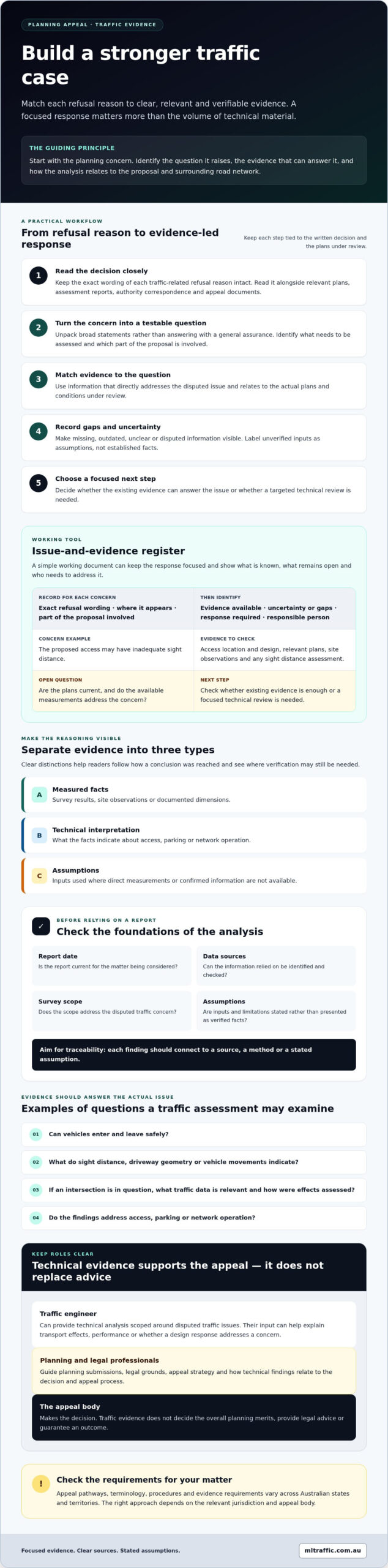
Keep three types of information distinct:
- Measured facts: survey results, site observations or documented dimensions.
- Technical interpretation: what those facts indicate about access, parking or network operation.
- Assumptions: inputs used where direct measurements or confirmed information aren’t available.
Making these distinctions visible helps readers follow how each conclusion was reached and identify where further verification may be needed.
Where does traffic evidence sit within an appeal?
A traffic assessment may support broader planning submissions by explaining whether a transport concern is substantiated, how the proposal performs, or whether a design response addresses the issue. It doesn’t determine the planning merits or establish the legal grounds of an appeal. Planning or legal advisers should guide appeal strategy, including how technical findings relate to the decision and appeal process.
A traffic engineer can provide technical analysis, but that isn’t legal advice or a prediction of approval. A clear case explains what the engineering evidence can establish, what remains a planning judgement, and what the appeal body must decide. No traffic report can guarantee the outcome.
How to turn refusal reasons into traffic evidence
Use the written decision as your starting point. Read each refusal reason alongside the relevant plans, assessment reports, authority correspondence and appeal documents. Keep the wording of the traffic concern intact before interpreting it. A broad statement such as “traffic impacts are unacceptable” needs to be unpacked, not answered with a general claim that the proposal will work.
Next, create an issue-and-evidence register. This keeps your response focused on what has actually been raised and shows where information is missing, outdated, unclear or disputed. A simple working document is enough, provided each issue has a clear source and next step.
Build an issue-and-evidence matrix
For each concern, record the exact refusal wording, where it appears, and the part of the proposal involved. Then note the evidence available, what remains uncertain, the response required and who is responsible for it. Mark unverified inputs as assumptions, not established facts.
- Concern: the proposed access may have inadequate sight distance.
- Evidence to check: the access location and design, relevant plans, site observations and any sight distance assessment.
- Open question: are the plans current, and do the available measurements address the concern?
- Next step: decide whether existing evidence can answer the issue or whether a focused technical review is needed.
This format helps distinguish an evidence gap from a disagreement about how existing information has been interpreted. It also helps direct technical questions to a traffic engineer and broader appeal strategy questions to a planning or legal adviser.
Match common traffic concerns to suitable analysis
Choose analysis according to the issue, rather than adding every possible assessment. A concern about traffic generation may call for a review of trip assumptions and supporting data. Access and visibility concerns may require assessment of the driveway layout or sight distance. Intersection concerns may need intersection analysis. Use parking demand or vehicle swept path analysis only where parking provision or vehicle manoeuvring is directly in dispute.
For assessment context, consult Austroads’ Guide to Traffic Management Part 12. It can inform how development-related transport effects are considered. Check the relevant state or territory guidance and appeal requirements as well.
Close each issue with a concise response: state the concern, identify the evidence relied on, explain what it shows and acknowledge any limitations. If you need project-specific traffic evidence, reviewing the relevant traffic assessment services can help identify what technical work may address the issues.
How to test traffic reports, data and competing conclusions
A traffic report is useful for an appeal issue only if its evidence matches the proposal and the question being assessed. Review it against the current plans, not just its conclusions. A report may be detailed yet rely on an earlier layout, a different development scale or assumptions that no longer reflect the application under review.
Conflicting conclusions don’t automatically mean one expert is wrong. The reports may use different survey periods, network assumptions, development scenarios or assessment boundaries. Compare those inputs first. This is a practical part of how to build a strong traffic case for a planning appeal: identify what explains the difference before deciding whether more analysis is needed.
Review the scope and reliability of existing evidence
Check the underlying material, not just summary findings. For traffic surveys, note the dates, locations, methods and any limitations stated in the report. Confirm that the assessed development details match the current proposal, including relevant access arrangements and site plans. If information is missing, record the gap and consider how it may affect the conclusion. Don’t dismiss evidence simply because its findings are unfavourable.
Ask whether the source supports the conclusion drawn. For example, observations at one location may not answer a concern about another access point. A survey may also be limited if its scope or timing doesn’t reflect the question under review. A traffic engineer can assess whether the existing report addresses the appeal issues and distinguish an evidence weakness from a difference in interpretation.
Assess technical conclusions and alternatives
Check whether assumptions about traffic generation, route choice and network operation are stated and explained. For a disputed intersection, identify whether the analysis covers the relevant movements and scenario. For an access concern, check that the plans and assessment address the specific access configuration. If two reports reach different findings, compare their inputs and methods on a like-for-like basis before relying on either conclusion.
Use a comparison record to keep the review focused. For each issue, capture:
- Concern: the traffic issue raised in the decision or appeal material.
- Evidence: the report, survey or plan relied on by each position.
- Limitation: any gap, assumption or difference in scope that could affect the conclusion.
- Response: whether the evidence is sufficient, needs clarification or calls for further technical review.
Expert evidence requirements depend on the appeal forum. For matters before VCAT, the VCAT Practice Note for Expert Evidence sets out expectations for expert material in its proceedings. Check the relevant tribunal or court requirements for your matter, and seek planning or legal advice on procedural questions. Technical review can inform an appeal, but it doesn’t replace that advice or predict the decision.
How to prepare an appeal-ready traffic evidence package
A clear evidence package makes it easier to follow how the traffic analysis answers the appeal issues. Organise the decision documents, current development plans, traffic reports, relevant correspondence and supporting technical data in one controlled set. Use consistent file names and dates so readers can identify which version of a plan or report each conclusion relies on.
For each technical finding, make the evidence trail visible: identify the source, the method used and any assumption that affects the result. If an assumption hasn’t been verified, label it clearly. This traceability helps the planning adviser, legal representative and decision-maker understand the basis and limits of the analysis.
Structure the technical material for clear review
Arrange the report or evidence summary around the traffic issues under consideration. Use headings that correspond to those issues, then explain the relevant method, finding and response. Concise tables, annotated plans or diagrams can clarify access arrangements, vehicle movements or the location of an assessed intersection. Keep supporting material in labelled appendices and refer to each appendix consistently in the main text.
- Core documents: decision and appeal materials, current plans, technical reports and relevant correspondence.
- Supporting evidence: source data, survey information, calculations and figures relied on in the analysis.
- Document control: dates, revision identifiers and clear references between findings and source material.
Keep the main explanation focused. Include enough detail for readers to check the reasoning, but avoid burying key findings in unreferenced attachments.
Coordinate experts and address limitations
Before finalising submissions, agree who is responsible for each type of issue. The traffic engineer should address technical transport questions; the planning adviser should place those findings within the planning merits; and a legal representative should guide legal submissions and procedural matters. Engineering conclusions shouldn’t be framed as legal advice.
Disclose relevant limitations, such as unavailable data or an assumption used in the analysis, and explain how each affects the conclusion. Then check that report findings match the development plans and appeal documents. Inconsistencies can create avoidable uncertainty, even where the underlying analysis is sound.
Submission formats, evidence requirements and deadlines can differ between appeal pathways. Confirm the requirements for the relevant jurisdiction with the responsible authority or your adviser, and allow time to resolve document or version discrepancies. For project-specific technical input, review traffic assessment services and consider whether a report review is needed to support the appeal package.
When to engage a traffic engineer for a planning appeal
Consider a traffic engineering review when a refusal turns on technical questions that existing evidence doesn’t resolve. Examples include disputed traffic generation assumptions, whether the proposed access addresses a sight distance concern, or how development traffic may affect an intersection. A review can also help test whether an existing report responds to the issues raised, or whether its data, scope or assumptions need clarification.
The purpose is to answer defined engineering questions, not to produce a report for its own sake. When considering how to build a strong traffic case for a planning appeal, focus the work on the evidence gap that matters to the appeal. A traffic engineer provides technical analysis. They don’t provide legal representation, determine planning merits or guarantee an appeal outcome. Coordinate their work with your planning adviser and legal representative.
What to provide when seeking a traffic review
Give the engineer enough material to understand the decision and the proposal under review. A focused brief helps them assess the relevant evidence and avoid work that doesn’t address the appeal issues.
- The written decision, refusal reasons and available appeal documents.
- Current development plans and any earlier versions relevant to the concerns.
- Existing Traffic Impact Assessment reports, technical data and related correspondence.
- A short list of disputed findings, unanswered questions and applicable submission deadlines.
Ask the engineer to define the review scope, required inputs, deliverables, assumptions and limitations. Confirm which questions need technical analysis and which should go to your planning or legal adviser. Check any expert evidence and submission requirements with the relevant appeal body or adviser, as procedures vary by jurisdiction.
Choose support that matches the evidence gap
A Traffic Impact Assessment may be relevant where the appeal concerns development traffic or effects on the surrounding network. If the issue is narrower, request analysis suited to it: intersection analysis for a disputed intersection, sight distance assessment for a visibility concern, or vehicle swept path analysis where vehicle manoeuvring is in question. The right scope depends on the plans, refusal reasons and available evidence.
ML Traffic Engineers Australia provides traffic engineering and transport planning services nationally, including Traffic Impact Assessments and intersection analysis. Review the traffic assessment services to see which technical areas may relate to your evidence gap. If a project-specific review appears relevant, contact the traffic engineering team with the decision documents and your questions. A technical review can support an appeal, but the overall case remains a matter for the relevant decision-maker.
Build your appeal on clear, relevant evidence
A strong traffic case starts with the issues in the decision, then connects each concern to evidence relevant to the proposal. Check that reports use current plans, explain their assumptions and show how conclusions were reached. Keep technical findings distinct from planning merits and legal submissions, and confirm appeal procedures with the relevant authority or adviser.
If a report leaves a gap or competing conclusions need review, define the technical questions before commissioning further work. That focused approach is central to how to build a strong traffic case for a planning appeal. A traffic engineer can assess the evidence and provide technical analysis, but can’t determine the appeal outcome or replace planning and legal advice.
ML Traffic Engineers provides traffic engineering and transport planning services across Australia and has over 15 years of experience supporting development applications. Relevant services include Traffic Impact Assessments, intersection analysis and sight distance assessment. Discuss traffic assessment support for your appeal to find out whether project-specific technical input may help address the issues in your case.
Frequently Asked Questions
What makes a traffic case strong in a planning appeal?
A strong traffic case links each traffic-related concern to relevant, verifiable evidence and a clear technical response. It should use information that matches the current proposal, explain its methods and assumptions, and identify any limitations. To understand how to build a strong traffic case for a planning appeal, focus on answering the specific issues in the decision rather than relying on a lengthy report that doesn’t address them directly.
Can a traffic engineer help challenge a council traffic assessment?
Yes. A traffic engineer can review the assessment’s scope, data, assumptions and methods, then explain whether its conclusions address the proposal and the issues in dispute. For example, they may identify that an intersection analysis uses a different development scenario from the current plans. Their role is to provide technical analysis, not legal representation or a prediction of the appeal outcome.
What traffic evidence should I include in a planning appeal?
Include evidence that directly addresses the traffic issues raised, such as the decision documents, current plans, relevant traffic reports, survey data and correspondence. Depending on the concern, supporting analysis might cover traffic generation, access, sight distance, intersection operation, parking demand or vehicle manoeuvring. Include sources, dates, methods and relevant assumptions so the basis of each technical conclusion can be checked. Confirm submission requirements with the relevant appeal body or adviser.
How do I respond to traffic-related reasons for refusal?
Start with the exact wording of each refusal reason and identify the traffic question it raises. Match that question to existing evidence, then check whether the information is current and relevant to the proposal. Set out what the evidence shows, how it was assessed and any limitations. If there’s a material gap or disputed assumption, seek targeted technical advice rather than making an unsupported assertion.
Do I need a new Traffic Impact Assessment for an appeal?
Not necessarily. First check whether the existing Traffic Impact Assessment reflects the current proposal and adequately addresses the refusal issues. If it remains relevant, a focused review or supplementary analysis may help clarify a particular assumption or technical concern. A new assessment may be worth considering if the proposal has changed or important evidence gaps remain. A traffic engineer can advise on technical scope, while your adviser can confirm procedural requirements.
Can traffic evidence guarantee planning appeal approval?
No. Traffic evidence can help explain and test transport-related issues, but it can’t guarantee approval or determine the appeal by itself. The appeal decision involves matters beyond engineering analysis, including planning merits and any applicable legal considerations. A traffic engineer can provide technical findings within a defined scope. A planning or legal adviser can help explain how those findings relate to the wider appeal and its requirements.
Do planning appeal requirements differ between Australian states and territories?
Yes. Appeal pathways, decision-making bodies, terminology and evidence procedures vary across Australian jurisdictions. Requirements can also depend on the type of decision under review and the relevant forum. Before preparing or lodging material, check current instructions, deadlines and expert evidence requirements with the responsible authority, tribunal or court, or a planning or legal adviser. Don’t assume a process used in one state applies elsewhere.

Disclaimer
The content on www.mltraffic.com.au, including all technical articles, guides, and resources, is provided for general informational and educational purposes only. It is not intended to constitute professional advice in traffic engineering, transportation planning, development approvals, or any other technical or legal field.
While ML Traffic Engineers makes every reasonable effort to ensure the accuracy, completeness, and timeliness of the information published, we do not provide any warranties or representations (express or implied) regarding its reliability, suitability, or availability for any particular purpose. Any reliance you place on the content is strictly at your own risk.
In no event shall ML Traffic Engineers, its directors, employees, authors, or affiliates be liable for any direct, indirect, incidental, special, consequential, or punitive damages (including, without limitation, loss of profits, data, or business opportunities) arising out of or in connection with the use of, or inability to use, any information provided on this website.
The articles and guides on this site are not a substitute for engaging a qualified, registered professional traffic engineer (such as an NPER or RPEQ engineer) to assess your specific project requirements. For tailored advice, compliance assessments, or traffic engineering services, please contact a competent professional.
This disclaimer may be updated from time to time without notice. By accessing or using this website, you agree to be bound by the most current version of this disclaimer.
