

A single incorrect decimal point in your traffic assessment can trigger a formal Request for Information (RFI) that stalls your project for 90 days or more. You know that Council planners and Transport for NSW authorities prioritize data integrity. However, the technical conflict between ITE manuals and local guidelines often leads to avoidable errors. It’s common to feel uncertain when translating complex building dimensions into precise vehicle movements for a development application.
This professional guide provides the technical framework you need to master how to calculate trip generation rates using established Australian methodologies. You’ll gain the expertise required to produce Council-compliant traffic data that withstands rigorous scrutiny from state authorities. We’ve seen how accurate forecasting prevents costly delays across more than 10,000 sites since 2005. We will examine the specific variables impacting trip generation, compare the application of TfNSW Technical Direction TDT 2013/04a against international standards, and outline a step-by-step methodology for accurate traffic volume forecasting.
Key Takeaways
- Understand why accurate trip generation is the critical first step in the four-step transport modelling process required for your Development Application (DA).
- Identify the correct industry-standard data sources, such as the “Guide to Generating Traffic Developments” and the ITE Trip Generation Manual, to ensure regulatory compliance.
- Master a precise 5-step methodology on how to calculate trip generation rates by correctly defining land-use categories and independent variables like GFA.
- Avoid common pitfalls that lead to Council rejection, including miscalculated inbound/outbound trip splits and overlooked service vehicle requirements.
- Learn how professional traffic engineering validation and senior-level expertise ensure your traffic data withstands technical scrutiny from local authorities.
Table of Contents
- What is Trip Generation and Why Does it Matter for Your DA?
- Standard Sources for Trip Generation Rates in Australia
- How to Calculate Trip Generation: A 5-Step Process
- Common Pitfalls and How to Avoid Council Rejection
- Why Professional Traffic Engineering Validation is Essential
What is Trip Generation and Why Does it Matter for Your DA?
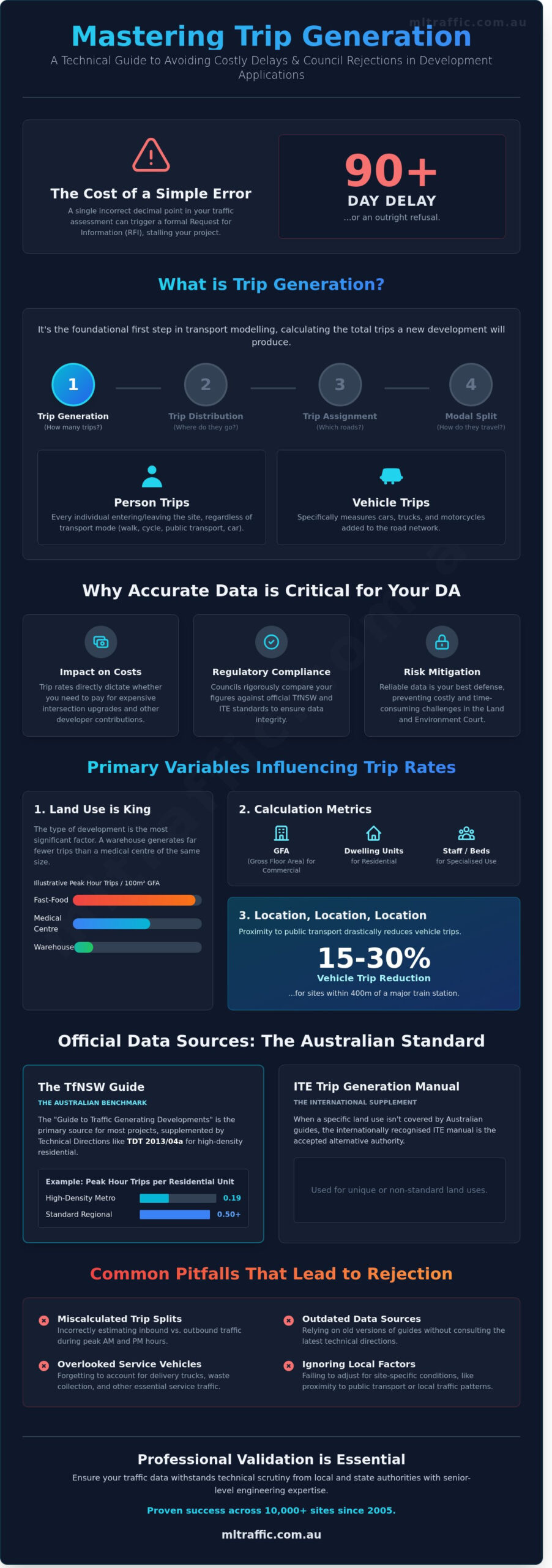
Trip generation is the foundational first step of the professional four-step transport modelling process. It involves calculating the total number of trips a proposed development will produce during peak hours and over a 24-hour period. For developers, this data is the primary metric Councils use to evaluate the impact of a project on the local road network. Since 2005, ML Traffic Engineers has observed that accurate trip data is the most scrutinized component of any Development Application (DA). If your figures are inaccurate, you risk a formal Request for Information (RFI) or an outright refusal.
It’s vital to distinguish between person trips and vehicle trips. A person trip accounts for every individual entering or leaving the site, regardless of their mode of transport. A vehicle trip specifically measures the cars, trucks, and motorcycles added to the road. In high-density urban areas, person trips might be high while vehicle trips remain low due to high public transport usage. Understanding how to calculate trip generation rates allows you to prove your project won’t cause gridlock, which is essential for securing planning approval.
- Direct Impact: Trip rates dictate whether you need to pay for intersection upgrades.
- Compliance: Councils compare your figures against the RMS Guide to Traffic Generating Developments or ITE standards.
- Risk Mitigation: Reliable data prevents costly delays in the Land and Environment Court.
Trip Generation in the Context of a TIA
Trip generation forms the base of a Traffic Impact Assessment. Once you establish the generation rate, you move to trip distribution (where the cars go) and trip assignment (which specific roads they use). If the initial generation figures are flawed, the entire assessment fails. Over 10,000 sites analyzed by our firm show that incorrect rates lead to unnecessary and expensive infrastructure redesigns. Precision at this stage ensures the Council’s engineering department accepts your traffic report without dispute.
Primary Variables Influencing Trip Rates
Several variables determine the final trip count. Land-use type is the most significant factor. A 1,000 sqm warehouse generates far fewer peak-hour trips than a 1,000 sqm medical centre or a fast-food outlet. We use specific independent variables to calculate these figures, including:
- Gross Floor Area (GFA): Typically used for commercial and industrial projects.
- Dwelling Units: The standard metric for residential apartments or subdivisions.
- Staff or Bed Count: Used for specialized uses like childcare centres or aged care facilities.
Location also plays a decisive role. A development within 400 metres of a major train station can see vehicle trip reductions of 15% to 30% compared to isolated suburban sites. When you determine how to calculate trip generation rates, you must account for these site-specific factors to avoid overestimating your traffic impact and overpaying on developer contributions.
Standard Sources for Trip Generation Rates in Australia
Selecting the correct data source is the first step in learning how to calculate trip generation rates for any Australian development. Traffic engineers rely on established manuals to ensure assessments meet council requirements. Using outdated figures leads to rejected applications. Accuracy requires a deep understanding of which guide takes precedence in a specific jurisdiction.
The TfNSW Guide: The Australian Benchmark
The Guide to Traffic Generating Developments, published by Transport for New South Wales (TfNSW), remains the primary benchmark for most Australian projects. While the original guide dates back to 2002, it’s supplemented by newer Technical Directions, such as TDT 2013/04a. This update is critical for high-density residential developments near transit hubs. Professionals must distinguish between “High Density Residential” and “Regional” rate variations. For example, a high-density apartment in a metropolitan center might generate 0.19 trips per unit, whereas a regional site could exceed 0.5 trips per unit. We interpret the survey-based data in the technical appendices to find the most representative match for your site’s specific characteristics.
ITE Trip Generation Manual: When to Use It
When an Australian land use doesn’t fit TfNSW categories, we look to the Institute of Transportation Engineers (ITE) Trip Generation Manual. The 11th Edition contains over 1,500 data sets. It’s useful for niche land uses like specialized medical clinics or unique industrial facilities not covered locally. However, using this data without modification is a technical error. American data often reflects higher car dependency and different vehicle ownership levels. This creates a risk of over-estimating traffic for Australian sites. We apply adjustment factors to align international data with local driving conditions and proximity to public transport.
Maintaining compliance in 2024 requires using the most current versions of these documents. Councils and state authorities frequently update their preferred data sets to reflect changing travel behaviors. Our engineers verify every rate against the latest technical bulletins to ensure your Traffic Impact Statement (TIS) stands up to scrutiny. We have processed over 10,000 sites using these rigorous standards. You can review our traffic engineering services to see how we apply this data to development applications.
- TfNSW Guide (2002): The foundational document for Australian trip rates.
- Technical Direction TDT 2013/04a: Essential for modern high-density residential calculations.
- ITE Manual (11th Edition): The global standard for niche or specialized land uses.
- Victorian Traffic Engineering Manuals: Used specifically for projects within Victoria to meet Department of Transport standards.
Experienced consultants don’t just copy numbers from a table. We analyze the survey peak hours and the standard deviation provided in the source data. This ensures the peak vehicle movements used in your assessment are realistic and defensible during the RPEQ certification process. If the data is 20 years old, we look for contemporary surveys to validate the results.
How to Calculate Trip Generation: A 5-Step Process
Understanding how to calculate trip generation rates is a fundamental requirement for any Traffic Impact Assessment (TIA). Developers must follow a standardized methodology to ensure that the projected traffic volumes are defensible during the council approval process. Our traffic engineering services utilize a rigorous 5-step framework to determine these figures with precision.
- Step 1: Define the Land Use Category. You must categorize the development precisely according to the relevant planning scheme or the RMS Guide to Traffic Generating Developments. A “High Density Residential” site has different characteristics than “Medium Density Residential” or “Seniors Housing.”
- Step 2: Identify the Independent Variable. The rate is applied against a specific unit of measure. This is usually the Gross Floor Area (GFA) for commercial projects, per 100sqm, or the number of units/bedrooms for residential developments.
- Step 3: Select the Appropriate Peak Hour Rate. Traffic impact is measured during the AM and PM road network peaks. You must select the specific rate for these windows, as PM peaks for retail are often significantly higher than AM peaks.
- Step 4: Apply the Formula. Use the standard equation: Total Trips = Trip Rate × Independent Variable. This provides the raw number of vehicle trips generated by the site.
- Step 5: Document the Source and Adjustments. Every calculation must cite its source, such as the RMS Guide (2002) or TDT 2013/04a. Any deviations or reductions must be justified with empirical data or site-specific surveys.
Step-by-Step Calculation Example
Consider a 20-unit residential apartment block in a high-density area. According to standard RMS rates, the PM peak hour rate is 0.29 trips per unit. To determine how to calculate trip generation rates for this site, you multiply 20 units by 0.29, resulting in 5.8 (rounded to 6) vehicle trips per hour (vtph). For daily traffic (vtpd), the rate is typically 3.1 trips per unit, totaling 62 daily trips. If the site is mixed-use, perhaps including 100sqm of specialty retail, you must calculate the retail generation separately and add it to the residential total before applying any shared-use reductions.
Adjusting for Trip Reductions
Raw trip rates don’t always reflect reality. For retail centres, we apply “multi-purpose trip” reductions, which can account for 15% to 25% of traffic. This recognizes that one visitor may visit multiple shops within the same complex. Service stations and fast-food outlets rely heavily on “pass-by” traffic, where up to 45% of vehicles are already on the road and simply turning into the site. Finally, a robust Green Travel Plan can justify a 5% to 10% reduction in rates by demonstrating proximity to high-frequency public transport and the provision of superior end-of-trip facilities.
Common Pitfalls and How to Avoid Council Rejection
Council engineers frequently reject Traffic Impact Statements because developers fail to account for the nuances of local movement. Understanding how to calculate trip generation rates requires more than just copying figures from a historical table. Accuracy in your submission prevents costly delays during the Request for Information (RFI) stage and ensures your project remains viable.
Several technical oversights lead to immediate pushback from authorities:
- Ignoring Directional Splits: Residential developments typically see an 80% outbound split during the 7:00 AM to 9:00 AM peak. Applying a generic 50/50 split misrepresents the actual impact on local intersections and signal timings.
- Service Vehicle Oversight: A standard warehouse or retail site generates specific heavy vehicle movements for waste collection and freight. Failing to include these 10 to 20 daily movements leads to physical site failure and safety concerns.
- Outdated Data: Using data from 2015 doesn’t reflect 2024 travel patterns. Post-pandemic shifts have altered peak hour volumes by up to 12% in specific metropolitan sectors as work-from-home trends stabilize.
- Parking Induced Demand: High parking ratios often increase trip rates by 5% to 10% because more users choose private vehicles over public transport when a space is guaranteed.
As travel patterns become more complex and data sources evolve, the tools for analysis must also advance. For professionals looking to stay ahead of these trends, it can be beneficial to explore Artificial Intelligence Course and learn how to apply predictive modeling to traffic engineering challenges.
The Problem with Generic Rates
Council engineers view “rule of thumb” estimates with skepticism. These averages often fail to account for site-specific constraints or local congestion levels. We use Swept Path Analysis to validate that the physical layout can accommodate the vehicle types identified in your calculations. If you under-estimate traffic in sensitive residential zones, your application will likely face refusal based on community amenity impacts. Professional engineers don’t guess; they use verifiable data to support every claim.
When to Use Site-Specific Surveys
If standard guides don’t fit your specific land use, you must employ the Empirical Method. This involves conducting precise traffic counts at three similar existing sites to establish a bespoke rate. This is the most effective way to show how to calculate trip generation rates for unique developments like specialized medical centres or boutique childcare hubs. To override standard guide rates, you must present this data in a format that complies with Australian Standards. Professional surveys provide the technical evidence needed to prove your development won’t compromise the safety or efficiency of the local road network.
If your project requires a bespoke assessment to satisfy Council requirements, contact our senior engineers for a direct technical consultation.
Why Professional Traffic Engineering Validation is Essential
Understanding how to calculate trip generation rates provides the technical baseline for your development application. However, raw numbers alone rarely satisfy Council planners or transport authorities. These agencies require certified analysis from qualified traffic consultants who can justify every vehicle movement added to the local road network. ML Traffic Engineers has been trading since 2005, and we apply data gathered from over 10,000 sites to ensure your calculations stand up to rigorous scrutiny. This deep database allows us to use realistic variables rather than generic averages that often lead to over-engineered requirements or project rejections.
Our firm operates on a principal-led philosophy that sets us apart from larger, bureaucratic consultancies. The traffic consultant who provides your project quote is the same senior engineer who performs the technical work and signs the final report. This direct accountability ensures that complex technicalities aren’t lost in translation between junior staff and senior management. When you face difficult Council negotiations, you need evidence-based reporting. We’ve defended trip data for every conceivable land use, including apartments, childcare centres, medical clinics, and industrial warehouses, using empirical evidence to turn subjective debates into factual approvals.
Securing Your DA Approval
A professional Traffic Impact Assessment (TIA) does more than just count cars. It integrates your trip data with functional site requirements like Car Park Design. Every project we handle must meet the rigid standards of AS 2890.1 to ensure safety and compliance. We verify that your peak hour volumes align with driveway ramp grades and sight-line requirements. If you’re ready to move your project forward with a team that understands how to calculate trip generation rates for maximum efficiency, contact ML Traffic Engineers for a project-specific quote today.
Our National Expertise
With experience spanning across 10,000+ sites, our team understands the nuances of different local government areas and their specific transport requirements. Our senior principals, Michael Lee and Benny Chen, bring between 30 and 40 years of individual experience to every traffic assessment. You get direct access to this expertise without navigating layers of administrative gatekeepers. You can learn more about our team and our hands-on philosophy. We focus on providing meticulous, results-oriented service for private clients who need their development applications approved without unnecessary delays or technical errors.
Secure Your Development Approval with Accurate Traffic Data
Mastering how to calculate trip generation rates is essential for any developer who wants to avoid council rejection. Precise data prevents the costly delays associated with Requests for Further Information (RFIs). While the 5-step process provides a framework, professional validation ensures your Traffic Impact Assessment meets the strict requirements of Australian Standards. ML Traffic Engineers offers over 15 years of industry experience to help you navigate these technical hurdles. We’ve successfully assessed 10,000+ sites across Australia, providing the technical certainty required for complex DAs. You don’t have to worry about junior gatekeepers or administrative delays. The principal who provides your quote is the seasoned expert who performs the actual engineering work. This hands-on accountability ensures your project remains on schedule and compliant. Get a Professional Traffic Impact Assessment Quote today. We’re ready to help you clear the path for your next successful development.
Frequently Asked Questions
What is the difference between trip generation and trip distribution?
Trip generation calculates the total number of vehicle movements entering and exiting a site, while trip distribution determines the specific directions those vehicles take on the surrounding road network. Generation focuses on the volume produced by a land use, such as 40 trips per hour for a childcare center. Distribution uses existing traffic patterns or gravity models to assign those 40 trips to specific intersections and approach routes.
How do I find the trip generation rate for a specific land use in Australia?
You should consult the Transport for NSW Guide to Traffic Generating Developments or the updated Technical Direction TDT 2013/04a for standard Australian rates. These documents provide empirical data for various categories, such as high-density residential units which typically generate 0.19 to 0.24 peak hour trips. If your specific land use isn’t listed, we conduct independent surveys of 3 similar sites to establish a defensible rate.
Does a higher trip generation rate always mean I need more parking?
No, trip generation measures the flow of traffic while parking demand depends on the duration of stay and local Council LEP requirements. A drive-through coffee shop has a high trip generation rate but low parking demand because customers stay for less than 5 minutes. Conversely, a 500 square meter medical clinic has lower trip generation but requires significant parking because patients remain on-site for 45 to 60 minutes.
Can I use ITE rates for a Development Application in Australia?
You can use Institute of Transportation Engineers (ITE) rates only as a secondary reference when Australian data from TfNSW or Victorian sources is unavailable. Most Australian Councils prefer local data because US driving habits and urban densities differ from our domestic standards. If we use ITE data, we must justify the selection with a comparative analysis to ensure the 85th percentile rates align with local traffic behavior.
What happens if Council disagrees with my calculated trip rates?
If a Council officer disputes your figures, you must provide a formal rebuttal supported by 7 day traffic counts or empirical evidence from comparable developments. We often resolve these disputes by presenting data from our database of 10,000 plus sites to prove the proposed rates are realistic. This technical justification is vital to avoid a Request for Information (RFI) that could delay your project by 60 days or more.
How does Gross Floor Area (GFA) affect the total number of trips?
Total trips are the direct product of the GFA multiplied by the specific rate assigned to that land use. For a warehouse, the rate might be 0.5 trips per 100 square meters of GFA, meaning a 2,000 square meter facility generates 10 peak hour trips. Accuracy is critical when learning how to calculate trip generation rates because even a 10% error in GFA measurements can lead to incorrect infrastructure levy assessments.
Do I need a traffic engineer to calculate these rates for my DA?
Yes, Council typically requires a Traffic Impact Statement (TIS) or Assessment signed by a qualified professional to ensure the calculations meet Australian Standards. An experienced engineer understands how to calculate trip generation rates while accounting for multi-use discounts and public transport credits. This expertise ensures your application passes the initial 14 day lodgment check and moves straight to the formal assessment phase without technical setbacks.
Are trip generation rates different for weekends versus weekdays?
Yes, rates fluctuate significantly based on the day, with retail and recreational sites often seeing 40% higher volumes on Saturdays than on weekdays. We analyze the “design hour” which is the period of peak impact for your specific development. For a standard office, we focus on the weekday PM peak, but for a 1,000 square meter gym, we must assess the Saturday morning peak to satisfy Council requirements.
Which areas do you cover?
We are traffic engineers servicing Melbourne, Sydney, Brisbane, Gold Coast, Hobart, Perth, Adelaide, Darwin, Canberra and surrounding areas.
Disclaimer
The content on www.mltraffic.com.au, including all technical articles, guides, and resources, is provided for general informational and educational purposes only. It is not intended to constitute professional advice in traffic engineering, transportation planning, development approvals, or any other technical or legal field.
While ML Traffic Engineers makes every reasonable effort to ensure the accuracy, completeness, and timeliness of the information published, we do not provide any warranties or representations (express or implied) regarding its reliability, suitability, or availability for any particular purpose. Any reliance you place on the content is strictly at your own risk.
In no event shall ML Traffic Engineers, its directors, employees, authors, or affiliates be liable for any direct, indirect, incidental, special, consequential, or punitive damages (including, without limitation, loss of profits, data, or business opportunities) arising out of or in connection with the use of, or inability to use, any information provided on this website.
The articles and guides on this site are not a substitute for engaging a qualified, registered professional traffic engineer (such as an NPER or RPEQ engineer) to assess your specific project requirements. For tailored advice, compliance assessments, or traffic engineering services, please contact a competent professional.
This disclaimer may be updated from time to time without notice. By accessing or using this website, you agree to be bound by the most current version of this disclaimer.
