

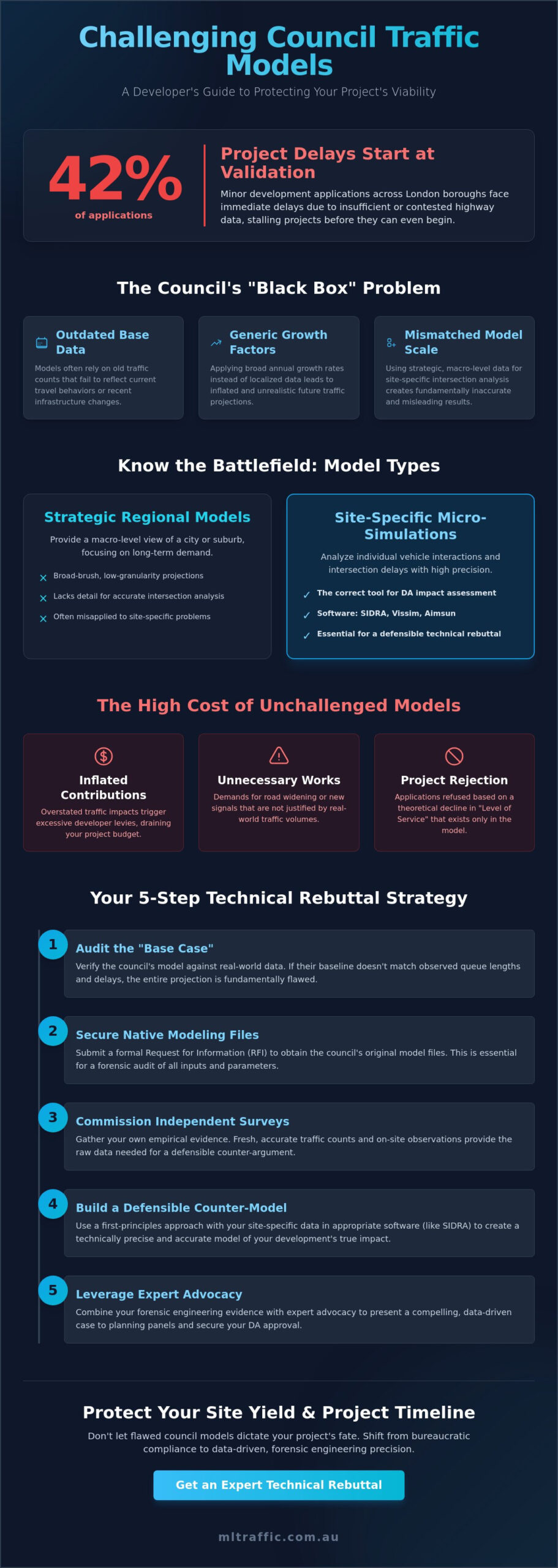
42% of minor development applications across London boroughs face immediate delays at the validation stage due to insufficient or contested highway data. You’ve likely experienced the frustration of a project being stalled by inflated traffic impact projections or aggressive parking requirements that don’t reflect site-specific realities. It’s common to feel that council modeling acts as a “black box” designed to demand excessive infrastructure contributions. Learning how to challenge a council traffic model is essential to protecting your site yield and project timeline.
We’ll show you the technical strategies and evidence-based methods required to successfully dispute these projections and secure your DA approval. This guide details how to identify specific errors in council modeling, present a defensible counter-model using empirical data, and leverage the latest Department for Transport TAG guidance. By shifting from theoretical assumptions to forensic engineering data, you can minimize unnecessary costs and keep your development on track. The focus here is on expert-led technical precision rather than bureaucratic compliance.
Key Takeaways
- Distinguish between strategic regional models and site-specific micro-simulations like SIDRA or Vissim to identify the appropriate scale for technical dispute.
- Learn how to challenge a council traffic model by auditing trip generation rates and verifying if “Base Case” calibrations reflect actual real-world queue lengths.
- Utilize sensitivity analysis and a first-principles approach to rebuild models from raw traffic count data rather than relying on generic, inflated assumptions.
- Secure native modeling files through formal RFI requests and commission independent surveys to provide a defensible technical rebuttal for your development application.
- Combine forensic engineering precision with expert advocacy to minimize infrastructure contributions and ensure project progression through planning panels.
What is a Council Traffic Model and Why Do They Fail?
Traffic modeling serves as a mathematical representation of real-world traffic conditions. It acts as a predictive tool to assess how a new development affects intersection performance and road network capacity. Councils rely on these transportation forecasting models to determine whether a local area can absorb additional vehicle movements. However, these models are only as reliable as the data used to calibrate them.
Many councils operate within a “Black Box” framework. They often utilize outdated base-year data or apply generic annual growth factors that fail to account for localized changes in travel behavior. When you investigate how to challenge a council traffic model, your primary objective is to expose these internal inconsistencies. By replacing broad-brush assumptions with verified, site-specific empirical evidence, you shift the technical burden of proof back onto the regulatory authority.
To better understand this concept, watch this helpful video:
It’s critical to distinguish between the two primary scales of modeling. Strategic regional models provide a macro-level view of an entire city or suburb, focusing on long-term demand. Conversely, site-specific micro-simulation models, such as SIDRA or Vissim, analyze individual vehicle interactions and intersection delays. Councils often misapply strategic data to site-specific problems. This leads to inaccurate conclusions about a development’s impact and unjustified demands for infrastructure.
Common Software Platforms Used by Councils
Councils typically mandate specific software for technical submissions. Understanding these platforms is the first step in identifying modeling errors:
- SIDRA Intersection: This is the industry standard for individual intersection analysis. It evaluates capacity, level of service (LoS), and queue lengths.
- Vissim and Aimsun: These platforms are used for complex network modeling. They simulate individual vehicle flows to visualize bottlenecks across multiple signalized intersections.
- Strategic Models: These broad-brush projections often lack the granularity required for precise Intersection Analysis.
The Consequences of an Unchallenged Flawed Model
Accepting a flawed model without technical scrutiny can be devastating for project viability. Flawed projections lead to inflated infrastructure contributions, where overstated traffic impacts trigger excessive Section 7.11 or similar developer levies. You might also face unnecessary requirements for road widening or signalization that the actual traffic volume doesn’t justify. Ultimately, projects are frequently rejected based on a perceived “unacceptable” decline in Level of Service (LoS) that exists only in a theoretical, uncalibrated model. Professional intervention ensures your development isn’t penalized for systemic modeling errors.
Identifying Technical Flaws in a Council Traffic Projection
Auditing a council’s traffic projection is a forensic exercise that requires scrutinizing every input variable. When determining how to challenge a council traffic model, the first step is to verify the “Base Case” calibration. A model is only valid if it accurately reflects current real-world conditions. We frequently find that council models fail to match observed queue lengths or existing intersection delays. If the baseline is incorrect, every subsequent projection for your development is fundamentally flawed.
Growth rate assumptions and saturation flow parameters are often manipulated to produce overly conservative outcomes. Many 10-year projections rely on generic growth factors rather than realistic census data or localized planning trends. Similarly, gap acceptance parameters used in software like SIDRA may be set too high, assuming drivers are less efficient than they actually are. Referencing the Queensland Government’s Guide to Traffic Impact Assessment provides a benchmark for what constitutes acceptable modeling standards and where council projections might deviate from established engineering principles. Learning how to challenge a council traffic model requires this level of deep dive into saturation flow and gap acceptance parameters.
Trip Generation: Generic vs. Empirical Data
Councils often rely on generic trip generation guides, such as the RTA or TfNSW Technical Directions, which may not account for the efficiency of modern mixed-use developments. These standard rates frequently overstate vehicle movements for sites with high public transport accessibility. Trip generation is the most common point of model failure in 2026. To counter this, we conduct “like-for-like” surveys at existing sites with similar land-use characteristics. This empirical data provides a much more accurate representation of actual traffic demand than theoretical guides. If you need assistance with data collection, our team provides comprehensive Traffic Impact Assessment (TIA) Reports to support your technical challenge.
Intersection Geometry and Phasing Errors
A frequent technical error in council modeling involves the misrepresentation of physical road geometry. Models must reflect actual lane widths, turn bay lengths, and gradient realities. Errors in signal phasing or pedestrian crossing timings can also lead to artificial congestion in the simulation. Utilizing Swept Path Analysis can prove a model’s geometric assumptions are physically impossible, such as assuming a heavy vehicle can navigate a turn that is physically too narrow. Highlighting these physical constraints forces the council to reconsider their modeling logic and adjust their requirements accordingly.
Strategic Methods to Challenge Model Assumptions
Challenging a council’s position requires more than pointing out errors; it demands a proactive technical strategy. When considering how to challenge a council traffic model, developers must employ rigorous testing methodologies that withstand regulatory scrutiny. One of the most effective tools in this process is Sensitivity Analysis. This involves testing how marginal adjustments in input variables, such as a 5% reduction in background traffic or a minor change in gap acceptance, alter the final performance metrics of an intersection.
The Sensitivity Analysis Framework
We focus on identifying “tipping points” where a development’s impact transitions from acceptable to supposedly “unacceptable.” By isolating these variables, we can demonstrate that the council’s “worst-case scenario” is statistically improbable. Our reports present a “Likely Case” based on empirical reality versus the “Council Case” based on theoretical extremes. This comparison often reveals that the infrastructure upgrades demanded by the council are disproportionate to the actual impact. Cross-referencing methodologies against established standards, such as those found in Caltrans’ Traffic Impact Study Preparation Guide, provides a global benchmark for technical rigor.
Data-Driven Rebuttals
Rebuilding a model from first principles is often necessary when the council’s base data is corrupted or outdated. This involves using 24-hour pneumatic tube counts instead of limited manual peak-hour counts to capture a comprehensive view of road performance. Historical traffic data can also be leveraged to disprove inflated growth projections that don’t align with actual trends. These data-driven rebuttals form the backbone of a successful Traffic Impact Assessment (TIA).
Technical precision is further bolstered by comparative modeling. Running the same data through different software platforms, such as comparing SIDRA results with Vissim simulations, can highlight discrepancies in how the council’s software handles specific traffic behaviors. Finally, an independent peer review of the council’s native modeling files can uncover hidden “hard-coded” assumptions that artificially inflate congestion levels. This forensic approach is essential for any developer looking into how to challenge a council traffic model effectively.
Step-by-Step: Preparing a Technical Rebuttal and Counter-Model
Successfully executing a challenge requires a disciplined, chronological approach. You cannot rely on qualitative arguments alone when dealing with technical planning panels. The process for how to challenge a council traffic model begins with securing the raw data that formed the basis of the council’s initial assessment. Without the native files, your team is essentially guessing at the internal logic that led to the disputed projections.
Follow these five steps to build a defensible technical case:
- Step 1: Submit a formal Request for Information (RFI) to obtain the council’s native modeling files, such as .sip for SIDRA or .vsz for Vissim.
- Step 2: Commission independent traffic counts and site-specific surveys to verify the base case and prove current road performance.
- Step 3: Audit the files to identify specific parameter errors, including inflated trip rates, unrealistic saturation flows, or incorrect Peak Hour Factors (PHF).
- Step 4: Execute a comprehensive counter-model that incorporates the corrected empirical data and reflects your proposed site design.
- Step 5: Compile these findings into a formal Technical Traffic Engineering Response Report, certified and signed by a senior principal.
Requesting Council Modeling Files
You’re entitled to review the underlying logic used to assess your Development Application (DA). Requesting native modeling files is a mandatory step because PDF summary reports often mask “hard-coded” errors. These might include manually overridden saturation flows or hidden penalties on specific movements that aren’t visible in a standard printout. A qualified Traffic Engineer must audit these files directly to identify where the council has deviated from standard modeling protocols or national guidelines. If your project is currently stalled by disputed projections, contact our senior principals to initiate a forensic model audit and secure the data you need.
Building the Counter-Model
A defensible counter-model must adhere strictly to Australian Standards, specifically AS 2890.1 and AS 2890.2 for parking and access. Every deviation from the council’s original model requires explicit technical justification. We use visual evidence, including queue diagrams and flow maps, to translate complex data into a format that non-technical planners and planning panels can understand. This transparency builds credibility and makes it difficult for authorities to maintain a position based on flawed theoretical data. By documenting how to challenge a council traffic model through corrected geometry and realistic phasing, you provide a clear path to DA approval with minimal infrastructure contributions.
Leveraging Expert Traffic Engineering Advocacy for DA Success
Technical accuracy is the baseline, but securing a Development Application (DA) approval often requires strategic negotiation. When you learn how to challenge a council traffic model, you quickly realize that data alone rarely convinces a skeptical planning officer or a local community group. Professional advocacy bridges the gap between a corrected technical model and a successful project determination. Senior principals must lead these discussions to ensure the technical integrity of the rebuttal is maintained throughout the negotiation process.
Resolution often involves proposing minor design modifications that address localized safety concerns without sacrificing site yield. For instance, adjusting a Sight Distance Assessment or refining a car park entry can satisfy council requirements while the underlying traffic model remains the primary defense against excessive infrastructure levies. This collaborative yet firm approach moves the project from a technical stalemate to a resolution that respects both engineering standards and commercial realities.
Expert Witness and Planning Panel Representation
Planning panels and the Land and Environment Court demand a high level of technical accountability and professional tenure. We represent the integrity of our empirical data under rigorous cross-examination, ensuring that the council’s theoretical assumptions are held to the same standard as our forensic evidence. Project momentum is maintained through this professional accountability, as senior experts provide the necessary assurance to decision-makers that the development’s impact is manageable. Defending the model at this level requires an expert who understands the nuances of both transportation planning and legal procedure.
The ML Traffic Advantage
ML Traffic Engineers Australia distinguishes itself through a commitment to personnel continuity. Our promise is simple: the engineer who initiates your project and performs the technical modeling is the same expert who represents you at council meetings and planning panels. This “no-gatekeepers” approach ensures that nothing is lost in translation between the data collection and the final advocacy. With over 15 years of experience in dismantling flawed council objections across Australia, our senior leadership provides direct, authoritative guidance on every project.
Our experience spans a vast range of project environments, including residential flat buildings, commercial office towers, industrial warehouses, child care centers, medical facilities, and complex mixed-use precincts. This breadth of practical knowledge allows us to anticipate council objections before they are formally issued. We focus on delivering results-oriented engineering that avoids unnecessary bureaucracy and protects your site yield. If you are facing project delays due to inflated traffic projections, contact our senior principals to discuss your specific council RFI. This is the most effective way to learn how to challenge a council traffic model while protecting your project’s bottom line.
Securing Your Development Approval Through Technical Precision
Challenging a council’s position requires a synthesis of forensic data and strategic negotiation. We’ve detailed the steps from auditing native files to presenting a defensible counter-model that adheres to Australian Standards. By prioritizing empirical surveys over generic guides, you ensure your development isn’t penalized for systemic modeling errors. This comprehensive approach is central to understanding how to challenge a council traffic model effectively.
ML Traffic Engineers Australia offers the technical depth and regulatory experience necessary to dismantle flawed objections. Our team provides national coverage across all Australian jurisdictions, ensuring your project meets local requirements without unnecessary infrastructure costs. With direct access to senior principals and a commitment to personnel continuity, you’re supported by experts who understand every line of code in your model.
Speak directly with a Senior Principal at ML Traffic Engineers Australia to challenge your council RFI. Your project’s viability depends on technical accuracy, and we’re ready to help you move your development forward with confidence.
Frequently Asked Questions
Can I legally challenge a council traffic model?
Yes, administrative law and planning regulations allow for technical rebuttals through the formal planning process. If a council’s decision relies on flawed data, it can be contested in the Land and Environment Court or before local planning panels. This process requires demonstrating that the council’s model fails to adhere to national standards or utilizes incorrect base-year data. Expert engineering advocacy is essential to prove that the regulatory authority’s projections don’t reflect empirical reality.
How much does it cost to prepare a counter-traffic model?
The cost varies depending on the technical scope and the complexity of the road network involved. Factors influencing the final investment include the number of intersections requiring analysis, the necessity for independent 24-hour pneumatic tube counts, and the type of software utilized. Complex micro-simulations generally require more senior principal hours than a standard SIDRA intersection audit. Developers should focus on the long-term savings gained by reducing inflated infrastructure contributions.
What is the most common error found in council traffic models?
The most frequent failure is the use of outdated or generic trip generation rates that overstate a development’s impact. Councils often apply broad-brush guides that fail to account for modern mixed-use efficiencies or localized public transport accessibility. Identifying these specific parameter errors is a critical step in how to challenge a council traffic model. Another common issue is poor “Base Case” calibration, where the model doesn’t match current real-world queue lengths or delays.
Do I need a new Traffic Impact Assessment (TIA) to challenge the council?
Typically, a formal technical addendum or a revised Traffic Impact Assessment (TIA) Report is required to dispute council findings. This document serves as a forensic engineering rebuttal that replaces theoretical assumptions with empirical data from independent site surveys. It provides the defensible evidence needed to satisfy planning panels and protect your site yield. A senior principal must certify the report to ensure it carries the necessary professional weight during negotiations.
How long does the traffic model rebuttal process usually take?
The technical rebuttal process generally takes between 4 and 8 weeks to complete. This timeline accounts for the time needed to secure native modeling files from the council, commission independent traffic counts, and execute the counter-model. Understanding how to challenge a council traffic model within statutory RFI response periods is vital for maintaining project momentum. Complex network simulations using Vissim or Aimsun may extend this timeframe due to the depth of data processing required.
What happens if the council refuses to share their modeling files?
If a council refuses a formal request for native files, developers can pursue access through Government Information Public Access (GIPA) requests or similar legal channels. Councils are generally obligated to provide the technical basis for their planning decisions. Reviewing these files is essential to uncover “hard-coded” errors or manual overrides that are hidden in standard PDF summary reports. Access to these files allows your engineer to perform a direct audit of the council’s internal logic.
Can a traffic model challenge prevent a DA refusal?
A successful challenge can prevent a DA refusal by removing the technical grounds for the objection. Many refusals are based on a perceived “unacceptable” decline in Level of Service (LoS) that only exists in a flawed model. By presenting a defensible counter-model, you prove that the development’s impact is manageable. This often leads to a favorable determination with significantly reduced requirements for road widening or other costly infrastructure upgrades.
Is SIDRA the only software used for traffic model challenges?
SIDRA is the industry standard for individual intersection analysis, but it isn’t the only tool available. Complex challenges often utilize micro-simulation platforms like PTV Vissim or Aimsun to model intricate network interactions. The 2026 versions of these software suites offer advanced AI-driven forecasting that provides a more accurate representation of traffic flow than older council models. Choosing the right software depends on whether the challenge focuses on a single point of access or a broader regional network.

Disclaimer
The content on www.mltraffic.com.au, including all technical articles, guides, and resources, is provided for general informational and educational purposes only. It is not intended to constitute professional advice in traffic engineering, transportation planning, development approvals, or any other technical or legal field.
While ML Traffic Engineers makes every reasonable effort to ensure the accuracy, completeness, and timeliness of the information published, we do not provide any warranties or representations (express or implied) regarding its reliability, suitability, or availability for any particular purpose. Any reliance you place on the content is strictly at your own risk.
In no event shall ML Traffic Engineers, its directors, employees, authors, or affiliates be liable for any direct, indirect, incidental, special, consequential, or punitive damages (including, without limitation, loss of profits, data, or business opportunities) arising out of or in connection with the use of, or inability to use, any information provided on this website.
The articles and guides on this site are not a substitute for engaging a qualified, registered professional traffic engineer (such as an NPER or RPEQ engineer) to assess your specific project requirements. For tailored advice, compliance assessments, or traffic engineering services, please contact a competent professional.
This disclaimer may be updated from time to time without notice. By accessing or using this website, you agree to be bound by the most current version of this disclaimer.
