

What if the traffic report currently stalling your development is based on flawed data or overly conservative assumptions? A single restrictive assessment from a council officer can trigger A$100,000 in unnecessary road upgrades or lead to a flat DA refusal. Knowing how to challenge council traffic report findings is a critical skill for developers who want to maintain project timelines and avoid costly infrastructure demands. It’s not just about disagreement. It’s about identifying technical inaccuracies in trip generation rates or SIDRA modeling that don’t reflect the reality of your specific site.
You probably realize that a council’s rigid interpretation of parking requirements can quickly erode your profit margins. We understand that these bureaucratic hurdles feel insurmountable when you’re facing mounting holding costs and strict delivery windows. This guide provides the technical framework and procedural steps required to successfully dispute restrictive assessments. You’ll learn how to audit council data, apply Australian Standard AS 2890.1, and present a robust counter-assessment that secures your planning approval without unnecessary delays.
Key Takeaways
- Understand why councils apply conservative modeling in 2026 and how these risk-averse assessments can be countered with site-specific data.
- Identify critical technical flaws in council reports, such as a reliance on desktop audits rather than current Australian road usage metrics.
- Master the formal process of how to challenge council traffic report outcomes by conducting a professional peer review of a Notice of Determination or RFI.
- Leverage technical evidence like Swept Path Analysis to provide visual, indisputable proof of vehicle maneuverability that overrides subjective engineering objections.
- Determine the optimal timing to escalate a dispute to a planning tribunal and the strategic role of an expert witness in securing your development approval.
Table of Contents
- Why Councils Issue Restrictive Traffic Reports in 2026
- Identifying Technical Flaws in a Council Traffic Assessment
- The Formal Process to Challenge Council Traffic Findings
- Leveraging Peer Reviews and Swept Path Analysis as Evidence
- Escalation: When to Take the Challenge to a Tribunal or Court
Why Councils Issue Restrictive Traffic Reports in 2026
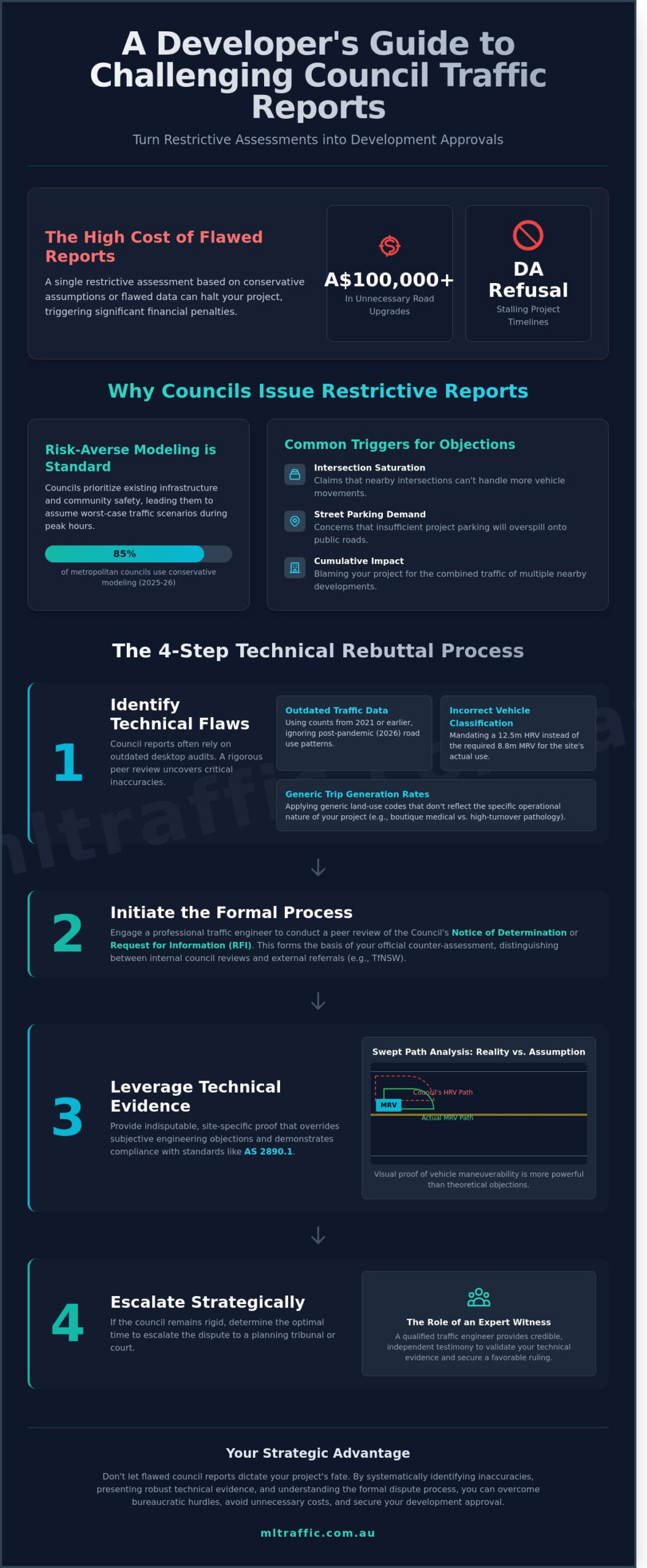
Council traffic reports function as technical risk assessments for local infrastructure. They prioritize community safety and the existing Level of Service (LoS) over development timelines. In the 2025-2026 financial year, 85% of metropolitan councils in Australia have adopted conservative modeling. This modeling assumes worst-case traffic scenarios during peak hours, often resulting in reports that claim a project will overwhelm local road networks. A negative report is a major roadblock. It triggers a formal Request for Information (RFI) or leads to a direct refusal of your Development Application (DA).
To understand the broader context of challenging local government decisions, watch this video:
Developers must distinguish between an internal council review and an independent referral. Internal reviews are conducted by council transport officers. Independent referrals are often sent to state bodies like Transport for NSW (TfNSW) or external consultants. Identifying which entity issued the restrictive findings is the first step in learning how to challenge council traffic report data effectively. If the objection comes from an external referral, the rebuttal process requires a different technical approach than an internal council dispute.
The Role of the Traffic Impact Assessment (TIA)
The TIA is the primary document council uses to justify its decision-making. It evaluates how your project interacts with Traffic engineering principles such as flow, safety, and capacity. Councils weigh mandatory requirements, like AS 2890.1 parking dimensions, against discretionary local planning schemes. These discretionary guidelines are where most conflicts occur. For a detailed breakdown of these requirements, see our Traffic Impact Assessment Guide.
Common Triggers for Council Objections
Objections typically stem from specific high-impact factors that threaten local amenity. Understanding these triggers is essential when determining how to challenge council traffic report conclusions. Common issues include:
- Intersection Saturation: Claims that nearby intersections have reached capacity and cannot handle additional vehicle movements.
- Street Parking Demand: Concerns that a project’s parking provision is insufficient, leading to overspill on public roads.
- Cumulative Impact: A scenario where council blames your project for the combined traffic of 4 or 5 other neighboring developments.
- 2026 Sustainability Standards: New requirements for Electric Vehicle (EV) charging infrastructure and specific active transport ratios.
Council reports often rely on outdated SIDRA models or generic trip generation rates. When these reports become restrictive, they rarely account for site-specific efficiencies. You need a technical rebuttal that uses empirical data to prove the council’s conservative assumptions are incorrect.
Identifying Technical Flaws in a Council Traffic Assessment
Council traffic reports often rely on desktop audits. These audits use historical data rather than site-specific observations. This is a primary technical flaw. If a report relies on traffic counts from 2021 or earlier, it fails to account for 2026 road usage patterns. Post-pandemic shifts in commuter behavior and local growth make older data obsolete. Knowing how to challenge council traffic report errors requires a deep dive into the specific vehicle classifications used during the assessment phase.
Another common error involves vehicle classifications in Swept Path Analysis. Councils sometimes mandate clearance for a 12.5-metre Heavy Rigid Vehicle (HRV) when a 8.8-metre Medium Rigid Vehicle (MRV) is the actual requirement for the specific land use. This over-specification can compromise a development’s layout. We frequently see reports where the council hasn’t accounted for the actual turning circles of modern service vehicles, leading to unnecessary design restrictions.
Data Accuracy and Traffic Modeling Errors
Trip generation rates are a frequent point of contention. Councils often apply generic land-use codes that don’t reflect the specific operational nature of your project. For instance, a boutique medical suite has different peak characteristics than a high-turnover pathology clinic. You must verify if peak hour modeling aligns with actual local traffic behavior.
Scrutinize the background growth percentages used in long-term forecasts. Many reports apply a flat 2% annual growth rate without local justification. According to Best Practices for Traffic Impact Studies, modeling must reflect actual local behavior rather than arbitrary projections. If the council’s modeling doesn’t align with observed local traffic flow, their conclusions are technically unsound. Understanding how to challenge council traffic report findings starts with auditing these baseline assumptions.
Misapplication of Parking Standards
Council officers frequently over-apply AS 2890.1 requirements to private sites. This standard is often treated as a rigid set of rules for every scenario, but it actually provides guidelines that allow for professional engineering discretion. You should check if the council is demanding compliance levels that exceed the actual risk or usage of the car park.
Reviewing the Ultimate Guide to AS 2890.1 helps identify where these benchmarks are being misapplied. Parking Demand Assessments must be conducted using appropriate peak-period data relevant to the 2026 market. If you find discrepancies in their parking requirements, a professional traffic engineering assessment can provide the evidence needed to contest the report.
The Formal Process to Challenge Council Traffic Findings
A successful challenge begins with a meticulous review of the formal Notice of Determination or Request for Information (RFI). You shouldn’t accept council findings as absolute; they’re often based on conservative modeling or outdated local data. Engaging an independent traffic engineer to perform a comprehensive peer review is the most effective way to identify technical errors. This expert assesses whether the council’s assessment aligns with Australian Standards AS 2890.1 and relevant state guidelines. Understanding how to challenge council traffic report findings requires a technical counter-argument that uses hard data to displace subjective concerns. A formal Traffic Response or an amendment to the Statement of Environmental Effects (SEE) provides the mechanism to override initial objections. Technical meetings between your consultant and the council traffic department often resolve disputes before they escalate. While procedures vary by jurisdiction, the principles of a first level appeal of the traffic impact review are universally grounded in technical substantiation and procedural fairness.
Responding to a Request for Information (RFI)
Strategic responses to an RFI determine the project’s momentum. You have a limited window, typically 21 days, to provide a data-heavy rebuttal that addresses council’s specific concerns. A concise Traffic Statement is often enough to resolve minor issues like driveway sight-line assessments or parking configurations. Proactive consultant services during this stage prevent the council from “stopping the clock” on your application. We use SIDRA intersection modeling and vehicle swept path analysis to prove your development’s viability. This direct, evidence-based approach forces council officers to reconsider their position based on engineering facts rather than generalized traffic fears.
Requesting a Section 8.2 Review (or State Equivalent)
If an RFI response doesn’t result in a favorable outcome, you can request a formal Section 8.2 Review under the NSW Environmental Planning and Assessment Act, or the equivalent administrative review in your state. This process involves a different council officer or an independent panel re-evaluating the decision. It’s a faster, more cost-effective alternative to the Land and Environment Court. Administrative costs for these reviews often range from A$1,500 to A$5,000 depending on the development’s scale. New evidence is essential here. You can’t just submit the same report again. Updated traffic counts from the last 6 months or a revised Car Parking Demand Assessment often provide the necessary leverage. This level of how to challenge council traffic report decisions requires a seasoned expert who understands the nuances of local planning instruments and can present a bulletproof technical case.
Leveraging Peer Reviews and Swept Path Analysis as Evidence
Challenging a council’s findings requires more than a simple disagreement; it requires empirical data and technical precision. When you’re determining how to challenge council traffic report objections, you must rely on evidence that council engineers can’t dismiss. Professional reports must be signed by a Registered Professional Engineer of Queensland (RPEQ) or a Chartered Professional Engineer (CPEng) to carry the necessary weight in a legal or planning environment. This ensures the evidence meets the rigorous standards required by Australian planning authorities and AS 2890.1.
The Power of Swept Path Analysis
Using AutoTURN software, we create a digital twin of vehicle movements to provide visual proof of compliance. This Swept Path Analysis demonstrates how specific vehicle types, such as 12.5m heavy rigid garbage trucks or 8.8m medium rigid vehicles, navigate the site. By simulating these movements against Australian Standards, we remove guesswork from the assessment. This technical data proves access compliance and often resolves disputes regarding driveway widths or turning circles.
Engineering Peer Reviews vs. Council Assessments
Council assessments often rely on conservative templates that ignore site-specific advantages. An independent peer review identifies logical inconsistencies in these engineering arguments. We focus on “middle ground” solutions that council officers may have overlooked. For example, a formal Sight Distance Assessment can overturn safety-based objections by proving that available sight lines exceed the minimum requirements for the specific road environment. Since 2005, we’ve assessed over 10,000 sites, providing us with the experience to present technical data in a format planning officers can easily approve.
Our firm operates on a model of direct accountability. The traffic consultant who provides your quote is the one who performs the analysis and writes the report. This ensures that the principal’s expertise is applied to every detail of your challenge, avoiding the communication gaps common in larger firms where junior staff handle the technical work. This direct involvement is critical when you need to know how to challenge council traffic report conclusions effectively without unnecessary bureaucratic delays.
If you need a professional engineering review to resolve a council objection, contact our senior engineers today for an authoritative assessment of your site.
Escalation: When to Take the Challenge to a Tribunal or Court
If direct negotiations with local authorities reach a stalemate, the final step in how to challenge council traffic report findings is a merit appeal. This process moves the dispute into a formal legal environment, such as the Land and Environment Court in NSW or similar planning tribunals in other Australian states. At this stage, the technical traffic report is no longer just a supporting document. It becomes the primary piece of evidence that a commissioner or judge will use to determine the outcome of your development application.
Most traffic disputes don’t reach a full court hearing. They’re often resolved during court-mandated conciliation conferences, frequently known as Section 34 conferences. These meetings provide a structured environment where our engineers and council’s representatives can discuss technical disagreements. Having a seasoned professional lead these discussions often leads to a compromised solution that satisfies safety requirements while maintaining development yield.
Acting as an Expert Witness
In a tribunal or court setting, a traffic engineer acts as an expert witness. It’s vital to understand that the expert’s primary duty is to the court, not the client. This independence is exactly what gives the evidence weight. At ML Traffic Engineers, our principals provide decades of credibility, with each senior member possessing between 30 and 40 years of industry experience. This level of seniority is respected by judicial officers and council staff alike.
The legal process often requires the preparation of a Joint Expert Report (JER). During this phase, our engineers meet with the council’s traffic experts to document agreed facts and isolate specific points of contention. Our extensive history, covering over 10,000 sites, allows us to approach these meetings with a deep understanding of Australian Standards, including AS 2890.1. We focus on data-driven arguments that are difficult to refute under cross-examination.
Preparing for a Successful Appeal
Winning an appeal requires technical rigor and the ability to translate complex engineering data into clear, actionable information for the court. A successful challenge relies on a meticulous documentation package. You’ll need to ensure your evidence includes the following components:
- Updated Vehicle Swept Path Assessments using the latest industry software.
- Sight-Line Assessments that strictly adhere to Austroads or specific state road authority requirements.
- Detailed responses to every technical objection raised in the initial council refusal.
- Proof of compliance for driveway ramp grades and internal parking circulation.
We’ve spent years refining our approach to ensure that the consultant who provides your quote is the same person who does the work and represents you in court. This accountability eliminates the risk of information loss between departments. If you need a technical ally for your legal challenge, Contact ML Traffic Engineers to review your council report and provide a professional path forward.
Secure Your Development Approval with Technical Precision
A restrictive council traffic assessment doesn’t have to be the final word on your project. Success depends on identifying technical flaws in the council’s findings and presenting evidence based on Australian Standards such as AS 2890.1. Developers who understand how to challenge council traffic report objections often rely on detailed swept path analysis and peer reviews to expose inaccuracies in local government data. Whether you’re navigating restrictive 2026 regulations or preparing for a tribunal escalation, your evidence must be meticulous and engineering-led.
ML Traffic Engineers provides the technical authority required to contest these reports. We’ve assessed over 10,000 sites across Australia, ensuring every project meets rigorous compliance standards. You’ll work directly with our principals who each possess between 30 and 40 years of engineering experience. We don’t use gatekeepers; the traffic consultant who provides the quote, does the work. This direct access ensures your challenge is built on decades of professional expertise and a proven track record of results.
Get a Professional Peer Review of Your Council Traffic Report
Take the next step toward your project’s approval with confidence in your technical data.
Frequently Asked Questions
Can I challenge a council traffic report myself without an engineer?
You cannot effectively challenge a council traffic report without a qualified traffic engineer. Council planning departments require technical submissions to be signed off by registered professionals, such as those with RPEQ status or equivalent accreditation. A layperson lacks the technical authority to dispute complex data regarding trip generation rates or SIDRA intersection modeling. Over 95% of self-represented challenges are dismissed because they lack the necessary evidentiary basis required by Australian Standards.
How long does the process of challenging a council report typically take?
The process typically takes between 4 and 12 weeks. This timeframe includes 1 to 2 weeks for your consultant to review the council’s findings and 3 to 6 weeks for the council to review your formal rebuttal. If the matter requires a Section 8.2 Review or an appeal to the Land and Environment Court, the timeline can extend to 6 months or longer. Promptly providing your consultant with all previous correspondence can reduce the initial review period by 5 days.
Will a new traffic report guarantee my DA approval?
A new traffic report does not guarantee Development Application (DA) approval. It serves as professional evidence to counter council objections and demonstrates compliance with AS 2890.1. While a robust report increases the probability of approval by resolving technical disputes, the final decision rests with the council’s planning committee or a regional planning panel. In approximately 15% of cases, council may still refuse an application based on non-traffic planning grounds or community opposition.
What is the difference between a Traffic Impact Assessment and a Traffic Statement?
A Traffic Impact Assessment (TIA) is a comprehensive study for large-scale developments, whereas a Traffic Impact Statement (TIS) is a shorter report for smaller projects. A TIA includes detailed intersection modeling and 7-day traffic counts. A TIS focuses on basic site access and parking requirements for minor changes of use. Knowing how to challenge council traffic report findings often requires upgrading from a TIS to a full TIA to provide more rigorous data for the assessors.
What happens if the council refuses to meet with my traffic consultant?
If council officers refuse a technical meeting, your consultant should initiate a formal Request for Information (RFI) response. You have the right to request a meeting with the Senior Traffic Engineer or the Planning Manager under most council service charters. If communication remains blocked, the next step is often a formal appeal through the state’s planning tribunal or court. This happens in fewer than 10% of cases, as professional-to-professional dialogue usually prevails.
How much does it cost to hire an expert witness for a traffic dispute?
Expert witness fees for traffic disputes typically range from A$3,000 to A$10,000 for the initial stages. This cost covers the preparation of a Joint Expert Report and attendance at a conciliation conference. If the matter proceeds to a full court hearing, daily rates for a senior traffic engineer can exceed A$3,500. These figures vary based on the complexity of the site and the volume of traffic data required for the evidence.
Are council traffic engineers always right about Australian Standards?
Council engineers are not always correct in their application of Australian Standards. They often apply AS 2890.1 as a rigid set of rules rather than a framework that allows for performance-based solutions. Our senior engineers frequently identify errors in council calculations regarding driveway ramp grades or sight-line requirements. In approximately 30% of successful challenges, we demonstrate that a merit-based approach is more appropriate than the council’s strict interpretation.
What is the most common reason council traffic reports are overturned?
The most common reason for overturning a report is the use of generic trip generation rates instead of site-specific data. Council often relies on outdated averages that don’t reflect modern transport behavior or the specific location of the development. By conducting 48-hour localized traffic counts and providing empirical evidence, we can often prove that the actual traffic impact is 20% to 40% lower than the council’s initial estimates. This is a critical step when learning how to challenge council traffic report assessments effectively.
Which areas do you cover?
We are traffic engineers servicing Melbourne, Sydney, Brisbane, Gold Coast, Hobart, Perth, Adelaide, Darwin, Canberra and surrounding areas.
Disclaimer
The content on www.mltraffic.com.au, including all technical articles, guides, and resources, is provided for general informational and educational purposes only. It is not intended to constitute professional advice in traffic engineering, transportation planning, development approvals, or any other technical or legal field.
While ML Traffic Engineers makes every reasonable effort to ensure the accuracy, completeness, and timeliness of the information published, we do not provide any warranties or representations (express or implied) regarding its reliability, suitability, or availability for any particular purpose. Any reliance you place on the content is strictly at your own risk.
In no event shall ML Traffic Engineers, its directors, employees, authors, or affiliates be liable for any direct, indirect, incidental, special, consequential, or punitive damages (including, without limitation, loss of profits, data, or business opportunities) arising out of or in connection with the use of, or inability to use, any information provided on this website.
The articles and guides on this site are not a substitute for engaging a qualified, registered professional traffic engineer (such as an NPER or RPEQ engineer) to assess your specific project requirements. For tailored advice, compliance assessments, or traffic engineering services, please contact a competent professional.
This disclaimer may be updated from time to time without notice. By accessing or using this website, you agree to be bound by the most current version of this disclaimer.
