

The biggest mistake a developer can make is assuming the senior engineer who signs the proposal will be the one actually drafting the Traffic Impact Statement (TIS). When junior staff handle complex swept path assessments, the result is often a costly Request for Information (RFI) from Council that delays your project by months. You need a project that hits the ground running with a compliant, high-yield car park layout. Understanding how to choose a traffic engineering consultant is about identifying exactly who will be sitting at the CAD station and performing the technical work.
It’s frustrating to lose car park spaces to poor design compliance when every square meter impacts your bottom line. We’ll show you the technical benchmarks and accountability markers required to secure first-time council approval in 2026. This guide outlines the importance of direct access to RPEQ certified experts, the risks of the common "hand-off" consultancy model, and how to verify a consultant’s track record across thousands of successful Australian sites. You’ll learn how to ensure your consultant follows Australian Standards AS 2890.1 from the first draft to final submission.
Key Takeaways
- Understand why the traffic report is the critical path for Development Application (DA) approval and how it determines project timelines.
- Identify the technical benchmarks for AS 2890.1 compliance and the necessity of using AutoTURN software for accurate vehicle swept path assessments.
- Learn how to choose a traffic engineering consultant by verifying that the senior engineer providing the quote is the one performing the technical work.
- Utilise a specific developer’s checklist to vet consultants based on their successful council approval rates for your specific land-use type.
- Prioritise a principal-led consultancy model to eliminate junior-level errors that lead to costly Requests for Information (RFIs) and reduced car park yield.
Table of Contents
-
The Strategic Importance of Selecting the Right Traffic Engineering Consultant
-
Technical Competencies: Verifying Expertise in TIA and Swept Path Analysis
-
The Principal-Led Model vs. The Junior Hand-Off: A Comparison
-
A Developer’s Checklist: Questions to Ask Before Signing a Quote
-
Securing DA Approval: Why Technical Precision is Your Best Investment
The Strategic Importance of Selecting the Right Traffic Engineering Consultant
A traffic engineering consultant is a technical specialist responsible for the safe and efficient movement of vehicles and pedestrians within and around a development. Traffic engineering is a branch of civil engineering that applies scientific principles to the planning and functional design of roads and their networks. For Australian developers in 2026, this role is the critical path for Development Application (DA) approval. If your traffic report fails to address council concerns regarding congestion or safety, the entire project stalls.
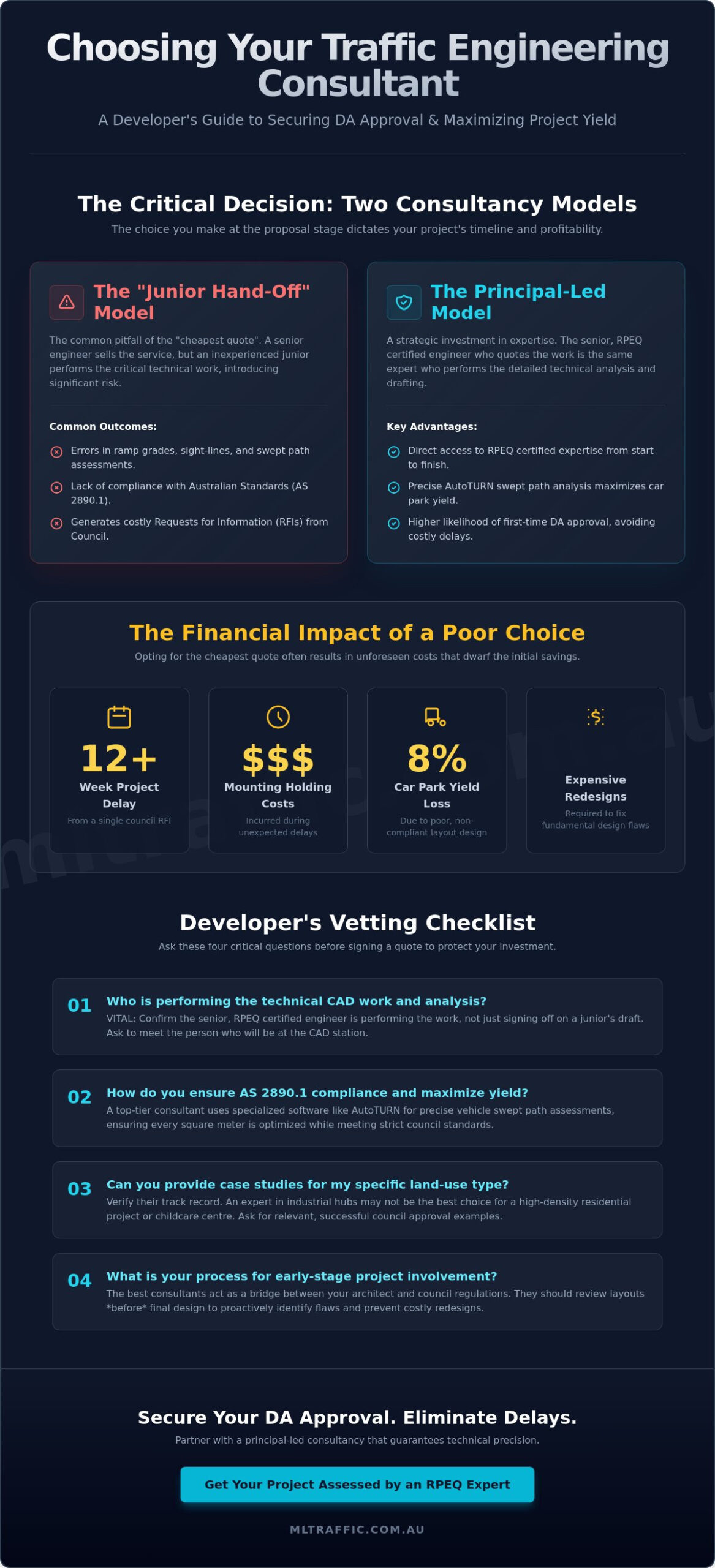
A consultant directly impacts project yield by optimizing car park layouts and access points. Every square meter of a site represents potential revenue. If an engineer lacks the skill to minimize wasted space in a basement design, you might lose 8% of your total car park yield. This loss often forces a reduction in the number of residential or commercial units allowed on the site. Knowing how to choose a traffic engineering consultant who prioritizes yield while maintaining compliance is a financial necessity.
To better understand this concept, watch this helpful video:
The High Cost of the "Cheapest Quote"
Choosing a consultant based solely on a low fee is a high-risk strategy. These proposals often rely on junior-level staff who lack the technical depth to spot errors in driveway ramp grades or sight-line assessments. When a council engineer identifies these technical oversights, they issue a Request for Information (RFI). Data from recent planning submissions shows that a single RFI can trigger a 12-week delay in project timelines. During this period, developers face mounting holding costs that far outweigh the few hundred dollars saved on the initial consultant quote.
The Role of Traffic Engineering in Development Applications
Professional consultants act as a bridge between your architect’s vision and the council’s regulatory requirements. They provide the technical data needed to justify land-use changes through a Traffic Impact Assessment. Early-stage involvement is vital. If a consultant reviews your site layout before the final design phase, they can identify fundamental flaws in vehicle entry points or loading bay dimensions. This proactive approach ensures your project meets AS 2890.1 standards long before it reaches the council desk. Learning how to choose a traffic engineering consultant who offers this level of early-stage scrutiny is the best way to prevent expensive redesigns later in the process.
Technical Competencies: Verifying Expertise in TIA and Swept Path Analysis
Technical proficiency is the foundation of any successful development application. When evaluating how to choose a traffic engineering consultant, you must look beyond their portfolio and scrutinize their technical toolkit. Council engineers expect reports built on rigorous data and specialized software like AutoTURN. This software allows for precise vehicle movement simulations. It ensures that a 12.5-meter Heavy Rigid Vehicle (HRV) can safely navigate a warehouse loading dock without striking structural columns or encroaching on pedestrian zones.
A high-quality Traffic Impact Assessment (TIA) must align with state-specific frameworks. For instance, the Transport Impact Assessment (TIA) guidelines provide a clear benchmark for what regulatory bodies require. Your consultant should demonstrate experience across various land-use types, including high-density residential, childcare centers, and industrial hubs. Each land-use has unique trip generation rates and parking requirements that a seasoned expert will know how to defend during council meetings.
Mastering Australian Standard AS 2890 Compliance
Compliance with AS 2890.1 (Off-street car parking) and AS 2890.2 (Commercial vehicle facilities) is mandatory. Many projects fail because of errors in driveway ramp grades or inadequate sight-line assessments. A ramp that is too steep or lacks a proper transition zone can render a car park unusable for low-clearance vehicles. This creates long-term legal liabilities for the developer. An expert engineer ensures every grade and sight distance meets the 2026 standards, preventing operational safety issues before they arise. You can view our full range of technical assessment services to see how these standards are applied.
Advanced Vehicle Swept Path and Access Assessment
A critical component of modern engineering is Swept Path Analysis. This is the only way to prove vehicle maneuverability on constrained sites. While some firms use basic "template-based" paths, these often fail on complex developments. A professional consultant uses dynamic simulations tailored to the specific design vehicle, whether it’s a B99 car or a large refuse truck. Verifying these skills is simple. Ask the consultant which design vehicle they’ve selected for your site and why. If they can’t cite the specific requirements of AS 2890, they aren’t the right partner for your project. Understanding how to choose a traffic engineering consultant means prioritizing those who can demonstrate software mastery and total compliance with Australian regulations.
The Principal-Led Model vs. The Junior Hand-Off: A Comparison
The internal structure of a consultancy often dictates the success of your development application. Many developers don’t realize that large multidisciplinary firms frequently operate on a "Junior Hand-off" model. In this scenario, a senior partner with 30 years of experience secures the contract, but the technical work is immediately delegated to a graduate engineer. This graduate may have less than 24 months of industry experience. When the person performing the swept path analysis or calculating parking demand lacks seniority, the risk of technical error increases exponentially. Errors at this stage lead to council RFIs that can stall a project for 60 days or more.
Direct accountability is the hallmark of the "Principal-Led" model. This approach ensures the engineer who provides your quote is the same individual performing the CAD work and drafting the final report. There is no communication breakdown because the senior expert is the "doer" rather than just a "reviewer." When considering how to choose a traffic engineering consultant, you must ask who will be sitting at the CAD station. Direct access to principals accelerates the project timeline. It allows for immediate technical pivots during the design phase, ensuring your site layout remains optimized for yield and compliance.
Accountability: Who is Actually Writing Your Report?
The danger of the "bait and switch" is real in traffic engineering. A senior partner sells the job based on their impressive resume, but they never touch the technical analysis. Inexperienced staff often miss subtle nuances in parking demand assessments, particularly for complex land uses like childcare centers or medical clinics. These nuances are what council engineers scrutinize most. Having a Senior Traffic Engineer handle the technical work and council negotiations directly is invaluable. A senior expert brings decades of experience to the table, knowing exactly which arguments will satisfy a skeptical council planner. They defend the project with the authority that only comes from performing the technical calculations themselves.
Boutique Specialist vs. Large Multidisciplinary Firms
Boutique specialist firms offer a level of responsiveness that large firms struggle to match. Large corporations often have multiple layers of management, meaning a simple design query can take days to resolve. Conversely, a boutique firm provides a direct line to the decision-maker. This speed is a competitive advantage when you are working against tight DA submission deadlines. When evaluating how to choose a traffic engineering consultant, identify if the firm has the national coverage required for your portfolio. A firm that has successfully navigated over 10,000 sites across Australia offers a breadth of experience that rivals any large firm, but with the accountability and speed of a principal-led team. Specialized boutiques prioritize your private development because it is their core business, not a secondary service line.
A Developer’s Checklist: Questions to Ask Before Signing a Quote
Vetting a consultant requires a structured interrogation of their technical capabilities and operational model. A fee proposal is not just a price; it’s a commitment to technical accuracy. When evaluating how to choose a traffic engineering consultant, you must move beyond the bottom line and audit the firm’s ability to deliver first-time DA approval. Use the following five-step checklist to verify their competence before committing your project budget.
-
Step 1: Inquire about the specific engineer who will perform the technical analysis. Demand a commitment that a senior expert, not a graduate, will handle the CAD work and report drafting.
-
Step 2: Request evidence of successful DA approvals for similar land-use types. A consultant who excels at residential apartments might lack the specific knowledge required for complex industrial warehouses or childcare centers.
-
Step 3: Verify the firm’s experience with your specific council. Local government engineers have unique preferences and interpretations of regional standards that a seasoned expert will already understand.
-
Step 4: Ask for a sample Swept Path Analysis. Review it for technical detail, clarity in AutoTURN simulations, and strict adherence to AS 2890.1 requirements.
-
Step 5: Confirm the scope includes post-submission support. Ensure the quote covers RFI responses and attendance at council meetings to defend the technical findings.
Red Flags in Traffic Engineering Quotes
Beware of quotes that are significantly lower than the industry average. These low-fee proposals often hide a lack of technical depth or indicate that the work will be outsourced to junior staff. A generic scope of work that doesn’t mention specific Australian Standards or site-specific constraints, such as driveway ramp grades, is a major warning sign. If a firm cannot provide direct contact details for the lead engineer, it suggests a "gatekeeper" model that will lead to communication delays and errors. Transparency is a critical step in how to choose a traffic engineering consultant who will actually add value to your development team.
Verifying National and Professional Qualifications
Professional accreditation is the only way to guarantee technical accountability. Ensure your consultant holds RPEQ (Registered Professional Engineer of Queensland) status or the equivalent state-based registration required for your project. A firm that has successfully navigated over 10,000 site assessments across Australia provides a level of reliability that smaller, less experienced firms cannot match. This volume of work demonstrates a deep understanding of varied council requirements and site constraints. Finally, confirm the firm carries comprehensive Professional Indemnity insurance. This protects your project against technical oversights that could lead to costly construction redesigns. For a transparent and technically sound assessment of your site, contact our senior engineers directly to discuss your project requirements.
Securing DA Approval: Why Technical Precision is Your Best Investment
Technical precision is the most effective way to protect your project’s return on investment. High-quality traffic reports don’t just meet standards; they pre-empt council objections. When a report is technically flawless, the council’s transport department has fewer reasons to stall your application. This speed translates directly into reduced holding costs. Deciding how to choose a traffic engineering consultant is ultimately a decision about risk management. You aren’t just buying a report; you’re buying the certainty that your project will break ground on schedule.
Expert car park design and demand assessments maximize project profitability. A consultant who understands the nuances of AS 2890.1 can often find additional spaces that a less experienced engineer would miss. This optimization increases the total yield of your development. The role of the consultant extends beyond the desk. They must defend the project during council meetings or planning panels with authoritative, data-backed arguments. Prioritizing experience and direct accountability over the lowest fee ensures your project is backed by a professional who can stand by their technical findings under scrutiny.
Managing the Council RFI Process
Prompt and technically sound RFI responses are critical for maintaining project schedules. A single poorly handled response can trigger further rounds of questioning, adding months to your timeline. There is a significant difference between simply "answering a question" and "solving a council concern." A senior engineer uses their reputation and technical depth to provide solutions that satisfy council officers immediately. Their long-standing history with regulatory bodies often facilitates smoother negotiations. When you understand how to choose a traffic engineering consultant, you prioritize those with a proven track record of resolving RFIs in the first instance.
Next Steps: Engaging Your Traffic Consultant
To receive an accurate traffic engineering quote, you must prepare your site plans and a clear project brief. Ensure these plans show all proposed entry points and internal parking layouts. A clear Service Agreement is essential. It should outline all deliverables, including Swept Path Analysis, Sight-Line Assessments, and post-submission support. This transparency prevents scope creep and ensures all technical benchmarks are met. At ML Traffic Engineers Australia, we operate on a simple principle: the traffic consultant who provides the quote, does the work. This hands-on approach has secured approvals for over 10,000 sites across Australia. Contact our senior engineers today for a principal-led assessment of your next development.
Secure Your Development Approval with Technical Certainty
Success in the 2026 development landscape requires moving beyond surface-level compliance to deep technical accountability. By prioritising the principal-led model and rigorous AS 2890.1 standards, you eliminate the technical oversights that lead to project-stalling RFIs. This guide has outlined how to choose a traffic engineering consultant by vetting their software mastery and ensuring the person who quotes the work is the one performing the analysis. These benchmarks are the difference between a project that remains on the critical path and one that faces months of avoidable delays.
ML Traffic Engineers Australia brings over 15 years of operational history and senior engineers with 30 to 40 years of specialised experience to every site. With a track record spanning more than 10,000 successful assessments nationwide, our team provides the technical certainty required for first-time council approval. We ensure that your car park yield is optimised and your site access is certified to the highest professional standards.
Get a Principal-Led Traffic Engineering Quote for Your Project
Your development’s success starts with accurate technical data and a reliable engineering partner who stays on the job from start to finish.
Frequently Asked Questions
What is the difference between a Traffic Impact Statement (TIS) and a Traffic Impact Assessment (TIA)?
A Traffic Impact Statement (TIS) is a concise report typically required for smaller developments with low traffic generation. A Traffic Impact Assessment (TIA) is a comprehensive, detailed study for larger projects that significantly influence the local road network. Council planning schemes define which report is necessary based on the scale of the proposed land-use and the expected trip generation rates.
How much does a traffic engineering consultant typically cost for a DA?
Fees for a development application vary based on the project’s complexity, the number of land-use types involved, and specific council requirements. A single-dwelling access assessment requires less technical work than a high-density mixed-use development. To receive an accurate quote, you must provide a detailed project brief and architectural site plans for a specific technical review.
How long does it take to prepare a standard traffic and parking report?
Standard traffic and parking reports generally take 5 to 10 business days to complete once all site plans are received. This timeline includes the site inspection, technical analysis, and report drafting. More complex assessments requiring intersection modeling or extensive parking demand surveys may take up to 20 business days to ensure all technical benchmarks are met.
Do I need a traffic engineer if my project already meets council parking rates?
Yes, meeting the minimum parking rates is only one component of council compliance. You still need professional certification that your site access, driveway grades, and internal circulation meet AS 2890.1 standards. Understanding how to choose a traffic engineering consultant ensures you have an expert who can certify vehicle maneuverability through precise swept path analysis.
What happens if council issues an RFI regarding the traffic report?
Your consultant reviews the council’s Request for Information (RFI) and provides a technical response or design amendment to resolve the concern. A senior engineer handles these negotiations directly to prevent project delays that can otherwise last 30 to 60 days. The goal is to provide a technical solution that satisfies the council officer without compromising the project’s layout or yield.
Can a traffic engineer help increase the number of parking spaces on my site?
Professional engineers often increase site yield by optimizing the car park layout and identifying wasted space. Through a parking demand assessment, they can provide empirical data to justify a reduction in the standard council parking rates. This approach often allows for a more efficient basement design, potentially increasing the total number of usable spaces or developable floor area.
Is a site visit always necessary for a traffic assessment?
A physical site visit is necessary for 95% of projects to accurately assess sight-lines, existing road conditions, and nearby parking restrictions. Desktop assessments often miss critical site constraints that lead to technical errors in the final report. An on-site inspection ensures the proposed access points are safe and comply with the latest Australian Standards.
What software should my traffic consultant be using for swept paths?
AutoTURN is the industry-standard software for performing vehicle swept path assessments. It allows engineers to simulate the movement of specific design vehicles, such as a B99 car or a 12.5m Heavy Rigid Vehicle, with high precision. When researching how to choose a traffic engineering consultant, confirm they use this software to ensure your site plans meet the rigorous maneuverability standards required by council.
Which areas do you cover?
We are traffic engineers servicing Melbourne, Sydney, Brisbane, Gold Coast, Hobart, Perth, Adelaide, Darwin, Canberra and surrounding areas.

Disclaimer
The content on www.mltraffic.com.au, including all technical articles, guides, and resources, is provided for general informational and educational purposes only. It is not intended to constitute professional advice in traffic engineering, transportation planning, development approvals, or any other technical or legal field.
While ML Traffic Engineers makes every reasonable effort to ensure the accuracy, completeness, and timeliness of the information published, we do not provide any warranties or representations (express or implied) regarding its reliability, suitability, or availability for any particular purpose. Any reliance you place on the content is strictly at your own risk.
In no event shall ML Traffic Engineers, its directors, employees, authors, or affiliates be liable for any direct, indirect, incidental, special, consequential, or punitive damages (including, without limitation, loss of profits, data, or business opportunities) arising out of or in connection with the use of, or inability to use, any information provided on this website.
The articles and guides on this site are not a substitute for engaging a qualified, registered professional traffic engineer (such as an NPER or RPEQ engineer) to assess your specific project requirements. For tailored advice, compliance assessments, or traffic engineering services, please contact a competent professional.
This disclaimer may be updated from time to time without notice. By accessing or using this website, you agree to be bound by the most current version of this disclaimer.
