

A development consent isn’t a green light to build; it’s a technical list of hurdles that can stall a project for months if handled incorrectly. Many developers treat the process of clearing traffic-related conditions of consent as a simple bureaucratic exercise, but Council engineers view it as a high-stakes safety and infrastructure audit. You’ve likely experienced the frustration of endless back-and-forth with authorities or the unexpected cost of revised engineering reports. These delays don’t just test your patience; they erode your project’s profit margins and push back your commencement dates.
We believe that clearing these conditions is a technical engineering exercise rather than an administrative one. This guide provides a comprehensive roadmap to navigate complex requirements and secure final planning approval. You’ll find actionable steps to satisfy Council through precise Traffic Impact Assessments and driveway ramp grade assessments that adhere to AS 2890.1 and the 2026 Austroads updates. We’ll show you how to provide the exact technical data required to fast-track your transition from consent to construction with fixed-cost engineering solutions.
Key Takeaways
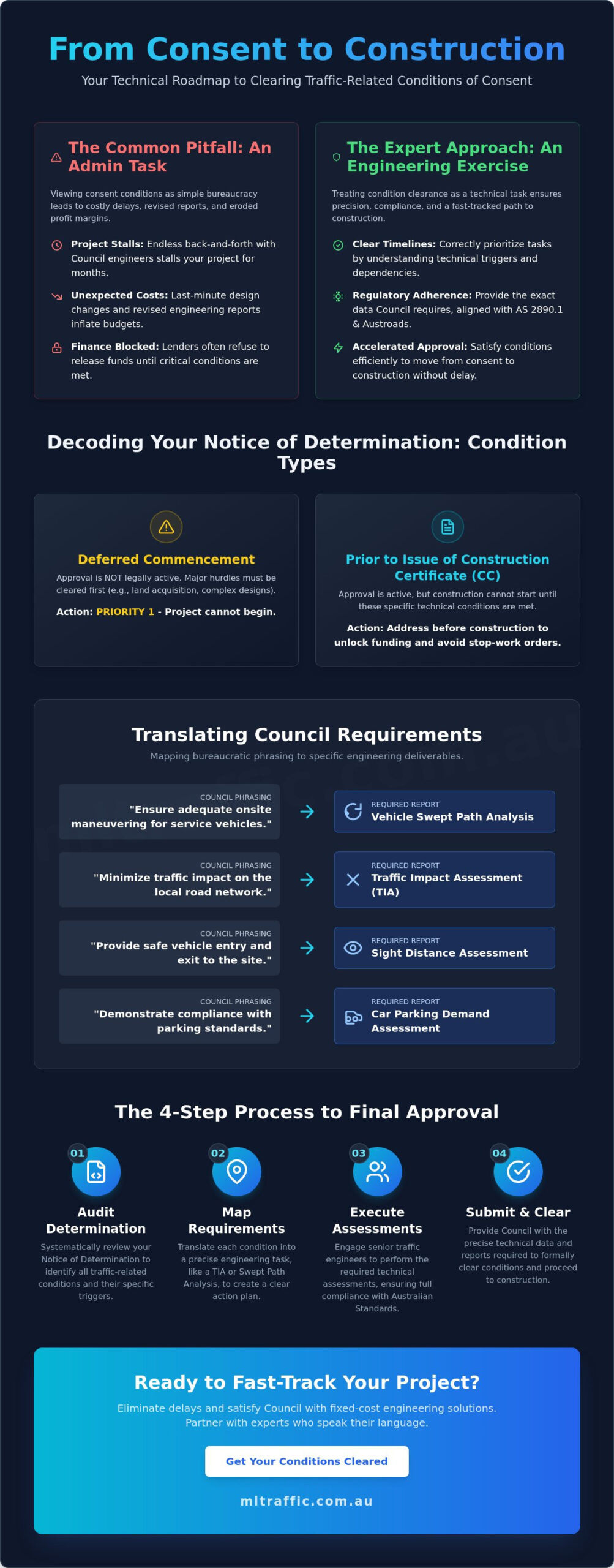
- Distinguish between “Deferred Commencement” and “Prior to Issue of Construction Certificate” conditions to correctly prioritize your project timeline.
- Map complex Council terminology to specific engineering requirements such as Vehicle Swept Path Analysis and Traffic Impact Assessment (TIA) reports.
- Implement a systematic audit of your Notice of Determination to streamline the process of clearing traffic-related conditions of consent.
- Navigate technical compliance hurdles by evaluating the feasibility of Section 4.55 modifications versus specialized engineering workarounds.
- Leverage direct access to senior traffic engineering principals to ensure all designs meet rigorous Australian Standards and local regulatory benchmarks.
Understanding Traffic-Related Conditions of Consent in Australia
Traffic conditions of consent are legally binding requirements imposed by planning authorities to mitigate the impact of new developments on the public road network. These conditions serve as technical safeguards. They ensure that a project aligns with the Australian Road Rules and local infrastructure capacities. For developers, the process of clearing traffic-related conditions of consent is a critical path item in the project lifecycle. Failure to address these technical requirements early often results in significant delays during the transition from planning approval to physical construction. This stage requires a meticulous approach to engineering compliance and regulatory adherence.
Councils derive their authority to impose these conditions from state-specific legislation. This includes the Environmental Planning and Assessment Act 1979 in New South Wales and the Planning and Environment Act 1987 in Victoria. These frameworks allow authorities to mandate specific engineering reports to verify that a site can safely accommodate its projected traffic volume. These might include a Traffic Impact Assessment (TIA) Report or a Vehicle Swept Path Analysis. Every condition must be technically sound and directly related to the proposed development to be enforceable under these acts.
To maintain public safety and preserve local amenity, authorities focus on how a site interacts with its surroundings. An influx of vehicles from a new development can strain intersection analysis benchmarks or exceed existing infrastructure capacity. By mandating a Car Parking Demand Assessment or a Sight Distance Assessment, authorities ensure the development doesn’t create hazardous conditions for pedestrians or other motorists. Compliance with the May 2026 Austroads Guide to Temporary Traffic Management (AGTTM) is now a standard requirement for many urban projects to manage these risks effectively.
To better understand the complexities of consent and compliance, watch this video:
Operational vs. Deferred Commencement Conditions
Developers must distinguish between operational consent and deferred commencement. A deferred commencement consent means the approval isn’t legally active until you satisfy specific requirements, such as land acquisition or complex modeling. Operational conditions usually specify triggers like “prior to the issue of a Construction Certificate.” Identifying these triggers in your Notice of Determination is essential for accurate project scheduling so you don’t face unnecessary work stoppages.
The Consequences of Non-Compliance
Attempting to start construction without clearing traffic-related conditions of consent is a high-risk strategy. It carries severe legal ramifications, including substantial fines and mandatory stop-work orders. Non-compliance also creates a significant barrier to project financing. Most lenders don’t release funds until they see proof that all “Prior to CC” conditions are satisfied. Additionally, failing to adhere to standards like AS 2890.1 can void your professional insurance coverage.
Common Traffic-Related Conditions and Required Reports
Council conditions often use vague phrasing that requires precise engineering interpretation. A requirement for “adequate onsite maneuvering” translates directly to a Vehicle Swept Path Analysis. Similarly, a condition regarding “safe entry and exit” usually necessitates a Sight Distance Assessment or a Driveway Ramp Grade Assessment. Identifying these technical requirements early is the first step toward clearing traffic-related conditions of consent without costly design revisions. We focus on mapping these bureaucratic phrases to specific, actionable engineering deliverables that satisfy regulatory scrutiny.
Detailed reports are the primary evidence Council engineers review. For most developments, this includes a formal Traffic Impact Assessment (TIA) Report to validate that the local network can absorb the additional trip generation. During the construction phase, you’ll need a Traffic Guidance Scheme (TGS) that complies with the latest Austroads standards. The June 2026 update to the Austroads Guide to Temporary Traffic Management (AGTTM) is now the mandatory benchmark for projects in Victoria and South Australia. Queensland is expected to follow this transition by November 2026. Adhering to these updated standards is essential for securing a Road Occupancy Permit and avoiding project shutdowns.
Car Parking and Access Compliance (AS 2890)
Councils frequently mandate compliance with AS 2890.1 for off-street parking. This involves verifying bay dimensions, aisle widths, and blind aisle extensions. A common condition involves a Driveway Ramp Grade Assessment to ensure vehicles don’t scrape their chassis on steep transitions. We often see conditions that require a formal certification of the car park design before a Construction Certificate is issued. For a deeper look at these technicalities, review our AS 2890.1 Explained guide.
Vehicle Maneuvering and Loading Requirements
Maneuvering conditions are particularly strict for commercial and multi-residential projects. You must prove that waste collection vehicles and delivery trucks can enter and leave the site in a forward direction. We use specialized software to perform a Vehicle Swept Path Analysis, which maps the exact footprint of a turning vehicle. This analysis clears conditions related to loading dock efficiency and internal road widths. Our Swept Path Analysis Guide details how these simulations prevent infrastructure damage and operational bottlenecks.
If you’re facing complex access requirements, our senior principals can review your notice of determination to identify the most efficient path to compliance.
Step-by-Step Guide to Satisfying Traffic Conditions
Satisfying technical requirements isn’t a matter of negotiation; it’s a matter of compliance. Clearing traffic-related conditions of consent involves a five-step engineering workflow designed to eliminate bureaucratic friction. This process begins the moment you receive your Notice of Determination (NoD). Developers who wait until the last minute often face work stoppages that jeopardize project timelines. A proactive approach ensures that every engineering hurdle is cleared before it impacts your construction schedule.
- Step 1: Audit the Notice of Determination. Identify every clause that mentions traffic, parking, access, or maneuvering. Look for specific triggers tied to project milestones.
- Step 2: Technical Feasibility Review. Engage a senior traffic engineer to determine if the conditions are physically possible to meet without redesigning the basement or structural footprint.
- Step 3: Technical Documentation. Prepare the required reports, such as a Traffic Impact Assessment (TIA) or a Vehicle Swept Path Analysis, ensuring they meet current Australian Standards.
- Step 4: Formal Submission. Submit the documentation to the Council engineer or the Accredited Certifier responsible for issuing the Construction Certificate.
- Step 5: Resolution and Clearance. Address any technical queries from the authority and secure the formal clearance letter that officially clears the condition.
Auditing Your Consent Document
A thorough audit distinguishes between mandatory conditions and simple advice notes. Mandatory conditions use definitive language like “must” or “shall” and are usually tied to legal triggers. For instance, some conditions must be cleared prior to any demolition work, while others are required before the issue of an Occupation Certificate. We recommend grouping related conditions into a single engineering package. This approach reduces reporting costs and ensures a consistent technical narrative across your Traffic Impact Assessment and Car Park Design documentation. Missing a single time-sensitive trigger can halt a project for weeks.
The Engineering Submission Workflow
Technical submissions often fail because they lack senior-level oversight. At ML Traffic Engineers Australia, we ensure that the same principal who initiates the project performs the technical work. This continuity is vital when coordinating with architects to update site plans based on traffic findings. If a Swept Path Analysis reveals that a heavy vehicle can’t navigate a tight turn, the architectural plans must be adjusted before submission. Signing off on Australian Standards compliance, such as AS 2890.1, provides the Certifier with the assurance needed to approve the works. Adhering to the May 2026 Austroads updates ensures your Traffic Guidance Scheme meets the newest national safety benchmarks for 2026 and beyond.
Solving Complex Compliance Issues and Council Objections
Technical roadblocks are common during the post-consent phase. You might find that a specific condition is physically impossible to meet due to site constraints or heritage protections. When this happens, clearing traffic-related conditions of consent requires a strategic choice between a legal modification and an engineering workaround. A Section 4.55 modification (in NSW) or a Section 72 amendment (in Victoria) officially changes the wording of your consent, but this process can take months. We often prefer engineering workarounds, such as using a Vehicle Swept Path Analysis to prove that a narrower driveway still accommodates the design vehicle, satisfying the condition’s intent without reopening the planning file.
Council engineers frequently issue a Request for Further Information (RFI) if they find gaps in your initial Traffic Impact Assessment (TIA) Report. These requests often center on intersection analysis or trip generation rates. If Council objects based on local road capacity, we perform a detailed Intersection Analysis using industry-standard modeling software. This data-driven approach provides objective proof that your development won’t degrade the level of service on surrounding streets. Providing this level of technical detail is the most effective way to overcome subjective objections from authorities.
When Design Conflicts with Conditions
Clashes between architectural aesthetics and traffic safety are frequent in high-density projects. An architect might design a sleek entrance that doesn’t provide the required Sight Distance Assessment benchmarks. We resolve these conflicts by proposing performance-based solutions. In tight urban sites, this might involve installing convex mirrors or integrated warning systems to compensate for limited sightlines while still meeting Australian Standards. This approach ensures you don’t have to sacrifice valuable floor space to meet rigid traffic requirements.
Managing External Stakeholders
Projects fronting state-managed roads require approvals beyond the local Council level. You’ll need to coordinate with state road authorities, such as Transport for NSW or the Department of Transport and Planning in Victoria. These agencies have their own set of benchmarks for clearing conditions, particularly regarding heavy vehicle access and construction traffic. Understanding the role of a traffic engineer is essential here, as we act as the technical liaison between your civil contractors, waste management providers, and government regulators.
Don’t let technical objections stall your project. Contact our senior principals today to resolve your complex Council conditions and secure your Construction Certificate.
Partnering with ML Traffic Engineers Australia for Final Approval
Securing a Construction Certificate requires more than just submitting paperwork; it requires a specialized engineering partner who understands the nuances of local government expectations. At ML Traffic Engineers Australia, we specialize in clearing traffic-related conditions of consent through a combination of technical precision and direct regulatory engagement. Our firm provides developers with direct access to senior principals for every project. This “no-gatekeepers” approach ensures that your complex technical queries are addressed by experts with the authority to make critical design decisions on the spot.
With over 15 years of experience navigating Australian council requirements, we’ve developed a deep understanding of the specific benchmarks used by planning authorities across the country. We don’t just provide surface-level advice. We deliver a full suite of technical services, including Traffic Impact Assessment (TIA) Reports, Vehicle Swept Path Analysis, Car Park Design, and Traffic Guidance Schemes (TGS). Our personnel continuity promise means the same expert who initiates your project remains your point of contact until the final clearance is secured, ensuring no technical detail is lost in transition.
Our Approach to Clearing Conditions
Time is a critical factor in any development project. We prioritize rapid turnaround on all technical reports to maintain your project momentum and prevent costly work stoppages. Our team pays meticulous attention to Australian Standards to minimize the risk of receiving a Request for Further Information (RFI) from Council engineers. When disputes arise regarding intersection capacity or parking demand, we engage in direct communication with Council technical staff. This professional liaison often resolves engineering conflicts without the need for lengthy formal appeals or design modifications.
Get Started on Your Compliance Today
Navigating the transition from planning approval to construction is simpler with a single-source traffic engineering consultancy. By consolidating your Traffic Impact Assessment, Car Parking Demand Assessment, and Sight Distance Assessment with one firm, you ensure a cohesive technical narrative that Councils can easily approve. We invite you to send your Notice of Determination to our team for an initial review of your traffic clauses. Our senior principals will identify the most efficient path for clearing traffic-related conditions of consent for your specific site. Contact ML Traffic Engineers Australia to clear your conditions and move your project toward completion.
Secure Your Construction Certificate Without Delay
Successful developers recognize that post-consent compliance is a technical requirement rather than a bureaucratic hurdle. By auditing your Notice of Determination immediately and mapping clauses to specific engineering reports like Vehicle Swept Path Analysis and TIA reports, you eliminate the risk of work stoppages. Adhering to the latest 2026 Austroads standards and AS 2890.1 ensures your submission meets Council’s rigid benchmarks on the first attempt. This proactive strategy prevents the unexpected costs associated with revised engineering reports and design modifications later in the project lifecycle.
The process of clearing traffic-related conditions of consent is more efficient when managed by seasoned experts who understand the nuances of national regulatory frameworks. ML Traffic Engineers Australia brings over 15 years of experience and national coverage across Australia to every project. We provide direct principal involvement to ensure accountability and technical precision. This hands-on approach resolves complex compliance issues before they become project-ending bottlenecks. Don’t let bureaucratic back-and-forth stall your project commencement. Contact our senior traffic engineers to clear your conditions today. Our results-oriented approach gets your project out of the planning phase and onto the construction site.
Frequently Asked Questions
What is a deferred commencement condition in a traffic context?
A deferred commencement condition prevents a development consent from becoming legally active until specific requirements are satisfied. In a traffic context, this often involves securing third-party approvals or finalising land acquisitions for road widening. You cannot begin any physical work on site until these “Schedule 1” conditions are cleared and the authority issues a notice stating the consent is operational.
Can I start site preparation before clearing traffic conditions?
No, you cannot legally commence site preparation if your traffic conditions are triggered “Prior to Demolition” or “Prior to Construction Certificate.” Starting work without clearing traffic-related conditions of consent is a breach of national planning frameworks like the NSW Environmental Planning and Assessment Act 1979. This results in stop-work orders, significant fines, and potential issues with project financing and insurance coverage.
How long does it typically take to clear traffic conditions of consent?
The timeframe for clearing traffic-related conditions of consent depends on the complexity of the required reports and Council response cycles. A senior engineer can typically produce a Traffic Impact Assessment or Vehicle Swept Path Analysis within 5 to 10 business days. However, the formal review process by Council or a Private Certifier often takes an additional 4 to 6 weeks depending on their current assessment backlog.
Do I need a new Traffic Impact Assessment if my DA is already approved?
You may need a revised Traffic Impact Assessment (TIA) if your final construction plans differ from the initial concept or if Council imposed specific operational benchmarks. Authorities often require an updated TIA to reflect the latest trip generation data or to ensure the project complies with the May 2026 updates to the Austroads Guide to Temporary Traffic Management (AGTTM).
What happens if I cannot meet a specific parking condition?
If a parking condition is technically impossible due to site constraints, you must apply for a formal modification under Section 4.55 or Section 72. Alternatively, a senior traffic engineer can prepare a Car Parking Demand Assessment to justify a lower parking provision. This report uses empirical data to prove that the development’s actual requirements are lower than Council’s standard rates, satisfying the condition’s intent through a performance-based solution.
Is a Swept Path Analysis always required for condition clearance?
A Vehicle Swept Path Analysis is mandatory whenever a condition references onsite maneuvering, service vehicle access, or forward-direction entry and exit. It provides the technical proof that waste trucks and delivery vehicles can navigate the site without striking infrastructure. Certifiers rely on these simulations to verify that the car park design adheres to AS 2890.1 and AS 2890.2 standards before signing off on the works.
Who is responsible for signing off on traffic-related conditions?
Responsibility lies with either the local Council’s traffic engineer or an Accredited Certifier, as specified in the Notice of Determination. Some conditions require a formal “clearance letter” from Council after they review your technical reports. Other conditions allow a qualified traffic engineer to issue a compliance certificate, confirming the final design meets all relevant Australian Standards and consent requirements.
Can I modify a condition after the DA has been granted?
Yes, you can modify a condition by submitting a modification application to the original consent authority. This is a common strategy when architectural designs clash with rigid traffic requirements. You must provide supporting documentation, such as a revised Sight Distance Assessment or Intersection Analysis, to prove that the proposed change doesn’t compromise road safety or increase the impact on the public road network.

Disclaimer
The content on www.mltraffic.com.au, including all technical articles, guides, and resources, is provided for general informational and educational purposes only. It is not intended to constitute professional advice in traffic engineering, transportation planning, development approvals, or any other technical or legal field.
While ML Traffic Engineers makes every reasonable effort to ensure the accuracy, completeness, and timeliness of the information published, we do not provide any warranties or representations (express or implied) regarding its reliability, suitability, or availability for any particular purpose. Any reliance you place on the content is strictly at your own risk.
In no event shall ML Traffic Engineers, its directors, employees, authors, or affiliates be liable for any direct, indirect, incidental, special, consequential, or punitive damages (including, without limitation, loss of profits, data, or business opportunities) arising out of or in connection with the use of, or inability to use, any information provided on this website.
The articles and guides on this site are not a substitute for engaging a qualified, registered professional traffic engineer (such as an NPER or RPEQ engineer) to assess your specific project requirements. For tailored advice, compliance assessments, or traffic engineering services, please contact a competent professional.
This disclaimer may be updated from time to time without notice. By accessing or using this website, you agree to be bound by the most current version of this disclaimer.
