

The lowest fee on your traffic engineering quote is often the most expensive line item in your project budget. You understand that a single error in a driveway ramp grade or a flawed vehicle swept path assessment triggers a Request for Further Information (RFI) that can stall your development for 12 weeks or more. It’s a common frustration to see junior engineers make avoidable mistakes on complex sites, leading to costly redesigns and lost car park yield.
This article provides a comprehensive framework for a traffic engineering consultants comparison Melbourne developers can use to evaluate technical expertise, senior accountability, and strict compliance with Australian Standard AS 2890.1. We’ll examine how to verify senior-level involvement and optimize your car park layout to ensure your project achieves first-time DA approval without the hidden costs that arise when the person who quotes the job isn’t the one doing the work. You’ll learn how to identify consultants who prioritize direct communication and technical precision to keep your project on schedule and within budget.
Key Takeaways
- Understand why low-fee proposals often result in costly project delays and the hidden risks of junior staff handling complex technical assessments.
- Identify the “Principal-Led” model as a critical benchmark, ensuring the senior consultant who provides your quote is the one actually performing the work.
- Utilize a professional traffic engineering consultants comparison Melbourne to evaluate an engineer’s specific project history and verify compliance with Australian Standards.
- Learn to distinguish between a basic Traffic Statement and a comprehensive Traffic Impact Assessment to ensure your scope of works satisfies all council requirements.
- Discover how direct access to experienced principals with over 15 years of industry expertise secures better outcomes for high-stakes Australian development projects.
Table of Contents
-
The Hidden Risks of Selecting a Traffic Engineering Consultant Based on Price Alone
-
Key Criteria for Comparing Traffic Engineering Firms: Expertise vs. Execution
-
Comparing Service Depth: From Swept Paths to Complex Traffic Impact Assessments
-
A Developer’s Framework for Evaluating Traffic Engineering Quotes
-
Why Senior-Led Consultancies Deliver Better Outcomes for National Projects
The Hidden Risks of Selecting a Traffic Engineering Consultant Based on Price Alone
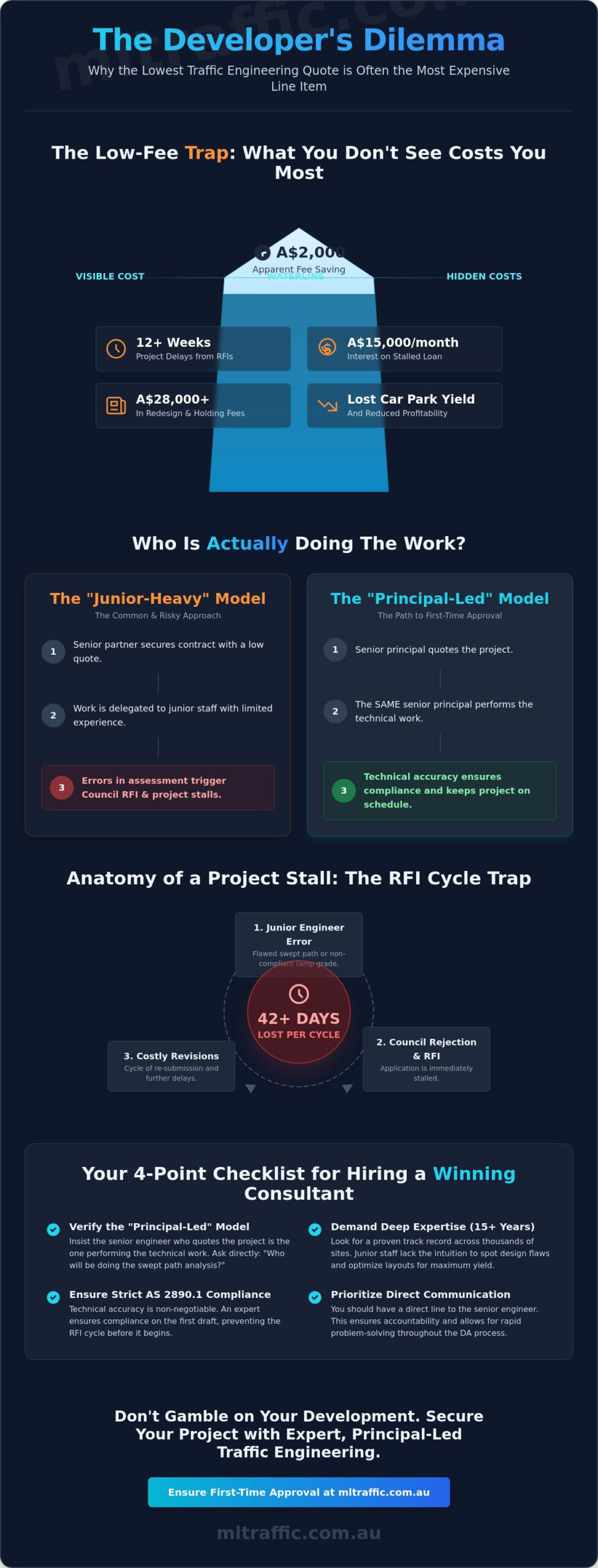
Selecting the lowest bidder for a development application is a common strategy that frequently backfires. When conducting a Traffic engineering consultants comparison Melbourne, developers must look beyond the initial fee proposal. A A$2,000 saving on professional fees is negligible when compared to the A$15,000 per month interest costs on a stalled A$3 million construction loan. Low-cost firms often delegate complex tasks to junior staff with limited experience. This leads to errors in Traffic engineering assessments that council officers will inevitably identify during the referral process.
At ML Traffic Engineers, we’ve observed that the traffic consultant who provides the quote must be the one who does the work. Junior staff lack the intuition to spot design flaws early. If a junior engineer misses a non-compliant driveway grade, the project can stall for 42 days or more while the design is revised and re-circulated through council departments. You’re not just paying for a report; you’re paying for the technical accuracy that prevents these costly administrative bottlenecks.
To better understand the technical differences between various engineering roles, watch this helpful video:
The Council RFI Trap: Why Technical Accuracy Matters
A Request for Further Information (RFI) is the primary cause of project delays in Victoria. Budget traffic reports frequently overlook critical details such as sight distance requirements or precise vehicle swept path analysis. When a consultant misses these details, council rejection is immediate. This triggers a cycle of revisions and re-submissions. Every RFI cycle adds weeks to your timeline and thousands to your financing costs. Expert consultants ensure compliance with AS 2890.1 on the first draft, which keeps your application moving through the system without unnecessary friction.
Impact on Project Yield and Profitability
Expert car park design is a form of value engineering that directly impacts your bottom line. A seasoned expert can often find ways to save square meterage or include additional parking spots within the same footprint. Consider these factors:
-
Ramp Efficiency: A poorly designed ramp might require a total redesign of the basement levels if it doesn’t meet Australian Standards.
-
Parking Layout: Optimising column placement can sometimes add 5% to 10% more parking spaces.
-
Yield Optimisation: Better traffic flow can allow for higher density in residential or commercial developments.
A case study of a recent Melbourne development showed that a compliant first draft saved the developer A$28,000 in redesign fees and holding costs. When you perform a Traffic engineering consultants comparison Melbourne, prioritise firms with a proven track record across thousands of sites. You can view our full range of technical capabilities on our services page to see how we mitigate these risks.
Key Criteria for Comparing Traffic Engineering Firms: Expertise vs. Execution
A critical factor in any traffic engineering consultants comparison Melbourne developers conduct is the gap between the sales pitch and the technical delivery. Large corporate firms often use senior partners to secure a contract before handing the actual Traffic Impact Assessment (TIA) to junior graduates. This "Junior-Heavy" model introduces risks in council negotiations and technical accuracy. For a project to succeed, the engineer who provides the quote must be the one performing the work. This ensures accountability and a direct line of communication throughout the planning permit process.
Verification of professional registrations is mandatory. In Australia, look for Registered Professional Engineer of Queensland (RPEQ) status or equivalent state-based registrations like the Victorian Professional Engineers Registration. These credentials guarantee that the consultant meets the high standards required by the Board of Professional Engineers. Technical proficiency should span diverse land-use types, including child care centres, medical clinics, and industrial warehouses, as each requires specific adherence to Australian Standards like AS 2890.1 for off-street car parking.
Seniority and Accountability in Traffic Engineering
Experience in traffic engineering isn’t just a number. There is a vast difference between a consultant with 5 years of experience and one with 30 years when defending a Car Parking Demand Assessment before a council. Senior engineers possess the historical context of local government requirements and can anticipate objections before they are raised. Ask potential firms if you’ll have direct mobile access to your lead engineer. Avoiding gatekeepers is essential for fast-tracking approvals. Senior-Led Consultancies prioritize this direct accountability, ensuring that technical decisions are made by experts rather than trainees.
The Comparison Matrix: Boutique vs. Large Multidisciplinary Firms
Large firms often prioritize volume-based report generation, leading to "cookie-cutter" TIAs that might not address site-specific constraints. Boutique firms typically offer higher responsiveness and a personal touch. While large firms boast massive departments, verify they use industry-standard software like Sidra Intersection for intersection analysis, AutoTURN for vehicle swept paths, and Aimsun for microsimulation. A boutique firm with these tools provides the same technical depth as a multinational but with significantly faster turnaround times. If you need a detailed traffic impact assessment, ensure the firm demonstrates a proven track record across thousands of previous sites to confirm their depth of experience.
Selecting a partner with a hands-on approach reduces the likelihood of costly RFI (Request for Further Information) delays from council. You can learn more about our principal-led approach to see how direct accountability impacts project timelines.
Comparing Service Depth: From Swept Paths to Complex Traffic Impact Assessments
Comparing quotes requires looking beyond the bottom line. A thorough traffic engineering consultants comparison Melbourne often reveals that cheaper quotes omit critical compliance checks. You must verify if the consultant is providing a basic Traffic Statement or a comprehensive Traffic Impact Assessment (TIA). A Traffic Statement typically addresses minor changes in land use with negligible traffic increases. In contrast, a TIA is a deep dive into trip generation, intersection degree of saturation, and detailed parking demand.
Vehicle Swept Path Analysis is the most common point of failure in planning applications. If a quote doesn’t explicitly include B85 or B99 vehicle templates for every tight turn, you’ll likely face RFI (Request for Further Information) delays. Meticulous swept path mapping ensures that waste collection trucks and delivery vans can enter and exit the site in a forward direction. This is a non-negotiable requirement for most Victorian councils and should be clearly detailed in any professional scope of works.
Decoding the Traffic Impact Assessment (TIA) Report
A high-quality TIA must include empirical data rather than generic estimates. Look for specific mentions of parking demand surveys conducted at similar sites or within a 200-meter radius of your development. Some firms cut corners by using outdated data instead of fresh, site-specific surveys. This lack of detail leads to permit refusals when Council engineers scrutinize the findings. Every TIA should link directly to broader Traffic Engineering requirements, ensuring the proposed access doesn’t compromise local road safety or network performance.
Technical Standards: AS 2890.1 Compliance
Your consultant must guarantee compliance with AS 2890.1 for off-street car parking and AS 2890.2 for commercial vehicles. This is a mandatory requirement for Australian developments. Effective car park design requires precise driveway ramp grade assessments. A 1:4 grade might work for the ramp itself, but without the correct 1:20 transitions at the top and bottom, vehicles will scrape. When reviewing professional engineering services, refer to Austroads’ guide to procurement to understand the standards expected of engineering experts. A firm specializing in AS 2890.1 will catch these issues at the design stage, saving you thousands in post-construction rectification costs. Don’t accept a quote that doesn’t explicitly list these standards as deliverables.
A Developer’s Framework for Evaluating Traffic Engineering Quotes
Selecting the right partner requires a structured approach that goes beyond the bottom-line figure. A traffic engineering consultants comparison Melbourne developers conduct must prioritize technical accountability and local council proficiency. Use this five-step framework to vet every proposal you receive.
-
Step 1: Verify the specific engineer’s project history. Large firms often use senior partners to win the bid, then delegate the technical work to junior staff. At ML Traffic Engineers, the consultant who provides the quote is the one who does the work. Ensure the individual signing your report has at least 15 years of experience in your specific development sector.
-
Step 2: Check for inclusion of council-specific assessments. A generic quote often misses localized requirements like Green Travel Plans or specific parking overlays required by the City of Melbourne or City of Yarra.
-
Step 3: Analyze the "Assumptions" section for hidden costs. Look for exclusions regarding traffic counts or RFI (Request for Further Information) responses. A low-cost quote becomes expensive if it excludes the A$1,000 to A$2,000 cost of intersection volume data.
-
Step 4: Assess the firm’s relationship with local planning authorities. Ask how many successful applications they have lodged with the Department of Transport and Planning (formerly VicRoads) in the last 24 months.
-
Step 5: Request a sample Swept Path Analysis. Review it for clarity and strict adherence to AS 2890.1. If the diagrams are cluttered or lack clear turn-radius data, council planners will likely reject the submission.
The Red Flag Checklist for Traffic Quotes
Quotes that fail to reference Australian Standards (AS 2890.1:2004) or specific municipal planning codes are immediate red flags. You should also be wary of engineers who refuse to provide direct mobile contact details; this often indicates a bureaucratic layer that will delay your project. If a proposal offers vague timelines that don’t align with your DA lodgment date, it suggests a lack of capacity to meet strict Victorian planning windows.
The Value of a Multi-State Portfolio
Engineers with experience across NSW, VIC, and QLD offer a superior level of technical adaptability. A multi-state portfolio demonstrates that the consultant understands the nuances of different jurisdictions, from Transport for NSW requirements to Brisbane City Council codes. This breadth of experience across retail, medical, and childcare land uses ensures that your project benefits from diverse compliance outcomes. A national perspective allows engineers to apply best-practice solutions that a strictly local, single-state firm might overlook.
For a detailed assessment of your site requirements, contact our senior engineers directly for a transparent, fixed-fee quote.
Why Senior-Led Consultancies Deliver Better Outcomes for National Projects
Senior leadership in traffic engineering isn’t just about a title on a business card. It represents the difference between a project that stalls at the council level and one that moves straight to construction. ML Traffic Engineers has been trading since 2005. In those 15 plus years, we’ve completed assessments for over 10,000 sites across Australia. This volume of work provides a deep database of precedents that junior firms simply can’t match. When you perform a traffic engineering consultants comparison Melbourne developers rely on, the level of direct principal involvement is the most critical metric.
We operate with a strict "No Gatekeeper" policy. This means you have direct access to our principals, Michael Lee and Benny Chen. They bring between 30 and 40 years of experience each to every project. Unlike larger firms where senior partners secure the contract and then delegate the technical work to graduates, we maintain a hands-on approach. The traffic consultant who provides your quote is the person who does the work. This ensures that the technical design is meticulous from the start, streamlining the path to council approval and reducing the need for costly revisions.
Our Approach to Traffic Impact Assessments and Statements
We focus on minimizing technical risks for private developers nationwide. Our team identifies potential access and parking issues before they become roadblocks in the planning process. We use specialized industry software like AutoTURN to generate precise vehicle swept path assessments. This level of technical accuracy ensures that your site layout functions correctly and meets all regulatory requirements. You can learn more about our full suite of Traffic Engineering Services to see how we handle everything from TIS reports to RPEQ certifications.
Proven Success Across All Land-Use Types
Our experience is exhaustive. We’ve delivered successful outcomes for a vast range of developments, including:
-
Multi-deck car parks and basement parking facilities
-
Complex industrial loading docks and warehouses
-
Residential apartments, townhouses, and mixed-use towers
-
Childcare centers, medical clinics, and schools
-
Service stations, fast food outlets, and shopping centers
Every project we undertake ensures strict compliance with Australian Standards, specifically AS 2890.1 (Off-street car parking), AS 2890.2 (Commercial vehicle facilities), and AS 2890.6 (Off-street parking for people with disabilities). This technical rigor is why we’re a preferred choice in any traffic engineering consultants comparison Melbourne. We don’t guess; we calculate. Contact us today for a Principal-led consultation to discuss your specific site requirements and ensure your development application is backed by seasoned expertise.
Secure Your Project Approval with Senior-Led Expertise
Selecting the right partner involves more than comparing bottom-line figures. A thorough traffic engineering consultants comparison Melbourne requires evaluating technical depth and direct accountability. Choosing a firm based on price alone often leads to expensive delays during the RFI stage or critical non-compliance with AS 2890 standards. Since 2005, ML Traffic Engineers has assessed over 10,000 sites across Australia, ensuring every project meets rigorous council and regulatory requirements.
You’ll work directly with principals who bring 30 to 40 years of experience to your development. This includes everything from initial Swept Path Analysis to complex Traffic Impact Assessments. We operate on a simple principle: the consultant who provides your quote is the one who performs the work. This hands-on approach eliminates firm bureaucracy and ensures your project benefits from deep-seated expertise. Reliable results come from senior-led execution, not junior staff oversight. We’re ready to help you navigate the technicalities of your next development with precision and authority.
Get a Principal-Led Traffic Engineering Quote from ML Traffic Engineers
Frequently Asked Questions
How much does a Traffic Impact Assessment (TIA) usually cost?
A Traffic Impact Assessment for a standard small-scale development typically ranges from A$2,500 to A$5,000 depending on the project’s complexity. Larger commercial or mixed-use developments require more intensive data collection and often cost between A$8,000 and A$15,000. These figures cover site inspections, data analysis, and report drafting, but exclude external costs like third-party traffic counts or Council application fees.
What is the difference between a Traffic Engineer and a Traffic Controller?
Traffic engineers are professional consultants who design infrastructure, conduct impact assessments, and ensure compliance with Australian Standards like AS 2890.1. They handle the planning and approval phases of your project through technical analysis. In contrast, traffic controllers are on-site personnel who physically manage vehicle flow using stop-slow bats and signage during the construction phase. You’ll need an engineer for your Development Application and a controller once boots are on the ground.
Do I need a traffic report for a small residential development?
Most Victorian councils require a traffic report if your development doesn’t meet the standard car parking requirements set out in Clause 52.06 of the planning scheme. Even for a two-unit subdivision, a report justifies parking reductions or validates narrow driveway access. When performing a traffic engineering consultants comparison Melbourne developers should check if the firm has experience with specific local council requirements for residential zones to ensure a smooth approval process.
How long does it take for a traffic consultant to complete a report?
A standard traffic report takes approximately 10 to 15 business days to complete from the date of instruction. This timeline includes site visits, assessment of existing conditions, and technical drafting. Complex projects requiring 7-day traffic counts or intersection modelling via SIDRA software may take 4 to 6 weeks to finalize. Delays often occur if architectural plans are updated mid-process or if external data providers have backlogs.
What are the most common reasons councils reject traffic reports?
Councils frequently reject reports due to non-compliance with AS 2890.1 (Parking Facilities) or inadequate sight-line assessments. Data shows 35% of RFI (Request for Further Information) notices stem from poor justification for parking shortfalls or inaccurate swept path diagrams. Using outdated traffic volume data or failing to address specific local planning policy objectives also leads to immediate pushback from council engineers. Accuracy in the initial submission is critical for project timelines.
Can a traffic engineer help with car park design and yield optimization?
Traffic engineers specialize in car park layout optimization to maximize vehicle yield while maintaining safety. We review driveway ramp grades, column placements, and aisle widths to ensure every square metre is utilized efficiently. Early involvement in the design phase prevents costly structural changes later. We ensure your basement or surface parking complies with the specific requirements of the Australian Standards to avoid permit delays and maximize your project’s value.
Is a Swept Path Analysis always required for a Development Application?
A Swept Path Analysis is mandatory for any development where vehicles must navigate tight turns or reverse into traffic. It’s the only way to prove a B85 or B99 vehicle can enter and exit the site in a single motion as required by most Australian councils. If your project involves a basement car park, a loading bay, or a narrow laneway, you’ll need these digital simulations to satisfy the planning department’s safety criteria.
How do I know if my traffic consultant is properly registered and qualified?
Verify your consultant’s credentials by checking the National Engineering Register (NER) or state-specific registers like RPEQ in Queensland. In Victoria, ensure the lead engineer holds a recognized degree and has extensive experience with the Transport Integration Act 2010. Professional firms will provide the qualifications of the senior staff who’ll actually perform the work. This ensures your project isn’t handed off to an unqualified junior staff member who lacks the necessary expertise.
Which areas do you cover?
We are traffic engineers servicing Abbotsford, Aberfeldie, Aintree, Airport West, Albanvale, Albert Park, Albion, Alphington, Altona, Altona Meadows, Altona North, Ardeer, Armadale, Arthurs Seat, Ascot Vale, Ashburton, Ashwood, Aspendale, Aspendale Gardens, Attwood, Avondale Heights, Balaclava, Balwyn, Balwyn North, Bangholme, Bayswater, Bayswater North, Beaconsfield, Beaumaris, Bellfield, Bentleigh, Bentleigh East, Berwick, Bittern, Blackburn, Blackburn North, Blackburn South, Bonbeach, Boronia, Box Hill, Box Hill North, Box Hill South, Braeside, Braybrook, Brentford Square, Brighton, Brighton East, Broadmeadows, Brooklyn, Brunswick, Brunswick East, Brunswick West, Bulla, Bulleen, Bundoora, Burnley, Burnside, Burwood, Burwood East, Cairnlea, Camberwell, Campbellfield, Canterbury, Carlton, Carlton North, Carnegie, Caroline Springs, Carrum, Carrum Downs, Caulfield, Caulfield East, Caulfield North, Caulfield South, Chadstone, Chelsea, Chelsea Heights, Cheltenham, Chirnside Park, Clarinda, Clayton, Clayton South, Clematis, Clifton Hill, Coburg, Coburg North, Cocoroc, Coldstream, Collingwood, Coolaroo, Craigieburn, Cranbourne, Cranbourne East, Cranbourne North, Cranbourne South, Cranbourne West, Cremorne, Croydon, Croydon Hills, Croydon North, Croydon South, Dandenong, Dandenong North, Dandenong South, Deer Park, Delahey, Derrimut, Diamond Creek, Diggers Rest, Dingley Village, Docklands, Doncaster, Doncaster East, Donnybrook, Donvale, Doreen, Doveton, Eaglemont, East Melbourne, Edithvale, Elsternwick, Eltham, Eltham North, Elwood, Emerald, Endeavour Hills, Epping, Essendon, Essendon Fields, Essendon North, Essendon West, Fairfield, Fawkner, Ferntree Gully, Ferny Creek, Fitzroy, Fitzroy North, Flemington, Footscray, Forest Hill, Frankston, Frankston North, Frankston South, Gardenvale, Gladstone Park, Glen Huntly, Glen Iris, Glen Waverley, Glenroy, Greensborough, Greenvale, Guys Hill, Hadfield, Hampton, Hampton East, Hampton Park, Harkaway, Hawthorn, Hawthorn East, Heathmont, Heidelberg, Heidelberg Heights, Heidelberg West, Highett, Hillside, Hoppers Crossing, Hughesdale, Huntingdale, Hurstbridge, Ivanhoe, Ivanhoe East, Jacana, Kalkallo, Kealba, Keilor, Keilor Downs, Keilor East, Keilor Lodge, Keilor North, Keilor Park, Kensington, Kew, Kew East, Keysborough, Kings Park, Kingsbury, Kingsville, Knoxfield, Lalor, Langwarrin, Laverton, Laverton North, Lilydale, Lower Plenty, Lynbrook, Lyndhurst, Lysterfield, Macleod, Maidstone, Malvern, Malvern East, Maribyrnong, McCrae, Meadow Heights, Melbourne, Mentone, Mernda, Mickleham, Middle Park, Mill Park, Mitcham, Mont Albert, Mont Albert North, Montmorency, Moonee Ponds, Moorabbin, Mooroolbark, Mordialloc, Mornington, Mount Waverley, Mulgrave, Murrumbeena, Narre Warren, Narre Warren North, Narre Warren South, Newport, Niddrie, Noble Park, Noble Park North, North Melbourne, Northcote, Notting Hill, Nunawading, Oak Park, Oaklands Junction, Oakleigh, Oakleigh East, Oakleigh South, Officer, Ormond, Pakenham, Parkdale, Park Orchards, Pascoe Vale, Pascoe Vale South, Patterson Lakes, Plenty, Point Cook, Port Melbourne, Portsea, Prahran, Preston, Princes Hill, Reservoir, Richmond, Ringwood, Ringwood East, Ringwood North, Ripponlea, Rosanna, Rosebud, Rowville, Roxburgh Park, Rye, Sandhurst, Sandringham, Scoresby, Seabrook, Seaholme, Seddon, Seaford, South Kingsville, South Melbourne, South Morang, South Wharf, South Yarra, Southbank, Spotswood, St Albans, St Helena, St Kilda, St Kilda East, St Kilda West, Strathmore, Sunshine, Sunshine North, Sunshine West, Surrey Hills, Sydenham, Tarneit, Taylors Hill, Taylors Lakes, Templestowe, Templestowe Lower, Thomastown, Thornbury, Toorak, Tottenham, Travancore, Truganina, Tullamarine, Vermont, Vermont South, Viewbank, Wantirna, Wantirna South, Watsonia, Watsonia North, Werribee, Werribee South, West Footscray, West Melbourne, Westgarth, Wheelers Hill, Wildwood, Williamstown, Williamstown North, Windsor, Wonga Park, Wyndham Vale, Yallambie, Yarraville.

Disclaimer
The content on www.mltraffic.com.au, including all technical articles, guides, and resources, is provided for general informational and educational purposes only. It is not intended to constitute professional advice in traffic engineering, transportation planning, development approvals, or any other technical or legal field.
While ML Traffic Engineers makes every reasonable effort to ensure the accuracy, completeness, and timeliness of the information published, we do not provide any warranties or representations (express or implied) regarding its reliability, suitability, or availability for any particular purpose. Any reliance you place on the content is strictly at your own risk.
In no event shall ML Traffic Engineers, its directors, employees, authors, or affiliates be liable for any direct, indirect, incidental, special, consequential, or punitive damages (including, without limitation, loss of profits, data, or business opportunities) arising out of or in connection with the use of, or inability to use, any information provided on this website.
The articles and guides on this site are not a substitute for engaging a qualified, registered professional traffic engineer (such as an NPER or RPEQ engineer) to assess your specific project requirements. For tailored advice, compliance assessments, or traffic engineering services, please contact a competent professional.
This disclaimer may be updated from time to time without notice. By accessing or using this website, you agree to be bound by the most current version of this disclaimer.
