

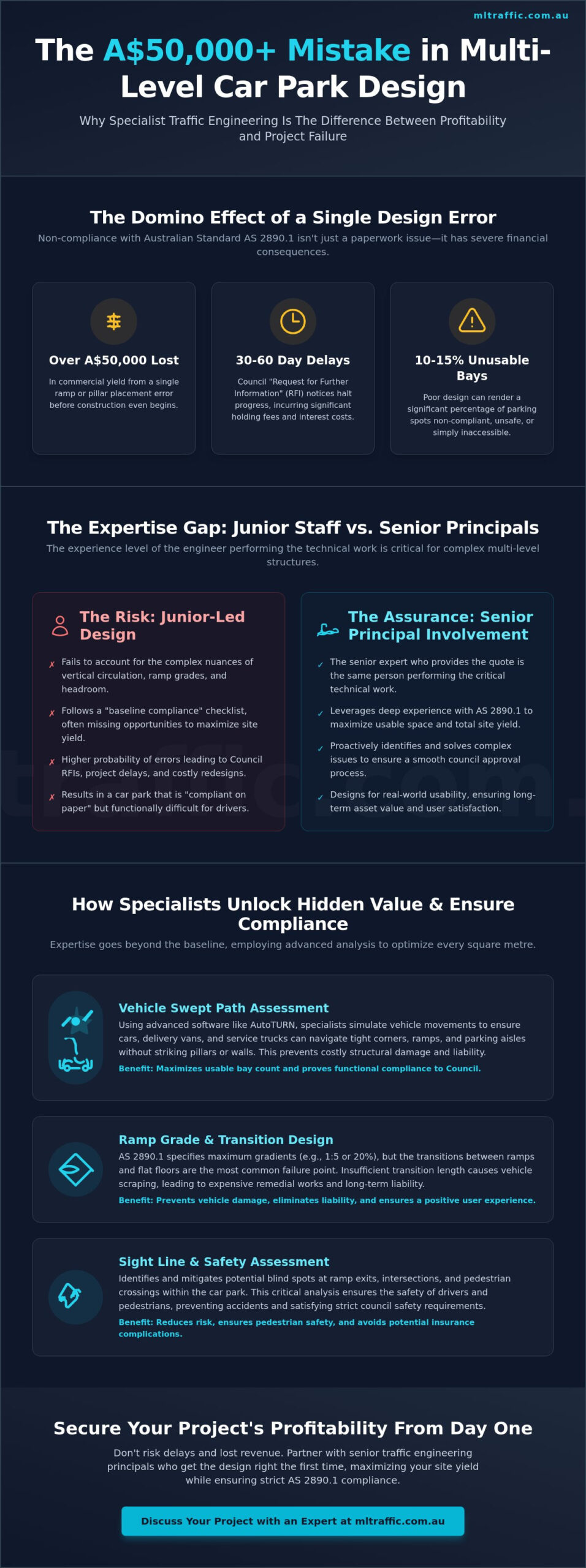
A single design error in a multi-level car park ramp can cost a developer over A$50,000 in lost commercial yield before construction begins. You understand that maximizing the number of parking bays is the difference between a profitable project and a rejected application. It’s frustrating when Council returns a non-compliance notice for AS 2890.1 because a junior staff member failed to account for correct driveway ramp grades or sight-line assessments.
A thorough traffic engineering consultants comparison Adelaide helps you avoid these costly delays by identifying firms where senior principals actually perform the technical work. You’ll learn how to evaluate expertise to ensure your multi-level design maximizes site yield while remaining strictly compliant with Australian Standards. We will outline the specific criteria for assessing technical proficiency, from Vehicle Swept Path Assessments to managing complex Council negotiations, so your project moves from planning to approval without technical errors.
Key Takeaways
- Understand why multi-level car park design requires specialist engineering to manage complex vertical circulation, ramp grades, and headroom constraints that standard reports often overlook.
- Learn how the expert interpretation of Australian Standard AS 2890.1 distinguishes high-tier consultants from those who only meet baseline compliance requirements.
- Use a structured traffic engineering consultants comparison Adelaide to evaluate how different firms leverage Swept Path Analysis and AutoTURN simulations to maximize your total site yield.
- Discover why direct involvement from senior principals is essential for navigating the technical nuances of complex parking structures and avoiding the risks associated with junior-led designs.
Table of Contents
-
Why Multi-Level Car Park Design Requires Specialist Traffic Engineering
-
How to Compare Traffic Engineering Consultants: A Selection Framework
-
Why Senior Staff Involvement is Critical for Complex Parking Structures
Why Multi-Level Car Park Design Requires Specialist Traffic Engineering
Multi-level car park design is a high-stakes engineering challenge. It requires the precise management of vertical circulation and tight spatial constraints that aren’t present in standard surface lots. Many developers make the mistake of using generalist traffic reports that fail to address the technical nuances of multi-storey car park design. These nuances include exact ramp grades, transition zones, and minimum headroom clearances required by Australian Standard AS 2890.1. A single design error in a ramp’s curve or a pillar’s placement can render 10% to 15% of parking spots unusable or legally non-compliant. A specialist consultant acts as the essential bridge between the architect’s vision and the council’s strict safety requirements. When conducting a traffic engineering consultants comparison Adelaide, it’s vital to select a firm that understands the specific South Australian planning codes and DIT requirements.
The High Cost of Non-Compliant Design
Failure to meet compliance standards during the initial submission often triggers a "Request for Further Information" (RFI) from the local council. This process typically delays a project by 30 to 60 days, resulting in significant holding fees and increased interest costs on construction loans. Beyond the approval phase, poor ramp design leads to vehicle scraping. This creates long-term liability issues for the developer and can lead to expensive remedial works. Non-compliance also negatively impacts the property valuation. If a car park doesn’t meet the dimensions specified in AS 2890.1, insurance providers may refuse coverage for accidents occurring within the facility. At ML Traffic Engineers, we focus on getting the technical specifications right the first time to avoid these costly setbacks.
The Intersection of Engineering and Commercial Yield
Yield in a parking context refers to maximizing the number of bays without compromising safety or accessibility. A specialist engineer identifies "lost" space through clever bay angling and strategic pillar placement. This process involves detailed analysis of the following factors:
-
Vehicle Swept Path Assessment: Using software to simulate car movements ensures vehicles can navigate tight corners without hitting structural columns.
-
Sight-Line Assessment: Identifying potential blind spots at ramp exits and intersections to prevent pedestrian accidents.
-
Bollard and Kerb Placement: Optimizing the footprint of safety features to reclaim square meterage.
Precise traffic engineering directly dictates the total Net Lettable Area (NLA) and the overall commercial viability of the development. Every square metre saved in the car park design can potentially be repurposed for more valuable commercial or residential use. When performing a traffic engineering consultants comparison Adelaide, developers should look for firms where the principal engineer is directly involved in the design. This ensures that the person who provides the quote is the one performing the complex calculations required to maximize your project’s yield.
Key Technical Compliance Standards: AS 2890.1 and Beyond
Australian Standard AS 2890.1 is the mandatory baseline for off-street car parking. It dictates everything from stall dimensions to aisle widths. While every engineer must follow these rules, a traffic engineering consultants comparison Adelaide often reveals that interpretation is where projects succeed or fail. Compliance on a drawing doesn’t always translate to a functional car park. Experienced consultants look beyond the bare minimum to ensure the layout works for real drivers in high-pressure environments. For mixed-use multi-level developments, AS 2890.2 for service vehicles is equally vital. It ensures that waste collection and delivery trucks can enter and exit without striking the ceiling or blocking internal traffic flow. You can review the specifics in our AS 2890.1 Guide.
Navigating Ramp Grades and Transitions
Ramp grades are the most technical aspect of multi-level design. AS 2890.1 specifies maximum gradients, often 1:5 (20%) for public car parks or 1:4 (25%) for private ones. However, the transitions between the ramp and the flat floor are the most common point of failure. If these transitions aren’t long enough, vehicles will scrape their front or rear bumpers. A design might appear compliant on a 2D floor plan, but it’s often non-functional in practice. We use detailed longitudinal sections to model the vertical path of a vehicle. This proves clearance exists at every point of the climb. Without this level of detail, you risk expensive remedial works after the concrete is poured.
B85 and B99 Vehicle Design Templates
Traffic engineers use standardized vehicle templates to test their designs. The B85 template represents the 85th percentile vehicle, which covers most standard cars on Australian roads. The B99 template represents the 99th percentile, accounting for large SUVs, 4WDs, and luxury sedans. Adelaide councils frequently require B99 clearance for ramp widths and turn circles to account for the increasing size of modern vehicles. Designing solely to B85 standards in a modern development is a mistake. It leads to tight turns that frustrate drivers and cause property damage. Meticulous consultants prioritize B99 swept paths in high-traffic areas to ensure the car park remains usable as vehicle trends shift toward larger frames. If you have questions about specific site constraints, you can contact our senior engineers for a technical review.
A thorough traffic engineering consultants comparison Adelaide should focus on how a firm handles these technicalities. The difference between a "pass" from council and a car park that’s actually easy to drive through comes down to these specific engineering choices. We ensure every design is both compliant and practical for the end user.
Comparing Swept Path Analysis and Site Yield Capabilities
Swept Path Analysis is the technical proof of concept for every multi-level car park design. It demonstrates that the proposed layout functions in reality, not just on a 2D plan. Consultants use specialized software like AutoTURN to simulate vehicle movements based on the B85 and B99 vehicle dimensions specified in Australian Standard AS 2890.1. A critical factor in a traffic engineering consultants comparison Adelaide is whether the firm relies on standard, automated paths or provides optimized simulations. Optimized paths allow for tighter, more efficient layouts that don’t sacrifice safety or compliance. This precision is vital for high-density urban developments where every square metre carries a high land value. For a deeper look at these technical requirements, see our Swept Path Analysis Guide.
Critical Maneuvering Areas in Multi-Level Structures
Multi-level structures present unique spatial constraints that require careful management. Dead-end aisles are common in these designs and require a compliant 3-point turn maneuver to ensure vehicles can exit in a forward direction. Structural pillars often conflict with these paths, creating tight squeeze points. An experienced consultant identifies these "blind spots" during the initial drafting phase. They must analyze worst-case scenarios, such as:
-
Two vehicles passing on a curved ramp with limited sightlines.
-
Large SUVs navigating narrow transition grades between levels.
-
Reverse maneuvers into bays adjacent to structural walls or fire stairs.
Failure to account for these movements leads to operational bottlenecks and potential property damage once the facility is operational.
Maximizing Bay Count Through Meticulous Design
The commercial viability of a car park often depends on the total bay count. A skilled consultant justifies parking credits or reductions by performing rigorous car parking demand assessments based on local council data and empirical evidence. There’s a constant trade-off between bay width and total yield. While wider bays improve user comfort, they reduce the total number of spaces available for the development. ML Traffic Engineers addresses this by ensuring the consultant who quotes the project is the one who performs the technical work. This hands-on approach eliminates communication gaps between management and the design desk. Precise design can often recover 5% to 10% of floor space that would otherwise be wasted. This level of detail is essential when conducting a traffic engineering consultants comparison Adelaide to find a partner who prioritizes your project’s yield and compliance simultaneously.
How to Compare Traffic Engineering Consultants: A Selection Framework
Selecting a partner for a multi-level car park requires more than checking a box for a civil engineering firm. Developers often face a choice between large generalist firms and niche traffic specialists. While large firms offer prestige, they frequently delegate complex technical work to junior graduates. For a high-stakes multi-level project, a traffic engineering consultants comparison Adelaide should prioritize hands-on senior expertise over company size. Niche specialists bring a level of focus that prevents the "over-engineering" or "under-designing" common in generalist reports.
Four Pillars of Consultant Comparison
-
Pillar 1: Technical Depth. Ensure the consultant has a granular understanding of AS 2890.1 (Off-street car parking), AS 2890.2 (Commercial vehicle facilities), and AS 2890.6 (Off-street parking for people with disabilities). They must also navigate local South Australian council nuances, such as specific access requirements for the City of Adelaide or suburban hubs like West Torrens.
-
Pillar 2: Accountability. The traffic consultant who provides the quote should be the one doing the work. At many firms, senior staff only perform a final review while juniors do the heavy lifting. Real accountability requires the senior expert to execute the swept path analysis and ramp grade calculations personally.
-
Pillar 3: Responsiveness. Design iterations are inevitable during the Development Application (DA) process. You need a consultant who responds within 24 to 48 hours, not two weeks. Delays in traffic report revisions can stall an entire project timeline and increase holding costs.
-
Pillar 4: Track Record. Look for a firm with experience across 10,000+ sites. A consultant who’s worked on thousands of diverse land-use types, from high-density apartments to commercial warehouses, will anticipate council objections before they arise.
Red Flags to Watch For
Be cautious of quotes that sit significantly below market rates. These often indicate a "copy-paste" reporting style that fails to address site-specific constraints. If you can’t get a direct mobile number for the engineer signing your report, it’s a sign of a bureaucratic structure that will slow your project down. Another major red flag is junior staff handling complex Vehicle Swept Path Assessments without direct, minute-by-minute senior oversight. This leads to errors in ramp design that are costly to fix once construction begins.
When conducting your traffic engineering consultants comparison Adelaide, request specific examples of multi-level projects they’ve successfully steered through the approval process. Proven results in high-density environments are the only true measure of competence. You need an engineer who understands that a car park isn’t just a slab of concrete, it’s a functional asset that must balance yield with user safety.
Work with senior experts who handle your project from initial quote to final approval. Contact ML Traffic Engineers to discuss your multi-level car park design today.
Why Senior Staff Involvement is Critical for Complex Parking Structures
A common grievance in the Australian development industry is the "bait and switch" model. Developers often meet a senior partner during the initial consultation only to have their technical work handed off to a graduate with less than 24 months of experience. For a simple driveway crossover, this might be acceptable. For a multi-level car park, it is a significant risk. These structures require precise calculations regarding ramp grades, headroom clearances, and complex circulation patterns that entry-level staff simply haven’t mastered.
Multi-level design is an exercise in spatial efficiency and safety. A single error in a Vehicle Swept Path Assessment can render an entire floor of parking stalls inaccessible for certain vehicle classes. When conducting a traffic engineering consultants comparison Adelaide, you’ll find that ML Traffic Engineers operates on a different premise: the consultant who provides your quote is the one who performs the work. This model ensures that every aspect of your car park design, from aisle widths to queuing analysis, is handled by an engineer with decades of experience rather than a trainee.
The "Direct Access" Advantage
Direct communication with principals Michael Lee or Benny Chen speeds up the design process significantly. You don’t have to wait for a junior staffer to check with a supervisor before answering a technical query. This responsiveness is vital when your architect needs immediate feedback on structural column placement or ramp configurations to maintain the project timeline.
Having a senior engineer who can defend their report during council meetings or ERD Court appeals is a major asset. A report is only as strong as the engineer’s ability to justify their findings under scrutiny from council planners or concerned stakeholders. You can read more about our hands-on philosophy on our About ML Traffic page. Our principals bring between 30 and 40 years of experience to every project, ensuring your design is compliant with AS 2890.1 and local planning codes from the outset.
Securing Your DA Approval
Choosing the right consultant is an investment in your project’s timeline and budget. A flawed Traffic Impact Statement (TIS) often leads to multiple Requests for Further Information (RFI) from the council, which can delay a Development Application (DA) by 12 to 24 weeks. This delay can cost thousands in holding costs and lost revenue. When performing a traffic engineering consultants comparison Adelaide for a multi-level project, use this final checklist:
-
Does the principal engineer personally sign off on all swept path and sight-line assessments?
-
Is the firm’s experience backed by a portfolio of over 10,000 completed sites?
-
Will you have the principal’s direct mobile number for urgent design changes?
-
Does the firm specialize in private development applications rather than government contracts?
ML Traffic Engineers focuses on providing technical certainty for private developers. We understand the bureaucratic requirements of Adelaide councils and provide the meticulous documentation needed to secure approvals. Contact ML Traffic Engineers for a specialized car park design quote and ensure your multi-level project is handled by seasoned experts.
Secure Your Multi-Level Development with Expert Traffic Engineering
Designing a multi-level car park is a high-stakes investment where technical precision directly impacts site yield and safety. Success depends on rigorous adherence to AS 2890.1 standards and accurate swept path analysis to ensure functional vehicle movement. When conducting a traffic engineering consultants comparison Adelaide, developers must prioritize firms that provide direct access to senior experts rather than delegating tasks to junior staff. ML Traffic Engineers brings over 15 years of specialist experience to every complex parking project. We have successfully completed over 10,000 site assessments across Australia, ensuring developments meet all local and national regulatory requirements. Our unique operating model means the senior consultant who quotes your job is the exact professional who performs the work. This eliminates communication gaps and ensures your parking structure’s design is optimized for maximum efficiency and compliance. Don’t risk costly design revisions or delays in the planning stage. Get the technical certainty your Adelaide development requires from a proven industry leader.
Get a Professional Traffic Engineering Quote for Your Development
Frequently Asked Questions
How much does a traffic engineering report for a multi-level car park cost?
Costs for a traffic engineering report vary based on project scale and technical complexity. For a multi-level car park, professional fees generally range from A$3,500 to over A$15,000 depending on the number of levels and required intersection modelling. A simple statement for a smaller site sits at the lower end, while a full assessment for a major CBD development requires more intensive data collection and analysis.
What is the minimum bay size required by AS 2890.1?
AS 2890.1 specifies minimum bay sizes based on the specific user class. For Class 1A residential parking, the standard length is 5.4 metres and the width is 2.4 metres. For Class 2 long-term parking, the width increases to 2.5 metres. Our traffic engineering consultants comparison Adelaide services ensure your multi-level design accounts for these 100% compliance requirements to avoid costly redesigns during the construction phase.
Why does council require a swept path analysis for my car park design?
Councils require a swept path analysis to prove that the 99th percentile vehicle can safely navigate the car park without striking columns or walls. We use CAD-based software to simulate vehicle movements through ramps and tight corners. This technical assessment confirms that the 5.8-metre B99 vehicle can enter and exit the site in a forward direction, which is a mandatory safety requirement for most Australian local government authorities.
Can a traffic engineer help me reduce the number of parking spaces required by council?
Yes, an engineer can justify a reduction in parking spaces through a Car Parking Demand Assessment. We analyse empirical data from similar land uses and consider the site’s proximity to public transport hubs. If the statutory requirement in the Planning and Design Code exceeds actual demand, we provide the technical evidence needed to support a lower provision in your development application, potentially saving significant construction costs.
How long does it take to prepare a Traffic Impact Assessment (TIA)?
Preparation of a Traffic Impact Assessment typically takes between 10 and 20 business days. This timeframe includes site inspections, traffic volume counts, and technical report drafting. Larger multi-level projects involving complex SIDRA intersection modelling may require up to 30 days to complete. We ensure the consultant who quotes for your project is the one performing the work to maintain this schedule and ensure technical accuracy.
What is the difference between a Traffic Impact Statement and a Traffic Impact Assessment?
A Traffic Impact Statement (TIS) is a concise document for low-impact developments with minimal traffic generation. A Traffic Impact Assessment (TIA) is a comprehensive report required for larger projects like multi-level car parks that significantly affect the local road network. TIAs include detailed intersection analysis and 10-year traffic growth projections, whereas a TIS focuses primarily on site-specific access and parking compliance issues.
Do I need a traffic engineer for a small multi-level residential development?
You need a traffic engineer for any multi-level residential project to ensure compliance with the Planning and Design Code. Even a small 3-level development requires certification for driveway gradients, sight-line assessments, and waste vehicle access. In Adelaide, 95% of councils require a professional traffic report to progress a development application through the assessment process. This ensures the design is functional and meets Australian Standards.
What happens if my car park design does not meet Australian Standards?
If your car park design fails to meet AS 2890.1, council will likely issue a Request for Further Information (RFI) or refuse the application. Non-compliance leads to safety hazards, such as insufficient sight distances or vehicles scraping ramps. Our engineers identify these issues early, ensuring your multi-level design meets 100% of the mandatory technical specifications before submission to avoid project delays and long-term legal liability.
Which areas do you service?
We are traffic engineers servicing Aberfoyle Park, Adelaide, Adelaide Airport, Albert Park, Alberton, Aldinga, Aldinga Beach, Allenby Gardens, Angle Park, Ascot Park, Athelstone, Auldana, Beaumont, Belair, Bellevue Heights, Blackwood, Brighton, Broadview, Burnside, Camden Park, Campbelltown, Christie Downs, Christies Beach, Clarence Park, Clearview, Clovelly Park, Coromandel Valley, Croydon, Daw Park, Dernancourt, Dulwich, Eden Hills, Edwardstown, Elizabeth, Enfield, Felixstow, Findon, Flagstaff Hill, Fulham, Gawler, Gepps Cross, Gilles Plains, Gillman, Glen Osmond, Glenelg, Glenelg North, Glengowrie, Glenunga, Golden Grove, Goodwood, Grange, Greenacres, Hackham, Hackney, Hallett Cove, Happy Valley, Hawthorn, Henley Beach, Highbury, Hindmarsh, Hope Valley, Ingle Farm, Kensington, Kent Town, Keswick, Kilburn, Kilkenny, Kingswood, Kurralta Park, Largs Bay, Linden Park, Lockleys, Magill, Malvern, Marion, Mawson Lakes, Melrose Park, Mile End, Mitcham, Modbury, Morphett Vale, Mount Barker, Mount Osmond, Myrtle Bank, Nailsworth, Netherby, Newton, Noarlunga Centre, North Adelaide, North Plympton, Norwood, Oaklands Park, Panorama, Para Hills, Parafield Gardens, Paralowie, Parkside, Pasadena, Payneham, Pennington, Plympton, Pooraka, Port Adelaide, Port Noarlunga, Prospect, Regency Park, Reynella, Richmond, Rose Park, Rostrevor, Salisbury, Seacliff, Seaton, Semaphore, Somerton Park, St Marys, St Peters, Stepney, Stonyfell, Sturt, Tea Tree Gully, Tennyson, Toorak Gardens, Torrensville, Tranmere, Tusmore, Unley, Vale Park, Walkerville, Warradale, Wayville, West Beach, West Lakes, Woodville, Wynn Vale.

Disclaimer
The content on www.mltraffic.com.au, including all technical articles, guides, and resources, is provided for general informational and educational purposes only. It is not intended to constitute professional advice in traffic engineering, transportation planning, development approvals, or any other technical or legal field.
While ML Traffic Engineers makes every reasonable effort to ensure the accuracy, completeness, and timeliness of the information published, we do not provide any warranties or representations (express or implied) regarding its reliability, suitability, or availability for any particular purpose. Any reliance you place on the content is strictly at your own risk.
In no event shall ML Traffic Engineers, its directors, employees, authors, or affiliates be liable for any direct, indirect, incidental, special, consequential, or punitive damages (including, without limitation, loss of profits, data, or business opportunities) arising out of or in connection with the use of, or inability to use, any information provided on this website.
The articles and guides on this site are not a substitute for engaging a qualified, registered professional traffic engineer (such as an NPER or RPEQ engineer) to assess your specific project requirements. For tailored advice, compliance assessments, or traffic engineering services, please contact a competent professional.
This disclaimer may be updated from time to time without notice. By accessing or using this website, you agree to be bound by the most current version of this disclaimer.
