

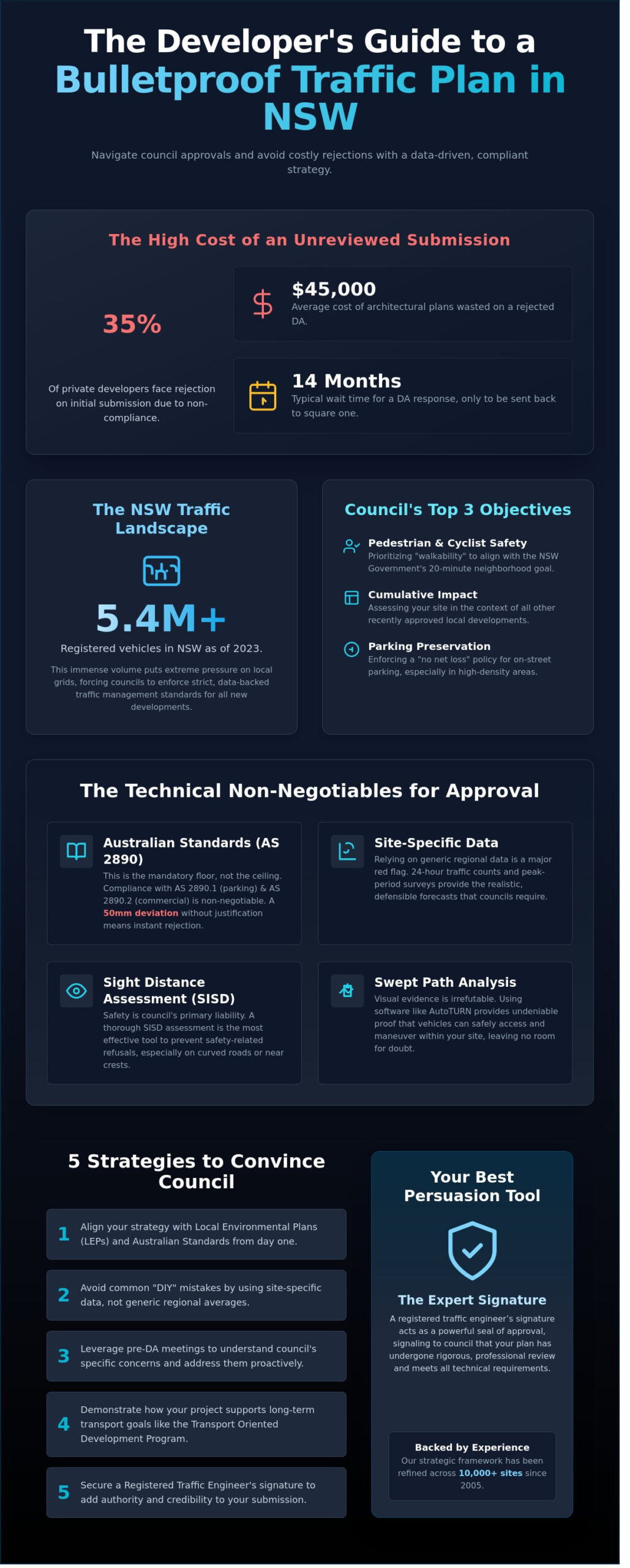
Imagine spending $45,000 on architectural plans and waiting 14 months for a Development Application response, only to receive a formal rejection because your driveway ramp grade doesn’t meet AS 2890.1 standards. This scenario is a reality for roughly 35% of private developers in NSW who submit technical reports without a rigorous compliance review. You’ve likely felt that council requirements are a moving target, making the task of convincing council your traffic plan in NSW is sound feel like an uphill battle against opaque local environmental plans and technical jargon.
It’s frustrating when a project you’ve invested significant capital into stalls because of a single overlooked swept path assessment. We’re here to change that. This guide provides the exact strategic framework we’ve used across 10,000 sites since 2005 to ensure your submission is bulletproof. You’ll learn the specific steps to ensure your traffic impact assessment meets strict NSW standards and sails through the council approval process. We’ll break down the critical technical requirements and show you how to present data that council officers can’t find fault with.
Key Takeaways
- Learn why aligning your strategy with Local Environmental Plans and Australian Standards is the non-negotiable first step toward council approval.
- Identify the common “DIY” mistakes and data oversights that cause NSW councils to reject even the most well-intentioned development applications.
- Discover the specific strategic steps for convincing council your traffic plan in NSW is sound by leveraging pre-DA meetings and long-term transport goals.
- Find out how a registered traffic engineer’s signature acts as a powerful persuasion tool to help your project navigate complex planning bureaucracy.
Understanding the NSW Council Traffic Approval Landscape
NSW councils aren’t just being difficult when they scrutinize your application; they’re managing a state with over 5.4 million registered vehicles as of 2023. This volume puts immense pressure on local grids. Convincing council your traffic plan in NSW is sound requires more than a simple map. Your Local Environmental Plan (LEP) sets the legal framework for what you can build, but your traffic strategy proves the local infrastructure can actually handle it.
To better understand this concept, watch this helpful video:
Council officers evaluate your Statement of Environmental Effects (SEE) to ensure technical alignment with Traffic engineering principles. A “sound” plan is a data-backed document that demonstrates your project won’t cause safety hazards or gridlock. It’s about showing that a 15-unit apartment complex won’t turn a quiet cul-de-sac into a bottleneck during the 8:00 AM school run. If your data is weak, your application will stall.
The Role of Transport for NSW (TfNSW)
Local councils don’t always have the final word. If your development sits on or near a classified road, such as a state highway or a major arterial route, council must refer the plan to TfNSW. They use a strict hierarchy of road classifications to determine who has jurisdiction. In many cases, state-level guidelines under the State Environmental Planning Policy (SEPP) will override local council preferences. Understanding these layers is vital for convincing council your traffic plan in NSW is sound, especially for high-impact commercial sites.
Common Local Council Traffic Objectives
Councils prioritize specific community outcomes that go beyond just moving cars. You’ll need to address these three areas:
- Pedestrian Safety: Plans must prioritize “walkability” and cyclist safety to align with the NSW Government’s 20-minute neighborhood goal.
- Cumulative Impact: Assessors look at your site alongside the 10 other developments approved in your suburb over the last 18 months.
- Parking Preservation: Most councils, particularly in high-density areas like Sydney’s Inner West, enforce a “no net loss” policy for on-street parking to protect existing residents.
The Technical Non-Negotiables of a Sound Traffic Plan
Council assessors see hundreds of applications every year. They’ll spot a generic, cut-and-paste plan in seconds. To succeed in convincing council your traffic plan in NSW is sound, you must treat Australian Standards (AS 2890) as the floor, not the ceiling. Compliance with AS 2890.1:2004 for car parking and AS 2890.2 for commercial vehicles is mandatory. If your driveway grades or parking space dimensions deviate by even 50mm without a robust engineering justification, you’ll face an immediate rejection.
Accuracy depends on site-specific data. Relying solely on regional averages from the TfNSW Guide for Traffic Generating Developments is a risk. We often conduct 24-hour traffic counts or peak-period surveys at similar existing sites to provide a realistic forecast of how your development will actually behave. This data-driven approach is essential when integrating your proposal with wider engineering services. Your plan should also align with broader state initiatives like the Transport Oriented Development Program. Showing the council that your project supports these high-level transport strategies demonstrates that you’ve considered the long-term vision for the precinct.
Safety is the council’s primary liability. An accurate Sight Distance Assessment is the most effective way to prevent safety-related refusals. We measure the Safe Intersection Sight Distance (SISD) to ensure drivers can see oncoming traffic and pedestrians clearly. If your site is on a curved road or near a crest, this assessment is the difference between an approval and a flat “no.”
Swept Path Analysis: Visual Proof of Access
Visual evidence is harder to argue with than text. We use AutoTURN software to simulate vehicle movements, providing undeniable proof that the largest expected vehicle can maneuver safely. Whether it’s a 12.5m Heavy Rigid Vehicle or a standard waste collection truck, the council needs to see the vehicle enter and leave in a forward direction. A common mistake that triggers a Request for Information (RFI) is failing to account for the 300mm to 500mm clearance required from curbs or structural pillars. Getting these details right the first time keeps your application moving.
Traffic Impact Assessment (TIA) Core Components
A TIA must quantify trip generation rates with precision. We analyze intersection performance to determine the Level of Service (LoS). If a local intersection currently operates at LoS B, your development shouldn’t push it to LoS D without a clear mitigation strategy. We also address parking demand by comparing your proposed land use against the local Council Development Control Plan (DCP). If you’re providing fewer spaces than the DCP requires, we provide the empirical evidence needed to justify the shortfall. Convincing council your traffic plan in NSW is sound is much easier when every claim is backed by a specific number or a verified survey. If you aren’t sure if your current layout meets these standards, you can contact our senior engineers for a preliminary review.
Why Council Rejects Traffic Plans (And How to Avoid It)
NSW councils reject roughly 20% of initial traffic submissions because the documentation lacks site-specific depth. When you submit a plan that relies on “DIY” templates or outdated figures, you invite immediate scrutiny. Council assessors are trained to spot generic reports that don’t account for the unique constraints of a local street network. Convincing council your traffic plan in NSW is sound requires a shift from “checking boxes” to providing a bulletproof technical argument.
Most refusals stem from four critical oversights:
- Using recycled data that doesn’t reflect post-2023 traffic volumes.
- Failing to model peak-hour congestion at the nearest signalized intersection.
- Ignoring the 12.5-meter Heavy Rigid Vehicle (HRV) requirements for waste collection.
- Overlooking the safety of pedestrians and cyclists in high-density zones.
If your plan fails to address how a garbage truck will enter and exit the site in a single forward motion, it won’t pass. We’ve seen projects delayed by 6 months because the applicant didn’t provide a Vehicle Swept Path Assessment. You can view our full range of technical traffic engineering services to see how these requirements are met professionally.
The “Copy-Paste” Trap
Assessors see hundreds of reports a year. They quickly identify generic data pulled from projects in different LGAs. Your TIA must be tailored to the specific Local Environmental Plan (LEP) and Development Control Plan (DCP) of your council. Using traffic counts from 2021 or earlier is a major red flag. Current, post-2023 data is mandatory to reflect the new reality of Sydney’s road usage. We ensure every count is fresh and every report respects the local zoning rules.
Addressing the Resident Objection Factor
Councils are politically sensitive to community “parking anxiety.” If 50 local residents write letters complaining about street parking, the council will look for any weakness in your traffic report to justify a refusal. We proactively address these concerns by including a Car Parking Demand Assessment. It’s about making technical findings accessible. We translate complex data into clear safety and noise mitigations that non-engineers can understand. This proactive approach is vital for convincing council your traffic plan in NSW is sound while silencing valid objections from neighbors. If you need a report that stands up to public scrutiny, contact our senior engineers directly.
5 Strategies to Convince Council Your Plan Is Sound
Securing an approval isn’t just about submitting technical drawings; it’s about building a narrative of safety and efficiency. To succeed in convincing council your traffic plan in NSW is sound, you need to prove that your development won’t just function, but will integrate seamlessly into the existing road network. This requires a shift from defensive reporting to proactive problem-solving.
The Power of Pre-DA Consultation
Don’t wait until you lodge your Development Application to speak with the council traffic engineer. A pre-DA meeting is the most effective way to identify “deal-breaker” issues early. Ask specific questions about local black spots or planned road upgrades that might affect your site. By addressing these concerns before the formal lodgement, you build a rapport with assessing officers. It shows you’re cooperative rather than combative. This early engagement can save you 3 to 6 months in potential RFI (Request for Further Information) delays.
Your strategy should also align with the Council’s long-term transport goals. If the local government area is pushing for 20% more cycling infrastructure by 2030, show how your plan supports that goal. Always provide conservative data estimates. Over-estimating potential traffic impact by 5% or 10% builds more trust than being overly optimistic. It proves you’ve accounted for worst-case scenarios, like peak Friday afternoon periods.
Data Visualisation and Clarity
A single clear diagram often carries more weight than ten pages of technical jargon. Assessing officers have heavy workloads and appreciate clarity. Use high-quality visualisations to demonstrate strict compliance with AS 2890.1 for car park design. Show “before and after” scenarios to illustrate that the impact on local intersections is minimal. Clear swept path assessments for a 12.5m heavy rigid vehicle, for instance, can immediately resolve concerns about site access.
The most critical factor is the person behind the report. You need a consultant who is experienced in NSW-specific requirements and understands the nuances of various local councils. With over 10,000 sites assessed since 2005, we know that technical accuracy is only half the battle. At ML Traffic Engineers, the consultant who provides the quote, does the work. Convincing council your traffic plan in NSW is sound becomes much simpler when your consultant has a proven track record of 30 plus years in the field.
Ready to get your project moving? Contact our senior engineers today for a direct consultation on your traffic plan.
Why an Expert Signature Is Your Best Persuasion Tool
Convincing council your traffic plan in NSW is sound depends heavily on the credentials behind the document. A registered traffic engineer’s stamp isn’t just a formality. It’s a guarantee of technical accuracy that planning officers trust. At ML Traffic Engineers, we bring between 30 and 40 years of experience to every project. This level of seniority helps you bypass the usual bureaucratic friction found in NSW planning departments. Our “No Gatekeepers” approach ensures you speak directly to the principals, Michael Lee or Benny Chen, rather than junior staff who lack the authority to influence council decisions.
Accountability in Traffic Engineering
Reliability starts with our “quote-to-completion” promise. The consultant who provides your initial quote is the same senior expert who performs the technical work. This eliminates the risk of data being lost in translation between departments, which is a common cause of report inaccuracies. We prioritize RPEQ or equivalent senior certification because NSW projects demand high-level oversight. If your application faces challenges, our experts serve as witnesses to support your case at a tribunal or the Land and Environment Court. We’ve applied this rigorous standard across more than 10,000 sites since 2005, ensuring every Traffic Impact Statement (TIS) is defensible under scrutiny.
Moving from Lodgement to Approval
The period after you lodge your Development Application (DA) is critical. Councils often issue Requests for Information (RFIs) that require immediate, technical responses. We manage these queries directly, providing the specific data needed to keep your project moving. Our team negotiates conditions of consent to ensure parking and traffic requirements remain fair and achievable. We focus on specific outcomes to keep your project on schedule:
- Drafting professional technical responses to complex council RFIs.
- Negotiating parking credits and traffic flow conditions.
- Aligning site designs with Australian Standards like AS 2890.1.
- Providing direct advocacy with planning officers to resolve disputes.
You don’t need to handle the bureaucracy alone. You can contact an expert today to review your site and ensure your traffic plan meets every regulatory benchmark required for a successful approval.
Secure Your Development Approval Today
Navigating the NSW planning landscape doesn’t have to be a guessing game. Success relies on strict technical compliance with standards like AS 2890.1 and addressing council concerns before they become formal objections. By focusing on data-driven assessments and clear site-line analysis, you remove the friction from the approval process. The most effective shortcut to convincing council your traffic plan in NSW is sound involves leveraging a signature that local authorities already respect.
ML Traffic Engineers brings over 15 years of specific experience in NSW development applications to your project. We’ve successfully navigated requirements for more than 10,000 sites nationwide. You won’t be passed off to a junior staffer; instead, you get direct access to our senior principals, Michael Lee and Benny Chen. They ensure every assessment meets rigorous standards because the consultant who quotes your job is the one who does the work.
Get a professional traffic assessment that NSW councils trust; contact ML Traffic Engineers today.
Your project deserves a clear path forward and we are ready to help you clear this final hurdle.
Frequently Asked Questions
How long does it usually take for a NSW council to review a traffic plan?
NSW councils typically take between 40 and 90 days to review a traffic plan during the formal Development Application assessment. This timeframe fluctuates based on the complexity of the 10,000 sites we’ve handled since 2005. If Transport for NSW requires a referral for projects on classified roads, expect an additional 21 days for their statutory response. We recommend submitting early to avoid peak holiday processing delays.
Do I need a full Traffic Impact Assessment for a small development?
You don’t always need a full TIA; a concise Traffic Impact Statement often suffices for smaller developments like 3-unit townhouses or minor retail fit-outs. Most NSW councils trigger a full TIA only when a project exceeds specific thresholds, such as generating more than 30 vehicle trips per hour. Providing a professional statement early prevents the council from requesting more expensive, unnecessary reports later in the process.
What is the difference between a Traffic Management Plan and a Traffic Guidance Scheme in NSW?
A Traffic Management Plan is a high-level strategic document that describes how you’ll manage overall project impacts on the road network. In contrast, a Traffic Guidance Scheme, formerly known as a TCP, is a technical diagram showing exactly where to place every cone and sign. NSW legislation requires a TGS for any work impacting road users, while a TMP is usually a broader requirement for construction or large-scale events.
Can I use traffic data from a few years ago for my current DA?
Councils generally reject traffic data that’s older than 12 to 24 months because it doesn’t reflect current road conditions or recent local developments. Convincing council your traffic plan in NSW is sound requires using fresh data, especially since post-2021 traffic patterns have shifted significantly across Sydney. We recommend conducting new 7-day pneumatic tube counts to ensure your application stands up to scrutiny from council engineers.
What happens if the Council disagrees with my traffic consultant’s findings?
If a council engineer disagrees with the report, they’ll issue a formal Request for Further Information, which effectively pauses your assessment clock. This happens in roughly 15% of complex applications we see. We resolve these disputes by providing technical evidence, such as SIDRA intersection modeling or Vehicle Swept Path Assessments, to prove that our findings meet the specific requirements of the local environmental plan and Australian Standards.
How much does a professional Traffic Impact Assessment report cost in NSW?
A professional TIA report in NSW typically costs between $2,500 for simple residential projects and upwards of $15,000 for large-scale commercial developments. These fees cover the data collection, technical analysis, and the RPEQ certification required for legal submission. Since 2005, we’ve maintained a strict policy where the consultant who provides your quote is the expert who actually completes the technical work on your project.
Does a sound traffic plan guarantee my DA will be approved?
A sound traffic plan doesn’t guarantee approval, but it eliminates one of the top three reasons for DA refusal in NSW. While traffic is a critical component, council also weighs your application against zoning laws, aesthetics, and environmental impact. Having a robust, compliant plan ensures that traffic issues won’t be the deal-breaker that stops your project from moving forward to the final approval stage.
What are the most common AS 2890.1 compliance issues in NSW car parks?
The most common failures involve driveway ramp grades exceeding the 1:20 limit for the first 6 metres and inadequate sight-lines for pedestrians. We see these technical errors in about 30% of initial architectural drawings. Ensuring your plan adheres strictly to AS 2890.1 standards for parking modules and turning circles is essential for convincing council your traffic plan in NSW is sound and safe for public use.
Disclaimer
The content on www.mltraffic.com.au, including all technical articles, guides, and resources, is provided for general informational and educational purposes only. It is not intended to constitute professional advice in traffic engineering, transportation planning, development approvals, or any other technical or legal field.
While ML Traffic Engineers makes every reasonable effort to ensure the accuracy, completeness, and timeliness of the information published, we do not provide any warranties or representations (express or implied) regarding its reliability, suitability, or availability for any particular purpose. Any reliance you place on the content is strictly at your own risk.
In no event shall ML Traffic Engineers, its directors, employees, authors, or affiliates be liable for any direct, indirect, incidental, special, consequential, or punitive damages (including, without limitation, loss of profits, data, or business opportunities) arising out of or in connection with the use of, or inability to use, any information provided on this website.
The articles and guides on this site are not a substitute for engaging a qualified, registered professional traffic engineer (such as an NPER or RPEQ engineer) to assess your specific project requirements. For tailored advice, compliance assessments, or traffic engineering services, please contact a competent professional.
This disclaimer may be updated from time to time without notice. By accessing or using this website, you agree to be bound by the most current version of this disclaimer.
