
Imagine spending A$15,000 on a new concrete entry only to receive a council demolition order because your ramp grade exceeds the 1 in 4 limit by a fraction of a percent. For many Australian property owners, the realization that their project doesn’t meet AS 2890.1 standards comes far too late. Learning how to design a council compliant driveway is about more than just aesthetics; it’s about navigating a rigid intersection of national engineering codes and specific local government requirements. You likely already feel that the gap between a functional design and a legal one is dangerously thin, especially when you’re managing a steep or awkward block.
We know the pressure to get your Development Application or crossover permit right is immense. You don’t want to deal with the A$5,000 re-work costs that follow a failed inspection. This guide provides the technical roadmap you need to master ramp transitions and prevent car scraping for good. We will walk through the 2026 Australian Standard updates, specific grade calculations for sloped sites, and the exact steps to secure your design approval without the typical bureaucratic headaches.
Key Takeaways
- Identify the legal distinctions between public crossovers and private property boundaries to prevent non-compliance and potential demolition orders.
- Understand the technical specifications of AS 2890.1 to learn exactly how to design a council compliant driveway that meets 2026 national width and safety benchmarks.
- Master the "Scrape Test" and maximum allowable gradients to ensure your ramp design provides safe ground clearance for low-profile vehicles.
- Navigate the council approval roadmap by coordinating site surveys with standard drawings to account for utility pits and street trees.
- Discover how professional traffic engineering reports can fast-track your Development Application (DA) and ensure the consultant who quotes the work, does the work.
Understanding Driveway Compliance: Why Your Council Crossover Matters
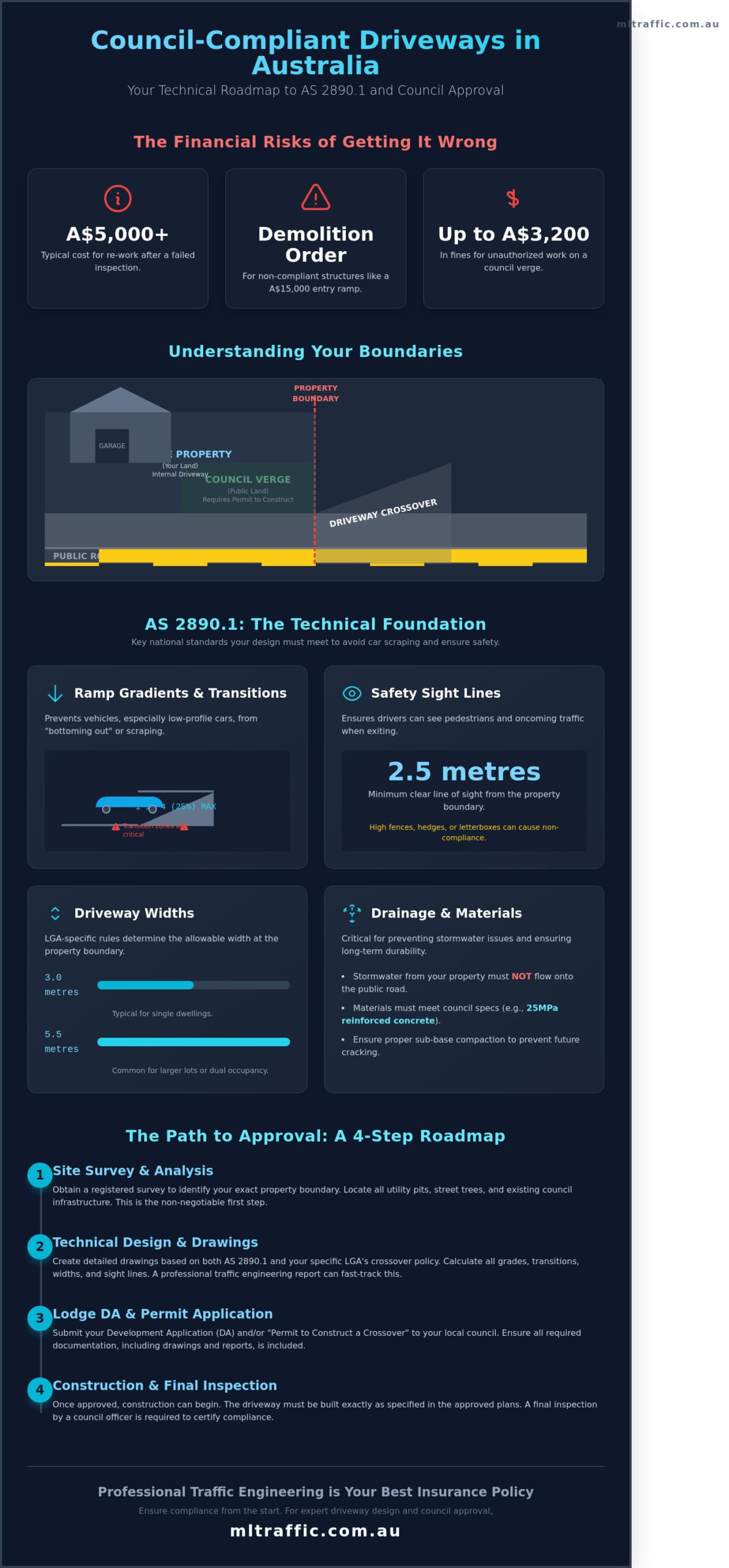
Designing a driveway involves more than choosing a finish or deciding where to park the ute. It’s a technical exercise that sits at the intersection of private property and public infrastructure. When you look at how to design a council compliant driveway, you’re managing two distinct zones. The "crossover" is the section of the driveway located on the council verge, spanning from the road kerb to your property boundary. While you pay for its construction, this land belongs to the local government. The internal driveway is everything behind your property line. Jurisdictions overlap here because your internal grades must match the council’s fixed levels at the boundary to prevent drainage issues or vehicle scraping.
By 2026, many Australian local councils have increased site inspections by 22% to ensure all new builds meet strict accessibility and safety codes. The legal consequences of ignoring these standards are steep. Non-compliant construction can lead to "Notice to Comply" orders, forcing you to tear up fresh concrete at your own expense. Fines for unauthorized work on a council verge can exceed A$3,200 in certain LGAs. Beyond the legal risks, a compliant design ensures your vehicle doesn’t bottom out and protects your home’s resale value. Most savvy buyers now look for a certified crossover that adheres to Pavement engineering principles for long-term durability and soil stability.
Your Local Government Area (LGA) acts as the primary regulator for these structures. They set the specific width standards, typically ranging from 3.0 metres for single dwellings to 5.5 metres for larger lots. They also dictate which materials are permitted, such as 25MPa reinforced concrete or heavy-duty asphalt. Understanding how to design a council compliant driveway requires a deep dive into these local manuals, as a design approved in one suburb might be rejected in the next. We’ve seen hundreds of projects delayed because the owner didn’t check the specific LGA requirements for reinforcement mesh or sub-base compaction.
The Difference Between Private Property and Council Verge
You must identify your exact boundary using a registered survey before you start digging. Many homeowners mistakenly believe their land title extends all the way to the road kerb. In reality, the council verge usually begins between 300mm and 1.5 metres from the kerb. You’re legally required to obtain a "Permit to Construct a Crossover" before any work begins on this public land. A common pitfall occurs when homeowners pour concrete over utility pits or water meters. If the council needs to access these services, they’ll break your driveway and won’t pay for the repairs if your crossover isn’t compliant.
Safety and Sight-Line Requirements
Safety is the council’s highest priority. You must calculate minimum sight distances to protect pedestrians on the footpath and drivers on the road. For most residential designs, you need a clear line of sight for at least 2.5 metres from the property boundary. High fences, thick hedges, or large letterboxes can inadvertently void your compliance. Blind spots contribute to over 1,500 low-speed driveway accidents annually across Australia. Proper design mitigates these risks by ensuring the exit point is perpendicular to the road. This gives the driver the best possible view of oncoming traffic and prevents dangerous "blind" entries into the street.
- AS 2890.1 Compliance: Ensures the ramp grades don’t cause vehicles to bottom out.
- Drainage Control: Prevents stormwater from your property flowing onto the public road.
- Material Durability: Prevents the crossover from cracking under the weight of heavy delivery trucks.
The Technical Foundation: Australian Standard AS 2890.1
AS 2890.1:2004 is the primary Australian Standard for off-street car parking. It serves as the technical bible for engineers and architects across the country. If you want to understand how to design a council compliant driveway, you have to start with this document. It sets the national benchmark for everything from ramp grades to parking space dimensions. While councils have their own specific crossovers policies, they almost always defer to AS 2890.1 for the core engineering requirements. Failing to meet these standards doesn’t just mean a rejected application; it often results in a driveway that’s physically difficult or dangerous to use.
One of the biggest mistakes property owners make is assuming the driveway width should simply match the garage door. This logic often leads to non-compliance. Council regulations focus on the point where your property meets the public road. Most local government areas require a residential driveway width between 3.0m and 5.5m at the property boundary. If your garage is a triple-car setup at 9.0m wide, your driveway must taper down significantly before it hits the footpath. Designing without this taper in mind can lead to costly reconstruction orders after a council inspection.
Compliance also relies on the "design car" models. Engineers don’t just guess if a car fits; they use the B85 and B99 vehicle templates. The B85 represents the 85th percentile of vehicles on Australian roads, while the B99 represents the 99th percentile, which includes large SUVs and utility vehicles like the Toyota HiLux or Ford Ranger. For a residential driveway to be truly compliant, it must allow a B85 vehicle to enter and exit in a single maneuver without crossing onto the wrong side of the road or hitting a physical obstruction.
Driveway Widths and Turning Circles
Standard residential widths usually sit at 3.0m for single dwellings, but this increases for multi-unit developments. The complexity arises when your property is on a narrow street or a busy road. In these cases, a simple straight driveway won’t work because the car needs a wider arc to turn. This is where Swept Path Analysis becomes essential. It’s a digital simulation that proves a B85 or B99 vehicle can navigate your specific entry point safely. If you’re dealing with a tight site, providing this analysis to the council can be the difference between approval and a flat refusal.
Surface Materials and Structural Integrity
Council inspectors are particularly strict about what you put on the ground. Approved materials typically include reinforced concrete, asphalt, or specific types of permeable pavers. For a standard residential crossing, you’ll generally need 100mm to 125mm of N25 or N32 grade concrete reinforced with SL72 or SL82 mesh. Commercial driveways often require a thickness of 150mm to 200mm to support heavier vehicle weights without damaging the underlying utility pipes. You also need to ensure the surface meets slip resistance standards, usually a P4 or P5 rating, to keep pedestrians safe in all weather conditions. Proper drainage is the final piece of the puzzle; you can’t let water shed directly onto the public road or a neighbor’s property.
If you’re unsure about your specific site constraints, it’s often best to consult a professional who can provide a quick assessment of your plans before you submit them to the council.
Designing for Slopes: Ramp Grades and Transition Zones
Designing a driveway on a sloping block requires more than a simple slab of concrete. You must account for the laws of physics and the rigid requirements of Australian Standard AS 2890.1. For most residential properties, the maximum allowable gradient is 1 in 4, or 25%. However, you can’t simply jump from a flat garage floor to a 25% slope. Doing so creates a sharp peak that will damage the underside of almost any standard vehicle. This is why understanding how to design a council compliant driveway involves mastering the geometry of vertical curves and transitions.
The "Scrape Test" is the industry benchmark for ground clearance. We use specific vehicle templates, usually the B85 vehicle which represents 85% of the cars on Australian roads, to simulate movement over your proposed design. If the template shows the chassis or bumpers touching the ground, the design fails. To pass, you need transition segments. These are typically 2-meter long sections with a 1 in 8 (12.5%) gradient placed at the top and bottom of the main ramp. These buffers provide the necessary clearance for low-profile cars to move from the road to the steep ramp without bottoming out.
Calculating the change of grade is a technical necessity. AS 2890.1 dictates that for any change in grade greater than 12.5% (summit) or 15% (sag), a transition is mandatory. If your main ramp is 25% and your garage floor is 0%, the change is 25%. Since 25% exceeds the 12.5% limit, you must include that 2-meter transition zone to bridge the gap safely and legally.
Calculating the Breakover Angle
The breakover angle is the maximum supplement angle a vehicle can drive over without the apex of the curve touching the underbody. SUVs with high ground clearance handle these angles easily, but a standard sedan or a sports car will struggle. We design "summit" curves at the top of a hill and "sag" curves at the bottom to soften these angles. A professional section drawing at a 1:50 scale is the best way to visualize these grade changes. It allows us to plot the exact path of a vehicle’s wheelbase to ensure no part of the car makes contact with the pavement.
Managing Steep Blocks and High-Side Properties
High-side properties often present the most significant challenges for compliance. If a direct path from the street to the garage is too steep, we often recommend a "zig-zag" or curved driveway. By increasing the length of the driveway path, we effectively reduce the gradient to a manageable level. You must also consider council restrictions on "cut and fill." Many local councils in Australia limit excavations to a maximum of 1,000mm to maintain soil stability and neighborhood character.
When your site’s topography makes a standard design impossible, you’ll need professional intervention. This is when you should use a Driveway Ramp Grade Assessment to prove feasibility. This assessment provides the empirical data and longitudinal sections that council planners require to approve a non-standard design. It’s a reliable way to ensure your project doesn’t stall at the DA stage due to technical non-compliance. Our experts focus on these technicalities so your driveway is both functional and fully compliant with local regulations.
The Approval Roadmap: From Drawing Board to Council Inspection
Navigating the path to a finished crossover requires a disciplined sequence. You can’t just start digging. Local government authorities in Australia, such as Brisbane City Council or the City of Sydney, maintain strict protocols to ensure public infrastructure remains protected. Understanding how to design a council compliant driveway involves more than just picking a material; it requires a structured approach to technical approvals and engineering precision.
- Step 1: Obtain Standard Drawings. Every council provides technical templates for crossovers. These documents specify the required thickness, reinforcement, and apron width. These drawings are the blueprint for your approval.
- Step 2: Conduct a Site Survey. You must locate all assets. This includes water meters, telecommunication pits, and street trees. Mapping these early prevents expensive redesigns later in the process.
- Step 3: Draft a Professional Site Plan. Your plan needs to show longitudinal sections, cross-falls, and specific tie-in levels to the existing kerb. It must demonstrate compliance with Australian Standard AS 2890.1, which governs off-street car parking and access. Professional engineers use software to model these gradients to ensure a 100mm clearance for the B85 design vehicle.
- Step 4: Submit Your Application. This is often a Section 138 application or a specific Crossover Permit. Expect a processing time of 10 to 20 business days depending on the complexity of the site.
- Step 5: Pre-pour Inspection and Certification. Never pour concrete without an officer present. The pre-pour inspection verifies that the sub-grade is compacted and the steel reinforcement is placed at the correct depth. Skipping this step can result in a fine exceeding A$2,000 and an order to remove the non-compliant slab.
Dealing with Utilities and Street Infrastructure
You’re required by law to lodge a Dial Before You Dig inquiry via 1100.com.au before any excavation begins. This report identifies underground cables and pipes that aren’t visible from the surface. Most councils demand a 1.0m clearance from stormwater pits and a 1.5m clearance from power poles. If a street tree stands in your way, you’ll likely need an arborist report. Councils rarely allow the removal of healthy street trees. Your design must often pivot to accommodate the Structural Root Zone, which can extend several meters from the trunk.
Common Reasons for Council Rejection
Applications fail when they ignore technical safety. Inadequate sight distance is a primary culprit. If a driver can’t see pedestrians clearly due to a fence or a sharp angle, the council will reject the plan based on AS 2890.1 safety criteria. Non-compliant gradients also trigger rejections. A ramp that’s too steep, exceeding a 1:20 grade in the first 6 meters from the property line, creates a bottoming-out risk for vehicles. Finally, ensure your design doesn’t encroach on a neighbor’s property line or a shared easement. These legal boundaries are non-negotiable and require a minimum offset of 500mm in most jurisdictions.
For expert assistance with your crossover application and technical drawings, contact our experienced traffic engineers today.
Why Professional Traffic Engineering is Your Best Insurance Policy
Designing a driveway isn’t just about pouring concrete. It’s a technical challenge that requires meeting strict local government regulations and Australian Standards. When you’re figuring out how to design a council compliant driveway, a professional traffic engineering report serves as your best insurance policy. It protects your budget from the massive costs of remedial works. If a council inspector finds your driveway grade exceeds the maximum allowable limit after construction, the cost to jackhammer and rebuild a 15-metre driveway can easily surpass A$18,000. It’s much cheaper to get the calculations right on paper first.
Professional reports do more than just prevent errors; they fast-track the Development Application (DA) process. Most council delays happen because plans lack specific technical data like swept path assessments or sight-line clearances. We provide the exact documentation assessors need to see. This reduces the likelihood of a Request for Further Information (RFI), which can stall your project for 6 to 10 weeks. Our team leverages 15+ years of experience to negotiate with council assessors, using proven data to justify designs in complex residential environments.
- Avoid Demolition: We ensure your ramp grades meet AS 2890.1 before the first shovel hits the ground.
- Senior Oversight: Every project benefits from the involvement of experts who’ve handled over 10,000 sites since 2005.
- Compliance Certainty: We interpret complex local environmental plans (LEPs) so you don’t have to.
- Predictable Outcomes: Detailed engineering drawings provide a clear roadmap for your contractors.
Learning how to design a council compliant driveway requires a deep understanding of vehicle clearance transitions and boundary levels. We take the guesswork out of the equation. By providing RPEQ-certified or senior-level assessments, we give the council the confidence they need to sign off on your plans quickly.
The ML Traffic Engineers Pty Ltd Advantage: Direct Access to Experts
We don’t believe in hiding behind account managers or junior staff. The traffic consultant who quotes your job is the one who does the technical work. This direct line of communication reduces bureaucracy and ensures your engineering documentation is precise and compliant from the start. You’ll work with senior engineers who understand the nuances of urban planning. You can learn more about our hands-on approach to see how our experience translates into faster approvals for your project.
Next Steps for Your Project
Getting your driveway design approved starts with accurate data. To provide a quote for a driveway grade or swept path assessment, we generally require your architectural site plans and a topographic survey showing boundary levels. These documents allow us to model your driveway in 3D to ensure no vehicles will "bottom out" or scrape. Once you have your site data ready, reach out to our team at ML Traffic Engineers Pty Ltd for a consultation. We’ll review your requirements and provide a clear, fixed-price quote to get your DA across the finish line.
Don’t leave your property access to chance. A small investment in professional traffic engineering today prevents a very expensive mistake tomorrow. We’ve been trading since 2005 and have the local knowledge to navigate even the most restrictive council requirements across Australia.
Secure Your Development Approval with Technical Precision
Navigating the 2026 Australian Standards requires more than a basic sketch. It demands a deep understanding of AS 2890.1 transition zones and specific ramp grades to prevent vehicle scraping. Learning how to design a council compliant driveway is the first step, but executing that design to meet strict local government criteria is where projects often stall. You’ve got to get the technical foundation right from day one to avoid expensive reconstruction costs or permit denials.
ML Traffic Engineers provides the certainty your project needs. Our senior engineers possess between 30 and 40 years of experience and have successfully assessed over 10,000 sites across Australia. We’re specialists in AS 2890.1 and AS 2890.2 compliance, ensuring your plans are meticulous and ready for council inspection. We believe in direct accountability, so the expert who quotes your job is the same person who completes the technical work.
Contact ML Traffic Engineers today for a compliant driveway design assessment. We’ll help you clear the final hurdle and get your development moving forward with total confidence.
Frequently Asked Questions
How steep can a driveway be before it fails council compliance?
A driveway typically fails compliance if the gradient exceeds 25% as specified in the AS 2890.1 standards. You must include transition grades of 12.5% for at least 2.0 metres at the top and bottom of the ramp to prevent vehicles from scraping. If your site exceeds these specific limits, council will likely reject your application without a technical justification from a certified traffic engineer.
Do I need a traffic engineer for a standard residential driveway?
You need a traffic engineer if your driveway design deviates from standard council drawings or involves a steep gradient over 15%. While a basic flat crossover might pass with a standard builder’s plan, 85% of complex residential developments require a formal assessment to ensure compliance with sight-line requirements. We provide the technical reports councils demand to approve these non-standard designs and ensure safety.
What is the standard width for a council crossover in Australia?
The standard width for a single residential crossover in Australia is 3.0 metres at the property boundary. Double crossovers usually range between 5.4 and 6.0 metres depending on your specific local government area’s 2024 technical specifications. Knowing how to design a council compliant driveway means checking these exact dimensions before pouring concrete to avoid costly rectification orders from the local authority.
Can I build a driveway over a council stormwater pipe or utility pit?
You can’t build directly over a utility pit or stormwater pipe without a formal Build Over Easement permit and specific structural protection measures. Councils require a minimum 1.0 metre clearance from any utility assets like sewer manholes or electrical pillars. If an asset is within your path, you’ll need an engineer to coordinate with the utility provider for a relocation or a reinforced slab design.
What happens if my driveway doesn’t meet AS 2890.1 standards?
If your driveway fails AS 2890.1 standards, the council will refuse your Occupation Certificate or issue a formal rectification order. This often results in A$5,000 to A$15,000 in additional costs to demolish and rebuild the non-compliant section. Our team ensures every design meets the 2004 standards for parking facilities to prevent these expensive legal and construction delays for your project.
How much does a council driveway permit cost in 2026?
In 2026, a standard residential driveway permit application fee averages between A$450 and A$850 across major Australian metropolitan councils. This fee covers the initial assessment and the final inspection of the crossover construction. You should also budget an additional A$1,200 for a professional traffic report if your site has 10% more slope than the standard council allowance permits.
Is a swept path analysis required for a double garage driveway?
A swept path analysis is required if your double garage has restricted internal maneuvering space or sits on a classified main road. This B85 vehicle simulation proves that a standard car can enter and exit the property in a single forward motion. Understanding how to design a council compliant driveway involves using specialized software to map these wheel paths and avoid council objections during the DA process.
How do I calculate the ramp grade for a sloped block?
Calculate your ramp grade by dividing the total vertical rise by the horizontal distance and multiplying by 100. For example, a 1.5 metre rise over a 10 metre length results in a 15% grade. You must measure from the property boundary to the garage floor level to ensure the profile stays within the 25% maximum limit allowed by Australian safety standards for residential access.
Which areas do you service?
We are traffic engineers covering Melbourne, Sydney, Brisbane, Gold Coast, Hobart, Perth, Adelaide, Darwin and surrounding areas.

Disclaimer
The content on www.mltraffic.com.au, including all technical articles, guides, and resources, is provided for general informational and educational purposes only. It is not intended to constitute professional advice in traffic engineering, transportation planning, development approvals, or any other technical or legal field.
While ML Traffic Engineers makes every reasonable effort to ensure the accuracy, completeness, and timeliness of the information published, we do not provide any warranties or representations (express or implied) regarding its reliability, suitability, or availability for any particular purpose. Any reliance you place on the content is strictly at your own risk.
In no event shall ML Traffic Engineers, its directors, employees, authors, or affiliates be liable for any direct, indirect, incidental, special, consequential, or punitive damages (including, without limitation, loss of profits, data, or business opportunities) arising out of or in connection with the use of, or inability to use, any information provided on this website.
The articles and guides on this site are not a substitute for engaging a qualified, registered professional traffic engineer (such as an NPER or RPEQ engineer) to assess your specific project requirements. For tailored advice, compliance assessments, or traffic engineering services, please contact a competent professional.
This disclaimer may be updated from time to time without notice. By accessing or using this website, you agree to be bound by the most current version of this disclaimer.
