

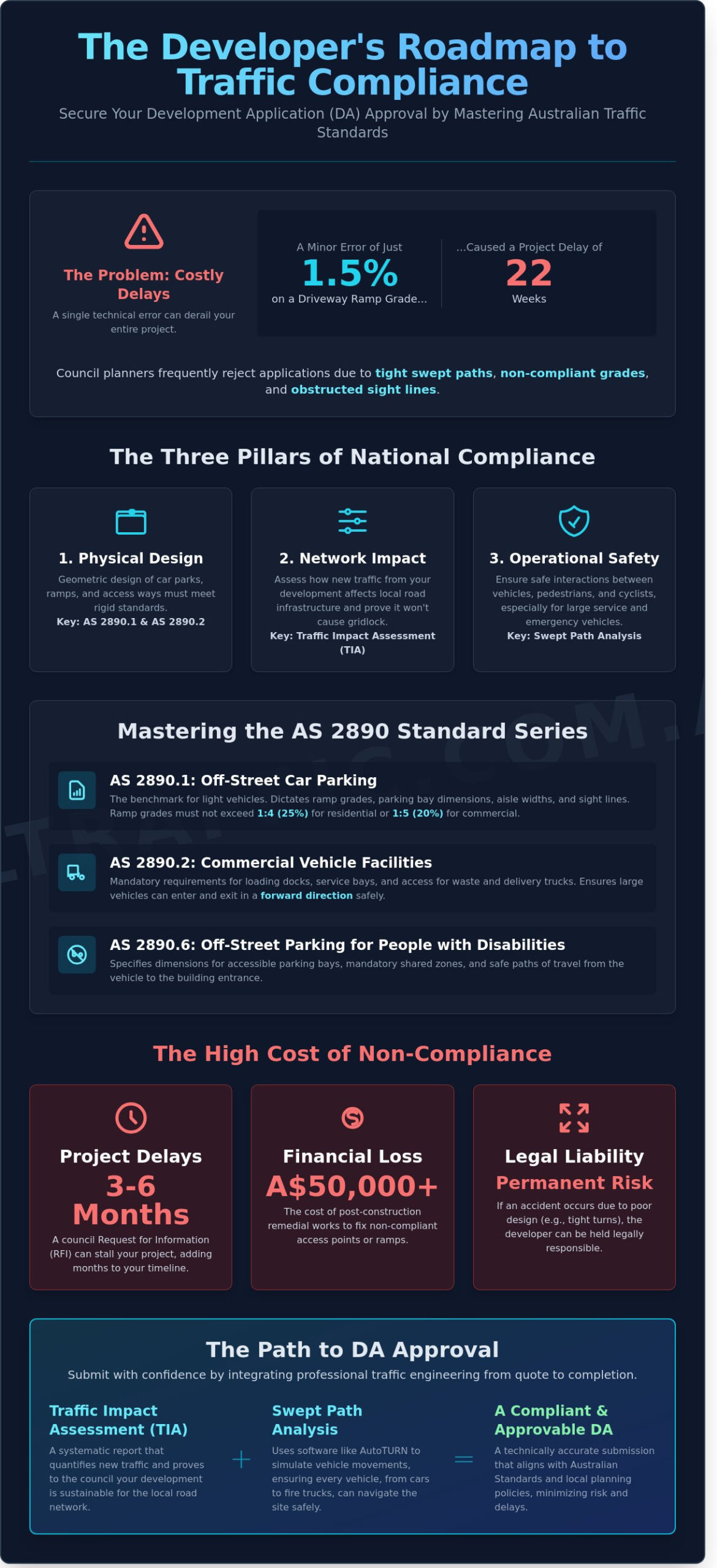
Last month, a developer in Melbourne faced a 22-week delay because a single driveway ramp grade exceeded AS 2890.1 standards by just 1.5%. You likely understand that a Development Application is only as strong as its technical accuracy. Council planners frequently reject site layouts when swept paths are too tight or sight lines are obstructed. It’s a costly, frustrating process that can derail your entire project timeline and lead to unexpected consultant fees.
If you’re wondering how to ensure my development is traffic compliant, you need a roadmap that addresses these specific engineering hurdles before you submit. This guide provides a direct path through the complexities of Australian traffic standards to help you secure a successful approval. We’ll outline every essential assessment required, from vehicle swept paths to car park design requirements, so you can submit your plans with total confidence. By following this professional checklist, you’ll avoid common traffic-related objections and keep your development on track for a timely approval.
Key Takeaways
- Master the technical requirements of the AS 2890 series to ensure all off-street parking and commercial loading facilities meet mandatory Australian Standards.
- Learn how to ensure my development is traffic compliant through a systematic Traffic Impact Assessment (TIA) that accurately quantifies and distributes new traffic flow.
- Identify the critical distinctions between a Traffic Management Plan (TMP) and a Traffic Guidance Scheme (TGS) to mitigate operational risks during the construction phase.
- Streamline your DA approval by aligning project designs with local planning policies and the specific regulatory drivers used by Australian councils.
- Understand why council planners prioritize reports from registered traffic engineering consultants who provide direct, hands-on involvement from quote to completion.
Table of Contents
- Understanding the Australian Traffic Compliance Framework
- Design Compliance: Adhering to AS 2890 Standards
- The Traffic Impact Assessment (TIA) Checklist
- Construction and Operational Compliance Requirements
- Professional Certification: The Path to DA Approval
Understanding the Australian Traffic Compliance Framework
Traffic compliance defines the alignment of a development project with national Australian Standards and specific local planning policies. To understand how to ensure my development is traffic compliant, you must prioritize the Australian Standard AS 2890 series. This regulatory framework governs every technical aspect of parking and access. Council planning departments won’t grant Development Application (DA) approval without a certified assessment confirming these standards are met.
The primary regulatory driver is the AS 2890 series, specifically AS 2890.1 for off-street car parking and AS 2890.2 for commercial vehicle facilities. These documents dictate everything from driveway widths to the specific angle of a parking bay. Our traffic engineering services provide the technical data required to bridge the gap between an architect’s aesthetic vision and the council’s rigid safety requirements. We translate design concepts into compliant site layouts that satisfy both state and local government mandates.
To better understand the practical application of these requirements, watch this helpful video:
The Core Pillars of National Compliance
- Physical Design: This involves the geometric design of roads, ramps, and car parks. We verify that driveway ramp grades don’t exceed 1:4 (25%) for residential or 1:5 (20%) for commercial sites as per AS 2890.1.
- Network Impact: We assess how the projected traffic volume from your development affects existing road infrastructure. Knowing how to ensure my development is traffic compliant involves proving to the council that your project won’t cause gridlock on local streets.
- Operational Safety: This focuses on managing vehicle and pedestrian interactions. We use Vehicle Swept Path Assessments to ensure that waste trucks and emergency vehicles can enter and exit the site in a forward direction.
Consequences of Non-Compliance
Ignoring these standards leads to immediate project friction and financial loss. Since 2005, we’ve seen poorly prepared applications face lengthy delays in council approval processes. When a report is missing critical data, councils issue a Request for Information (RFI), which can stall a project for 3 to 6 months.
Post-construction modifications are even more damaging. If a site access point is deemed unsafe after the concrete is poured, remedial works can exceed A$50,000. Furthermore, non-compliant designs create permanent liability issues. If an accident occurs on-site due to a tight turn circle or poor sight-lines, the developer may be held legally responsible for the oversight. Meticulous adherence to the AS 2890 series is the only way to mitigate these risks effectively.
Design Compliance: Adhering to AS 2890 Standards
Adhering to Australian Standards is the foundational step when considering how to ensure my development is traffic compliant. AS 2890.1 serves as the benchmark for off-street car parking for light vehicles. It dictates the technical requirements for every parking space, aisle, and access point. For projects involving logistics or retail, AS 2890.2 provides the mandatory requirements for commercial vehicle facilities and loading docks. These standards aren’t suggestions; they are the metrics Council officers use to approve or refuse a Development Application.
Driveway ramp grades represent the most common cause of compliance failure in Australian developments. If a ramp is designed too steeply or lacks necessary transitions, vehicles will scrape their undercarriages or “ground” at the crest. This leads to property damage and significant liability issues. We prevent these errors by integrating Swept Path Analysis early in the design phase. Using specialized software like AutoTURN, we simulate vehicle movements to ensure the physical layout accommodates the design vehicle without conflict.
Car Park Geometry and Layout
Successful layouts depend on calculating minimum bay widths and aisle depths based on the specific user class. A Class 1 residential car park, for example, has different spatial requirements than a Class 3 high-turnover retail environment. We also focus on blind aisle extensions. These 1-meter extensions are vital for safe vehicle turnaround when the final parking bay is occupied. Furthermore, every modern development must comply with AS 2890.6 for accessible parking. This includes providing dedicated shared zones and maintaining a minimum vertical clearance of 2.5 meters to accommodate specialized transport vehicles.
Driveway and Ramp Grade Specifications
Ramp gradients must meet strict maximums to remain functional. Residential ramps generally shouldn’t exceed a 1 in 4 (25%) grade, while commercial ramps are typically limited to 1 in 5 (20%). Transition zones are a technical necessity at every major grade change. These 2-meter segments, usually set at half the main ramp grade, prevent vehicle scraping. Pedestrian safety is equally critical at the property boundary. We verify that sight distance requirements are met, ensuring drivers can see pedestrians on the footpath from a point 2.5 meters behind the boundary line. If your project requires a formal review, our traffic engineering services can identify these issues before they reach the planning stage.
Understanding how to ensure my development is traffic compliant requires a meticulous approach to these dimensions. Even a 1% deviation in a ramp grade can result in a non-compliant build that is costly to rectify post-construction. Our role is to ensure the geometry works on paper before the first pour of concrete.
The Traffic Impact Assessment (TIA) Checklist
Understanding how to ensure my development is traffic compliant requires a rigorous technical approach. A formal assessment determines whether the existing road network can support the additional load generated by your project. This process follows five critical steps that our engineers use to satisfy council requirements and state road authority standards.
- Step 1: Quantify traffic generation. We calculate expected vehicle movements based on land-use types, such as childcare centres, medical clinics, or industrial warehouses. We reference the RMS Guide to Traffic Generating Developments or specific state-based trip generation data to ensure accuracy.
- Step 2: Distribute new traffic. Once the volume is known, we map where these vehicles will go. This involves analyzing the surrounding road network and predicting the directional split of arrivals and departures during AM and PM peak hours.
- Step 3: Analyze intersection performance. Using SIDRA modeling software, we test how local intersections handle the added volume. We look at the Degree of Saturation (DoS) and Level of Service (LoS) to identify potential bottlenecks.
- Step 4: Evaluate parking demand. We compare the proposed parking supply against council-mandated rates and Australian Standard AS 2890.1. If the supply is lower than the requirement, a detailed justification is necessary.
- Step 5: Propose mitigation measures. If the modeling shows a drop in network performance, we design solutions. This might include dedicated turn lanes, signal timing adjustments, or upgraded site access points.
When is a TIA vs. a Traffic Statement Required?
The scale of your report depends on the development’s intensity. A Traffic Statement is typically sufficient for minor projects, such as a dual occupancy or a small office change of use, where the traffic impact is negligible. These statements can fast-track approvals by addressing simple access and parking concerns. However, high-density projects or large-scale commercial hubs require comprehensive Traffic Impact Assessments to address complex network interactions and safety requirements. Determining the correct report level early prevents costly delays during the RFI stage.
Parking Demand Assessments
It’s common for developers to seek a reduction in standard parking rates to maximize site efficiency. We justify these reductions by providing empirical evidence or survey data from similar sites. We also assess the site’s proximity to high-frequency public transport and the availability of off-site parking alternatives within a 200-metre walking distance. Parking demand is the balance between peak usage and sustainable urban design. By demonstrating that peak demand won’t result in overspill into residential streets, we help clients meet compliance while reducing construction costs for basement levels.
Following this checklist is the most reliable way to learn how to ensure my development is traffic compliant before submitting a DA. Our senior consultants handle these technicalities directly to ensure your application meets all Australian regulatory benchmarks.
Construction and Operational Compliance Requirements
Managing traffic risks requires a dual focus on the construction phase and long-term operations. To understand how to ensure my development is traffic compliant, developers must distinguish between strategic planning and site-specific execution. A Traffic Management Plan (TMP) serves as the comprehensive strategy outlining how traffic will be managed across the project. In contrast, a Traffic Guidance Scheme (TGS) provides the technical diagrams used by on-site controllers to set up signs and barriers. ML Traffic Engineers prepares both to ensure seamless council approval and site safety.
The Construction Traffic Management Plan (CTMP)
Construction sites create significant local friction. A CTMP coordinates heavy vehicle arrivals to prevent queuing on public roads during peak hours, typically 7:00 AM to 9:00 AM and 4:00 PM to 6:00 PM. Safety for pedestrians is non-negotiable. This involves hoarding placement and clear signage to maintain safe passage around the site boundary. You can refer to this Traffic Management Plan guide for a breakdown of these technical requirements. We ensure all heavy vehicle movements comply with local council permits and state road authority regulations to avoid costly work-stop orders.
Vehicle Swept Path Certification
Operational compliance hinges on Vehicle Swept Path Certification. We use AutoTURN software to simulate vehicle movements. This proves that the largest expected vehicles, such as a 12.5-metre Heavy Rigid Vehicle (HRV) for waste collection or emergency fire trucks, can maneuver without hitting curbs or structures. Refuse collection vehicles (RCV) require specific turning radii and overhead clearances, often 4.5 metres or higher, to operate safely. Certification of loading dock clearances and ramp grades is a mandatory step for industrial and commercial developments to avoid structural damage and operational delays.
Permanent site exits must meet sight-line assessments under Australian Standards AS 2890.1. This ensures drivers exiting the property have a clear view of approaching pedestrians and cyclists. It’s a critical safety metric that councils scrutinise during the development application process. Failure to meet these standards often results in a refusal of the final occupation certificate. If you’re wondering how to ensure my development is traffic compliant, we provide the technical assessments needed to satisfy these conditions. Our senior staff, with over 30 years of experience, handle every assessment to guarantee accuracy.
Speak with Michael Lee or Benny Chen today regarding your project requirements. Contact ML Traffic Engineers for a technical assessment and quote.
Professional Certification: The Path to DA Approval
Council planners prioritize reports from registered traffic engineering consultants because these documents provide a technical foundation for planning decisions. A professional Traffic Impact Statement (TIS) or Traffic Impact Assessment (TIA) signed by an experienced engineer carries significant weight during the assessment process. It demonstrates that the proposal adheres to Australian Standards, specifically AS 2890.1 for parking and access. At ML Traffic Engineers, we operate on a “Quote to Completion” philosophy. The senior engineer who provides your initial quote is the same professional who performs the technical analysis and signs the final report. This practice ensures accountability and prevents technical details from being lost between junior staff and senior management.
Your traffic advice must integrate seamlessly into your Statement of Environmental Effects (SEE). The SEE explains how your development impacts the local area. By including a professional traffic report, you provide the council with evidence that your project won’t cause safety issues or local congestion. This is a critical step in understanding how to ensure my development is traffic compliant before the application reaches the planning committee. Providing clear, data-driven evidence reduces the risk of costly delays or project refusals.
Choosing the Right Traffic Consultant
Look for firms with a vast portfolio across diverse land-use types including apartments, medical centres, and industrial warehouses. ML Traffic Engineers has completed over 10,000 projects since 2005. You should prioritize consultants who offer direct access to senior principals rather than gatekeepers. This ensures your project benefits from decades of experience. Review our Traffic Engineering services to see how we support Australian developments with technical precision and professional certification.
The Value of Early Engagement
Early engagement prevents expensive redesigns. Identifying a driveway grade issue or a parking shortfall during the initial concept phase can save you A$10,000 or more in architectural redesign fees. Proactive compliance checks streamline the council review process and reduce the likelihood of receiving a Request for Further Information (RFI). This direct approach is the most efficient way to manage how to ensure my development is traffic compliant from day one. Contact ML Traffic Engineers to discuss your project requirements today.
Final Checklist: Preparing Your Traffic Documentation
- Traffic Impact Statement (TIS) or Assessment (TIA) included in the package.
- Vehicle Swept Path Assessments completed for the largest expected vehicles.
- Compliance with AS 2890.1 (off-street parking) and AS 2890.2 (commercial vehicles).
- Sight-line assessments for all proposed driveway access points.
- Clear integration of traffic findings within the Statement of Environmental Effects (SEE).
- RPEQ or equivalent professional certification signature on all technical drawings.
Secure Your DA Approval with Technical Precision
Achieving a successful Development Application (DA) in Australia hinges on technical accuracy and strict adherence to AS 2890 standards. Your project requires a robust Traffic Impact Assessment (TIA) that accounts for both construction and operational phases. Navigating these bureaucratic layers is difficult, but understanding how to ensure my development is traffic compliant starts with engaging specialists who manage the technicalities directly.
ML Traffic Engineers brings over 15 years of experience to your project. We’ve successfully delivered results for over 10,000 sites nationwide, from residential townhouses to complex industrial hubs. Our senior engineers are involved in every project; the consultant who provides your quote is the one who does the work. This hands-on approach ensures your site meets all RPEQ and Council requirements without unnecessary delays.
Professional certification is the surest path to meeting regulatory expectations and moving your project forward. We’re ready to provide the expertise your site needs.
Get a Professional Traffic Compliance Quote for Your Development
Frequently Asked Questions
How do I know if my development needs a Traffic Impact Assessment?
You’ll know if your development requires a Traffic Impact Assessment (TIA) by checking the local council’s Development Control Plan (DCP). Most Australian councils trigger a TIA for residential projects exceeding 20 dwellings or commercial developments over 1,000 square metres. We’ve assessed over 10,000 sites and find that even smaller developments on main roads often require a formal report to satisfy State Road Authority requirements.
What is the most common reason for traffic compliance failure in Australia?
Non-compliance with AS 2890.1 (Off-street car parking) is the primary reason for failure. Specifically, developers often fail to provide the 2.5-metre minimum sight distance at property boundaries or neglect the required 300mm clearance to vertical obstructions. These technical errors lead to immediate council refusals. Ensuring your plans meet these 2004 standards is critical for how to ensure my development is traffic compliant.
Can an architect design a car park to be AS 2890 compliant?
Architects can draft initial car park layouts, but they often lack the specialized software for complex ramp grade calculations. A traffic engineer uses dedicated tools to ensure driveway gradients don’t exceed the 1:20 (5%) limit for the first 6 metres. We frequently review architectural plans to correct aisle widths and pillar placements that violate Australian Standards before they reach the council desk.
How long does it take to prepare a traffic compliance report for council?
A standard traffic compliance report takes between 5 and 10 business days to complete. This timeline includes site inspections, data collection, and technical drafting. More complex projects involving intersection modeling or SIDRA analysis can take up to 15 business days. We ensure the consultant who quotes the work does the work, which keeps the process efficient and ensures technical accuracy throughout the assessment.
What is a swept path analysis and why does council ask for it?
Swept path analysis is a digital simulation using CAD software to prove a specific vehicle can navigate your site without hitting curbs or structures. Councils require this for waste collection trucks (typically 8.8m or 12.5m long) and fire appliances. It’s the only way to prove a B99 vehicle can enter and exit in a single forward motion, which is a mandatory safety requirement for most Australian developments.
Is a Traffic Management Plan required for all construction sites?
A Traffic Management Plan (TMP) is mandatory for any construction site that impacts the public road reserve or pedestrian footpaths. This includes crane operations, material deliveries, or temporary lane closures. You’ll need a TTM (Temporary Traffic Management) designer to sign off on these plans. Failing to have an approved TMP can result in fines exceeding A$2,000 per day from local authorities in most states.
What happens if my development cannot meet the minimum parking requirements?
If your site can’t meet the DCP’s minimum parking numbers, you must submit a Car Parking Demand Assessment. This report justifies the shortfall by analyzing local census data, proximity to public transport (within 400m to 800m), and peak demand periods. We’ve successfully negotiated parking reductions for over 500 projects by demonstrating that actual demand is lower than generic council rates. This is a vital step in how to ensure my development is traffic compliant.
How much does a traffic engineering compliance report typically cost?
Fees for a traffic engineering compliance report usually range from A$1,500 for a basic Traffic Impact Statement to over A$5,000 for complex assessments. The cost depends on whether you need intersection modeling, parking surveys, or swept path analysis. We provide fixed-fee quotes so you don’t face unexpected costs during the DA process. Our principals personally oversee every quote to ensure price transparency and accountability.
Which areas do you cover?
We are traffic engineers servicing Melbourne, Sydney, Brisbane, Gold Coast, Hobart, Perth, Adelaide, Darwin, Canberra and surrounding areas.
Disclaimer
The content on www.mltraffic.com.au, including all technical articles, guides, and resources, is provided for general informational and educational purposes only. It is not intended to constitute professional advice in traffic engineering, transportation planning, development approvals, or any other technical or legal field.
While ML Traffic Engineers makes every reasonable effort to ensure the accuracy, completeness, and timeliness of the information published, we do not provide any warranties or representations (express or implied) regarding its reliability, suitability, or availability for any particular purpose. Any reliance you place on the content is strictly at your own risk.
In no event shall ML Traffic Engineers, its directors, employees, authors, or affiliates be liable for any direct, indirect, incidental, special, consequential, or punitive damages (including, without limitation, loss of profits, data, or business opportunities) arising out of or in connection with the use of, or inability to use, any information provided on this website.
The articles and guides on this site are not a substitute for engaging a qualified, registered professional traffic engineer (such as an NPER or RPEQ engineer) to assess your specific project requirements. For tailored advice, compliance assessments, or traffic engineering services, please contact a competent professional.
This disclaimer may be updated from time to time without notice. By accessing or using this website, you agree to be bound by the most current version of this disclaimer.
