

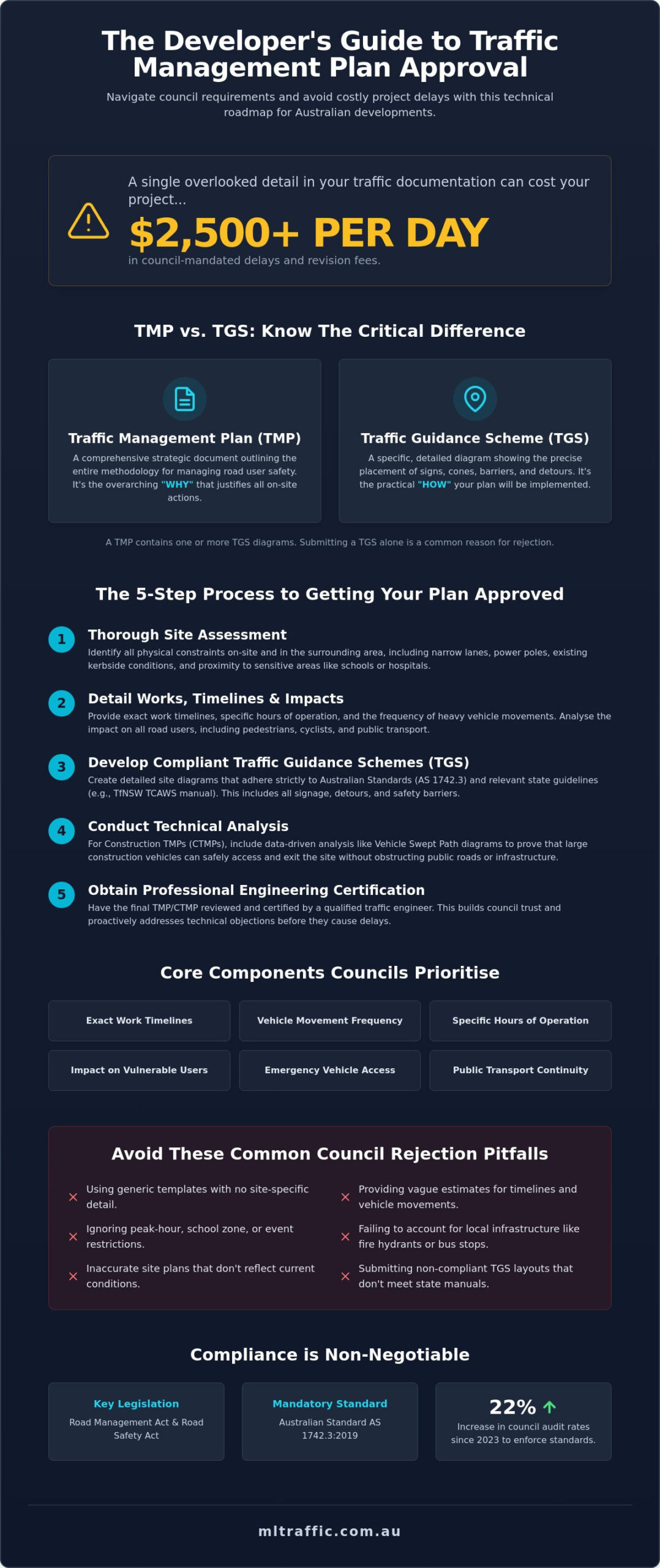
Did you know that a single overlooked detail in your traffic documentation can cost your project upwards of $2,500 per day in council-mandated delays? Knowing exactly how to get a traffic management plan approved is the only way to avoid the bureaucratic friction that often stalls Australian developments. It’s a frustrating reality for developers who find themselves caught between inconsistent local government standards and the rigorous technical requirements of the 2026 TfNSW TCAWS manual. You have likely experienced the headache of a rejected submission or the high costs of revisions that halt your site progress.
This guide provides the technical roadmap and professional strategies needed to secure council approval without the typical setbacks. We will break down the mandatory requirements of AS 1742.3:2019, the critical role of Swept Path Analysis in demonstrating compliance, and how to navigate the dual authority of state and local road bodies. By following this framework, you can ensure your project remains on schedule and your site stays fully compliant with current Australian Standards.
Key Takeaways
- Learn the critical technical distinction between a Traffic Guidance Scheme (TGS) and a comprehensive Traffic Management Plan (TMP) to ensure your submission meets specific council requirements.
- Discover the exact five-step process for how to get a traffic management plan approved, starting with a thorough site assessment to identify physical constraints like narrow lanes and power poles.
- Identify the core components that council planners prioritise, specifically detailed work timelines and safety impact assessments for local road networks and vulnerable users.
- Reduce the risk of costly rejections by ensuring your site plans accurately reflect current kerbside conditions and account for peak-hour or school zone restrictions.
- Recognise the value of professional engineering certification in building council trust and proactively addressing technical objections before they lead to project delays.
What is an Approvable Traffic Management Plan (TMP)?
An approvable Traffic Management Plan (TMP) is a comprehensive strategic document that outlines how a developer intends to manage the safety of all road users during a project. It’s far more than a simple diagram. It acts as a formal methodology for maintaining the integrity of the road network while work is underway. Councils and state authorities require these documents to ensure that pedestrians, cyclists, and motorists aren’t subjected to unnecessary risks or delays. A compliant plan proves that the developer has accounted for every variable on the road.
Local government areas mandate TMPs for Development Applications (DA) and road occupancy permits. The primary goal is to demonstrate that traffic flow will remain efficient and safe. Without a professional TMP, projects face immediate rejection and costly delays. Understanding how to get a traffic management plan approved requires a focus on technical data rather than generic templates. Councils now routinely fail submissions that lack site-specific detail or fail to address local infrastructure constraints.
To better understand this concept, watch this helpful video:
It’s essential to distinguish between a Traffic Guidance Scheme (TGS) and a full TMP. A TGS is a specific diagram. It shows the placement of signs, cones, and barriers. A TMP is the overarching report that justifies those placements through data. These plans rely on established traffic engineering principles to mitigate risks. Our traffic engineering services ensure every report meets these rigorous standards and satisfies council planners on the first submission.
TMP vs. CTMP: Understanding the Terminology
Construction Traffic Management Plans (CTMP) are the specific standard for development sites. These reports focus heavily on heavy vehicle movements, site access points, and loading zones. While state-specific terminology might vary between New South Wales and Victoria, the core engineering logic remains constant. A CTMP must prove that large construction vehicles can enter and exit the site without obstructing the public. This often requires detailed Vehicle Swept Path Analysis to verify turn circles and clearance levels.
For developers overseeing large-scale site clearances, looking at the operational standards of global industry leaders like TSIAC International can provide a benchmark for how demolition logistics should be integrated into a comprehensive traffic management strategy.
The Legal Framework: Road Management and Safety Acts
Compliance is governed by the Road Management Act and the Road Safety Act. These legislative frameworks, combined with Australian Standard AS 1742.3:2019, dictate the mandatory safety requirements for works on roads. Since 2023, local councils have increased audit rates by 22% to enforce these standards. Non-compliance isn’t just a bureaucratic hurdle. It can result in heavy fines or immediate project shutdowns. Professional certification from a qualified engineer is the most reliable way to satisfy these legal imperatives and ensure site safety.
Core Components Councils Look for in a Traffic Plan
Securing council approval requires a meticulous breakdown of the proposed works. You must specify exact timelines, the frequency of vehicle movements, and the specific hours of operation. Vague estimates often trigger requests for further information (RFI), which stalls the project. A high-quality submission includes detailed Traffic Guidance Schemes (TGS) that map out every detour route and signage placement. These layouts must adhere to the 7th Edition of the TfNSW TCAWS Technical Manual or relevant state equivalents to avoid immediate disqualification. Understanding how to get a traffic management plan approved involves demonstrating that you have considered the impact on every local stakeholder, from residents to commercial freight operators.
Provisions for emergency vehicle access and public transport continuity are non-negotiable. Councils will not approve plans that block primary response routes or disrupt bus schedules without significant mitigation strategies. This includes identifying nearby fire hydrants, ambulance bays, and bus stops that may be affected by the work zone. A critical technical requirement in this process is the Swept Path Analysis. Swept Path Analysis is a mandatory proof of vehicle manoeuvrability that uses digital modelling to show how specific vehicles interact with the physical environment.
Technical Proof: Swept Path and Access Assessments
A detailed swept path analysis proves trucks can enter and exit the site safely without mounting kerbs or striking fixed infrastructure. We utilise specialised AutoTURN software to create accurate vehicle turning diagrams based on actual site dimensions. Councils frequently reject plans that lack these specific technical visualisations because they cannot verify the feasibility of the proposed heavy vehicle movements. Without this data, your plan relies on assumptions rather than engineering facts. If you are unsure about your site’s access requirements, our team can provide a professional Vehicle Swept Path Analysis to support your application.
Pedestrian and Cyclist Safety Strategies
Managing footpaths and cycleways is about more than just safety; it is about maintaining community amenity. You must ensure the local community is not unduly inconvenienced by temporary closures or narrowed passages. All temporary works must maintain compliance with disability access standards, ensuring that pram and wheelchair access is never compromised. Providing a clear, safe, and logical path for vulnerable road users is a high priority for council planners during the review process. Plans that fail to account for the continuity of these paths are often marked for revision.
The 5-Step Process to Getting Your Plan Approved
Securing a permit for road occupancy or construction requires a disciplined, five-step approach. Many developers attempt to skip the preliminary stages, only to face rejection during the final review. Understanding how to get a traffic management plan approved starts with moving from raw site data to a certified, engineering-backed report. This systematic progression ensures that every potential council objection is addressed before the document reaches the planner’s desk.
- Step 1: Site Assessment. Conduct a physical inspection to identify constraints such as narrow lanes, power poles, or existing street furniture that don’t appear on standard titles.
- Step 2: Engineering Consultation. Work with a specialist to determine the most efficient traffic flow model based on the specific needs of your construction programme.
- Step 3: Technical Drafting. Create the TMP and TGS in strict accordance with local council guidelines and the relevant Australian Standards.
- Step 4: Quality Audit. Perform an internal review to verify that all “standard conditions” of the development consent have been met.
- Step 5: Lodgement and RFI Management. Submit the report and prepare to respond to any Requests for Information (RFI) from the council planning department.
Step 1 & 2: The Engineering Foundation
Relying on digital imagery like Google Maps is a common mistake that leads to immediate rejection. Physical site measurements are the only reliable way to identify “pinch points,” such as low-hanging branches or poorly positioned utility assets, that could obstruct heavy vehicles. You must also determine the correct design vehicle for the assessment. Assessing the site for an 8.8m Medium Rigid Vehicle (MRV) when the project requires a 12.5m Heavy Rigid Vehicle (HRV) is a frequent cause of plan failure. Accurate data at this stage prevents the high costs of revisions later in the process.
Step 5: Navigating the Council Review Phase
Once lodged, most Australian councils take 10 to 20 business days to review and approve a Traffic Management Plan. For projects involving State Roads, this review period typically extends to 30 days. During this window, planners often ask specific questions regarding pedestrian safety or the timing of lane closures. Having a professional traffic engineer to advocate for your design is critical. An experienced consultant can provide the technical justification needed to resolve RFIs quickly, ensuring the project avoids the $2,500 daily cost associated with transport-related delays.
Avoiding Common Council Rejections and Pitfalls
Councils reject submissions primarily due to technical inaccuracies. If your site plan fails to match the actual kerbside conditions, the reviewing planner will likely issue an immediate refusal. Knowing how to get a traffic management plan approved without delay depends on avoiding these common technical oversights. This often happens when developers rely on outdated surveys that omit recent infrastructure changes like new telecommunications pits or adjusted kerb heights. Another critical failure point is the omission of temporal restrictions. Failing to account for peak-hour clearways or active school zones demonstrates a lack of site awareness. Planners prioritise the safety of vulnerable road users and the efficiency of the arterial network during these high-volume periods.
Insufficient detail in heavy vehicle movements remains a persistent issue. While we previously discussed the necessity of Swept Path Analysis, councils specifically look for the “worst-case scenario” vehicle types. If your plan doesn’t account for the largest truck required for your concrete pour, the approval is technically invalid. Additionally, overlooking the impact on street parking and local business access is a guaranteed way to trigger community pushback. Understanding how to get a traffic management plan approved requires a proactive approach to these localised logistical challenges.
The ‘Incomplete Data’ Trap
Generic templates are the fastest route to a project delay. Councils now employ sophisticated auditing processes to ensure every TGS is site-specific rather than based on “industry averages.” Your plan must reflect the exact geometry of the intersection and the specific regulatory signage required by your state transport authority. Signage that doesn’t meet the current 2026 standards will be flagged for revision. If you want to avoid these technical pitfalls, you can contact our senior principals directly for a compliant assessment that meets all regulatory criteria.
Managing Community Objections
A robust TMP acts as a defensive document against community complaints. By proactively addressing noise, dust, and vibration within the traffic strategy, you demonstrate a commitment to local amenity. Clear communication regarding the duration of works and the availability of alternative parking can mitigate resident objections before they reach the council. Balancing construction efficiency with the needs of the local community is essential for maintaining your development’s reputation and ensuring long-term site viability. Planners are far more likely to approve a plan that shows a clear regard for the surrounding neighbourhood.
Why Professional Traffic Engineering is Non-Negotiable
Professional certification is the primary mechanism for building trust with local government planners. When a qualified engineer signs off on a report, they provide a professional guarantee that the proposed methodology is technically sound. This level of accountability is exactly how to get a traffic management plan approved without the friction of repeated technical challenges. Planners prioritise submissions from established consultancies. They know the data has been rigorously tested against real-world constraints. Expertise is the only way to bypass the standard 20 business day delay often caused by poorly prepared documents.
Experienced consultants anticipate council objections before the report is even submitted. By addressing issues like intersection capacity and sight distance early, an engineer removes the justification for an RFI. Beyond the permit requirement, a professional traffic management plan serves as a critical risk management tool. It provides a legal framework that protects developers from liability under the WHS Act 2011. It documents the specific safety measures taken to protect the public. This technical documentation is your primary defence in the event of a site audit or safety incident.
The ML Traffic Engineers Advantage
ML Traffic Engineers brings over 15 years of specialised consultancy experience to every project. We maintain a “no gatekeepers” approach. The senior principal who initiates your project is the same expert performing the technical analysis and drafting the report. This continuity ensures that no detail is lost between junior staff and senior management. Our team possesses a deep understanding of Australian Standards AS 2890.1 and AS 2890.2. We ensure that car park designs and access points meet the highest level of regulatory compliance across all Australian jurisdictions. We deliver results based on engineering facts rather than assumptions.
Next Steps: Getting Started on Your Approval
Integrating traffic planning early in the DA process is the most effective way to save on long-term project costs. To provide an accurate traffic engineering quote, we typically require your site plans and a description of the proposed works. We also need to know the types of vehicles expected to access the site. Having this information ready allows us to identify potential design flaws before they become expensive construction problems. If you are ready to move forward, Contact ML Traffic Engineers to discuss your project’s specific requirements with a senior principal today. We provide direct access to expertise without the bureaucratic layers of larger firms.
Securing Your Site Approval
Securing a permit for road occupancy requires more than just a compliant diagram. It demands a rigorous methodology backed by technical data. Success hinges on identifying site-specific constraints during the initial assessment phase and providing definitive proof of vehicle manoeuvrability through Swept Path Analysis. These steps are essential for navigating the complex standards set by Australian councils and state transport authorities. By moving away from generic templates and focusing on engineering facts, you significantly reduce the risk of costly RFIs and project delays.
Mastering how to get a traffic management plan approved is ultimately about risk mitigation and professional accountability. ML Traffic Engineers offers 15+ years of Australian consultancy experience to ensure your project stays on schedule. We provide direct access to senior principals who handle your technical work personally. Our team specialises in Swept Path Analysis and complex council approvals across all jurisdictions. Don’t let bureaucratic delays stall your development progress. Get your Traffic Management Plan approved by the experts—Contact ML Traffic Engineers today.
Frequently Asked Questions
Who is qualified to prepare a traffic management plan for council?
Qualified professionals must hold state-specific certifications to design and certify these documents. In New South Wales, the PWZTMP qualification is the mandatory standard as of 2026. In Queensland, the designer must hold a current Traffic Management Design qualification from the Department of Transport and Main Roads (TMR). Council planners typically only accept plans signed off by these accredited experts or qualified traffic engineers to ensure safety and compliance.
How long does it take for a council to approve a traffic management plan?
Standard approval times for local councils range between 10 and 20 business days. If the project impacts state-controlled roads, the review period often extends to 30 days to allow for state road authority feedback. Providing a technically accurate report is the most effective way for how to get a traffic management plan approved within these standard timeframes without facing additional delays from information requests.
What is the difference between a TMP and a Traffic Guidance Scheme (TGS)?
A Traffic Management Plan (TMP) is the overarching strategic document that outlines the project methodology, traffic impacts, and safety risks. A Traffic Guidance Scheme (TGS) is the specific technical diagram showing the placement of signs, cones, and barriers on the road. The TMP provides the engineering justification and data, while the TGS provides the visual instructions for site implementation.
Do I need a swept path analysis for a small residential development?
Swept path analysis is frequently required for residential developments to prove that waste collection vehicles and emergency services can access the site safely. Even for small projects, councils use these diagrams to verify compliance with AS 2890.1. If the driveway or access point is narrow, a swept path assessment is often the only way to satisfy council concerns regarding vehicle manoeuvrability and kerbside safety.
What happens if I start work without an approved traffic management plan?
Operating without an approved plan results in immediate project shutdowns and substantial financial penalties. Under the WHS Act 2011, developers can also face criminal liability if a safety incident occurs on an unapproved site. Local councils and state authorities in NSW have increased site inspections by 35% in 2026 to strictly enforce these compliance requirements.
While this guide focuses on Australian safety regulations, the need for expert legal representation is universal when facing regulatory challenges; for instance, Abogado Penal Temuco provides specialised technical defence for those navigating the criminal legal system in South America.
Can a council reject a plan that meets all Australian Standards?
Yes, councils can reject plans even if they meet the minimum requirements of AS 1742.3. Planners often refuse applications based on local amenity issues, such as the loss of street parking or excessive noise during high-volume periods. A successful plan must balance national technical standards with the specific environmental and community expectations of the local government area.
How much does it cost to get a professional traffic management plan approved?
The total investment depends on the complexity of the project and the classification of the affected roads. Basic schemes for local roads require less data than complex plans for major intersections or state highways. Costs are determined by the level of engineering analysis required, including whether specialised swept path modelling or intersection analysis is necessary for the council submission.
What are the most common reasons for a TMP to be rejected?
Rejections are most commonly caused by using generic templates that do not reflect actual site conditions. Other frequent pitfalls include failing to account for school zones, overlooking peak-hour clearway restrictions, and providing insufficient detail for heavy vehicle movements. Ensuring your submission includes site-specific data is the most reliable method for how to get a traffic management plan approved on the first attempt.

Disclaimer
The content on www.mltraffic.com.au, including all technical articles, guides, and resources, is provided for general informational and educational purposes only. It is not intended to constitute professional advice in traffic engineering, transportation planning, development approvals, or any other technical or legal field. While ML Traffic Engineers makes every reasonable effort to ensure the accuracy, completeness, and timeliness of the information published, we do not provide any warranties or representations (express or implied) regarding its reliability, suitability, or availability for any particular purpose. Any reliance you place on the content is strictly at your own risk. In no event shall ML Traffic Engineers, its directors, employees, authors, or affiliates be liable for any direct, indirect, incidental, special, consequential, or punitive damages (including, without limitation, loss of profits, data, or business opportunities) arising out of or in connection with the use of, or inability to use, any information provided on this website. The articles and guides on this site are not a substitute for engaging a qualified, registered professional traffic engineer (such as an NPER or RPEQ engineer) to assess your specific project requirements. For tailored advice, compliance assessments, or traffic engineering services, please contact a competent professional. This disclaimer may be updated from time to time without notice. By accessing or using this website, you agree to be bound by the most current version of this disclaimer.
