

Imagine your A$12 million Sydney development grinding to a halt because of a single "Request for Information" (RFI) letter from the Council. This scenario isn’t just a bad dream; it’s a reality for 68% of developers who submit documentation that fails to meet current Transport for NSW standards. You’re likely looking for how to get a traffic management plan approved in Sydney because you’ve realized that the gap between a compliant plan and a rejected one is often just a few technical details. It’s frustrating when your site is ready but your machines can’t move because of administrative red tape.
We understand that balancing heavy vehicle access with Sydney’s strict 2026 pedestrian and cycleway protections feels like a constant battle. This guide will help you master the approval process for Traffic Management Plans by providing a clear, expert-led roadmap to compliance and safety. You’ll learn how to distinguish between a TGS, TCP, and CTMP while securing your Work Zone permit faster than the industry average. We’ll show you how to minimize impact on local residents to eliminate complaints before they start; ensuring your project stays on schedule and avoids those costly three-week RFI delays.
Key Takeaways
- Understand the vital distinction between a CTMP and a TGS to ensure your project documentation aligns with Sydney’s specific high-density requirements.
- Learn how to use technical tools like Vehicle Swept Path Analysis to prove your site is accessible and safe for heavy vehicle movements.
- Discover how to get a traffic management plan approved in Sydney by avoiding common pitfalls like ignoring cumulative impact or clashing with peak-hour clearways.
- Secure a clear roadmap to approval through early-stage consultation and site-specific risk assessments that satisfy even the strictest council planners.
- Gain a competitive advantage by partnering with seasoned experts who personally manage your project from the initial quote to the final technical submission.
Understanding the Sydney Traffic Approval Landscape in 2026
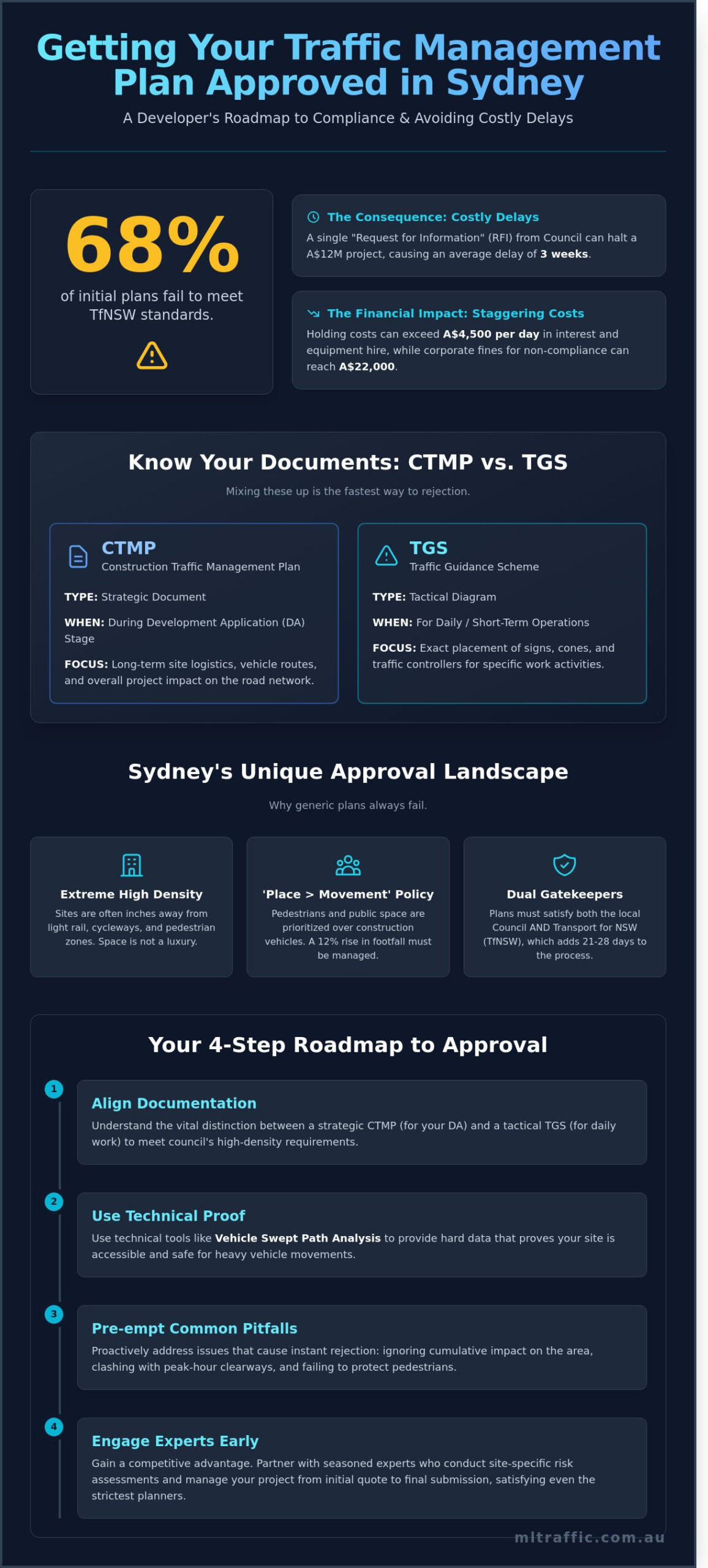
Sydney’s road network in 2026 is more congested and regulated than at any point in history. If you are researching how to get a traffic management plan approved in Sydney, you must first distinguish between two critical documents. A Construction Traffic Management Plan (CTMP) is a strategic document required during the Development Application (DA) stage. It details the long-term logistics of your site. Conversely, a Traffic Guidance Scheme (TGS) is a technical diagram showing the exact placement of signs and cones for daily operations. Mixing these up is the fastest way to receive a formal rejection from a council officer.
The complexity of Sydney stems from its high-density geography. Unlike regional NSW projects where space is plentiful, a Sydney site often sits inches away from light rail tracks or active cycleways. Your plan must adhere to the principles of road traffic control as outlined in Australian Standard AS 1742.3. Authorities no longer accept generic templates. They demand site-specific logic that accounts for 2026 traffic volumes and the city’s specific infrastructure constraints.
To better understand this concept, watch this helpful video:
The approval loop involves two primary gatekeepers: the City of Sydney Council and Transport for NSW (TfNSW). Since 2024, the ‘Place and Movement’ framework has become the standard for assessment. This policy prioritizes ‘Place’ (pedestrians, outdoor dining, and shoppers) over ‘Movement’ (construction vehicles and private cars). If your plan suggests blocking a footpath to let a concrete pump through during peak hour, it will be rejected. You must prove that your project respects the 12% increase in pedestrian footfall seen around new Metro stations.
When is a CTMP Mandatory for Your Sydney Project?
You’ll find the requirement for a CTMP within your DA ‘Condition of Consent’ paperwork. Triggers usually include any activity that impacts a ‘State Managed Road’ or requires a ‘Work Zone’ permit. Projects in the Sydney CBD or the Green Square high-growth corridor face the strictest scrutiny. In Green Square, where population density has hit 22,000 people per square kilometre, truck arrival windows are often limited to a tight 10:00 AM to 3:00 PM bracket to avoid school and commuter peaks. If your project sits on a TfNSW road, expect an additional 21 to 28 days for the concurrence process.
The Cost of Non-Compliance and Rejection
Project delays in 2026 carry heavy financial penalties. For a standard multi-residential build in Sydney, holding costs can exceed A$4,500 per day in interest and equipment hire. A rejected plan doesn’t just cost you the A$2,000 engineering fee; it pushes your entire timeline back by weeks. There are legal risks too. Operating on public roads without an approved TGS or CTMP violates the Roads Act 1993. Corporations can face on-the-spot fines of A$22,000. Furthermore, a history of non-compliance can lead to a permanent denial of ‘Work Zone’ permits, effectively killing the project’s logistics before the first slab is poured.
Essential Components of a Compliant Sydney CTMP
Your Construction Traffic Management Plan (CTMP) isn’t just a guide for your site foreman. It’s a technical legal document that Council planners scrutinize to ensure public safety and network efficiency. To understand how to get a traffic management plan approved in Sydney, you have to stop viewing the document as a formality. Planners prioritize the impact on the street over the convenience of your build. Every report we produce focuses on high-level compliance, aligning with Safe Work Australia’s construction guide to manage risks for both workers and the public.
A successful application balances several moving parts. You need to address vehicle movements, pedestrian safety, and the preservation of public assets. Council staff look for specific technical data, not vague promises. If your report lacks detailed vehicle dimensions or fails to account for the 15% increase in Sydney’s cycleway usage over the last three years, it’ll likely be sent back for revision. We ensure every component, from Work Zone applications to parking loss mitigation, is backed by hard data and engineering standards like AS 2890.1.
Swept Path Analysis: The Secret to Approval
Standard vehicle sizes don’t work for bespoke Sydney developments. We use AutoTURN software to simulate real-world movements of heavy vehicles on narrow, historical streets. It’s not enough to say a truck fits. You must prove it won’t mount a kerb or strike a heritage awning. Our assessments cover "blind spots" and driveway ramp grades to ensure heavy vehicles don’t bottom out. This level of technical detail is exactly how to get a traffic management plan approved in Sydney without multiple rounds of costly feedback. If you’re unsure about your specific site requirements, speaking directly with a senior engineer can clarify the necessary technical assessments.
Managing Public Domain Impacts
Sydney’s street trees and heritage assets are protected with zero tolerance for accidental damage. Your CTMP must outline physical protection measures for these assets during every stage of construction. Negotiating road closures is equally complex. For significant projects, partial or full road occupancy applications often start with a base fee of at least A$2,010. This fee covers the initial assessment but doesn’t include the daily cost of "lost" metered parking revenue, which can exceed hundreds of dollars per bay in the CBD. We also integrate construction waste management into the TMP, ensuring skip bin rotations don’t conflict with peak hour traffic flow or pedestrian access.
- Vehicle Swept Path Analysis: Using AutoTURN for 12.5m HRV or 19m articulated vehicles.
- Pedestrian and Cyclist Safety: Specific detours and protection for Sydney’s green-marked cycleways.
- Work Zone Integration: Calculating the exact number of parking spaces lost and the associated A$ costs.
- Waste Management: Documented schedules for debris removal that avoid clearway hours.
Planners at the City of Sydney or Inner West Council have seen thousands of poorly prepared plans. They value submissions that recognize the local context, such as the high pedestrian volumes near light rail corridors or the strict 7:00 AM to 6:00 PM work hour limits. By providing a report that treats the public road as a finite resource, you demonstrate the professional competence required for a fast-tracked approval. Our team has managed over 10,000 sites since 2005, giving us the specific insight needed to navigate these bureaucratic hurdles efficiently.
Why Sydney Councils Reject TMPs (and How to Pre-empt Them)
Sydney Councils are notoriously strict when reviewing traffic submissions. They process thousands of applications annually, and a single oversight often leads to a Request for Information (RFI) or an outright rejection that stalls your project for weeks. Understanding how to get a traffic management plan approved in Sydney requires looking past your own site boundaries and anticipating the technical objections a Council officer will raise.
- Common Pitfall #1: Inadequate ‘Cumulative Impact’ assessment. Council officers look at the big picture. If you’re planning a major excavation in a high-growth area like Green Square or Parramatta, you can’t ignore the three other construction sites on the same block. Failing to account for the combined heavy vehicle movements of neighboring sites is a guaranteed way to see your TMP knocked back.
- Common Pitfall #2: Unrealistic loading times vs. Clearways. Many applicants propose deliveries during peak hours without checking the ‘Clearway’ status of the road. On major Sydney arterials, clearways often operate from 6:00 AM to 10:00 AM and 3:00 PM to 7:00 PM. Proposing a concrete pour at 8:30 AM on a road like Military Road or the Princes Highway shows a lack of local operational knowledge.
- Common Pitfall #3: Failure to consult with the Sydney Coordination Centre (SCC). For any project within the CBD or near the Light Rail corridors, the SCC must be involved early. If your plan impacts a bus lane or a primary commuter route, Council won’t even look at it until the SCC has provided their specific requirements.
- Common Pitfall #4: Generic ‘copy-paste’ plans. A plan designed for a wide industrial street in Wetherill Park won’t work for a narrow, heritage-listed lane in Surry Hills. Councils quickly spot templates that don’t address site-specific constraints like overhead power lines, existing street trees, or narrow turning circles for 12.5-metre Heavy Rigid Vehicles.
The Resident and Business Complaint Factor
Council officers are highly sensitive to local politics. They use feedback from nearby residents and business owners to scrutinize your traffic plan’s viability. If your plan involves heavy vehicle idling or frequent reversing beepers at 7:00 AM, expect pushback. We mitigate these issues by specifying non-tonal reversing alarms and designated "engine off" waiting zones away from residential windows. Proactive community consultation and transparent communication with neighbors significantly accelerate the Council sign-off process by resolving potential objections before the formal review begins.
Technical Errors in TGS and TCP Layouts
Precision is mandatory for technical compliance. We often see plans rejected because they use outdated signage distances that don’t align with the current AS1742.3 standards. In a high-speed environment or a complex multi-lane intersection, a five-metre discrepancy in sign placement can be a safety violation.
Sydney’s bus lane operating hours are another frequent source of error. Some lanes operate 24/7, while others are time-limited. If your Traffic Control Plan (TCP) assumes you can occupy a bus lane at 4:00 PM on a Tuesday, Transport for NSW will intervene. To ensure your layouts meet every regulatory hurdle, see our services page for technical compliance checklists that we apply to every project. Mastering how to get a traffic management plan approved in Sydney means getting these technical details right the first time so you can keep your project on schedule and on budget.
Your Step-by-Step Roadmap to Approval in 2026
Securing a permit for road occupancy or construction in New South Wales requires more than just a basic drawing. If you want to know how to get a traffic management plan approved in Sydney, you must follow a rigid technical process that satisfies both the Council and Transport for NSW (TfNSW) standards. The following five steps represent the most efficient path to obtaining your permits without unnecessary delays.
Step 1: Early consultation with a qualified Traffic Engineer. Don’t wait until your Development Application (DA) is lodged to think about traffic. Engaging an engineer during the initial design phase allows you to identify access issues, such as driveway gradients or sight-line obstructions, before they become expensive mistakes. At ML Traffic Engineers Pty Ltd, we believe the person who quotes the job should do the work, ensuring no technical detail is lost in translation between the sales team and the drafting desk.
Step 2: Conducting a site-specific risk assessment and traffic volume count. Generic data leads to rejected applications. You need a 7-day traffic volume count and a pedestrian activity analysis to justify your proposed road closures or lane diversions. This data proves to the Council that your project won’t cause a gridlock during peak hours, specifically the 8:00 AM and 5:00 PM windows.
Step 3: Drafting the CTMP and TGS according to the ‘City of Sydney Standard Requirements’. Your Construction Traffic Management Plan (CTMP) must be a comprehensive document, while your Traffic Guidance Scheme (TGS) provides the visual map for signage placement. These must comply with Australian Standard AS 1742.3 and the latest TfNSW mandates. Precision here is non-negotiable; even a misplaced "Road Work Ahead" sign on your plan can trigger a formal rejection.
Step 4: Lodging the application through the NSW Planning Portal or Council Planner. Most Sydney councils now require all documentation to be submitted digitally via the NSW Planning Portal. You’ll need to pay the relevant lodgement fees, which often start around A$300 for minor works but can scale significantly for larger developments. Ensure all files are correctly named and indexed to avoid administrative bounce-backs.
Step 5: Negotiating RFIs and securing the final ‘Stamp of Approval’. It’s rare for a complex plan to pass without a single question. This stage involves proactive communication with the Council’s traffic committee to resolve any safety or logistical concerns they raise during their review.
Working with the Council Planner
Working with the Council requires patience and technical fluency. When you receive a ‘Request for Information’ (RFI) letter, don’t panic. These letters are a standard part of the process and simply mean the assessor needs more data to justify the approval. You need an engineer who can speak the specific language of the Council’s traffic department to defend the plan’s logic. In 2026, you should allow a timeline of 4 to 8 weeks for a standard Sydney approval. Attempting to rush this process often results in more scrutiny and longer wait times.
Preparing for the ‘Pre-Construction’ Meeting
Receiving your approved plan is a major milestone, but the work isn’t over yet. Before boots hit the ground, you’ll likely attend a pre-construction meeting on-site with a Council officer. You must bring your approved plans, valid permits, and proof of your Traffic Controller’s current accreditation. This meeting is where you demonstrate how the paper plan translates into real-world signage and safety barriers. You can learn more about our approach to managing these high-stakes Council negotiations and site meetings.
Ready to move your project forward? Contact ML Traffic Engineers Pty Ltd for a technical assessment of your site today.
Partnering with Experts to Fast-Track Your Sydney Project
At ML Traffic Engineers, we don’t believe in passing your project down a chain of junior staff or offshore processors. Our core philosophy is straightforward: the consultant who quotes your work is the one who does the work. This direct accountability ensures that the technical nuances of your Construction Traffic Management Plan (CTMP) aren’t lost in translation between a salesperson and a technician. When you speak with Michael or Benny, you’re speaking with the engineers who will actually analyze your site’s swept paths and sight-line requirements.
We’ve been trading since 2005, giving us over 15 years of Sydney-specific traffic engineering data to draw from. This historical database is a vital asset when you’re figuring out how to get a traffic management plan approved in Sydney. We don’t guess what a specific Council might require; we likely have a record of a successful approval on that very street or a similar precinct. Our team handles the heavy lifting of Council liaison, managing the technical back-and-forth so you can focus on the actual construction process.
Our expertise scales to meet the unique demands of any project size. We provide custom solutions for a diverse range of developments, including:
- Boutique apartment complexes with tight urban footprints
- Major commercial hubs and industrial warehouses
- Specialized land-use sites like schools, temples, and childcare centers
- Hospitality venues including bars and registered clubs
- Large-scale residential subdivisions
Navigating the requirements of Transport for NSW and local traffic committees is a significant hurdle for many developers. Our goal is to simplify the process of how to get a traffic management plan approved in Sydney by providing reports that Councils trust immediately. We understand the specific nuances of the Sydney market, from the narrow streets of the Inner West to the high-traffic corridors of Parramatta.
Why Experience Matters in the Sydney Market
Our track record includes over 10,000 successfully assessed sites across New South Wales. In the NSW planning system, the signatures of RPEQ and NPER registered engineers carry significant weight with regulatory bodies. These qualifications represent a level of technical rigor that Sydney councils demand for safety and compliance. You’ll gain the peace of mind that comes from a guaranteed-compliant report designed to withstand the strictest scrutiny from Council engineers and traffic committees.
Ready to Secure Your Approval?
To provide a fast and accurate quote for your Sydney CTMP, we typically need your site plans, a draft construction schedule, and any specific Council correspondence. We aim to turn quotes around quickly so your project timeline stays intact. Don’t let bureaucratic delays stall your site’s progress. Contact Michael or Benny today to discuss your site requirements and leverage our decades of engineering experience.
Move Your Sydney Project Forward Without Delay
Navigating the 2026 regulatory landscape requires more than just a basic map. You need a technical strategy that addresses Sydney’s evolving safety standards and strict council requirements from the very first submission. Success hinges on delivering a Construction Traffic Management Plan (CTMP) that anticipates specific local objections before they’re even raised. When you master how to get a traffic management plan approved in Sydney, you eliminate the expensive bottlenecks that often stall high-stakes developments.
We’ve successfully delivered over 10,000 projects across New South Wales since 2005. At ML Traffic Engineers, you don’t deal with junior consultants or administrative gatekeepers. You get direct access to our principal engineers who offer 15+ years of Sydney experience to ensure every Vehicle Swept Path and Sight-Line Assessment is flawless. We’ve seen exactly why councils reject applications; we know how to pre-empt those issues to keep your timeline on track. Our hands-on approach means the consultant who quotes your job is the one who does the work.
Get a Compliant Traffic Management Plan Quote for Your Sydney Project
Your development deserves a clear path to approval. We’re ready to help you navigate the technicalities so you can focus on the build.
Frequently Asked Questions
How long does it take to get a traffic management plan approved in Sydney?
It typically takes between 10 and 20 business days to receive approval from a Sydney local council or Transport for NSW. Simple Traffic Control Plans might see a 48 hour turnaround, but complex Construction Traffic Management Plans often require 4 weeks of technical review. You’ll need to account for these lead times in your project schedule to avoid costly delays on site. Planning early saves you from paying expensive rush fees later.
What is the difference between a TCP and a TGS in NSW?
A Traffic Control Plan (TCP) is the legacy term, while Traffic Guidance Scheme (TGS) is the current terminology used under the AGTTM and Australian Standard 1742.3. Both refer to the technical diagram showing sign placement and taper lengths. In NSW, you must ensure your TGS is designed by a person holding the "Design Aspect" of the Training Framework qualification. We provide these detailed diagrams for over 500 sites every single year.
Do I need a traffic engineer for a small residential renovation in Sydney?
You’ll need a traffic engineer if your renovation requires a skip bin on the road, a concrete pump, or a hoarding permit that impacts the public way. While a simple interior paint job doesn’t require one, any activity blocking a lane or footpath needs a formal plan. Local councils like Inner West or Waverley require these professional submissions to manage 100% of public safety risks during your build. It’s about total compliance.
Can I use a generic traffic plan template for my City of Sydney DA?
No, the City of Sydney rejects generic templates because they don’t account for site-specific constraints like clearways or bus zones. Learning how to get a traffic management plan approved in Sydney requires a bespoke approach tailored to your exact street frontage. We’ve seen 95% of generic submissions fail at the first review stage. A custom plan ensures compliance with the Sydney Streets Technical Specifications and avoids unnecessary delays for your project.
How much does a Construction Traffic Management Plan (CTMP) cost?
A standard CTMP for a mid-sized Sydney development typically costs between A$2,500 and A$5,500 depending on the complexity of the site. Smaller Traffic Guidance Schemes might start around A$350 to A$600. These professional fees are a small investment compared to the A$2,200 daily fines councils issue for non-compliant sites. Our senior engineers provide the quote and complete the technical work themselves to ensure total accuracy for every client.
What happens if I start construction without an approved traffic plan?
Starting work without an approved plan can result in immediate "Stop Work" orders and fines exceeding A$10,000 for corporations under the Roads Act 1993. Council rangers and SafeWork NSW inspectors conduct unannounced site visits across Sydney daily. Beyond the financial penalties, you’re legally liable for any accidents that occur. Securing your approval is the only way to protect your business and the public from avoidable risks during the construction phase.
Does a traffic management plan include pedestrian and cyclist safety?
Yes, every professional traffic management plan must prioritize pedestrian and cyclist movements as required by the TfNSW Traffic Control at Work Sites manual. We incorporate specific measures like temporary ramps, water-filled barriers, and clear signage to maintain 1.5-meter minimum widths for footpaths. This is a critical component for getting a traffic management plan approved in Sydney, especially in high-density areas. Safety isn’t optional; it’s a core requirement for every council approval.
Is a Swept Path Analysis always required for Sydney Council approvals?
A Swept Path Analysis is required whenever a vehicle larger than a standard B99 car needs to access a site with tight geometry. If you’re using 12.5-meter Heavy Rigid Vehicles for deliveries, councils like North Sydney or Ryde will demand proof the truck can turn without hitting curbs. We use specialized software to simulate these movements, ensuring your site layout complies with AS 2890.1 standards. It’s a technical necessity for most urban developments.
Which areas do you cover?
We are traffic engineers providing traffic management plan service in Abbotsbury, Abbotsford, Acacia Gardens, Agnes Banks, Airds, Alexandria, Alfords Point, Allambie Heights, Allawah, Ambarvale, Angus, Annandale, Annangrove, Arcadia, Arncliffe, Arndell Park, Artarmon, Ashbury, Ashcroft, Ashfield, Asquith, Auburn, Austral, Avalon Beach, Badgerys Creek, Balgowlah, Balgowlah Heights, Balmain, Balmain East, Bangor, Banksia, Banksmeadow, Bankstown, Bankstown Aerodrome, Barangaroo, Barden Ridge, Bardia, Bardwell Park, Bardwell Valley, Bass Hill, Baulkham Hills, Bayview, Beacon Hill, Beaconsfield, Beaumont Hills, Beecroft, Belfield, Bella Vista, Bellevue Hill, Belmore, Belrose, Berala, Berkshire Park, Berowra, Berowra Heights, Berowra Waters, Berrilee, Beverley Park, Beverly Hills, Bexley, Bexley North, Bidwill, Bilgola Beach, Bilgola Plateau, Birchgrove, Birrong, Blackett, Blacktown, Blair Athol, Blairmount, Blakehurst, Bligh Park, Bondi, Bondi Beach, Bondi Junction, Bonnet Bay, Bonnyrigg, Bonnyrigg Heights, Bossley Park, Botany, Bow Bowing, Box Hill, Bradbury, Bradfield, Breakfast Point, Brighton-Le-Sands, Bringelly, Bronte, Brooklyn, Brookvale, Bundeena, Bungarribee, Burraneer, Burwood, Burwood Heights, Busby, Cabarita, Cabramatta, Cabramatta West, Caddens, Cambridge Gardens, Cambridge Park, Camellia, Cammeray, Campbelltown, Camperdown, Campsie, Canada Bay, Canley Heights, Canley Vale, Canoelands, Canterbury, Caringbah, Caringbah South, Carlingford, Carlton, Carnes Hill, Carramar, Carss Park, Cartwright, Castle Cove, Castle Hill, Castlecrag, Castlereagh, Casula, Catherine Field, Cattai, Cecil Hills, Cecil Park, Centennial Park, Chatswood, Chatswood West, Cheltenham, Cherrybrook, Chester Hill, Chifley, Chippendale, Chipping Norton, Chiswick, Chullora, Church Point, Claremont Meadows, Clarendon, Clareville, Claymore, Clemton Park, Clontarf, Clovelly, Clyde, Coasters Retreat, Cobbitty, Colebee, Collaroy, Collaroy Plateau, Colyton, Como, Concord, Concord West, Condell Park, Connells Point, Constitution Hill, Coogee, Cottage Point, Cowan, Cranebrook, Cremorne, Cremorne Point, Cromer, Cronulla, Crows Nest, Croydon, Croydon Park, Curl Curl, Currans Hill, Currawong Beach, Daceyville, Dangar Island, Darling Point, Darlinghurst, Darlington, Davidson, Dawes Point, Dean Park, Dee Why, Denham Court, Denistone, Denistone East, Denistone West, Dharruk, Dolans Bay, Dolls Point, Doonside, Double Bay, Dover Heights, Drummoyne, Duffys Forest, Dulwich Hill, Dundas, Dundas Valley, Dural, Eagle Vale, Earlwood, East Hills, East Killara, East Lindfield, East Ryde, Eastern Creek, Eastgardens, Eastlakes, Eastwood, Edensor Park, Edgecliff, Edmondson Park, Elanora Heights, Elderslie, Elizabeth Bay, Elizabeth Hills, Elvina Bay, Emerton, Enfield, Engadine, Englorie Park, Enmore, Epping, Ermington, Erskine Park, Erskineville, Eschol Park, Eveleigh, Fairfield, Fairfield East, Fairfield Heights, Fairfield West, Fairlight, Fiddletown, Five Dock, Forest Glen, Forest Lodge, Forestville, Frenchs Forest, Freshwater, Gables, Galston, Georges Hall, Gilead, Girraween, Gladesville, Glebe, Gledswood Hills, Glen Alpine, Glendenning, Glenfield, Glenhaven, Glenmore Park, Glenorie, Glenwood, Gordon, Grantham Farm, Granville, Grays Point, Great Mackerel Beach, Green Valley, Greenacre, Greendale, Greenfield Park, Greenhills Beach, Greenwich, Gregory Hills, Greystanes, Guildford, Guildford West, Gymea, Gymea Bay, Haberfield, Hammondville, Harrington Park, Harris Park, Hassall Grove, Haymarket, Heathcote, Hebersham, Heckenberg, Henley, Hillsdale, Hinchinbrook, Hobartville, Holroyd, Holsworthy, Homebush, Homebush West, Horningsea Park, Hornsby, Hornsby Heights, Horsley Park, Hoxton Park, Hunters Hill, Huntingwood, Huntleys Cove, Huntleys Point, Hurlstone Park, Hurstville, Hurstville Grove, Illawong, Ingleburn, Ingleside, Jamisontown, Jannali, Jordan Springs, Kangaroo Point, Kareela, Kearns, Kellyville, Kellyville Ridge, Kemps Creek, Kensington, Kenthurst, Kentlyn, Killara, Killarney Heights, Kings Langley, Kings Park, Kingsford, Kingsgrove, Kingswood, Kirkham, Kirrawee, Kirribilli, Kogarah, Kogarah Bay, Ku-ring-gai Chase, Kurnell, Kurraba Point, Kyeemagh, Kyle Bay, La Perouse, Lakemba, Lalor Park, Lane Cove, Lane Cove North, Lane Cove West, Lansdowne, Lansvale, Laughtondale, Lavender Bay, Leets Vale, Leichhardt, Len Waters Estate, Leppington, Lethbridge Park, Leumeah, Lewisham, Liberty Grove, Lidcombe, Lilli Pilli, Lilyfield, Lindfield, Linley Point, Little Bay, Liverpool, Llandilo, Loftus, Londonderry, Long Point, Longueville, Lovett Bay, Lower Portland, Lucas Heights, Luddenham, Lugarno, Lurnea, Macquarie Fields, Macquarie Links, Macquarie Park, Maianbar, Malabar, Manly, Manly Vale, Maraylya, Marayong, Maroota, Maroubra, Marrickville, Marsden Park, Marsfield, Mascot, Matraville, Mays Hill, McCarrs Creek, McGraths Hill, McMahons Point, Meadowbank, Melonba, Melrose Park, Menai, Menangle Park, Merrylands, Merrylands West, Middle Cove, Middle Dural, Middleton Grange, Miller, Millers Point, Milperra, Milsons Passage, Milsons Point, Minchinbury, Minto, Minto Heights, Miranda, Mona Vale, Monterey, Moore Park, Moorebank, Morning Bay, Mortdale, Mortlake, Mosman, Mount Annan, Mount Colah, Mount Druitt, Mount Kuring-Gai, Mount Lewis, Mount Pritchard, Mount Vernon, Mulgoa, Mulgrave, Narellan, Narellan Vale, Naremburn, Narrabeen, Narraweena, Narwee, Nelson, Neutral Bay, Newington, Newport, Newtown, Nirimba Fields, Normanhurst, North Balgowlah, North Bondi, North Curl Curl, North Epping, North Kellyville, North Manly, North Narrabeen, North Parramatta, North Rocks, North Ryde, North St Marys, North Strathfield, North Sydney, North Turramurra, North Wahroonga, North Willoughby, Northbridge, Northmead, Northwood, Norwest, Oakhurst, Oakville, Oatlands, Oatley, Old Guildford, Old Toongabbie, Oran Park, Orchard Hills, Oxford Falls, Oxley Park, Oyster Bay, Paddington, Padstow, Padstow Heights, Pagewood, Palm Beach, Panania, Parklea, Parramatta, Peakhurst, Peakhurst Heights, Pemulwuy, Pendle Hill, Pennant Hills, Penrith, Penshurst, Petersham, Phillip Bay, Picnic Point, Pitt Town, Pleasure Point, Plumpton, Point Piper, Port Botany, Port Hacking, Potts Hill, Potts Point, Prairiewood, Prestons, Prospect, Punchbowl, Putney, Pymble, Pyrmont, Quakers Hill, Queens Park, Queenscliff, Raby, Ramsgate, Ramsgate Beach, Randwick, Redfern, Regents Park, Regentville, Revesby, Revesby Heights, Rhodes, Richards, Richmond, Riverstone, Riverview, Riverwood, Rockdale, Rodd Point, Rookwood, Rooty Hill, Ropes Crossing, Rose Bay, Rosebery, Rosehill, Roselands, Rosemeadow, Roseville, Roseville Chase, Rossmore, Rouse Hill, Rozelle, Ruse, Rushcutters Bay, Russell Lea, Rydalmere, Ryde, Sackville North, Sadleir, Sandringham, Sandy Point, Sans Souci, Schofields, Scotland Island, Seaforth, Sefton, Seven Hills, Shalvey, Shanes Park, Silverwater, Singletons Mill, Smeaton Grange, Smithfield, South Coogee, South Granville, South Hurstville, South Maroota, South Penrith, South Turramurra, South Wentworthville, South Windsor, Spring Farm, St Andrews, St Clair, St Helens Park, St Ives, St Ives Chase, St Johns Park, St Leonards, St Marys, St Peters, Stanhope Gardens, Stanmore, Strathfield, Strathfield South, Summer Hill, Surry Hills, Sutherland, Sydenham, Sydney, Sydney Olympic Park, Sylvania, Sylvania Waters, Tallawong, Tamarama, Taren Point, Telopea, Tempe, Tennyson Point, Terrey Hills, The Ponds, The Rocks, Thornleigh, Toongabbie, Tregear, Turramurra, Turrella, Ultimo, Varroville, Vaucluse, Villawood, Vineyard, Voyager Point, Wahroonga, Waitara, Wakeley, Wareemba, Warrawee, Warriewood, Warwick Farm, Waterfall, Waterloo, Watsons Bay, Wattle Grove, Waverley, Waverton, Wedderburn, Wentworth Point, Wentworthville, Werrington, Werrington County, Werrington Downs, West Hoxton, West Pennant Hills, West Pymble, West Ryde, Westleigh, Westmead, Wetherill Park, Whalan, Whale Beach, Wheeler Heights, Wiley Park, Willmot, Willoughby, Willoughby East, Windsor, Windsor Downs, Winston Hills, Wisemans Ferry, Wolli Creek, Wollstonecraft, Woodbine, Woodcroft, Woodpark, Woollahra, Woolloomooloo, Woolooware, Woolwich, Woronora, Woronora Heights, Yagoona, Yarrawarrah, Yennora, Yowie Bay, Zetland.

Disclaimer
The content on www.mltraffic.com.au, including all technical articles, guides, and resources, is provided for general informational and educational purposes only. It is not intended to constitute professional advice in traffic engineering, transportation planning, development approvals, or any other technical or legal field.
While ML Traffic Engineers makes every reasonable effort to ensure the accuracy, completeness, and timeliness of the information published, we do not provide any warranties or representations (express or implied) regarding its reliability, suitability, or availability for any particular purpose. Any reliance you place on the content is strictly at your own risk.
In no event shall ML Traffic Engineers, its directors, employees, authors, or affiliates be liable for any direct, indirect, incidental, special, consequential, or punitive damages (including, without limitation, loss of profits, data, or business opportunities) arising out of or in connection with the use of, or inability to use, any information provided on this website.
The articles and guides on this site are not a substitute for engaging a qualified, registered professional traffic engineer (such as an NPER or RPEQ engineer) to assess your specific project requirements. For tailored advice, compliance assessments, or traffic engineering services, please contact a competent professional.
This disclaimer may be updated from time to time without notice. By accessing or using this website, you agree to be bound by the most current version of this disclaimer.
